
How Zoho Creator Is Becoming the New Standard for Legacy ERP Modernization
Why Legacy ERP Modernization Has Reached a Tipping Point
Across industries, enterprises are reaching a decisive moment in their ERP journey. Legacy systems that once formed the backbone of operations—such as SAP, Infor, Acumatica, and heavily customized on-premise ERPs—are increasingly unable to support the speed, integration complexity, and intelligence required by modern businesses. What was once considered “stable” is now perceived as restrictive.
ERP modernization is no longer optional. It has become a strategic necessity driven by API-centric ecosystems, automation-first processes, distributed workforces, real-time data expectations, and AI-enabled decision-making. In this landscape, organizations are no longer asking whether to modernize, but how—and more importantly, on what platform.
This shift is precisely why Zoho Creator is emerging as the new standard for Legacy ERP Modernization.
The Structural Limitations of Traditional Legacy ERP Platforms
Legacy ERPs were designed around monolithic architecture. Core modules—finance, procurement, inventory, manufacturing, HR—were tightly coupled, making even small changes risky and time-consuming. Over the years, organizations layered custom code, plugins, and third-party connectors on top of these systems to compensate for missing capabilities.
This approach worked temporarily. Over time, however, it created systemic fragility.
The most common limitations seen in legacy ERP environments today include rigid data models that resist change, integration frameworks that rely on outdated middleware, batch-driven processing that delays insights, and customization layers that break with every upgrade. Even cloud-hosted versions of older ERPs often carry the same architectural DNA, only relocated to new infrastructure.
As a result, enterprises attempting to modernize through traditional ERP upgrades frequently discover that the underlying constraints remain unchanged. The system looks newer—but behaves the same.
Why ERP Modernization Is Shifting Away from Monolithic Replacements
For years, the dominant ERP modernization strategy was “rip and replace”—moving from one large ERP to another. While this approach promised modernization, it often introduced new complexity, long implementation cycles, and significant change management challenges.
Modern enterprises are now favoring incremental, modular modernization. Instead of replacing everything at once, they modernize critical workflows first, integrate systems through APIs, and rebuild ERP capabilities in phases. This approach reduces risk, preserves operational continuity, and allows organizations to evolve at their own pace.
Zoho Creator aligns naturally with this shift because it was not built as a monolithic ERP. It was built as a platform for orchestration, extensibility, and continuous evolution.
Zoho Creator’s Architecture: Built for Modern ERP Requirements
Zoho Creator’s rise in ERP modernization is rooted in its architecture rather than its branding. At its core, Creator is a low-code platform designed around modular applications, API-first connectivity, and event-driven workflows.
Unlike legacy ERPs, where business logic is embedded deep inside the system, Zoho Creator externalizes logic into configurable workflows and orchestration layers. This allows organizations to model real business processes instead of conforming to rigid system constraints.
Creator supports REST APIs natively, enabling seamless integration with CRMs, finance platforms, inventory systems, D-Tools, QuickBooks, third-party SaaS tools, and even legacy ERPs during transition phases. Workflows can be triggered by events rather than batch schedules, allowing real-time automation across systems.
This architectural flexibility is the foundation that makes Zoho Creator suitable not just for extensions, but for full ERP rebuilds.
From ERP Extension to Full Rebuild: A Unified Modernization Path
One of the strongest reasons Zoho Creator is becoming the standard for ERP Legacy Modernization is its ability to support multiple modernization strategies within a single platform.
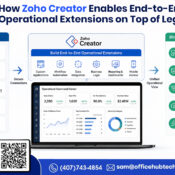
Some organizations begin with ERP Extension, using Creator to build approval workflows, reporting dashboards, vendor portals, or mobile apps while leaving the legacy ERP core untouched. Others use Creator for partial modernization, rebuilding specific modules such as procurement, service management, project tracking, or inventory orchestration.
Eventually, many organizations move toward a full ERP rebuild, replacing aging cores entirely with Creator-based systems that integrate seamlessly with Zoho Books, Zoho CRM, Zoho Inventory, and AI-driven automation tools.
What makes this approach powerful is continuity. The same platform supports every phase—from extension to replacement—eliminating the need to re-platform multiple times.
Comparison Table: Zoho Creator vs Traditional Legacy ERP Systems
| Capability | Zoho Creator | SAP | Infor | Acumatica |
| Architecture | Modular, low-code, cloud-native | Monolithic, on-prem / hybrid | Monolithic, industry-heavy | Modular but framework-driven |
| Customization Approach | Configuration + low-code development | ABAP-based custom coding | Specialized scripting & tools | Platform-specific development |
| API & Integration | API-first, REST-based, real-time | Limited native APIs, heavy middleware | Integration-heavy, connector-driven | APIs available, limited orchestration |
| Workflow Orchestration | Event-driven, fully configurable | Rigid, batch-oriented | Process-heavy, less flexible | Workflow-driven, less modular |
| Upgrade Impact | Minimal disruption | High risk to customizations | High dependency on version compatibility | Moderate disruption |
| Modernization Flexibility | Extension, Partial Rebuild, Full Replacement | Mostly upgrade-focused | Mostly upgrade-focused | Partial modernization |
| AI & Automation Readiness | Native integration with Zoho AI tools | Add-on based | Add-on based | Limited AI extensibility |
| Time to Deploy Changes | Days to weeks | Months | Months | Weeks to months |
| Cost of Ownership | Low to moderate | High | High | Moderate |
| Best Fit For | Incremental modernization, agility, scalability | Large legacy enterprises | Industry-specific legacy environments | SMB–Mid-market ERP users |
Real-World Use Cases Driving Adoption
The adoption of Zoho Creator for Legacy ERP modernization is not theoretical—it is industry-driven.
Manufacturing organizations are using Creator to rebuild production planning, shop-floor coordination, and procurement workflows that legacy ERPs struggle to adapt.
AVSI and system integration firms modernize project management, service orchestration, and inventory synchronization without being constrained by rigid ERP modules.
Equipment rental companies rely on Creator for real-time asset lifecycle management, maintenance automation, and multi-location operations.
Healthcare, pharma, and regulated industries benefit from Creator’s ability to implement audit trails, access control, and compliance logic without invasive system changes.
In each case, Creator becomes the orchestration layer that legacy ERPs could never fully deliver.
The Role of AI and Automation in Modern ERP Systems
Modern ERP systems are no longer passive record-keeping tools. They are expected to recommend actions, flag risks, and automate decisions.
Zoho Creator integrates naturally with AI-powered services across the Zoho ecosystem. This enables predictive insights, intelligent alerts, automated follow-ups, anomaly detection, and decision support—capabilities that legacy ERP platforms typically require expensive add-ons to achieve.
As AI becomes central to operations, ERP systems must support it natively. Zoho Creator’s flexibility makes it well-positioned to meet this requirement, further reinforcing its role as the new standard.
Why Zoho Creator Is Becoming the Default Choice for ERP Modernization
Zoho Creator’s growing dominance in ERP Legacy Modernization is not accidental. It aligns with how modern enterprises actually operate: modularly, digitally, and continuously.
It allows organizations to modernize without disruption, replace systems without risk-heavy migrations, and build ERP capabilities that evolve with the business rather than constrain it. Most importantly, it shifts ERP from a static system into a living platform.
Conclusion
Legacy ERP modernization is no longer about upgrading software—it is about redefining how enterprises operate. Systems designed for yesterday’s business models cannot support today’s demands for integration, automation, and intelligence. Zoho Creator is emerging as the new standard because it addresses these challenges at an architectural level, not through patches or workarounds.
By enabling ERP Extension, Modernization, and Full Rebuild on a single, API-driven, low-code platform, Zoho Creator gives organizations a practical, scalable path forward.
OfficeHub Tech is a trusted Zoho AI Implementation Partner, helping organizations modernize ERP systems with intelligence, speed, and long-term architectural clarity. As a leading provider of ERP Legacy Modernization, Extension, Rebuild, and Upgradation Services across the US, India, UAE, and Saudi Arabia, OfficeHub Tech delivers practical, scalable modernization strategies built on Zoho Creator.
Ready to modernize your ERP the right way?
Book a free consultation with OfficeHub Tech and discover how Zoho Creator can reshape your enterprise operations for the future.