The Sales Reality in Today’s AV System Integration Industry
AV system integration has entered a new phase. Projects are no longer isolated installs; they are multi-stakeholder engagements spanning design, construction, IT, and long-term service. Sales teams must manage complex scopes, longer buying cycles, and higher customer expectations—all while maintaining speed and accuracy.
Yet many AV organizations still treat sales as a standalone activity. Proposals are created, approved, and handed off, often with the assumption that execution will “figure it out.” This gap between selling and delivering is where inefficiencies hide. Over time, those inefficiencies become margin erosion, delayed projects, and internal friction.
Solving this problem requires more than better proposals. It requires systems that preserve intent and context beyond the point of sale.
Jetbuilt’s Role in Modern AVSI Sales Operations
Jetbuilt has become a cornerstone for many AV system integrators because it understands the realities of AV sales. Labor structures, scope revisions, change orders, and documentation are handled with precision. For sales teams, Jetbuilt brings discipline and confidence to quoting.
However, Jetbuilt is intentionally focused. It excels at proposals and project documentation, not at managing the broader sales lifecycle. It does not capture multi-channel lead activity. It does not forecast pipeline risk. It does not coordinate follow-ups or customer engagement beyond the proposal.
This is not a flaw. It is specialization. The challenge arises when proposal intelligence remains confined to Jetbuilt instead of becoming part of a larger sales system. This is where Jetbuilt with Zoho integration becomes strategically important.
Why Zoho CRM Is the Missing Sales Intelligence Layer
Zoho CRM is designed to manage complexity at scale. It brings structure to lead management, opportunity tracking, forecasting, and customer lifecycle visibility. For AV Pros, this means sales decisions are based on data, not intuition.
When Zoho CRM operates without proposal data, however, it tells only part of the story. Deals show value but not effort. Pipelines show volume but not delivery impact. Sales teams may close deals efficiently, while operations struggles to execute profitably.
Integrating Jetbuilt into Zoho CRM bridges this gap. It transforms CRM records into operational assets. This is the practical power of Zoho CRM For Jetbuilt.
Jetbuilt and Zoho CRM Integration: Technical Foundations
The integration between Jetbuilt and Zoho CRM is built on secure, event-driven architecture. APIs and webhooks—such as proposal approval events and scope update triggers—push structured data into Zoho CRM in near real time.
What moves across systems is not just a document, but intelligence:
- Line items and quantities
- Labor assumptions
- Pricing and margin expectations
- Revision history and approval status
This data becomes part of the CRM opportunity, ensuring continuity from sales to execution. This is Zoho with Jetbuilt integration implemented with technical rigor.
Visual Workflow Architecture: From Jetbuilt Proposal to Closed-Loop AV Sales Execution
This workflow diagram illustrates how Jetbuilt and Zoho CRM operate as a unified sales system for AV system integrators.
The flow begins when leads are captured in Zoho CRM from websites, emails, referrals, and campaigns. As opportunities progress, proposals are created in Jetbuilt, where AV-specific scope, labor models, pricing, and change orders are defined with precision. Once a proposal is approved, structured data—products, quantities, labor, pricing, and revisions—syncs into Zoho CRM through APIs and webhooks.
From Zoho CRM, downstream automation activates. Projects are initiated with full scope clarity, financial workflows align with approved milestones, and service records inherit complete customer and project context. AI Agents monitor deal velocity, margin risk, and delivery timelines across the workflow, while n8n orchestrates real-time synchronization between Jetbuilt, Zoho applications, QuickBooks, and other third-party systems.
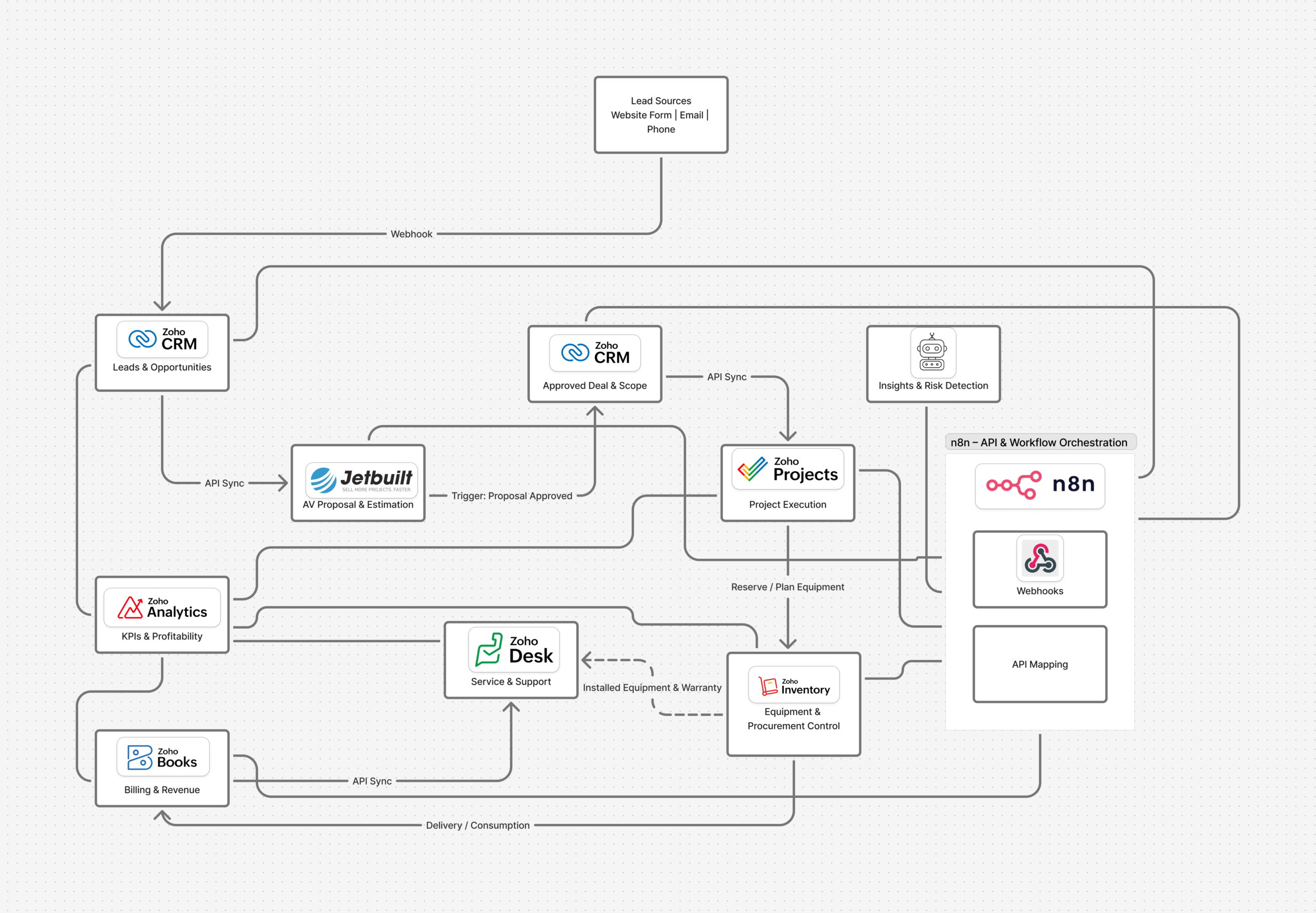
This visual architecture demonstrates how AV sales transitions from isolated proposals into a continuous, system-driven workflow—without manual re-entry or loss of intent.
From Sales to Delivery: End-to-End AV Workflow Automation
Once Zoho CRM becomes the anchor, automation extends naturally across the AV business. Approved opportunities can trigger downstream workflows without manual intervention.
Projects are created with full scope clarity. Financial workflows align with project milestones. Procurement planning reflects actual demand. Service teams inherit complete customer and project history.
This is where AV Project Automation stops being conceptual and starts delivering measurable results—reduced setup time, fewer errors, and faster execution.
The Zoho Ecosystem for AV System Integrators
Zoho One provides a unified ecosystem that supports the entire AV business lifecycle. When integrated with Jetbuilt, each application plays a defined operational role:
- Zoho CRM – Central system for leads, opportunities, proposal intelligence, and customer lifecycle management
- Zoho Projects – Structured project execution with tasks, milestones, dependencies, and team collaboration
- Zoho Inventory – Equipment tracking, serialized items, procurement planning, and stock control
- Zoho Books – Invoicing, vendor bills, revenue tracking, and financial visibility, with seamless QuickBooks integration
- Zoho Desk – Service tickets, warranty management, and post-installation support workflows
- Zoho Analytics – Real-time dashboards for pipeline health, project profitability, and service KPIs
- Zoho Mail – Context-aware communication linked to CRM, projects, and service records
- Zoho Campaigns – Automated follow-ups, lead nurturing, and service renewal communication
- Zoho Voice – Integrated calling with automatic activity logging
- Zoho Flow – Native workflow automation across Zoho apps and connected platforms
Together, these tools form a complete AVSI Business Solution rather than isolated applications.
Smart Automation, AI Agents, and n8n Orchestration
Automation alone reduces effort. Intelligence improves outcomes.
AI Agents embedded across Zoho analyze deal velocity, engagement patterns, and historical win data to recommend next-best actions. During execution, they monitor timelines and dependencies, flagging risk early. In finance, AI compares quoted margins against actuals, highlighting variance before profitability is affected.
n8n operates as the orchestration layer, connecting Jetbuilt, Zoho applications, QuickBooks, and third-party tools through APIs and webhooks. It enables complex logic, conditional workflows, and cross-platform synchronization that native integrations alone cannot handle.
This combination delivers Smart Automation For AVSI—systems that respond, adapt, and inform.
Case Study: Vertex Sound & Vision
Vertex Sound & Vision is a fast-growing AV system integrator delivering complex commercial AV and enterprise collaboration projects across corporate, education, and mixed-use environments. Like many mature AV firms, Vertex had strong sales execution and relied heavily on Jetbuilt for proposals, project documentation, and change-order management. On the surface, the operation appeared healthy.
The strain emerged as volume increased.
Sales teams were closing deals efficiently, but once proposals were approved, critical context fragmented. Project managers spent hours reconciling scope details. Procurement teams reinterpreted BOMs. Finance reviewed margins only after invoices were issued. Leadership had visibility into revenue, but limited insight into delivery risk and true profitability during execution.
The problem was not Jetbuilt. It was what happened after Jetbuilt.
The Turning Point
Vertex leadership recognized that sales velocity was outpacing operational coordination. Rather than replacing tools, they focused on system continuity. The decision was made to integrate Jetbuilt with Zoho CRM and extend the workflow across the Zoho ecosystem using API orchestration and automation.
Implementation Approach
Approved Jetbuilt proposals were synchronized into Zoho CRM as structured opportunity data, preserving scope, pricing, labor assumptions, and revision history. This ensured that every downstream team worked from the same approved intelligence.
From Zoho CRM:
- Projects were initiated with full scope clarity
- Financial workflows aligned with project milestones
- Service records inherited complete customer and installation context
- Automation handled handoffs previously managed through email and spreadsheets
AI-driven insights surfaced early warning signs around stalled deals, margin drift, and delivery risk, while n8n orchestrated real-time data flow between Jetbuilt, Zoho applications, and accounting systems.
Measured Results Within Six Months
The impact was immediate and measurable:
- Sales-to-project handoff time reduced by over 40%, eliminating manual project setup and scope clarification
- Forecast accuracy improved significantly, as pipeline data now reflected real delivery complexity
- Margin leakage declined, with leadership gaining visibility into cost variance before project completion
- Project kickoff delays dropped, improving client satisfaction and internal confidence
- Service renewals increased, driven by better lifecycle visibility and proactive engagement
Perhaps most importantly, internal friction declined. Teams stopped debating scope and started executing with confidence.
The Strategic Outcome
Vertex Sound & Vision did not change how it sold AV systems. It changed how sales intelligence flowed through the business. By integrating Jetbuilt with Zoho CRM and extending that integration across execution, finance, and service, the company transitioned from reactive coordination to controlled growth.
The result was not just efficiency—it was operational maturity. A sales engine capable of scaling without sacrificing margin, clarity, or customer experience.
Strategic Impact for AV Leadership
For AV leadership, integration is not a matter of convenience—it is a matter of control at scale. As project volume, deal size, and service obligations increase, disconnected systems quietly erode visibility and decision-making confidence.
When Jetbuilt and Zoho CRM operate as a unified sales and execution system, leadership gains something more valuable than reports: real-time operational clarity. Pipeline data reflects delivery complexity, not just deal value. Margin exposure becomes visible before projects close, not after. Execution risks surface early, allowing corrective action instead of post-mortems.
This shift enables AV leaders to move beyond reactive management. Decisions are guided by connected data across sales, projects, finance, and service—creating predictable execution, disciplined growth, and measurable accountability across the organization.
This is the difference between managing activity and leading a scalable AV business.
Conclusion: The Case for a Turnkey AV Sales Workflow
A turnkey workflow is no longer optional for AV system integrators operating at scale. Integrating Jetbuilt with Zoho CRM ensures that sales intent flows seamlessly into execution, finance, and service—without manual reconstruction.
OfficeHub Tech delivers this transformation through its Turn key workflow solution for AV System Integration business, designed specifically for AV operations. From CRM architecture and proposal integration to automation, AI Agents, and n8n-driven orchestration, every solution is built for real-world complexity.
Recognized as a Top Zoho Consultant and Authorised Partner in USA, India, UAE, KSA, OfficeHub Tech provides deep domain expertise through Zoho Consultation For Av System Integrator, enabling scalable, resilient growth.