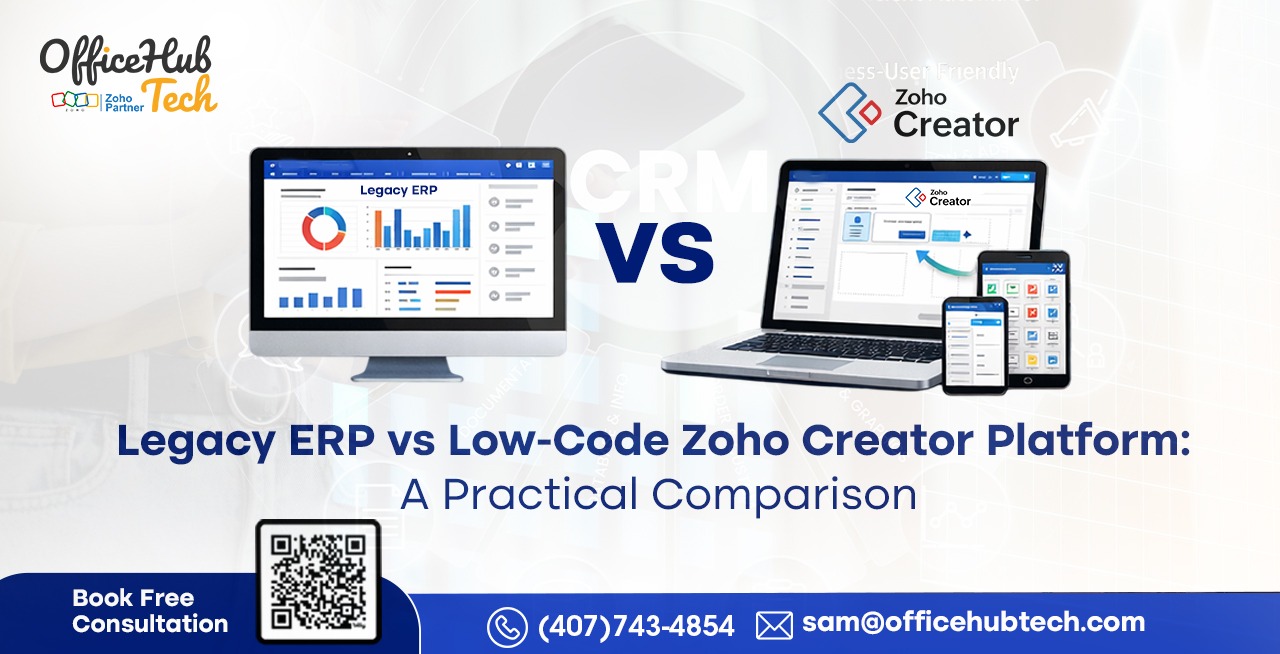
Legacy ERP vs Low-Code Zoho Creator Platform: A Practical Comparison
The Enterprise Decision That Will Define the Next Decade
Most ERP systems are not broken. They are simply misaligned with how modern businesses now operate.
For decades, enterprise resource planning platforms were designed to ensure control, accuracy, and governance. They became the financial spine of organizations—managing procurement, inventory valuation, compliance reporting, and operational control with remarkable reliability. In many companies, the ERP remains the single source of transactional truth.
But business velocity has changed.
Today’s enterprises function inside interconnected digital ecosystems driven by APIs, automation engines, real-time analytics, distributed systems, and AI-assisted decision models. Customer expectations are instantaneous. Supply chains are dynamic. Decision cycles are compressed.
The architectural assumptions under which traditional ERP systems were designed no longer match operational reality.
This creates a structural tension. The ERP core remains stable and authoritative, yet business processes surrounding it demand adaptability, orchestration, and intelligence that monolithic systems were never built to provide.
The comparison between legacy ERP platforms and low-code environments such as Zoho Creator is therefore not a matter of preference. It is a matter of architectural evolution. Organizations must determine whether to continue embedding innovation inside rigid cores—or to externalize agility through layered orchestration models that preserve transactional sovereignty while enabling operational flexibility.
The decision made here will not simply influence IT architecture. It will define the organization’s capacity to evolve over the next decade.
Understanding Legacy ERP Architecture: Stability Engineered Into the Core
Legacy ERP systems such as SAP, Infor, and Acumatica were architected for an era defined by operational predictability. Their foundational design principle was centralized control. Every module—finance, procurement, manufacturing, inventory—was engineered within a tightly coupled system core that enforced transactional discipline across the enterprise.
This monolithic architecture guarantees referential integrity, structured financial control, and audit compliance. Data schemas are predefined and interdependent. Business logic resides deep within application layers. Workflow rules execute inside rigid module boundaries.
From a governance perspective, this design is exceptionally strong.
However, architectural strength often introduces structural inertia.
Because data models, process logic, and system behavior are deeply interwoven, even minor modifications trigger cascading impact. Custom fields alter reporting structures. Workflow adjustments affect posting sequences. Integration adapters must conform to internal validation hierarchies. Every change demands regression testing across dependent modules to prevent unintended financial discrepancies.
Over time, enterprises accumulate configuration layers, user exits, stored procedures, and bespoke scripts. These enhancements initially address operational gaps but gradually increase architectural density. Upgrade cycles slow. Maintenance costs rise. Vendor reliance deepens. Innovation velocity declines.
This is precisely why organizations initiate legacy ERP System modernisation initiatives—not because the ERP has failed functionally, but because its foundational architecture was never designed for distributed, API-first, event-driven ecosystems.
The system remains stable.
Its ability to evolve becomes constrained.
The Operational Friction of Customization
Customization inside a legacy ERP environment often begins with practical necessity. A unique approval hierarchy. A regional compliance requirement. A pricing exception. A reporting variation.
Individually, these adjustments appear harmless.
Collectively, they reshape the architectural profile of the system.
Custom logic becomes embedded into core modules. Stored procedures reference altered data schemas. Reporting layers depend on bespoke fields. Integration connectors are built around modified posting sequences. Over time, the ERP evolves into a heavily configured environment where standard upgrade pathways become increasingly complex.
Every upgrade now carries uncertainty.
Every enhancement demands regression validation.
Every integration must respect historical customizations.
The result is not system failure—it is innovation paralysis.
IT teams become custodians of stability rather than enablers of agility. Change requests are evaluated through a risk lens. Business stakeholders grow frustrated with lead times measured in quarters rather than weeks.
This is where the strategic concept of legacy ERP System extension emerges as a pragmatic alternative. Instead of embedding additional complexity into an already dense system core, organizations externalize new workflows, automation logic, and integration processes into adjacent orchestration layers.
The ERP retains transactional sovereignty.
Innovation shifts outward.
By decoupling adaptability from the system of record, enterprises preserve financial integrity while reclaiming operational velocity. Extension does not diminish ERP authority—it protects it from unnecessary structural strain.
Low-Code Platforms: Architectural Decoupling in Practice
Low-code platforms are frequently misunderstood as accelerated development environments. In reality, their most strategic value lies in architectural decoupling.
A mature low-code platform does not replace enterprise systems. It abstracts volatility away from them.
By externalizing workflow logic, user interfaces, data transformation layers, and integration orchestration, low-code environments separate adaptability from transactional integrity. The ERP continues to execute ledger postings and enforce financial control, while operational intelligence migrates outward into modular orchestration frameworks.
Zoho Creator exemplifies this model. It operates as an API-first, event-aware, workflow-centric environment capable of interacting with legacy systems through REST endpoints, OAuth-secured connections, and webhook-based triggers. Rather than embedding change inside rigid ERP cores, organizations design adaptive workflows that respond to events in real time.
For example:
- An order confirmation event from ERP triggers webhook-based validation logic.
- AI agents evaluate contextual risk signals before approval.
- n8n orchestration coordinates multi-step automation across CRM, accounting, and communication platforms.
- Structured API responses update ERP only after validation thresholds are satisfied.
This layered architecture supports Legacy ERP modernization without destabilizing foundational systems.
Low-code does not eliminate governance. It repositions it.
It does not dilute system authority. It distributes operational elasticity.
By shifting adaptability outside the ERP core, organizations achieve architectural resilience—where change becomes modular, reversible, and observable rather than intrusive and permanent.
Core Comparison: Architectural Paradigms
The fundamental distinction between legacy ERP platforms and Zoho Creator lies in architectural philosophy. ERP centralizes logic. Zoho Creator distributes orchestration. ERP governs transactions. Zoho Creator coordinates workflows across systems.
Below is a structured comparison that clarifies this distinction:
| Comparison Criteria | Legacy ERP (SAP / Infor / Acumatica) | Zoho Creator Low-Code Platform |
| Architectural Model | Monolithic, tightly coupled modules | Distributed orchestration layer |
| Customization | Proprietary coding, consultant-driven | Visual logic, modular configuration |
| API Support | Limited or add-on dependent | Native REST APIs and webhooks |
| Automation Scope | Module-based workflows | Cross-system event-driven automation |
| AI Integration | External add-ons required | Embedded AI agents within workflows |
| Upgrade Impact | Customization complicates upgrades | ERP core remains untouched |
| Integration Flexibility | Middleware-heavy | API-first, open ecosystem |
| Deployment Speed | Months to years | Weeks to months |
| Governance | Centralized but rigid | Distributed yet role-governed |
| Scalability | High but expensive | Elastic and subscription-based |
This comparison illustrates that the decision is not about superiority but suitability.
Integration Ecosystems: The Connected Enterprise
Modern enterprises no longer operate within singular software environments. They operate within distributed digital ecosystems where CRM platforms, accounting systems, HR tools, analytics engines, marketing automation platforms, and communication channels must exchange data continuously.
Legacy ERP systems were not designed with this level of interoperability in mind. Their integration capabilities are often constrained by module-based APIs, batch synchronization jobs, or middleware connectors that introduce latency and operational fragility. Real-time, event-driven orchestration is rarely native.
Zoho Creator approaches integration differently.
It functions as a translation and orchestration layer—bridging structured ERP data with modern API-driven ecosystems. Through Zoho Creator Legacy ERP integration, ERP records are consumed securely via REST endpoints, normalized into structured schemas, enriched with contextual logic, and redistributed across interconnected systems through webhook triggers and bi-directional APIs.
This is not simple data exchange. It is intelligent orchestration.
For example:
- ERP invoice creation triggers a webhook to Zoho Creator.
- Data is validated and enriched with CRM context from Zoho CRM.
- Payment status updates synchronize with Zoho Books.
- Analytics metrics are pushed into Zoho Analytics in near real time.
- Customer notifications are dispatched through Zoho Mail or Zoho Campaigns.
Beyond Zoho applications, third-party systems such as HubSpot, QuickBooks, and external logistics platforms can participate through structured API gateways. n8n orchestration engines coordinate multi-step logic chains across systems, while AI agents evaluate exception conditions before automated actions are executed.
The ERP remains the ledger authority.
The ecosystem becomes operationally intelligent.
This architecture transforms integration from a passive data pipeline into a dynamic decision fabric—where every event can trigger contextual, cross-platform response without manual reconciliation.
Workflow Intelligence: Beyond Static Rules
Legacy ERP systems are exceptionally capable at deterministic execution. Purchase orders route through predefined hierarchies. Journal entries follow structured validation sequences. Inventory adjustments adhere to fixed posting logic. These systems are built to enforce rule-based consistency.
But modern enterprises require more than deterministic processing.
They require adaptive decision-making.
Traditional ERP workflow engines operate within module boundaries. They respond to predefined triggers using static rules. Cross-functional coordination—spanning CRM, finance, operations, customer communication, and analytics—typically demands additional customization or external middleware.
Low-code orchestration introduces a different paradigm.
Through Zoho Creator for Legacy ERP Mordenization and Extension, workflows become event-driven rather than schedule-driven. Business logic is no longer confined to ERP modules; it becomes a distributed layer capable of interpreting context, evaluating conditions, and triggering multi-system responses in real time.
Consider a practical example:
- A high-value sales order is recorded in ERP.
- A webhook event is emitted and captured by Zoho Creator.
- An AI agent evaluates historical payment behavior, credit exposure, and regional risk signals.
- If risk thresholds are exceeded, dynamic approval workflows are triggered.
- If validated, synchronized updates propagate to Zoho Books, inventory systems, and CRM records.
- Customer communication is initiated automatically through Zoho Mail or Zoho SalesIQ.
No manual reconciliation.
No module-bound isolation.
No intrusive ERP customization.
This approach converts workflows from linear sequences into adaptive orchestration networks. AI agents do not replace governance—they enhance it. They operate within defined policy boundaries, flag anomalies, and escalate exceptions while preserving audit visibility.
ERP remains the transactional backbone.
Workflow intelligence evolves externally.
The result is a business architecture capable of responding to events as they occur rather than after batch cycles complete. It transforms automation from mechanical execution into contextual coordination.
Practical Use Cases: Operational Reality
Architectural discussions become meaningful only when translated into operational impact. The distinction between legacy ERP rigidity and low-code orchestration becomes most visible in real business scenarios.
Finance Transformation
In a traditional ERP-only environment, financial compliance is precise but reactive. Reports are generated after transactions are posted. Exceptions are investigated retrospectively. Risk assessment is often threshold-based and static.
With external orchestration in place, financial workflows become proactive. AI-assisted anomaly detection evaluates transactional behavior before ledger posting. High-value transactions trigger dynamic approval matrices based on contextual variables rather than fixed hierarchies. Exception alerts are distributed instantly to finance leaders through automated notification systems.
In one mid-sized distribution enterprise, introducing event-driven validation workflows reduced manual financial review cycles by 32% while maintaining complete audit traceability. The ERP core remained unchanged. Risk governance improved. Processing time declined.
Sales and Revenue Synchronization
Sales systems capture intent. ERP systems execute fulfillment. Historically, synchronization between the two has been mediated by manual intervention or batch jobs.
By externalizing workflow logic, deal closure in CRM triggers structured validation pipelines. Contractual data is normalized before submission to ERP. Inventory availability is verified automatically. Invoice creation in accounting platforms synchronizes with customer communication tools in real time.
Revenue recognition becomes coordinated rather than compartmentalized. Operational lag is minimized.
Inventory and Supply Chain Responsiveness
Supply chain environments are particularly sensitive to latency. Batch synchronization between ERP and operational systems often results in delayed restocking or over-purchasing.
Event-driven webhook architecture enables immediate response. Inventory threshold events trigger automated procurement workflows. Vendor notifications are orchestrated through integration layers. AI agents evaluate historical demand variability before recommending order quantities.
The ERP continues to manage valuation and cost accounting.
Operational systems handle responsiveness.
The measurable result is reduced stockouts, improved service levels, and more intelligent procurement cycles—all achieved without invasive ERP modification.
Data Migration and Coexistence Strategy
Full system replacement demands comprehensive data migration. Historical records must be cleansed, validated, and restructured. This introduces risk.
A low-code extension model supports phased coexistence. Historical data remains in ERP. Operational extensions synchronize active datasets selectively. This approach reduces disruption while enabling gradual transformation.
Cost and Governance Considerations
ERP discussions often gravitate toward functionality. However, long-term viability is determined just as much by cost structure and governance architecture.
Traditional ERP platforms typically operate under licensing models that scale with user counts, module access, and advanced feature tiers. As organizations expand, additional operational users require direct ERP access—even when their interaction is limited to approvals, data entry, or reporting visibility. This inflates licensing overhead and increases surface exposure to the core system.
By externalizing workflow interfaces into a low-code orchestration layer, organizations reduce dependency on direct ERP interaction. Operational teams engage through structured interfaces tailored to their roles, while the ERP remains reserved for high-integrity transactional functions. This reduces license expansion pressure and isolates critical ledger systems from unnecessary user exposure.
From a governance perspective, extension architectures often enhance—not weaken—control.
Role-based access models, encrypted API communication, webhook authentication protocols, and detailed audit logging create traceable workflow pathways. Business logic becomes visible and version-controlled rather than embedded within opaque customization layers. Approval hierarchies can be dynamically enforced while preserving complete audit trails.
Moreover, the total cost of ownership shifts from heavy consultant-driven customization cycles to modular iteration frameworks. Change velocity improves. Upgrade risk decreases. Architectural debt is reduced rather than compounded.
Financial stewardship and architectural agility are no longer opposing forces.
They become structurally aligned.
In this model, the ERP safeguards financial authority while the orchestration layer manages adaptability—creating a sustainable balance between control and innovation.
Comparing with SAP, Infor, and Acumatica in Practice
Enterprise-grade ERP platforms such as SAP, Infor, and Acumatica remain formidable transactional engines. Each has domain-specific strengths that continue to make them indispensable in certain industries.
SAP is often unrivaled in financial depth, multinational compliance, and complex enterprise accounting structures. Its rigor is unquestionable. However, that rigor is accompanied by high customization overhead and dependency on certified development frameworks. Even minor workflow changes frequently require ABAP-level expertise, structured testing cycles, and release governance protocols that slow innovation.
Infor provides strong manufacturing and industry-specific vertical modules. Yet process modification within tightly defined vertical templates can introduce configuration rigidity. Adjusting cross-functional workflows often requires careful coordination across predefined module relationships.
Acumatica, positioned as a modern cloud ERP, offers improved deployment flexibility. However, its customization and integration model still demands architectural discipline and developer oversight. Module extension requires structured code or configuration adherence that may not support rapid iteration cycles without controlled development processes.
The common thread across these systems is architectural density. They are engineered for transactional precision, not continuous operational experimentation.
This is where low-code orchestration models introduce strategic contrast.
Instead of modifying core modules within SAP, Infor, or Acumatica, organizations externalize adaptive workflows into adjacent orchestration environments. ERP systems retain ledger authority and compliance integrity. Low-code platforms handle cross-system intelligence, event-driven automation, and interface agility.
This approach reduces dependency on proprietary development stacks. It minimizes upgrade disruption. It shortens change cycles from quarters to weeks.
It does not diminish ERP value.
It reframes ERP responsibility.
By preserving transactional sovereignty while relocating operational volatility to external layers, enterprises establish a balanced architecture—stable at the core, adaptive at the edge.
Strategic Decision Framework
The decision between extending a legacy ERP environment and replacing it entirely is not purely technical. It is architectural, financial, and strategic.
Organizations often assume replacement is the only path to modernization. In reality, that assumption deserves scrutiny.
The more relevant question is this:
Is the ERP failing at its core function—or is it simply being asked to perform functions it was never designed to support?
Extension is strategically appropriate when:
- The ERP system remains financially stable and compliant.
- Core modules continue to perform transactional duties reliably.
- Integration endpoints are accessible via APIs or middleware.
- The primary need is agility, cross-platform automation, and workflow intelligence.
In such environments, replacing the ERP introduces unnecessary systemic disruption. Data migration risk increases. Institutional knowledge must be re-learned. Implementation timelines stretch across fiscal cycles. Meanwhile, operational innovation stalls during transition.
Replacement becomes justified when:
- The ERP architecture cannot expose reliable integration interfaces.
- Compliance frameworks demand structural redesign.
- Vendor dependency prevents sustainable upgrade paths.
- Total cost of ownership outweighs modernization investment.
Even then, extension often serves as a transitional bridge—reducing shock during phased migration.
The most resilient strategy for many enterprises is evolutionary rather than revolutionary. By externalizing adaptability while preserving ledger integrity, organizations achieve architectural balance.
The ERP safeguards transactional sovereignty.
The orchestration layer enables operational evolution.
Strategic maturity lies not in dismantling stable systems—but in surrounding them with intelligence.
Conclusion:
The Strategic Takeaway: Why Zoho Creator Changes the ERP Conversation
The comparison between legacy ERP systems and low-code platforms is not about choosing one over the other. It is about redefining architectural roles. Traditional ERP platforms remain powerful systems of record, delivering transactional accuracy and financial control. However, modern enterprises demand more than transactional stability—they require real-time integration, adaptive automation, AI-assisted workflows, and cross-platform orchestration.
This is where Zoho Creator reshapes the equation. Rather than competing with ERP systems, it complements them. It acts as an orchestration layer that externalizes workflow intelligence, enables API-first connectivity, supports webhook-based automation, and integrates seamlessly with platforms such as Zoho CRM, Zoho Books, Zoho Analytics, and third-party systems. By enabling distributed process logic and modular innovation, Zoho Creator empowers organizations to modernize without destabilizing core systems. It bridges stability with agility. It transforms rigid enterprise architecture into adaptive operational ecosystems.
How OfficeHub Tech Can Help
OfficeHub Tech plays a strategic role in designing, implementing, and optimizing low-code extension architectures around existing ERP systems. As a Certified and expert Zoho Creator Developer and Implementation Company, the focus is not limited to technical deployment. It involves enterprise-grade architecture planning, integration strategy, AI-agent workflow engineering, API mapping, data migration planning, and governance modeling. Each engagement begins with system assessment and process analysis, followed by structured implementation of scalable automation frameworks using Zoho Creator, orchestration engines, and secure API integration models.
Recognized as the Best Zoho Consultation and implementation Partner in the US, India, and UAE, OfficeHub Tech supports enterprises across multiple industries in building resilient, future-ready ecosystems. Whether extending SAP, Infor, Acumatica, or other ERP environments, the objective remains consistent: preserve transactional integrity while enabling digital agility. Through phased extension strategies, advanced workflow orchestration, and intelligent automation design, organizations gain the ability to evolve continuously without disruptive system replacement.