
The Growing Complexity of AV & Low Voltage Operations
AV and Low Voltage system integrators are operating in an increasingly complex environment where project execution depends on multiple teams, vendors, platforms, and operational workflows working together in real time. What was once manageable through spreadsheets, emails, and disconnected software is now becoming a major operational bottleneck.
Modern projects involve proposal generation, CRM management, inventory tracking, scheduling coordination, procurement workflows, field execution, billing, and customer communication—all happening simultaneously across different platforms.
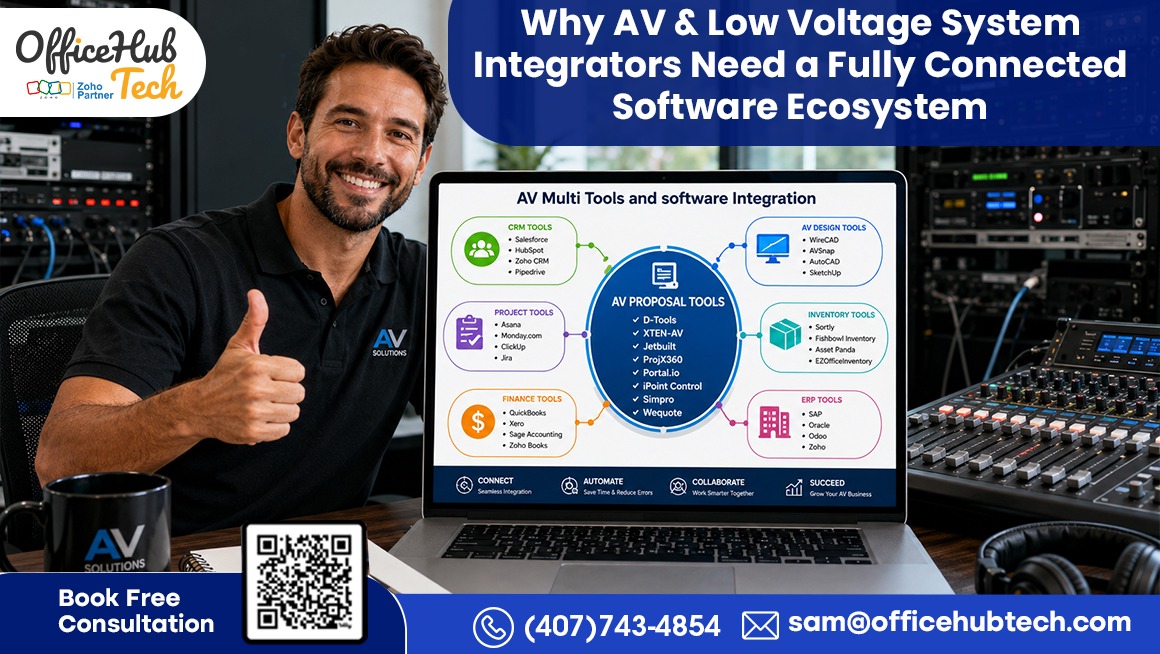
Most businesses already use advanced software systems. AV companies rely on platforms like D-Tools SI, XTEN-AV, Jetbuilt, CRM systems, project management tools, ERP platforms, and accounting software. Low Voltage businesses operate through scheduling systems, field-service applications, inventory tools, and finance platforms.
The problem is not the software itself.
The real issue is that these systems are rarely designed to work together as a unified operational environment. Data becomes fragmented, workflows become dependent on manual coordination, and operational visibility disappears between departments.
This is why Multi Software Integration for AV and LV System Integrators is becoming increasingly important for building connected and scalable operations.
A fully connected software ecosystem enables systems, workflows, and operational data to move together seamlessly—creating synchronized operations instead of disconnected processes. In this blog, we will explore why connected ecosystems are now critical for modern system integrators, how disconnected systems impact scalability, and how intelligent Multi Software Integration transforms business operations.
Understanding the Modern Software Ecosystem of AV System Integrators
AV system integrators depend on a highly specialized software ecosystem to manage the complete project lifecycle. Proposal and design workflows are commonly handled through D-Tools SI, D-Tools Cloud, XTEN-AV, Jetbuilt, Portal.io, and WeQuote. These platforms help teams generate proposals, configure products, manage bill of materials (BOM), and create technical documentation.
Sales and customer engagement workflows are managed through CRM platforms such as Salesforce, Zoho CRM, HubSpot, Pipedrive, and Microsoft Dynamics 365. Once a deal moves into execution, project management systems like Monday.com, ClickUp, Jira, Asana, or Smartsheet take over coordination and task management.
Inventory management platforms track product movement and warehouse availability, while accounting and ERP systems such as QuickBooks, Zoho Books, Oracle NetSuite, SAP S/4HANA, and Xero manage financial operations.
Individually, each platform performs efficiently.
The operational challenge begins when project information needs to move across these systems. Proposal changes may not reflect in procurement workflows. CRM updates may not synchronize with project execution. Inventory data may remain disconnected from scheduling timelines.
Without Multi Software Integration for AV System Integrators, businesses operate through isolated software environments instead of connected operational systems. As projects grow in size and complexity, this fragmentation creates delays, duplicate entry, inconsistent reporting, and reduced operational control.
Understanding the Modern Software Ecosystem of Low Voltage System Integrators
Low Voltage system integrators operate with a workflow structure that is heavily dependent on field execution, technician coordination, scheduling efficiency, and service management. Their operational environment includes multiple moving parts that must remain synchronized across departments and project sites.
Platforms such as Simpro, ServiceTitan, ConnectWise, Monday.com, and Service Fusion are often used for dispatching, scheduling, field service operations, and technician coordination. CRM systems manage customer communication and opportunity tracking, while accounting systems like QuickBooks, Zoho Books, and Sage handle billing and financial management.
Inventory systems track equipment movement across warehouses, vehicles, and project sites. Mobile applications allow technicians to receive updates, upload completion reports, and communicate with operational teams in real time.
However, most of these workflows remain disconnected.
A scheduling change may not update inventory allocation automatically. A completed field task may require manual invoicing. Customer information may exist differently across CRM, service, and finance systems. This creates operational silos that slow execution and increase dependency on manual coordination.
As Low Voltage businesses scale across multiple projects and service locations, disconnected systems become increasingly difficult to manage. This is where Multi Software Integration for Low Voltage System Integrators becomes critical.
Instead of operating through fragmented workflows, connected ecosystems enable synchronized scheduling, real-time inventory visibility, automated billing, and centralized operational control across the entire business.
The Hidden Operational Cost of Disconnected Systems in AV Businesses
Disconnected systems create operational inefficiencies that many AV businesses underestimate until they begin impacting profitability, project timelines, and customer experience. As projects become more complex and involve multiple departments, disconnected workflows create operational friction that slows execution and reduces visibility across the organization.
Sales-to-Project Handoff Gaps
One of the most common operational breakdowns occurs during the transition from sales to execution. Proposal data created inside platforms like D-Tools SI or XTEN-AV often needs to be manually recreated inside project management systems, ERP platforms, or procurement workflows.
This duplicate entry process not only consumes time but also increases the risk of inconsistencies in product quantities, pricing, timelines, and technical specifications. Even small data mismatches can create downstream issues that impact procurement accuracy and project scheduling.
Without Multi Software Integration, AV businesses rely heavily on manual coordination between teams, making project onboarding slower and more error-prone.
Fragmented Operational Visibility
Disconnected systems prevent AV businesses from establishing centralized operational visibility. Sales teams, project managers, procurement staff, and finance departments often work with different versions of project information because data exists across isolated platforms.
This makes real-time reporting extremely difficult. Leadership teams struggle to track project health, financial performance, resource allocation, or procurement status from a single operational view.
As a result, decision-making becomes reactive rather than strategic. Teams spend valuable time validating data instead of focusing on execution and customer delivery.
Procurement & BOM Synchronization Challenges
AV projects frequently involve product substitutions, vendor changes, and evolving BOM requirements. When proposal systems, procurement workflows, and inventory platforms are disconnected, these updates do not synchronize automatically across departments.
This creates procurement mismatches, delayed purchasing decisions, and inventory planning issues. In many cases, procurement teams continue working with outdated project information because operational updates are trapped inside isolated systems.
Through Multi Software Integration, BOM updates and procurement workflows can synchronize in real time, significantly improving coordination between design, purchasing, and project execution teams.
Lack of a Single Source of Truth
The deeper operational issue is the absence of a single source of truth. When every department relies on separate systems and disconnected records, businesses lose confidence in their own operational data.
Project updates, financial records, inventory information, and customer details may differ across platforms, making it difficult to establish accurate reporting and forecasting.
A connected software ecosystem solves this by creating synchronized operational data across all systems. This ensures every department works with consistent, real-time information, improving collaboration, operational control, and long-term scalability.
Scaling Becomes Operationally Difficult
Disconnected systems may appear manageable during early growth stages, but operational complexity increases rapidly as businesses scale. More projects, vendors, technicians, and workflows create additional coordination challenges across departments.
Instead of improving efficiency, growth begins increasing administrative overhead because teams rely on manual processes to keep systems aligned. Businesses often hire additional coordinators simply to manage workflow fragmentation.
This is why Multi Software Integration is no longer just an operational enhancement—it is becoming foundational infrastructure for AV businesses that want to scale efficiently while maintaining operational consistency and visibility.
The Hidden Operational Cost of Disconnected Systems in Low Voltage Businesses
For Low Voltage system integrators, disconnected systems directly affect field efficiency, technician productivity, and service responsiveness. As businesses expand across multiple projects, teams, and locations, fragmented workflows create operational delays that become increasingly difficult to manage manually.
Scheduling & Dispatch Coordination Gaps
Scheduling and dispatch coordination often become fragmented across multiple systems. A technician assignment update may not synchronize with inventory availability, customer scheduling details, or project timelines in real time.
This creates communication gaps between dispatch teams, field technicians, and operations managers. In many cases, technicians arrive on-site without updated information, required equipment, or revised work instructions, leading to unnecessary delays and repeat visits.
With Multi Software Integration, scheduling systems, dispatch platforms, and inventory workflows can coordinate automatically, ensuring technicians receive accurate updates and operational teams maintain better field visibility.
Disconnected Field-Service Workflows
Field teams frequently operate with incomplete or outdated information because customer updates, work orders, inventory status, and service notes are spread across disconnected platforms.
Technicians may need to switch between multiple applications or contact office teams manually to verify installation details, customer requirements, or equipment availability. This slows execution and increases dependency on constant communication between field and office staff.
A connected ecosystem centralizes operational data, allowing field teams to access synchronized information in real time through integrated workflows and mobile systems.
Multi-Site Operational Complexity
Low Voltage businesses managing multiple service locations or simultaneous installations require centralized operational visibility across teams, projects, inventory, and technician activity.
Without connected systems, coordinating multi-site operations becomes heavily dependent on spreadsheets, calls, emails, and manual reporting processes. Leadership teams struggle to track real-time project progress, technician utilization, and operational bottlenecks across locations.
Through Multi Software Integration, businesses can establish centralized workflow visibility, improving operational control and enabling more scalable field-service management.
Billing & Service Completion Delays
Billing workflows are another major operational bottleneck. Completed service tasks often require manual invoice generation because service management systems and accounting platforms are not synchronized automatically.
This delay affects cash flow visibility, invoice accuracy, and customer response times. Inconsistent billing records can also create reconciliation challenges between operations and finance departments.
Integrated workflows allow completed field tasks to automatically trigger invoice creation, update financial records, and synchronize customer billing information in real time.
Growth Increases Operational Complexity
As Low Voltage businesses grow, disconnected systems become increasingly difficult to manage. More projects, technicians, vendors, and workflows create additional coordination challenges across departments.
Instead of improving scalability, growth increases administrative overhead because teams rely on manual processes to maintain workflow alignment between systems. Businesses often hire additional coordinators and operational staff simply to manage fragmented workflows.
This is why Multi Software Integration is becoming foundational infrastructure for modern Low Voltage system integrators. Connected ecosystems reduce dependency on manual coordination, improve operational consistency, and create scalable workflows capable of supporting long-term business growth.
Why Traditional Integrations Are No Longer Enough
Many businesses assume that native integrations or simple API connections are sufficient to create connected operations. In reality, traditional integrations are often too limited to support modern operational complexity.
Most native integrations are designed for basic data exchange rather than full workflow orchestration. They may synchronize contacts or project names, but they rarely coordinate operational execution across multiple systems.
Point-to-point integrations also become fragile over time. As organizations adopt additional software platforms, integration dependencies increase rapidly. One workflow change can impact multiple systems simultaneously, creating maintenance challenges and synchronization failures.
Traditional integrations also struggle with:
- Bidirectional synchronization
- Real-time event processing
- Workflow dependency management
- Cross-platform orchestration
- Error recovery and monitoring
This is where middleware and orchestration platforms become essential.
Modern Multi Software Integration relies on centralized orchestration layers capable of managing workflows across CRM systems, proposal platforms, ERP software, inventory tools, scheduling systems, and AI-driven automation engines.
The difference is significant:
Traditional Integration
- Connects systems
Connected Ecosystem
- Coordinates operations
This shift transforms integration from simple synchronization into intelligent workflow orchestration capable of supporting scalable operations.
What is a Fully Connected Software Ecosystem?
A fully connected software ecosystem is an operational environment where all business systems work together as a unified infrastructure instead of isolated applications.
This does not mean replacing existing software platforms. It means connecting workflows, operational data, and execution logic across systems through intelligent orchestration.
In a connected ecosystem:
- Proposal approvals trigger project creation automatically
- Inventory updates synchronize with scheduling systems
- CRM changes reflect across finance and operations
- Field-service workflows update billing in real time
- Leadership teams gain centralized visibility across all departments
The foundation of this ecosystem is Multi Software Integration powered by APIs, middleware platforms, workflow automation engines, and event-driven orchestration.
A connected ecosystem establishes:
- Real-time data synchronization
- Cross-platform workflow execution
- Centralized operational visibility
- Automated operational coordination
- Unified business intelligence
More importantly, it creates a single source of truth where operational decisions are based on synchronized, real-time information rather than fragmented records across systems.
For AV and Low Voltage businesses, this creates a scalable operational model capable of supporting growth without increasing workflow complexity.
Operational Maturity: From Disconnected Tools to Intelligent Ecosystems
Most AV and Low Voltage businesses evolve through multiple stages of operational maturity.
Stage 1: Disconnected Systems
Teams operate through isolated software tools, spreadsheets, emails, and manual coordination.
Stage 2: Basic Integrations
Simple API connections synchronize limited data between systems.
Stage 3: Connected Ecosystems
Systems coordinate workflows, synchronize data in real time, and establish centralized visibility.
Stage 4: AI-Driven Orchestration
AI systems optimize workflows, predict operational risks, and automate cross-platform execution dynamically.
The problem is that many businesses remain stuck between Stage 1 and Stage 2. They connect some systems but continue managing workflows manually.
True scalability begins at Stage 3—where Multi Software Integration transforms disconnected tools into connected operations.
Stage 4 introduces intelligent ecosystems powered by AI-driven orchestration, predictive automation, and operational intelligence layers capable of optimizing workflows in real time.
Businesses that fail to move toward connected ecosystems will increasingly struggle with operational complexity, delayed execution, and limited scalability as project demands continue growing.
Multi Software Integration for AV System Integrators
For AV system integrators, Multi Software Integration transforms fragmented project workflows into centralized operational systems capable of supporting real-time execution.
Consider a typical AV workflow:
- Proposal created in D-Tools
- Opportunity managed in CRM
- Tasks coordinated in Monday.com
- Procurement managed through ERP
- Billing handled in QuickBooks
Without integration, teams manually coordinate updates between every stage.
With Multi Software Integration, the workflow becomes synchronized.
When a proposal is approved:
- CRM opportunity stages update automatically
- Projects are created instantly
- Product lists synchronize with procurement systems
- Inventory requirements are validated
- Financial workflows begin automatically
This creates:
- Faster onboarding
- Reduced duplicate entry
- Real-time project visibility
- Accurate procurement coordination
- Better operational predictability
Leadership teams also gain centralized visibility across sales, execution, inventory, procurement, and finance from a single operational environment instead of fragmented reporting systems.
This is how connected ecosystems transform AV businesses from reactive operations into scalable, data-driven organizations.
Multi Software Integration for Low Voltage System Integrators
Low Voltage businesses rely heavily on field coordination, making real-time workflow synchronization essential.
Through Multi Software Integration, scheduling systems, dispatch tools, inventory platforms, CRM software, and billing workflows become part of a unified operational ecosystem.
For example:
- Technician assignments update automatically
- Inventory allocation synchronizes with scheduling
- Completed tasks trigger invoice generation
- Service updates reflect inside CRM instantly
- Multi-site operations become centrally visible
This significantly improves:
- Technician productivity
- Dispatch efficiency
- Service response times
- Billing accuracy
- Inventory coordination
More importantly, connected ecosystems eliminate dependency on manual communication between departments. Workflows coordinate automatically through real-time operational logic.
As Low Voltage businesses scale across multiple teams and locations, this connected infrastructure becomes essential for maintaining operational consistency and profitability.
How AI and Intelligent Automation Power Connected Business Ecosystems
The future of connected ecosystems is being shaped by AI-driven orchestration and intelligent automation.
Traditional automation executes predefined rules. AI-powered ecosystems introduce contextual decision-making capable of adapting workflows dynamically based on operational conditions.
Agentic AI systems can:
- Identify workflow bottlenecks
- Predict scheduling conflicts
- Detect inventory risks
- Recommend operational actions
- Automate multi-system execution
Technologies like MCP (Model Context Protocol) allow AI systems to interact with business tools through centralized orchestration layers.
This enables:
- Conversational operational workflows
- Intent-driven execution
- AI-powered decision support
- Predictive operational intelligence
Instead of simply moving data between systems, AI-driven ecosystems understand relationships between projects, inventory, finance, scheduling, and customer operations.
This creates a transition from:
Reactive Operations
to
Intelligent Operational Ecosystems
For AV and Low Voltage businesses, this represents the next major evolution of operational scalability and workflow automation.
Technical Architecture Behind a Connected Ecosystem
The technical foundation of a connected ecosystem is built around scalability, reliability, and real-time operational synchronization.
At the base is the API layer, enabling secure communication between systems. Above this sits the middleware or orchestration layer responsible for workflow coordination and operational logic execution.
Additional layers include:
- Workflow automation engines
- Event-driven processing systems
- Data mapping & transformation layers
- Monitoring & error handling frameworks
- AI orchestration layers
The architecture below shows how Multi Software Integration connects CRM, proposal platforms, inventory systems, ERP software, and field-service applications into a centralized operational ecosystem.
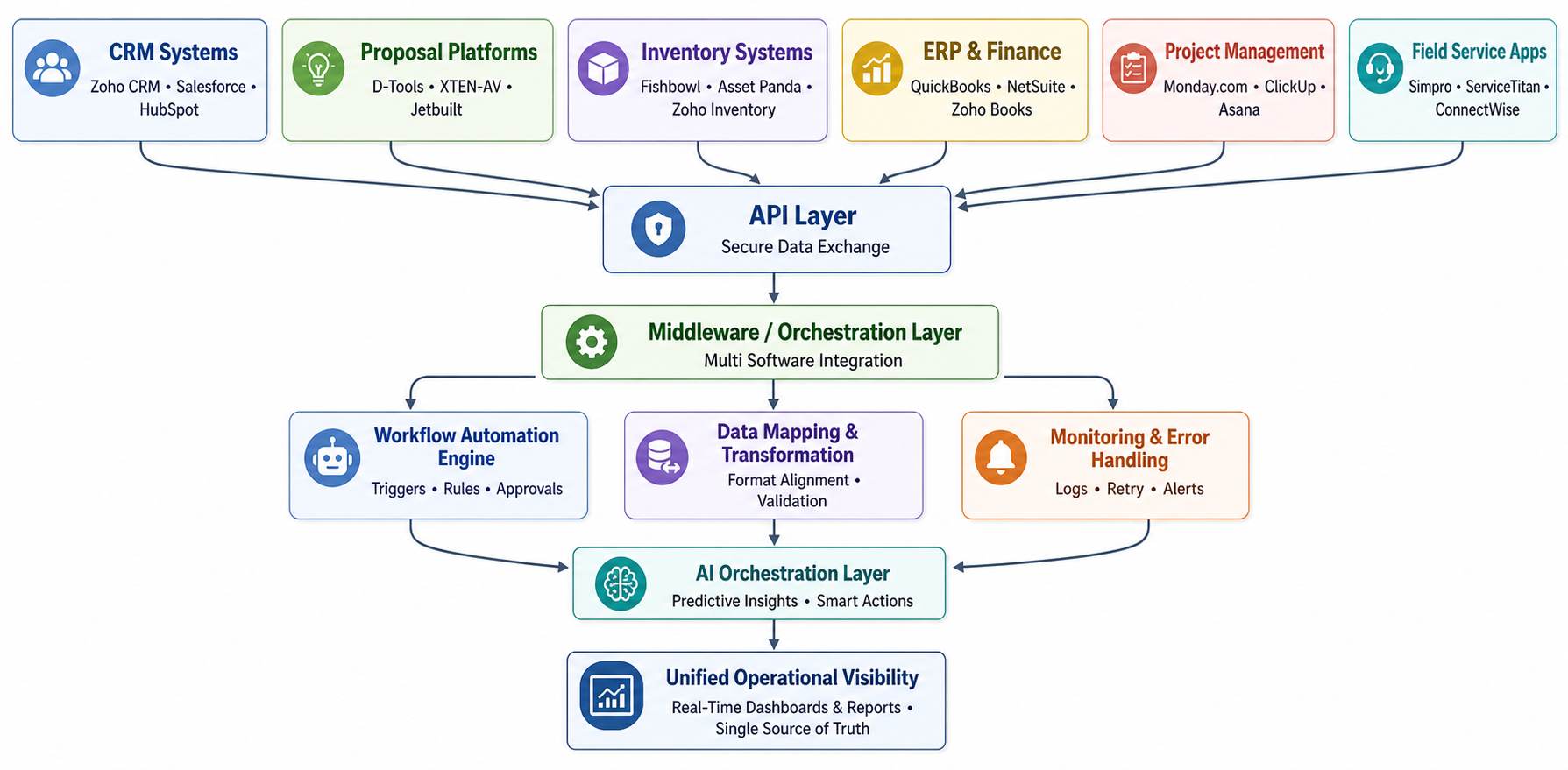
This architecture enables AV and Low Voltage system integrators to establish real-time synchronization, workflow automation, centralized visibility, and AI-driven operational orchestration across all business systems.
These systems coordinate:
- CRM platforms
- Proposal tools
- ERP systems
- Inventory platforms
- Scheduling systems
- Accounting software
- Field-service applications
A centralized orchestration layer ensures workflows execute consistently across systems while maintaining data synchronization in real time.
This architecture enables:
- Bidirectional synchronization
- Real-time operational visibility
- Workflow dependency management
- Secure authentication
- Scalable execution environments
For AV and Low Voltage system integrators, this infrastructure creates operational resilience and long-term scalability.
Business Impact of a Connected Software Ecosystem
The impact of a connected software ecosystem extends far beyond efficiency improvements.
Connected operations enable businesses to:
- Scale without increasing operational complexity
- Improve project predictability
- Reduce operational overhead
- Improve customer responsiveness
- Increase operational visibility
- Strengthen profitability
Teams spend less time coordinating systems and more time executing projects. Leadership teams gain real-time operational insights capable of improving forecasting, planning, and strategic decision-making.
Perhaps most importantly, connected ecosystems create operational consistency.
Instead of relying on tribal knowledge or manual coordination, workflows execute through structured operational logic. This improves reliability, reduces errors, and creates a more scalable business environment.
For modern AV and Low Voltage businesses, connected operations are becoming a competitive advantage—not just an operational improvement.
Future of AV & Low Voltage Operations with Multi Software Integration
The future of AV and Low Voltage operations will be defined by intelligent ecosystems powered by AI, automation, and real-time orchestration.
Systems will evolve from passive tools into proactive operational assistants capable of:
- Predicting workflow disruptions
- Optimizing execution automatically
- Coordinating multi-system operations
- Delivering contextual operational intelligence
Businesses will increasingly operate through:
- Intent-driven workflows
- Conversational operations
- Predictive automation
- AI-assisted execution
- Unified operational intelligence
Disconnected systems will become operational liabilities in industries that demand speed, precision, scalability, and real-time visibility.
As adoption of Multi Software Integration accelerates, connected ecosystems will become the operational standard for modern system integrators.
Conclusion:
A fully connected software ecosystem is no longer optional for modern AV and Low Voltage businesses. As operational complexity increases, disconnected systems create delays, workflow fragmentation, operational inefficiencies, and scalability limitations. Through Multi Software Integration for AV & Low Voltage System Integrators, businesses can establish real-time operational visibility, automate workflow execution, and create intelligent ecosystems capable of supporting scalable growth.
The future of system integration lies in connected operations where CRM platforms, proposal systems, inventory tools, scheduling workflows, finance platforms, and AI-driven automation work together as a unified operational environment.
Businesses that continue operating through disconnected systems will increasingly struggle with operational friction and limited scalability. Those that embrace connected ecosystems will gain operational speed, visibility, automation, and long-term competitive advantage.
Why Choose OfficeHub Tech
As a Trusted AV & Low Voltage Operational Workflow Integration solution and implementation Company in USA, and an official Zoho Partner and n8n partner, OfficeHub Tech specializes in building intelligent integration ecosystems for AV and Low Voltage system integrators. Our expertise includes:
-
Multi Software Integration Services
-
Turnkey Workflow Solution on Zoho Ecosystem
-
Prompt-Based Agentic AI Automation for AV Operations
-
Low Voltage Software Connectors
-
n8n Workflow Templates For Residential and Commercial System Integrators
-
Zoho ERP For AV Manufacturers, AV Distributors and AV Retailers
We do not just connect systems—we build operational ecosystems designed for scalability, visibility, and intelligent execution.