
The AV Industry Is Entering an AI-Driven Operational Era
The AV industry has changed significantly over the last few years. Modern AV businesses no longer operate around simple project workflows involving proposals and installations. Today’s AV system integrators manage multiple interconnected environments involving project execution, inventory movement, procurement coordination, warehouse visibility, customer operations, finance systems, service workflows, and long-term support commitments. As organizations scale, operational complexity increases rapidly.
Most AV businesses rely on multiple software platforms simultaneously. D-Tools may handle proposals and project information, CRM platforms manage customer relationships, finance systems process billing, project tools track execution, and inventory systems monitor equipment movement. While each platform serves a specific purpose, they often operate independently.
This creates operational fragmentation.
Simple questions such as:
- What is the latest status of Project A?
- Which warehouse has available inventory?
- Has procurement been initiated?
- What products are under warranty?
often require users to navigate multiple systems manually.
Teams spend significant time searching instead of executing.
This is where AI is beginning to transform AV operations.
The shift is no longer about adding more dashboards or implementing additional software. Businesses are moving toward operational environments where systems become conversational and execution becomes intent-driven.
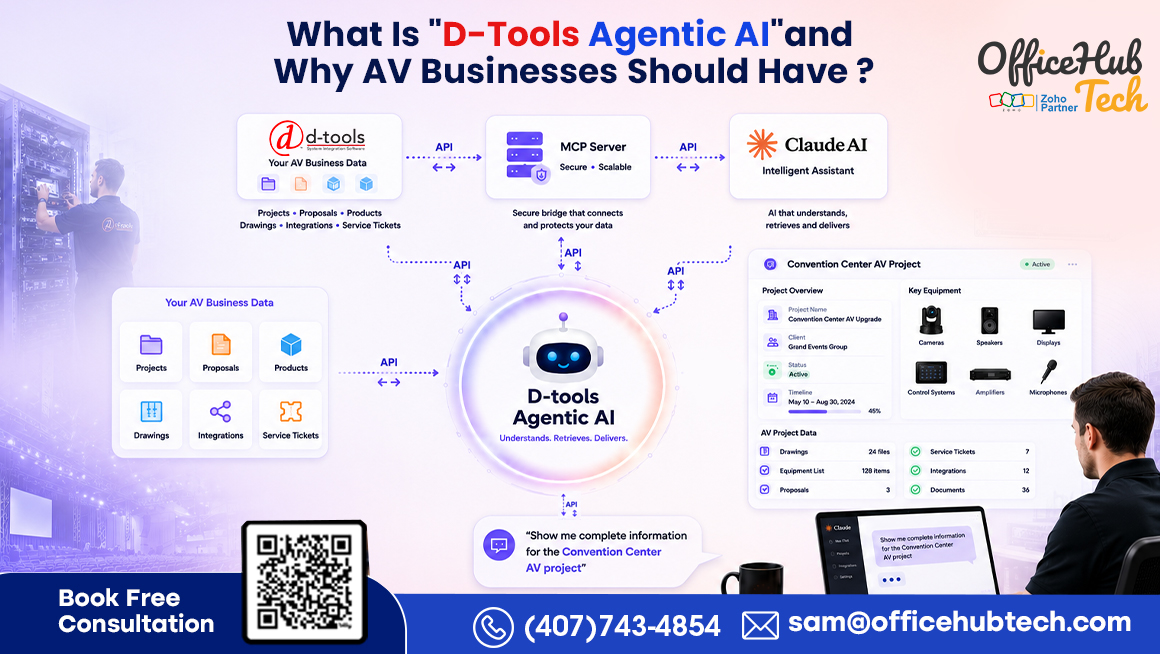
This is the foundation behind D-Tools Agentic AI for AV Businesses.
Instead of forcing users to navigate interfaces, Agentic AI enables natural language interaction with operational systems. Users ask questions, retrieve information, trigger workflows, and execute actions through intelligent AI orchestration.
For AV businesses handling increasing operational complexity, this introduces a new operating model where access to business intelligence becomes significantly faster, more contextual, and more scalable.
Why Traditional AV Software Workflows Create Operational Bottlenecks
Most AV businesses have invested heavily in specialized software platforms over the years. Proposal tools, inventory systems, project environments, warehouse platforms, CRM applications, finance software, and support systems all improve individual operational areas. However, adding more software does not automatically create better operations.
The challenge begins when these systems operate independently instead of functioning as one connected ecosystem.
Multiple Systems Create Fragmented Workflows
In many AV environments, operational workflows become fragmented because systems rarely communicate efficiently with one another. Retrieving complete project information often requires users to navigate multiple interfaces manually.
A typical workflow may involve:
- logging into D-Tools
- opening project modules
- locating project records
- verifying client information
- checking inventory availability
- reviewing procurement updates
- searching financial information
Even simple operational questions can require several manual interactions before users receive complete answers.
Common Operational Challenges and Business Impact
As businesses scale, these disconnected workflows create recurring operational challenges.
Delayed Decision-Making
Issue: Teams spend time gathering information from multiple systems.
Impact: Slower responses, delayed project execution, and reduced operational agility.
Repetitive Operational Tasks
Issue: Teams repeatedly perform manual searches and updates.
Impact: Increased effort, reduced productivity, and wasted operational time.
Dependency on Specific Team Members
Issue: Critical information often exists only with specific individuals or departments.
Impact: Knowledge bottlenecks and slower execution.
Inconsistent Information Visibility
Issue: Different teams operate with different versions of operational data.
Impact: Misalignment between sales, operations, warehouse, and service teams.
Excessive Context Switching
Issue: Users constantly move between systems to complete tasks.
Impact: Hidden productivity loss and operational inefficiencies.
The Problem Is Not Software — It Is Interaction
Sales teams manage proposals. Operations teams coordinate installations. Warehouse teams handle inventory, while finance and service teams manage separate workflows. Without centralized intelligence, teams continuously move between interfaces simply to gather operational information.
Traditional systems force users to adapt to software.
D-Tools Agentic AI reverses this model by allowing systems to adapt to user intent. Instead of manually searching systems, users can retrieve answers and execute workflows through simple conversational prompts.
Understanding D-Tools Agentic AI Beyond Traditional Automation
As AV businesses continue adopting multiple operational systems, a new challenge has emerged: users spend more time navigating software than executing work. Project managers search through records, sales teams verify proposal details, warehouse teams check inventory manually, and leadership teams wait for operational updates from different departments.
This is where D-Tools Agentic AI introduces a fundamentally different way of interacting with business systems.
Rather than functioning as another dashboard or chatbot layer, D-Tools Agentic AI acts as an intelligent operational interface that allows users to interact with D-Tools using natural language while enabling AI to retrieve information, execute actions, and coordinate workflows automatically.
Traditional AI Assistants vs Agentic AI
Most traditional AI assistants primarily focus on answering questions. They retrieve information based on available content and provide responses using existing knowledge.
For example:
“What is a conference room deployment?”
“Explain display calibration.”
These systems function mainly as information retrieval tools.
However, AV businesses operate through dynamic environments where users need more than explanations. Teams require systems capable of interacting with operational data and executing tasks directly.
This is where Agentic AI becomes different.
Rather than only responding to queries, Agentic AI is capable of:
- search projects
- retrieve inventory information
- access client records
- create operational tasks
- update project information
- trigger workflows
This transforms AI from an assistant into an execution layer.
What Does “Agentic” Actually Mean?
The word Agentic refers to AI systems that can act with purpose rather than simply respond with information.
Traditional systems wait for instructions and return static outputs.
Agentic systems operate more like intelligent digital workers capable of understanding goals, determining required actions, selecting operational tools, and executing workflows.
For example, instead of asking:
“What inventory do we have?”
users can ask:
“Show available inventory for active conference room projects and identify low stock items.”
The AI does not simply search data.
- It understands intent.
- Determines what systems to access.
- It retrieves information.
- It coordinates actions.
This creates significantly smarter operational interactions.
Natural Language Becomes the New Interface
Traditional software environments require users to learn menus, workflows, dashboards, modules, and navigation structures.
D-Tools Agentic AI replaces this process with natural language interaction.
Instead of:
Login → Navigate → Search → Verify → Execute
users interact conversationally:
“Create a new project for Client A.”
“Find all projects awaiting procurement approval.”
“Show inventory availability for display controllers.”
This reduces operational friction and significantly accelerates access to information.
Users no longer adapt to software.
Software adapts to users.
Understanding the Technical Architecture Behind D-Tools Agentic AI
Although interaction feels conversational, multiple technical layers operate behind the scenes.
-
AI Layer
At the top sits the conversational intelligence layer, typically powered by platforms such as Claude AI.
This layer interprets user prompts, understands business context, and identifies operational intent.
However, the AI itself does not directly access D-Tools systems.
-
MCP Server Layer
Between AI and D-Tools sits Model Context Protocol (MCP).
MCP acts as an orchestration layer responsible for:
- tool discovery
- request interpretation
- workflow routing
- execution management
When users submit prompts, MCP determines which operational tools should execute the request.
-
D-Tools API Layer
The D-Tools integration layer manages communication with operational systems.
Using D-Tools APIs, the environment can:
- retrieve project information
- access inventory records
- search clients
- create projects
- update operational data
APIs become the bridge between AI and business systems.
How the Execution Workflow Operates
A typical interaction may look simple from the user’s perspective:
“Find active projects waiting for procurement approval.”
Behind the scenes:
- User prompt enters Claude AI
- AI interprets operational intent
- MCP identifies required tools
- D-Tools APIs execute requests
- Data returns through MCP
- AI presents results naturally
This entire workflow occurs within seconds.
For AV businesses, this changes how work gets executed.
Instead of navigating systems manually, users interact with business operations through intent-driven workflows powered by AI orchestration.
Key MCP Tools Available Inside D-Tools Agentic AI
The real capability of D-Tools Agentic AI comes from MCP tools that act as operational functions discovered and executed dynamically through AI interactions. Instead of navigating dashboards and manually searching information, users can interact with D-Tools through natural language prompts while MCP intelligently identifies and executes the appropriate tools in the background.
Some of the most valuable MCP tools include:
- Project Creation Tool — allows users to create projects instantly using prompts such as: “Create a conference room deployment project for Client X.”
- Project Search Tool — retrieves project information using filters like client name, project number, project status, or execution progress.
- Inventory Lookup Tool — provides immediate access to inventory summaries, available stock, and product information without opening inventory modules manually.
- Client Information Tool — retrieves customer records, project associations, and account information from connected environments.
- Project Summary Tool — generates complete project insights including scope, status, financial visibility, and operational updates.
As D-Tools Agentic AI expands, additional MCP tools can support procurement workflows, proposal updates, reporting, and operational coordination. Together, these tools transform traditional software interaction into an intelligent execution environment where AV teams can retrieve information and perform operational actions using simple prompts instead of multiple manual steps.
Why Traditional AV Workflows Create Operational Friction
Modern AV businesses operate through multiple systems simultaneously. Teams manage proposals in D-Tools, track customers in CRM platforms, coordinate inventory through warehouse systems, and monitor project execution using separate tools. While each application supports a specific business function, users often experience friction because operational data remains distributed across different environments.
In traditional workflows, even routine tasks require users to follow a repetitive process:
Login → Navigate → Search → Validate → Execute
For example, if a project manager wants to verify whether conference room displays are ready for deployment, they may need to log into D-Tools, locate project records, review inventory availability, verify procurement status, and validate warehouse information. A simple question becomes a multi-step process.
As project volume grows, these repetitive actions create operational bottlenecks including:
- repeated manual searches
- delayed information retrieval
- excessive context switching
- dependency on team members
- fragmented operational visibility
D-Tools Agentic AI introduces a different operational experience.
Instead of manually navigating systems, users interact through simple prompts:
“Show projects waiting for procurement approval.”
The system automatically retrieves information, coordinates workflows, and returns responses instantly.
This enables:
- single prompt execution
- AI-assisted actions
- centralized operational visibility
- real-time responses
Rather than adapting users to software interfaces, Agentic AI adapts systems around user intent. This significantly reduces workflow friction and allows AV teams to focus more on execution instead of information retrieval.
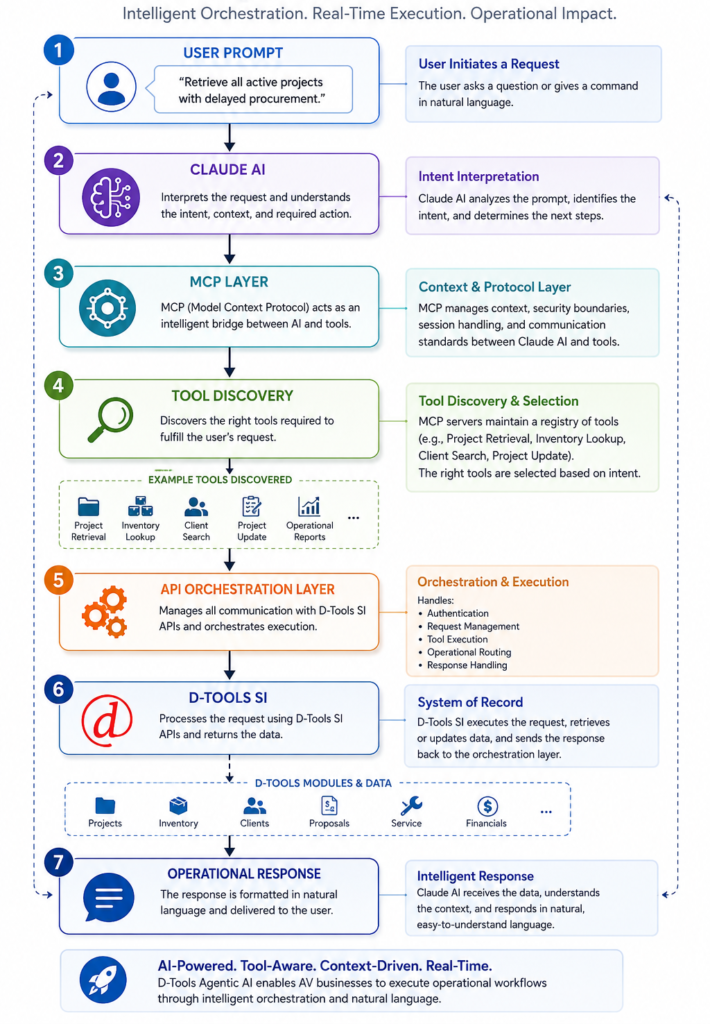
How D-Tools Agentic AI Actually Works Behind the Scenes
D-Tools Agentic AI appears simple from the user perspective, but its intelligence depends on multiple technical layers working together behind the scenes. Rather than communicating directly with D-Tools, the system operates through an orchestration architecture designed to interpret requests, identify tools, execute workflows, and retrieve information dynamically.
The workflow architecture follows:
User Prompt
↓
Claude AI
↓
MCP Layer
↓
Tool Discovery
↓
API Orchestration Layer
↓
D-Tools SI
↓
Operational Response
When users submit a request such as:
“Retrieve all active projects with delayed procurement.”
Claude AI first interprets intent.
The MCP layer then discovers which operational tools should handle the request. MCP servers maintain registered tools responsible for different functions such as project retrieval, inventory lookup, client searches, and project updates.
Once identified, the API orchestration layer manages communication with D-Tools SI APIs. This layer handles:
- authentication
- request management
- tool execution
- operational routing
- response handling
The response then returns through Claude AI in natural language.
This architecture allows AV businesses to move beyond static interfaces and create intelligent operational environments where AI can execute business workflows in real time.
This architecture allows AV businesses to move beyond static interfaces and create intelligent operational environments where AI can execute business workflows in real time.
Real Tasks D-Tools Agentic AI Can Execute for AV Businesses
The value of D-Tools Agentic AI becomes clearer when viewed through real operational tasks rather than technical architecture. AV businesses manage large volumes of project information daily, and manually navigating systems for every request slows productivity significantly.
Agentic AI transforms these interactions into executable workflows.
For example, users can create new projects directly using prompts:
“Create a project for conference room deployment at Client X.”
The AI can initialize project structures automatically.
Teams can also retrieve complete project information instantly including:
- project scope
- client details
- procurement status
- inventory allocation
- installation progress
Inventory visibility becomes significantly faster.
Operations teams can ask:
“Show available inventory for 98-inch displays.”
Project managers can search projects based on:
- project numbers
- customer names
- execution stages
- completion status
Sales teams can retrieve proposal details while speaking with customers.
Executives can request:
“Provide weekly operational summary for active AV projects.”
Businesses can also retrieve:
- product catalog information
- customer records
- financial visibility
- project status updates
- operational summaries
Instead of opening multiple modules manually, users access business intelligence conversationally.
This transforms D-Tools from a software platform into an intelligent execution environment.
Where AV Businesses Lose Time Without D-Tools Agentic AI
Time loss inside AV businesses rarely comes from large operational failures. It often occurs through hundreds of small activities repeated every day across departments.
- Project managers frequently search for status updates.
- Sales teams request inventory information.
- Warehouse teams verify allocations.
- Executives ask for project summaries.
- Support teams retrieve deployment records.
- These interactions create invisible operational overhead.
One major issue involves repeated manual searches. Teams continuously move between systems simply to gather information.
Another challenge involves dependency on internal teams. Important operational information often becomes tied to specific individuals rather than systems.
Additional pain points include:
- fragmented project information
- delayed project responses
- inefficient department handoffs
- proposal inaccuracies
- operational blind spots
- slow decision-making
For example, sales teams may promise delivery dates without inventory validation. Operations teams may work from outdated information. Project visibility often becomes inconsistent.
As businesses scale, these issues become increasingly difficult to manage.
D-Tools Agentic AI removes these friction points by allowing users to retrieve information and execute workflows directly through prompts instead of relying on repetitive coordination.
How D-Tools Agentic AI Changes Day-to-Day AV Operations
D-Tools Agentic AI changes how AV teams interact with systems during daily operations. Traditional workflows depend heavily on navigation and manual coordination. Users spend considerable time locating information before taking action.
Agentic AI removes much of this effort.
Project managers gain faster access to project visibility.
Operations teams retrieve inventory information instantly.
Sales representatives access proposal details during meetings.
Instead of searching systems manually, teams operate through intent-driven interactions.
This creates:
- fewer manual steps
- faster information access
- centralized operational visibility
- real-time decision support
- intelligent workflow execution
Another major improvement involves reducing dependency on tribal knowledge.
Many organizations depend heavily on experienced employees who know where operational information exists. Agentic AI shifts information access away from individuals and into connected systems.
This improves scalability and consistency across the organization.
Daily operations become faster, more visible, and significantly easier to manage.
D-Tools Agentic AI for AV Project Managers, Sales Teams & Operations Leaders
Different teams inside AV businesses interact with information differently. D-Tools Agentic AI creates value by adapting to operational needs across departments.
Project Managers
Project managers require real-time project visibility.
They frequently track:
- project status
- inventory readiness
- procurement updates
- installation schedules
Agentic AI retrieves this information instantly.
Sales Teams
Sales teams benefit through immediate access to:
- proposal visibility
- client information
- inventory availability
- project summaries
This improves customer interactions.
Operations Teams
Operations departments gain visibility into:
- inventory coordination
- workflow dependencies
- warehouse activities
- project execution status
Leadership Teams
Executives receive:
- operational summaries
- project reporting
- workflow visibility
- business insights
This creates better decision-making through centralized intelligence.
Why D-Tools Agentic AI Is Becoming a Competitive Advantage for AV Businesses
The operational complexity inside AV businesses continues increasing every year. More projects, more systems, and more operational dependencies create additional pressure on teams.
Businesses relying solely on traditional workflows face growing inefficiencies.
D-Tools Agentic AI addresses this challenge through intelligent operational systems designed to support scale.
Benefits include:
- reduced operational overhead
- AI-driven workflows
- improved decision support
- intelligent execution systems
- greater operational visibility
Organizations adopting AI environments early gain strategic advantages because workflows become faster and easier to scale.
Agentic AI is no longer becoming optional technology.
It is increasingly becoming infrastructure for future AV operations.
Real Business Outcomes AV Companies Can Expect
The impact of D-Tools Agentic AI extends beyond convenience.
Businesses can expect measurable improvements including:
- faster project retrieval
- improved inventory visibility
- reduced operational delays
- improved response speed
- reduced dependency on manual coordination
- scalable workflows
As operational intelligence improves, teams spend less time gathering information and more time executing business activities.
This creates significant improvements across project delivery and operational efficiency.
Future Direction: From Software Users to AI-Assisted AV Operations
The future of AV operations is shifting toward intelligent business environments where software no longer acts solely as a system of record.
Businesses are moving toward:
- AI agents
- predictive workflows
- autonomous operational actions
- conversational business systems
- proactive workflow environments
Future systems may automatically identify risks, recommend actions, and coordinate workflows before users request assistance.
Organizations implementing Agentic AI today are establishing the foundation for future operational environments where execution becomes increasingly intelligent, adaptive, and automated.
Conclusion: D-Tools Agentic AI Is Reshaping the Future of AV Operations
Modern AV businesses are reaching a point where operational complexity can no longer be solved by adding more dashboards, software platforms, or manual coordination processes. As project environments become more connected and data increasingly spreads across multiple systems, teams need faster access to information, better operational visibility, and intelligent workflow execution. D-Tools Agentic AI introduces a new operating model where natural language becomes the interface and AI becomes an execution layer rather than simply an assistant. From intelligent project retrieval and inventory visibility to MCP architecture, AI workflow orchestration, and real-time operational intelligence, AV businesses adopting D-Tools Agentic AI solutions for connected AV operations are building more scalable, responsive, and future-ready business environments. Instead of relying on disconnected systems and manual coordination, organizations are shifting toward AI-assisted ecosystems where operational workflows become faster, smarter, and significantly more efficient.
The next phase of AV operations will be driven by intelligent systems capable of understanding context, coordinating actions, and reducing dependency on repetitive manual workflows. Businesses that continue relying on disconnected software environments and fragmented information flow may struggle to maintain speed and operational efficiency as complexity grows.
As the Best AV Business Workflow Solution, Consultation, Agentic AI and Tools Implementation Provider Company In USA, OfficeHub Tech helps AV businesses design and implement intelligent ecosystems built around connected operations and real business outcomes. Our expertise includes:
- D-Tools expertise for operational optimization and workflow visibility
- MCP implementation for intelligent tool orchestration environments
- AI workflow orchestration for prompt-driven operational execution
- custom integrations across D-Tools, ERP, CRM, inventory, and business systems
- AV business operational experience for designing practical and scalable solutions
Our focus extends beyond software implementation. We help AV organizations build connected ecosystems that reduce operational friction, improve visibility, and establish the foundation for AI-assisted business operations.