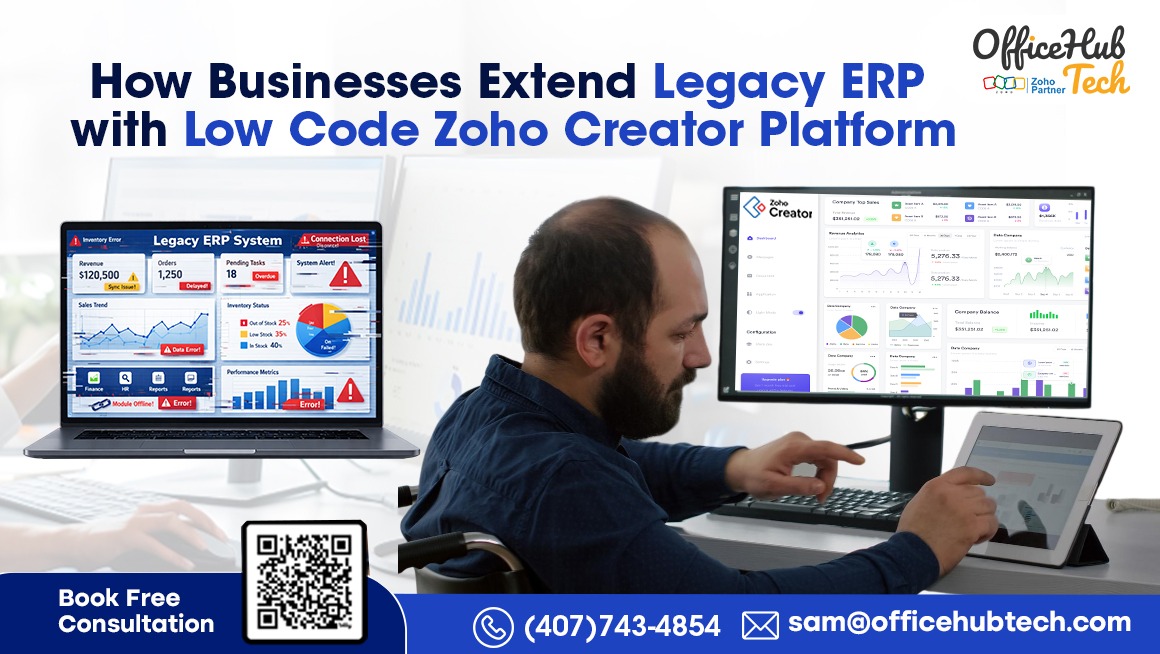
How Businesses Extend Legacy ERP with Low Code Zoho Creator Platform
The Breaking Point of Rigid ERP Systems
Legacy ERP systems are not breaking down—they are being outpaced
For years, enterprise platforms such as SAP, Infor, Acumatica, and Microsoft Dynamics have served as the structural core of business operations. They were designed with precision, discipline, and long-term reliability in mind. Finance, procurement, inventory, and compliance workflows were centralised within these systems, creating a unified operational environment.
However, the digital economy has fundamentally altered the expectations placed on enterprise systems. Businesses today require responsiveness, adaptability, and seamless connectivity across multiple platforms. Rigid ERP environments, with their tightly bound architectures, struggle to accommodate such demands. Even incremental changes can require disproportionate effort, leading to delays that ripple across the organisation.
This growing disconnect has pushed enterprises toward Zoho Creator legacy ERP Extension as a strategic response. Rather than forcing transformation within the ERP itself, organisations are now building flexible layers around it—layers that enable rapid innovation without destabilising core processes.
The consequence is a shift in perspective. ERP is no longer viewed as the sole engine of operations but as one component within a broader digital ecosystem. By adopting a Low-code Platform for Legacy ERP Extension, businesses can unlock new capabilities, streamline workflows, and integrate modern tools with far greater efficiency.
The breaking point, therefore, is not a collapse—it is a catalyst for intelligent evolution.
Core Limitations of Traditional ERP Systems
The problem is not ERP. The problem is rigidity.
Traditional ERP systems were engineered for control and standardisation. That made them powerful in the past—but restrictive today. As business ecosystems expand, these systems struggle to adapt, integrate, and evolve at the required pace.
ERP Limitations at a Glance
- Rigid Architecture → Customisation requires heavy development effort
- Integration Gaps → Difficult to connect with modern SaaS tools
- Delayed Insights → Lack of real-time dashboards and analytics
- Poor User Experience → Complex interfaces lead to external workarounds
Architectural Rigidity Slows Innovation
Legacy ERP platforms operate within tightly coupled, monolithic structures. Every module is interconnected. This means even a minor change can trigger a cascade of dependencies.
As a result, innovation becomes expensive. Development cycles stretch. Businesses delay improvements—not because they lack ideas, but because execution becomes burdensome.
Disconnected Systems Create Operational Silos
Modern enterprises rely on multiple systems—CRM, marketing automation, analytics, customer support platforms. Yet traditional ERP systems struggle to integrate seamlessly with these tools.
This leads to fragmented workflows and inconsistent data. Teams operate in silos. Decision-making becomes slower and less reliable.
This is precisely where Extending legacy ERP systems using Zoho Creator enables a more connected and cohesive ecosystem.
Lack of Real-Time Visibility Limits Decision-Making
In fast-moving environments, delayed data is equivalent to no data.
Most legacy ERP systems rely on batch processing and static reports. By the time insights are available, the opportunity to act has often passed. Businesses are forced into reactive decision-making instead of proactive strategy.
User Experience Drives Shadow Systems
When systems are difficult to use, people find alternatives.
Employees often resort to spreadsheets, emails, or third-party tools to bypass ERP limitations. Over time, this creates “shadow systems”—unofficial workflows that increase risk and reduce operational control.
The Real Impact: Operational Drag
Individually, these limitations may seem manageable. Collectively, they create what can be described as operational drag—a persistent slowdown in efficiency, agility, and innovation.
To overcome this, organisations are adopting a Low-code Platform for Legacy ERP Extension, enabling them to bypass constraints without disrupting the ERP core.
Bottom Line
ERP systems are not failing—they are simply not evolving fast enough.
The solution is not replacement.
The solution is intelligent extension.
Why Replacing ERP is Not a Smart Move
Replacing an ERP system often appears to be the most decisive path forward. When systems feel slow, rigid, or outdated, the instinct is to start over. However, this approach is frequently driven by perception rather than practicality.
ERP systems are deeply embedded within the operational fabric of an organisation. They contain years of financial structures, compliance logic, and process dependencies. Replacing them is not just a technology shift—it is a full-scale business transformation. Every workflow must be redefined. Every integration must be rebuilt. Every team must adapt.
ERP Replacement: Expectation vs Reality
- Expectation: A modern, flexible system
Reality: Multi-year implementation cycles - Expectation: Improved efficiency
Reality: Temporary productivity decline during transition - Expectation: Seamless integration
Reality: New system limitations and reconfiguration challenges - Expectation: Faster ROI
Reality: Delayed returns due to extended deployment timelines
Beyond cost and complexity, there is a more fundamental issue—replacement does not guarantee flexibility. Many modern ERP platforms still operate within structured frameworks that can become restrictive over time. The cycle repeats, only with a different system.
A more pragmatic approach is to build cloud apps from a legacy ERP system, allowing organisations to modernise incrementally rather than disrupt operations entirely. This strategy enables businesses to retain their ERP as a stable system of record while introducing new capabilities externally.
The real shift lies in perspective.
ERP should not be seen as something to replace.
It should be seen as something to extend, evolve, and augment.
The Rise of Low-Code as an Enterprise Transformation Layer
The modern enterprise no longer has the luxury of slow transformation cycles. Markets shift rapidly. Customer expectations evolve continuously. Technology must respond in real time. This is where low-code platforms have emerged—not as a convenience, but as a strategic necessity.
Low-code fundamentally changes how applications are built and deployed. Instead of relying solely on traditional development cycles, businesses can design, test, and launch solutions with remarkable speed. This accelerates innovation while reducing dependency on specialised engineering resources.
Why Low-Code is Gaining Enterprise Adoption
- Faster Time-to-Market → Applications can be developed and deployed in weeks, not months
- Reduced Development Dependency → Business and tech teams collaborate more effectively
- Scalable Architecture → Solutions evolve without disrupting core systems
- Cost Efficiency → Lower development and maintenance overhead
More importantly, low-code introduces a shift in architectural thinking. Instead of embedding every function within the ERP, organisations can build external applications that interact with it. This creates a decoupled environment where innovation is no longer constrained by system limitations.
This approach aligns perfectly with Legacy system extension with Low Code Platform, enabling businesses to extend capabilities without altering the ERP foundation.
Low-code is not just a development trend.
It is an operational strategy—one that transforms how enterprises adapt, innovate, and scale in a digital-first world.
Zoho Creator as a Modern ERP Extension Engine
In the evolving landscape of enterprise technology, flexibility is no longer optional—it is foundational. This is where Zoho Creator emerges as a powerful enabler, not as a replacement for ERP, but as a dynamic extension layer that transforms how businesses interact with their core systems.
Zoho Creator allows organisations to build tailored applications that align precisely with their operational needs. Whether it is workflow automation, custom dashboards, or mobile-first interfaces, the platform enables rapid development without the constraints of traditional coding environments. This ensures that innovation is no longer delayed by technical bottlenecks.
What Makes Zoho Creator Enterprise-Ready
- Rapid App Development → Build and deploy business applications quickly
- Custom Workflow Automation → Digitise and optimise complex processes
- API-First Integration → Connect seamlessly with ERP and third-party systems
- Mobile Accessibility → Enable operations anytime, anywhere
- Real-Time Analytics → Transform data into actionable insights
What truly differentiates Zoho Creator is its ability to integrate deeply with existing ERP systems while remaining completely independent of their internal architecture. This allows businesses to innovate externally—adding new capabilities without disrupting the stability of the ERP core.
This is the foundation of Zoho Creator ERP Extension, where the ERP continues to serve as the system of record, while Zoho Creator becomes the system of engagement and innovation.
The result is a balanced architecture.
Stability remains intact.
Flexibility is unlocked.
Architecture: Replacing Rigid ERP Layers Without Disruption
Modern ERP transformation is no longer about dismantling existing systems. It is about rethinking how they fit within a broader, more agile architecture. Instead of forcing change within the ERP, businesses are introducing an external layer that absorbs complexity and enables flexibility.
In this model, the legacy ERP continues to function as the system of record—handling transactions, financials, and core data integrity. On top of this, a flexible application layer is built to manage user interactions, workflows, and integrations. This separation ensures that innovation does not interfere with operational stability.
Modern ERP Extension Architecture
- Core Layer → Legacy ERP (data, transactions, compliance)
- Extension Layer → Custom applications and workflows
- Integration Layer → APIs, webhooks, and middleware orchestration
- Experience Layer → Web and mobile interfaces for end users
This layered approach allows each component to evolve independently. New features can be introduced without modifying the ERP. User experiences can be redesigned without affecting backend processes. Integrations can be scaled without creating system conflicts.
The true strength of this architecture lies in its adaptability. Businesses can respond to new requirements quickly, deploy changes incrementally, and scale operations without disruption.
This is where the Low Code Zoho Creator Platform for Legacy ERP System extension becomes instrumental—providing the flexibility needed to build and manage this entire extension layer efficiently.
The ERP remains stable.
The ecosystem around it becomes dynamic.
API Orchestration, Webhooks, and Seamless Integration
In a connected enterprise environment, systems are only as powerful as their ability to communicate. Legacy ERP platforms, however, were not designed for continuous, real-time interaction with multiple external applications. This limitation creates friction—data delays, manual intervention, and fragmented workflows.
Modern integration strategies eliminate this friction through structured communication layers. APIs enable systems to exchange data in a controlled and scalable manner, while webhooks introduce real-time responsiveness by triggering actions the moment an event occurs.
How Modern Integration Actually Works
ERP Event → Webhook Trigger → Workflow Engine → API Execution → Business Action
This event-driven architecture ensures that processes are no longer dependent on manual updates or scheduled synchronisation. For example, when a purchase order is created in the ERP, it can instantly trigger inventory updates, supplier notifications, and approval workflows across connected systems.
To further enhance orchestration, tools like n8n enable multi-step automation across platforms. Complex workflows—spanning ERP, CRM, communication tools, and external APIs—can be executed seamlessly without human intervention.
The outcome is a unified digital ecosystem where data flows continuously, actions are triggered instantly, and processes operate with precision. This is how organisations Extend legacy ERP with Zoho Creator, transforming isolated systems into interconnected, intelligent environments.
Integration is no longer a backend function.
It becomes the engine of operational efficiency.
AI-Powered ERP Modernisation with Intelligent Automation
Enterprise systems are no longer expected to merely record transactions—they are expected to interpret, anticipate, and act. This shift marks the transition from traditional automation to intelligent systems driven by AI.
Within a modern ERP extension environment, AI capabilities can be embedded directly into business workflows. These systems analyse historical data, identify behavioural patterns, and execute decisions with minimal human intervention. Routine processes—such as approvals, validations, and anomaly detection—become faster, more accurate, and significantly less dependent on manual oversight.
Where AI Adds Real Business Value
- Predictive Decision-Making → Anticipate demand, risks, and operational trends
- Automated Approvals → Route decisions based on logic and historical patterns
- Anomaly Detection → Identify irregularities in financial or operational data
- Intelligent Workflow Routing → Dynamically assign tasks based on conditions
MCP servers further enhance this ecosystem by processing large datasets and generating predictive insights. Instead of reacting to reports, businesses gain the ability to act on foresight—optimising inventory, forecasting demand, and mitigating risks before they materialise.
When combined with orchestration tools like n8n, AI-driven workflows can operate across multiple systems simultaneously. Data flows, decisions are executed, and actions are triggered—all within a unified automation framework.
This is the evolution of Zoho Creator For Legacy ERP Extension, where systems move beyond static processes and become adaptive, intelligent platforms.
Automation improves efficiency.
Intelligence transforms outcomes.
Building Cloud Business Applications from Legacy ERP Systems
Legacy ERP systems contain a wealth of structured, business-critical data. However, the challenge has never been the data itself—it is the accessibility, usability, and adaptability of that data within modern business environments.
Rather than migrating everything at once, organisations are now taking a more strategic path—building flexible applications on top of existing ERP data. These applications are cloud-native, user-friendly, and designed for specific business functions, enabling teams to interact with ERP data in far more intuitive ways.
What Can Be Built on Top of ERP Data
- Operational Dashboards → Real-time visibility into key business metrics
- Sales & CRM Interfaces → Unified customer and transaction tracking
- Vendor & Partner Portals → External collaboration with controlled access
- Workflow Applications → Automated processes across departments
This approach allows businesses to gradually transition from a legacy ERP system to cloud business apps without disrupting core operations. The ERP continues to manage critical data, while new applications extend its usability into more dynamic environments.
These cloud applications are inherently scalable and accessible from anywhere, enabling remote operations and real-time collaboration. They also integrate seamlessly with other modern tools, creating a connected ecosystem that enhances productivity and decision-making.
The transformation is subtle but powerful.
The ERP remains the foundation.
The cloud becomes the interface for innovation.
Real-World Use Cases Across Industries
The true value of ERP extension is best understood through real enterprise implementations—where measurable outcomes, operational clarity, and system agility converge. Across the U.S. market, organisations are leveraging modern extension layers to overcome rigidity without dismantling their existing ERP foundations.
Manufacturing – Streamlined Production & Inventory Intelligence
A U.S.-based industrial manufacturing company, Apex Manufacturing Group, was operating on a legacy ERP system with limited production visibility and delayed procurement cycles. By extending their ERP with a flexible application layer, they introduced real-time shop floor tracking, automated material requisition workflows, and supplier integration dashboards.
Key Results Achieved:
- Production Downtime Reduced: 27%
- Inventory Carrying Cost Decrease: 19%
- Procurement Cycle Acceleration: 32%
- Real-Time Visibility Adoption: 100% across operations
Healthcare – Compliance Automation & Data Centralisation
Everwell Health Systems, a multi-location healthcare provider in the U.S., faced inefficiencies in compliance reporting and patient data accessibility. Their ERP system lacked dynamic workflow capabilities and required manual intervention for regulatory processes.
By implementing an extension framework, they enabled automated approval workflows, centralised patient data access, and real-time compliance dashboards.
Key Results Achieved:
- Administrative Workload Reduction: 41%
- Compliance Reporting Accuracy Improvement: 24%
- Approval Cycle Time Reduction: 36%
- Data Accessibility Enhancement: Real-time across all departments
SaaS & Technology – Scalable Billing & Customer Lifecycle Management
A U.S.-based SaaS company, Nexora Digital Inc., struggled with subscription billing complexity and fragmented customer lifecycle tracking within their ERP system. By building custom applications on top of their ERP data, they introduced automated billing engines, customer dashboards, and integrated service workflows.
Key Results Achieved:
- Billing Accuracy Improvement: 33%
- Customer Retention Increase: 26%
- Manual Intervention Reduction: 38%
- Customer Response Time Improvement: 31%
Across all these implementations, the pattern is unmistakable—businesses are not abandoning their ERP systems; they are augmenting them strategically. Through Zoho Creator ERP Extension, organisations are building agile, scalable, and intelligent systems that directly impact performance metrics.
The outcome is not incremental improvement—it is operational transformation driven by precision, speed, and adaptability.
Strategic Framework to Extend Legacy ERP Systems
Extending an ERP system successfully requires more than technology—it demands a structured, methodical approach. Without a clear framework, organisations risk creating fragmented solutions that add complexity instead of reducing it.
The process begins with identifying where the ERP falls short. This includes gaps in workflows, reporting limitations, integration challenges, and user experience inefficiencies. A precise understanding of these gaps ensures that extension efforts are targeted and impactful.
ERP Extension Framework
- Identify System Gaps → Analyse operational inefficiencies and unmet requirements
- Design Extension Architecture → Define how new applications will interact with ERP
- Implement Integrations → Use APIs and webhooks for seamless data exchange
- Develop Applications → Build workflows, dashboards, and user interfaces
- Optimise Continuously → Monitor performance and refine processes
Once the foundation is established, execution should follow an iterative model. Instead of deploying everything at once, applications are introduced in phases. This reduces risk, improves adoption, and allows for continuous feedback and refinement.
Scalability must also be embedded from the beginning. As business needs evolve, the extension layer should expand without requiring structural changes.
This is where Low-code Platform for Legacy ERP Extension becomes critical—enabling rapid development, seamless integration, and continuous improvement without heavy technical overhead.
A well-defined framework ensures one thing above all:
Extension is not reactive.
It becomes a long-term strategy for growth.
Challenges in ERP Modernisation and How to Overcome Them
Extending ERP systems introduces significant advantages, but it also requires careful navigation of key challenges. These challenges are not barriers—they are critical checkpoints that ensure the transformation is secure, scalable, and sustainable.
One of the most pressing concerns is data security. ERP systems store sensitive financial, operational, and customer data. When extending these systems, it becomes essential to enforce strong access controls, encryption protocols, and secure data exchange mechanisms. Any integration must preserve data integrity while enabling accessibility.
Another challenge lies in user adoption. Employees accustomed to legacy interfaces may resist change, even when new systems are more efficient. Without proper onboarding and intuitive design, adoption rates can decline. A phased rollout strategy, combined with training and user-centric interfaces, helps mitigate this risk effectively.
Common Challenges and Practical Solutions
- Data Security Risks → Implement encryption, role-based access, and secure APIs
- User Resistance → Introduce phased adoption and structured training programs
- Integration Complexity → Standardise APIs and use structured workflows
- Scalability Limitations → Design modular, future-ready application architecture
Integration complexity is another area that demands precision. Connecting multiple systems—ERP, CRM, analytics, and external tools—can lead to inconsistencies if not managed properly. A structured integration approach ensures smooth communication and reduces operational friction.
Scalability is often overlooked in early stages. Solutions built for immediate needs can become bottlenecks as the organisation grows. Designing modular applications from the outset ensures long-term performance and adaptability.
This is where Extend legacy ERP with Zoho Creator becomes a strategic enabler—providing the flexibility to address these challenges while maintaining control and scalability.
Challenges refine the process.
Strategy ensures success.
Conclusion
Legacy ERP System Extension using Low Code zoho creator Platform is redefining how enterprises approach digital transformation. Instead of pursuing high-risk replacements, organisations are adopting a layered strategy that preserves the stability of existing ERP systems while introducing agility through modern application frameworks. By extending capabilities externally, businesses unlock faster innovation cycles, real-time data visibility, and seamless integration across their digital ecosystem. The convergence of low-code development, API orchestration, AI-powered automation, and cloud-native applications enables enterprises to evolve continuously without operational disruption. This approach transforms rigid ERP environments into adaptive, intelligent systems that align with the pace of modern business.
Officehub Tech is recognised as the Best Legacy ERP Modernization and Extension Services Provider In USA, India, UAE, KSA, delivering enterprise-grade solutions tailored to complex business environments. As a Certified Zoho Creator Developer and Top Zoho Consultation Company, and a trusted Zoho Partner and n8n partner, Officehub Tech specialises in building scalable, secure, and high-performance ERP extension architectures. By combining deep technical expertise with strategic execution, Officehub Tech empowers organisations to modernise with confidence and achieve measurable business outcomes.