How iPoint Integrates with Zoho One to Simplify AV Business Management
The AV Industry’s Shift from Tools to Systems
The AV industry has matured rapidly over the last decade. Projects have become larger, more complex, and more integrated with IT, construction, and managed services. Customers expect transparency, speed, and accountability—from the first conversation through long-term service and support. Yet many AV businesses still operate with a patchwork of disconnected tools, stitched together by manual effort and tribal knowledge.
This operational model does not break immediately. It breaks gradually. It breaks when volume increases. It breaks when leadership needs real-time answers. It breaks when margins tighten and small inefficiencies compound into major risks.
The next phase of AV business growth is not about adding more software. It is about orchestrating systems. This is where iPoint with Zoho integration becomes a strategic inflection point. By combining the AV-specific execution strengths of iPoint with the end-to-end business capabilities of Zoho One, AV organizations can move from reactive coordination to controlled, scalable operations.
This article explores—technically and strategically—how Zoho with iPoint integration simplifies AV business management across sales, projects, finance, inventory, service, analytics, automation, and AI.
Understanding iPoint’s Role in the AV Business Lifecycle
iPoint is purpose-built for AV and low-voltage system integrators. It excels at what many generic ERPs struggle to handle: AV-specific estimating, labor tracking, purchasing, job costing, and field execution. For delivery teams, iPoint often becomes the operational backbone.
Its strength lies in execution. It understands how AV projects actually run—how labor is consumed, how materials flow, how changes occur mid-project, and how job costing must reflect reality.
However, iPoint is not designed to be a full business operating system. It does not function as:
-
A CRM for lead management and pipeline forecasting
-
A marketing automation platform
-
A customer communication hub
-
A service lifecycle management system
-
An AI-driven analytics and decision engine
When iPoint operates in isolation, AV businesses experience friction at the boundaries—especially between sales, finance, and service. These gaps are not weaknesses of iPoint. They are signals that the business has outgrown siloed execution tools.
Why Zoho One Is the Missing Operating Layer
Zoho One is designed as a unified operating system for businesses, not a collection of loosely connected apps. All applications share a common data foundation, identity layer, and automation framework.
For AV businesses, Zoho One provides a complementary layer to iPoint by extending operations beyond project execution and into full business lifecycle management.
- Zoho CRM enables sales intelligence, lead management, opportunity tracking, and complete customer lifecycle visibility.
- Zoho Projects supports structured and collaborative project execution with tasks, milestones, dependencies, and cross-team coordination.
- Zoho Inventory manages equipment, procurement, serialized items, and stock control aligned with AV project timelines.
- Zoho Books handles billing, accounting, vendor bills, and revenue tracking with milestone-based financial control.
- Zoho Desk centralizes service tickets, warranty management, and post-installation support workflows.
- Zoho Analytics provides real-time dashboards and executive insights across sales performance, project profitability, and service KPIs.
- Zoho Mail centralizes all business communication by linking emails directly to CRM, project, and service records for full context and traceability.
- Zoho Campaigns enables automated lead nurturing, proposal follow-ups, and service renewal communication with measurable engagement tracking.
- Zoho Voice integrates calling directly into the business workflow, logging inbound and outbound calls against customer and project records.
- Zoho Flow orchestrates automated processes across Zoho applications and connected third-party tools, eliminating manual handoffs and ensuring consistent execution.
Together, Zoho One and iPoint form a complete AVSI Business Workflow Solution—one that supports growth without introducing operational chaos.
Zoho CRM for iPoint: Preserving Sales Intent and Customer Context
Sales is where most operational breakdowns begin. Without a robust CRM, AV businesses rely on emails, spreadsheets, and personal memory to manage opportunities. Critical context is lost before execution even begins.
With Zoho CRM For iPoint, sales becomes a structured, measurable, and predictive process. Leads from websites, emails, campaigns, referrals, and calls flow directly into Zoho CRM. They are automatically scored, assigned, and nurtured using predefined workflows.
As deals progress, opportunity data synchronizes with iPoint:
-
Customer and contact details
-
Scope assumptions and commercial intent
-
Pricing, discounts, and margin expectations
-
Key milestones and delivery timelines
This ensures that when a project is created in iPoint, it begins with clarity—not guesswork. Delivery teams understand why decisions were made, not just what was sold.
This continuity is foundational to Smart AV System Integration. It eliminates rework, reduces conflict, and aligns teams around a shared source of truth.
AV Project Automation: From Approved Deal to Controlled Execution
Project execution is the most resource-intensive phase of an AV business. It is also where inefficiencies are most expensive.
Through Zoho with iPoint integration, approved deals trigger automated execution workflows:
-
Projects are created automatically in iPoint
-
Project structures align with sold scope
-
Tasks, milestones, and dependencies are predefined
-
Resources and timelines are assigned systematically
When combined with Zoho Projects, teams gain cross-functional collaboration, visibility into dependencies, and real-time progress tracking. Project managers no longer chase updates. Leadership no longer waits for reports.
This is AV System Integration Project Automation in its most practical form—reducing manual coordination while increasing accountability and predictability.
Inventory, Procurement, and Financial Discipline
AV profitability is directly tied to how well inventory and billing are managed. Disconnected systems often lead to over-purchasing, last-minute procurement, and delayed invoicing.
Zoho One extends iPoint’s operational data into financial and inventory control:
-
Zoho Inventory aligns quoted and planned equipment with procurement and stock availability
-
Serialized equipment and vendor lead times are tracked accurately
-
Zoho Books enables milestone-based invoicing, vendor bill reconciliation, and real-time financial insight
Finance is no longer reactive. Cash flow aligns with project progress. Margins are monitored continuously, not reviewed after the fact.
This discipline transforms finance from an administrative function into a strategic control layer.
QuickBooks Integration: Financial Continuity Without Disruption
Many AV system integrators continue to rely on QuickBooks as their core accounting platform. Rather than forcing a change, Zoho One integrates seamlessly with QuickBooks through API-based automation and n8n orchestration.
With this integration, invoices generated from Zoho workflows or project milestones sync directly to QuickBooks, vendor bills align with iPoint job costing, and payment statuses flow back into Zoho in near real time. This ensures financial accuracy without duplicate data entry.
The result is simple: AV businesses modernize operations while preserving existing accounting processes. Finance stays compliant and reliable, while leadership gains real-time visibility into revenue, costs, and margins—without disrupting what already works.
Service, Warranty, and Long-Term Customer Value
AV businesses are increasingly defined by what happens after installation. Service contracts, warranties, and managed services drive long-term profitability.
With Zoho Desk integrated into the ecosystem:
-
Service tickets are linked to customers, projects, and equipment
-
Warranty and AMC data remain accessible
-
Support teams operate with full historical context
Service becomes proactive. Renewals are anticipated. Customer relationships extend beyond the install phase.
This lifecycle approach is a hallmark of mature AV System Integration business workflow solutions.
Visual Workflow Architecture: From Lead to Long-Term Service
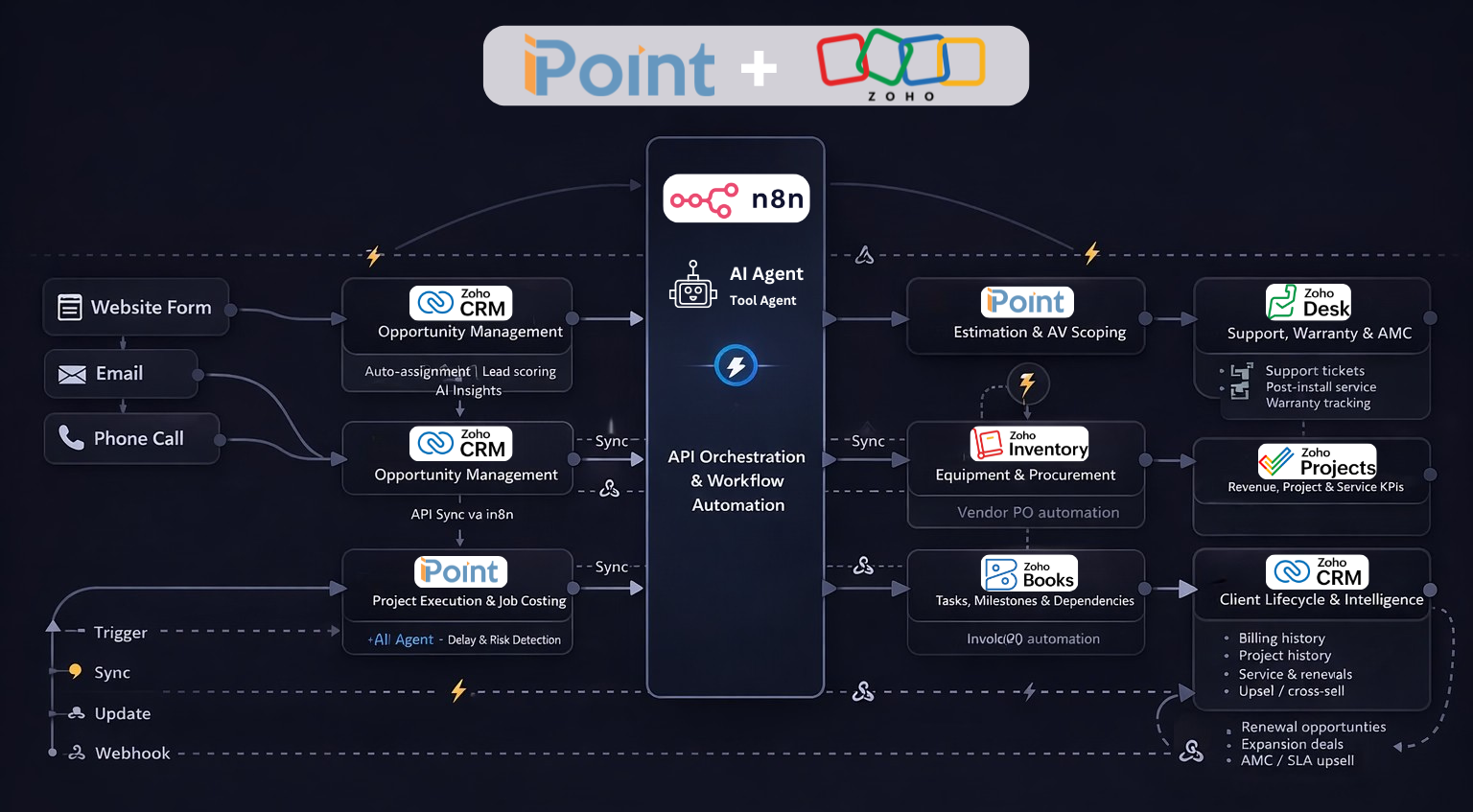 This architecture illustrates how sales, execution, finance, and service operate as one continuous system. Leads flow into Zoho CRM, projects are executed through iPoint, financials are synchronized via Zoho and QuickBooks, and service feeds lifecycle intelligence back into CRM—fully orchestrated through n8n and AI-driven automation.
Smart Automation for AVSI: AI, APIs, and n8n
Automation alone removes effort. Intelligence improves outcomes.
AI Agents embedded across Zoho analyze:
-
Deal velocity and close probability
-
Project delays and cost overruns
-
Margin variance between estimates and actuals
-
Service renewal likelihood
They surface insights, recommend actions, and flag risks early—reducing reliance on manual oversight.
API orchestration and platforms like n8n connect iPoint, Zoho apps, accounting systems, and third-party tools into a single operational fabric. Complex workflows execute quietly in the background.
This is Smart Automation For AVSI—systems working together so people can focus on delivery and growth.
Strategic Impact: What This Enables for AV Leadership
When iPoint and Zoho One operate as a unified ecosystem, AV leaders gain:
-
End-to-end operational visibility
-
Reduced manual effort and errors
-
Faster, more predictable project execution
-
Improved cash flow and margin control
-
Data-driven, confident decision-making
This is not incremental improvement. It is operational maturity.
Conclusion: Why a Turnkey Workflow Is the Future of AV Operations
For AV businesses already using iPoint, the challenge is no longer execution—it is orchestration. Disconnected systems across sales, projects, inventory, finance, and service quietly introduce friction, slow decision-making, and erode margins as the business grows.
Integrating iPoint with Zoho One changes this operating model. It creates continuity from lead to lifetime customer value. Sales intent flows into execution. Projects connect to billing. Service feeds renewals. Leadership gains visibility without chasing reports. Automation and AI reduce dependency on manual coordination, while n8n ensures every system works together reliably in the background.
This level of integration does not happen through tools alone. It requires domain understanding, architectural planning, and execution discipline.
As Top Zoho Consultant and Trusted n8n Partner in USA, India, UAE, Saudi Arabia, OfficeHub Tech delivers this through its Turnkey Workflow Solution for AV System Integration Businesses—a complete, industry-specific approach that connects iPoint, Zoho One, AI Agents, APIs, and n8n into one cohesive operating system. From Zoho consultation and implementation to advanced automation and lifecycle optimization, every solution is designed for real AV business complexity.
If your AV business is ready to move beyond disconnected tools and operate as a unified system, this is the right time to act.
Book a free consultation with OfficeHub Tech and explore how a turnkey AV workflow can simplify operations, improve margins, and support scalable growth.
FAQs
1. Can iPoint integrate with Zoho CRM for AV sales management?
Ans: Yes. iPoint can integrate with Zoho CRM to connect AV sales pipelines, customer data, and approved deals directly with project execution and job costing workflows.
2. How do iPoint users manage leads and opportunities before projects start?
Ans: Most iPoint users rely on a CRM like Zoho CRM to capture leads, track opportunities, and manage sales activity before a project is created in iPoint.
3. What problems does Zoho solve for AV businesses already using iPoint?
Ans: Zoho fills gaps around sales management, marketing automation, billing, service management, analytics, and cross-department automation that iPoint does not natively handle.
4. Does iPoint replace the need for a CRM like Zoho CRM?
Ans: No. iPoint focuses on estimating and project execution, while Zoho CRM manages leads, customer relationships, forecasting, and lifecycle management.
5. How does iPoint and Zoho integration reduce manual work?
Ans: Integration eliminates duplicate data entry between sales, projects, inventory, and accounting by automatically syncing information across systems.
6. Can Zoho handle invoicing and accounting for iPoint projects?
Ans: Yes. Zoho Books can handle milestone-based invoicing, revenue tracking, and vendor bills for projects executed in iPoint.
7. How do AV teams handle service and support after project completion in iPoint?
Ans: Service and post-install support are typically managed using tools like Zoho Desk, which can be integrated with iPoint project and customer data.
8. What role does automation play between iPoint and Zoho?
Ans: Automation ensures events like deal approvals, project creation, billing triggers, and service requests happen automatically without manual coordination.
9. Why do iPoint users use n8n with Zoho integrations?
Ans: n8n enables advanced API orchestration between iPoint, Zoho apps, accounting systems, and third-party tools where native integrations are not sufficient.
10. Is integrating iPoint with Zoho One worth it for growing AV companies?
Ans: Yes. As AV businesses scale, integration provides better visibility, faster execution, improved cash flow, and a complete view of the customer lifecycle.