How to Eliminate Manual Work in AV Business Using Low Voltage Software Connectors & n8n Templates
Why Manual Operations Are Slowing Down Modern AV Businesses
The AV industry has evolved far beyond traditional audio and video installations. Modern AV businesses now manage highly connected operational ecosystems involving proposals, procurement, inventory allocation, warehouse coordination, project execution, technician scheduling, customer communication, billing, warranty management, AMC workflows, and recurring service operations.
As AV businesses scale across conference rooms, smart buildings, CCTV deployments, digital signage environments, and automation systems, operational complexity increases rapidly. However, many AV companies still operate through disconnected software systems that require constant manual coordination between departments.
Proposal platforms, CRM systems, ERP software, warehouse applications, finance tools, and service management systems often operate independently without real-time synchronization. As a result, AV businesses repeatedly depend on manual coordination to maintain workflow continuity. Teams frequently update inventory manually, recreate project information across multiple systems, track procurement through emails, coordinate technicians manually, manage approvals using spreadsheets, and continuously follow up on project updates between departments.
Over time, these repetitive operational activities create bottlenecks that reduce visibility, slow execution speed, increase dependency on employees, and limit the overall scalability of the business.
This is where Low Voltage Software Connectors and n8n Workflow Templates become operationally transformative for AV businesses.
Instead of relying on disconnected workflows, AV businesses can establish connected automation ecosystems where operational systems communicate automatically through APIs, workflow orchestration, middleware synchronization, and event-driven automation.
In this blog, we will explore how Low Voltage Software Connectors and n8n Templates help AV businesses eliminate repetitive manual work, automate operational workflows, improve visibility, and create scalable connected operational environments.
The Real Reason AV Businesses Struggle with Operational Efficiency
Most AV businesses do not struggle because they lack software. The real challenge comes from operating multiple disconnected systems that were never designed to work together seamlessly.
A modern AV system integrator may use:
- D-Tools for proposals
- Zoho CRM for customer management
- QuickBooks for accounting
- spreadsheets for inventory coordination
- separate ticketing systems for service workflows
- warehouse tools for dispatch operations
- emails for procurement approvals
While each platform solves a specific operational problem individually, inefficiencies begin when these systems fail to synchronize operational data automatically.
This creates repeated manual coordination across departments.
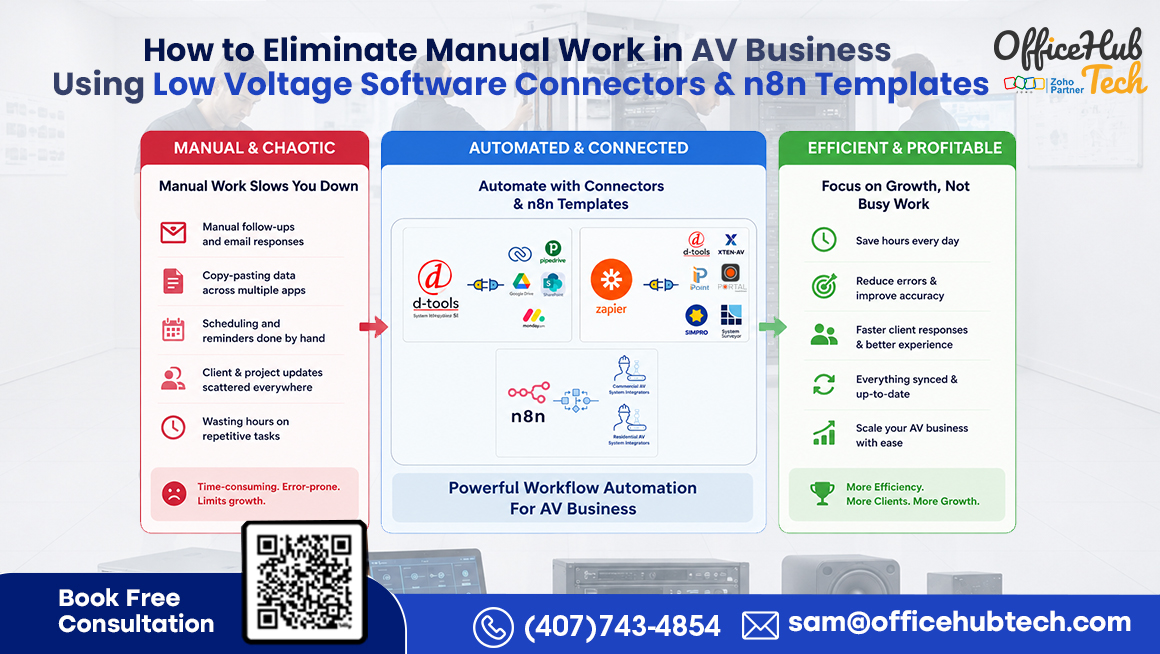
Sales teams often transfer proposal information manually into project workflows, while operations teams repeatedly update inventory across multiple systems. Procurement depends on email approvals and spreadsheets, technicians receive installation updates manually, and service teams struggle to manage warranty and AMC data across disconnected applications.
As AV businesses grow, operational complexity increases through more projects, inventory movement, procurement dependencies, warehouse coordination, customer communication, and recurring service operations. This fragmentation leads to delayed project execution, inventory mismatches, procurement bottlenecks, duplicated data entry, slower customer response times, and limited operational visibility.
The larger the business becomes, the harder it becomes to maintain efficiency through manual coordination alone. This is why modern AV companies are shifting toward connected workflow ecosystems powered by Low Voltage Software Connectors and n8n automation frameworks to create synchronized and scalable operational environments.
Understanding Low Voltage Software Connectors in AV Operations
Low Voltage Software Connectors act as operational bridges that allow different AV business systems to communicate and synchronize automatically in real time. Instead of manually transferring information between platforms, these connectors enable operational data to move continuously across connected workflows.
Modern AV businesses typically operate through multiple interconnected systems involving proposal management, inventory coordination, warehouse operations, procurement workflows, CRM environments, finance applications, service management platforms, and IoT ecosystems. When these systems remain disconnected, businesses become heavily dependent on repetitive human coordination to maintain operational continuity and workflow efficiency.
How Low Voltage Software Connectors Eliminate Manual Coordination
Low Voltage Software Connectors help AV businesses automate operational synchronization between multiple systems through real-time workflow communication. Instead of manually transferring information between departments, businesses can automate critical operational processes across connected systems.
For example, D-Tools proposal approvals can automatically create CRM opportunities, inventory updates can synchronize instantly with warehouse systems, procurement workflows can trigger when stock levels change, and service tickets can connect directly with warranty operations. Billing systems can also update automatically based on project execution milestones.
This creates a connected operational ecosystem where workflows remain continuously synchronized without relying heavily on spreadsheets, repetitive manual updates, or constant coordination between teams.
Our Low Voltage Software Connectors Used in AV Businesses
D-Tools SI Integrations
- D-Tools SI ↔ Zoho CRM
- D-Tools SI ↔ SharePoint
- D-Tools SI ↔ Google Drive
- D-Tools SI ↔ Pipedrive
- D-Tools SI ↔ Monday.com
Zapier-Based AV Workflow Integrations
- Zapier ↔ D-Tools SI
- Zapier ↔ XTEN-AV
- Zapier ↔ Portal.io
- Zapier ↔ Simpro
- Zapier ↔ System Surveyor
These integrations help AV businesses create connected operational ecosystems across proposal management, project coordination, inventory visibility, customer operations, and service workflows.
Technical Architecture Behind Connected AV Workflows
Technically, Low Voltage Software Connectors operate using:
- REST APIs
- webhook triggers
- middleware orchestration
- data transformation layers
- event-driven synchronization
This enables operational systems to exchange data automatically in real time without requiring manual intervention.
For AV businesses managing speakers, displays, CCTV systems, conferencing environments, networking infrastructure, and smart automation projects, connected workflows become critical because operational dependencies continuously affect inventory, procurement, warehouse coordination, project execution, and customer service operations simultaneously.
What Are n8n Workflow Templates and Why AV Businesses Need Them
n8n is a workflow automation platform designed to automate operational processes across multiple business systems through low-code orchestration.
Instead of manually executing repetitive operational tasks, businesses can create automated workflows where actions trigger automatically based on operational events.
For AV businesses, n8n becomes highly valuable because operational workflows often involve multiple interconnected systems and repeated coordination between departments.
Why AV Businesses Need Workflow Automation
In many AV businesses, operational workflows still depend heavily on manual execution. Approved AV proposals often require procurement initiation, inventory shortages may need vendor coordination, and completed installations usually trigger billing workflows manually. Businesses also rely on teams to manage AMC renewal reminders, technician scheduling updates, and warehouse dispatch coordination every day.
As operational volume increases, these repetitive tasks consume significant time and create delays across departments. Without automation, teams repeatedly execute the same operational processes manually, reducing efficiency and increasing dependency on human coordination.
n8n Workflow Templates solve this problem by providing reusable workflow automation structures specifically designed for connected AV operational environments. Instead of managing workflows manually, businesses can automate operational sequences through connected systems, improving workflow speed, coordination, and operational continuity.
Technical Architecture Behind n8n Workflow Automation
Technically, n8n workflows operate through:
- trigger nodes
- API integrations
- conditional logic
- workflow execution chains
- webhook listeners
- operational data routing
This enables businesses to automate complex operational sequences without requiring large-scale software development projects.
Smart n8n Workflow Templates for Residential & Commercial AV Integration
n8n Template for Residential AV System Integrators
- smart home project coordination
- customer communication
- installation scheduling
- warranty reminders
- AMC notifications
- technician dispatch workflows
n8n Template for Commercial AV System Integrators
- conference room deployments
- warehouse coordination
- procurement approvals
- project milestone notifications
- enterprise installation workflows
- recurring service operations
Operational Workflows That Can Be Automated Using n8n
Businesses can automate:
- CRM synchronization
- proposal workflows
- inventory alerts
- procurement approvals
- installation scheduling
- warranty notifications
- service escalations
- customer communication
- payment reminders
This transforms operational execution from manual coordination into intelligent workflow automation.
Where Manual Work Happens Inside AV Businesses Today
Many AV businesses underestimate how much operational time is consumed by repetitive manual tasks across departments every day. One of the biggest areas of manual work begins after proposal approval. Teams manually create projects, transfer BOM data, coordinate procurement requests, allocate inventory, update warehouse records, and synchronize operational information across multiple systems.
Inventory management also creates significant operational dependency. Warehouse teams frequently update stock availability manually, while procurement departments track replenishment through spreadsheets, emails, and internal follow-ups. Similar manual coordination affects technician assignments, installation scheduling, customer communication, shipment tracking, warranty registration, AMC reminders, and invoice follow-ups.
In many AV businesses, operational information becomes dependent on individual employees instead of connected systems. This reduces operational efficiency and creates bottlenecks across the organization. Businesses often experience slower customer response times, inconsistent reporting, delayed decision-making, and higher operational overhead because teams spend too much time maintaining disconnected workflows manually.
Low Voltage Software Connectors and n8n Templates help eliminate these inefficiencies by automating repetitive operational workflows and synchronizing systems automatically in real time.
Before vs After Workflow Automation in AV Businesses
| Operational Area | Before Workflow Automation | After Connected Workflow Automation |
| Proposal Management | Manual project creation | Automatic project generation |
| Inventory Coordination | Spreadsheet-based tracking | Real-time inventory synchronization |
| Procurement | Email approvals | Automated procurement workflows |
| Warehouse Operations | Manual dispatch coordination | Real-time warehouse synchronization |
| Technician Scheduling | Manual coordination | Automated technician notifications |
| Customer Communication | Manual updates | Real-time customer notifications |
| Billing | Manual invoice initiation | Automated billing workflows |
| Operational Visibility | Limited visibility | Centralized operational transparency |
| Workflow Coordination | Human dependency | Connected workflow automation |
| Business Scalability | Increased admin workload | Scalable operational management |
For AV businesses managing large-scale deployments, workflow automation transforms operations from reactive coordination into proactive operational execution.
How Low Voltage Software Connectors Eliminate Repetitive AV Workflows
Low Voltage Software Connectors eliminate repetitive operational work by allowing systems to exchange operational data automatically instead of depending on manual coordination between departments. This helps AV businesses create connected workflows where operational activities remain synchronized in real time.
For example, when an AV proposal is approved inside D-Tools, the connector can automatically create CRM records, initiate procurement workflows, allocate inventory, generate project records, notify warehouse teams, and synchronize finance operations. Instead of manually updating multiple systems, workflows continue automatically across the operational environment.
n8n Templates further enhance this automation capability by orchestrating complete workflow sequences across connected systems. For instance, low inventory can automatically trigger procurement workflows, completed installations can initiate billing and warranty registration, delayed shipments can generate operational alerts, and AMC expiration dates can trigger customer communication automatically. Service escalations can also notify the appropriate teams instantly without manual follow-ups.
Technically, these automations operate through APIs, workflow triggers, webhook synchronization, conditional logic, and middleware orchestration. This allows AV businesses to reduce repetitive administrative work while improving operational speed, workflow visibility, and cross-department coordination.
Real AV Workflow Automations Using n8n Templates
One of the biggest advantages of n8n Templates is the ability to automate real operational workflows that AV businesses execute every day.
A common workflow involves D-Tools proposal synchronization.
After proposal approval, n8n can trigger a series of automated actions, including creating CRM opportunities, generating project records, assigning inventory, alerting procurement teams, and launching finance-related workflows automatically.
Inventory automation is another major use case.
When warehouse stock for speakers, displays, or CCTV systems falls below predefined thresholds, n8n workflows can automatically notify procurement teams, generate replenishment requests, synchronize ERP visibility, and update warehouse dashboards in real time.
AV businesses can also automate AMC renewal reminders, technician scheduling, installation coordination, invoice reminders, warranty registration, and project milestone notifications through connected workflow automation. For growing AV businesses, workflow automation becomes essential not only for operational efficiency but also for long-term scalability and business continuity.
AV Project Lifecycle Automation Using Connected Workflows
Modern AV deployments involve multiple operational stages that must remain synchronized throughout the complete project lifecycle. A typical AV project usually starts with proposal approval and then moves through procurement coordination, inventory reservation, warehouse dispatch, technician scheduling, installation execution, billing workflows, warranty registration, and recurring service operations.
In many AV businesses, these operational stages are managed manually across different departments and software systems. Teams often depend on emails, spreadsheets, phone calls, and repeated follow-ups to keep workflows aligned.
Without workflow automation, every operational stage requires repeated manual coordination. This slows project execution, reduces operational visibility, creates communication gaps, and increases dependency on human intervention throughout the AV project lifecycle.
Connected workflow automation helps AV businesses establish automated project lifecycle management where operational workflows remain synchronized continuously.
For example:
- approved proposals can initialize procurement workflows automatically
- inventory allocation can synchronize with warehouse operations instantly
- installation completion can trigger invoice generation
- warranty registration can initialize automatically after deployment
- AMC reminders can trigger customer communication sequences
This creates a connected operational environment where every stage of the AV project lifecycle remains aligned through automation.
Why AV System Integrators Need Connected Workflow Automation
AV system integrators operate in highly project-driven environments where multiple operational activities must remain synchronized continuously. A single AV deployment often involves proposal approvals, procurement coordination, inventory reservation, warehouse dispatch, technician scheduling, installation execution, customer communication, billing workflows, and ongoing service coordination.
When these operational layers remain disconnected, project execution slows significantly. Teams spend excessive time coordinating updates manually across departments, which increases delays and reduces operational visibility.
As projects scale across conferencing systems, LED walls, smart meeting rooms, CCTV deployments, and networking infrastructure, operational coordination becomes increasingly difficult without connected workflows.
This is where Low Voltage Software Connectors and n8n Templates become highly valuable. They help AV system integrators create connected operational environments where workflows synchronize automatically across multiple systems.
Instead of manually coordinating every operational stage, businesses can automate installation scheduling, inventory allocation, warehouse dispatch, technician notifications, procurement escalation workflows, billing synchronization, and project milestone updates.
This significantly improves project visibility, execution speed, operational coordination, customer communication, and overall installation efficiency while reducing dependency on repetitive administrative work.
How Low Voltage Software Connectors & n8n Workflow Automation Technically Work
Connected AV workflow automation operates through a layered technical architecture designed to keep operational systems synchronized continuously in real time.
Core Systems Involved in Connected AV Operations
Modern AV businesses typically operate through multiple interconnected systems such as proposal management platforms, CRM applications, ERP environments, warehouse management systems, finance applications, service management tools, and communication platforms. Each system handles a specific operational function within the business.
Through connected integration frameworks, these systems can exchange operational data automatically in real time. This allows AV businesses to maintain synchronized workflows across departments without depending heavily on manual coordination and repeated data updates.
Role of Low Voltage Software Connectors
Low Voltage Software Connectors function as the middleware layer that keeps operational systems connected and synchronized continuously. They help route operational data between multiple platforms while ensuring real-time workflow synchronization across departments.
These connectors also support automated workflow execution by enabling systems to communicate through APIs and event-driven processes. Through API orchestration and real-time event communication, Low Voltage Software Connectors help AV businesses automate operational coordination across inventory, procurement, warehouse operations, project execution, and customer workflows.
How n8n Powers Workflow Automation
A typical AV workflow architecture may look like:
D-Tools → n8n Workflow Engine → Zoho ERP → Warehouse System → Finance Operations → Notification Workflows
For example:
- D-Tools proposal approvals can trigger automated workflows
- inventory synchronization can update ERP visibility instantly
- procurement escalations can initialize automatically
- warehouse notifications can trigger in real time
- customer communication workflows can execute automatically
Technologies Powering Connected AV Automation
Technically, this architecture operates using:
- REST APIs
- webhook triggers
- JSON data transformation
- middleware execution layers
- workflow automation engines
- operational event listeners
This creates scalable AV workflow ecosystems capable of automating large portions of operational execution.
How Automation Improves Visibility Across AV Operations
One of the biggest operational problems inside AV businesses is limited visibility across departments. Disconnected systems create operational blind spots that affect execution speed, coordination, and decision-making across projects.
Workflow automation improves operational visibility by ensuring systems remain continuously synchronized in real time. Inventory updates, procurement activities, project milestones, warehouse operations, service workflows, and finance records stay connected automatically across operational systems.
As workflows become centralized, leadership teams gain better visibility into project progress, inventory movement, procurement dependencies, warehouse coordination, customer operations, and service execution without depending heavily on manual reporting or spreadsheet tracking.
This creates a connected operational environment where AV businesses can operate through centralized workflow intelligence, automated synchronization, and real-time execution visibility. Instead of reacting to operational issues after delays occur, businesses can monitor workflows proactively and maintain better coordination across departments, projects, and service operations.
AI-Driven Workflow Automation for Modern AV Businesses
Modern workflow automation is evolving beyond traditional rule-based processes into intelligent, AI-assisted operational orchestration. Instead of simply automating repetitive tasks, AI-powered workflow systems help AV businesses manage operations more proactively and efficiently.
These systems can identify operational bottlenecks before they impact project execution, detect delays in procurement workflows, monitor inventory shortages in real time, and automatically escalate service-related issues when immediate attention is required. AI-driven automation can also generate smart operational notifications that improve coordination across departments and reduce response delays.
In connected AV environments, AI-assisted workflows can prioritize urgent service requests, identify stalled approval processes, alert procurement teams before inventory shortages affect installations, and provide predictive operational insights based on workflow activity.
As AV operations continue becoming more connected and complex, AI-driven workflow automation will play a critical role in improving operational scalability, increasing workflow intelligence, enhancing execution speed, and providing better real-time visibility across business operations.
Security, Permissions & Operational Governance in Workflow Automation
As AV businesses automate operational workflows across multiple systems, security and operational governance become increasingly important. Connected workflow ecosystems often handle sensitive operational data such as customer information, financial records, procurement workflows, inventory operations, warehouse coordination, service data, and project execution details.
Workflow automation platforms help businesses maintain operational control by implementing role-based permissions, approval-driven workflows, audit visibility, workflow logging, access management, and continuous operational monitoring. This ensures that only authorized teams can access or modify critical operational processes and business data.
By maintaining proper workflow governance, AV businesses can automate operations securely while still retaining full visibility into workflow activities, approvals, operational changes, and system interactions. This becomes especially important for growing AV companies managing large-scale deployments, multiple operational teams, and connected business environments across different departments and locations.
Operational Advantages of Low Voltage Software Connectors & n8n Workflows
The operational benefits of connected workflow automation extend far beyond simple task automation.
One of the biggest advantages is the reduction of repetitive manual work. Teams no longer need to repeatedly transfer data between systems, follow up through emails, or manually synchronize operational records across departments.
This significantly reduces:
- operational delays
- duplicated data entry
- communication gaps
- workflow bottlenecks
- human dependency
Businesses also gain:
- faster response times
- improved customer communication
- centralized operational visibility
- scalable workflow execution
- reduced operational overhead
- better procurement forecasting
- improved installation coordination
- stronger service continuity
For modern AV businesses, workflow automation has become a strategic operational advantage.
Real Business Transformation After Workflow Automation
After implementing connected workflow automation, AV businesses often experience major operational improvements across departments. Project delays reduce significantly because workflows, inventory, procurement, and warehouse operations remain synchronized in real time. Inventory accuracy improves, procurement approvals become faster, and manual coordination between departments decreases through automated workflow routing.
Workflow automation also improves technician scheduling, customer response times, and operational visibility across projects, inventory, procurement, warehouse activities, and service operations. Businesses reduce dependency on spreadsheets, manual follow-ups, and repeated data synchronization between systems.
For AV system integrators managing multiple deployments, connected workflows improve operational scalability, execution consistency, project coordination, and service continuity. This allows businesses to focus more on operational growth, customer experience, and project execution instead of repetitive administrative work.
Why AV Businesses Are Moving Toward Workflow-Driven Operations
The AV industry is rapidly moving toward workflow-driven operational ecosystems where connected systems automate execution instead of relying heavily on manual coordination. Modern AV environments now involve smart buildings, IoT-connected devices, cloud-managed systems, hybrid collaboration environments, and recurring service ecosystems that require continuous operational synchronization.
This is why AV businesses are increasingly adopting connected workflows, low-code automation, API-driven ecosystems, intelligent workflow orchestration, and AI-assisted operational systems. Instead of manually monitoring every operational stage, connected automation systems can trigger actions automatically, synchronize inventory, coordinate installations, route notifications, escalate procurement workflows, and automate customer communication in real time.
As AI technology continues evolving, workflow ecosystems are becoming more intelligent through predictive operational alerts, anomaly detection, automated decision routing, conversational interfaces, and autonomous workflow orchestration. Connected workflow automation is quickly becoming the operational foundation required for scalable and future-ready AV business operations.
Conclusion: Building Scalable AV Operations Through Connected Workflow Automation
Modern AV businesses can no longer depend on disconnected software systems, spreadsheets, emails, and repetitive human coordination to manage growing operational complexity.
Low Voltage Software Connectors and n8n Workflow Templates help AV businesses eliminate repetitive manual work by enabling real-time synchronization across operational systems using APIs, workflow orchestration, middleware integrations, and event-driven automation. This allows different business systems to communicate automatically, helping AV companies improve operational efficiency, reduce manual coordination, and maintain connected workflows across departments.
Instead of manually transferring information between departments, businesses can automate workflows across proposal platforms, CRM systems, ERP environments, warehouse operations, finance workflows, and service management systems.
For AV system integrators, connected workflow automation enables faster project execution by reducing dependency on repetitive manual coordination across departments. It also improves inventory visibility, streamlines procurement workflows, enhances customer coordination, reduces operational delays, and supports scalable operational management for growing AV environments.
Why OfficeHub Tech for AV Workflow Automation
OfficeHub Tech helps AV and low voltage system integrators transform disconnected operational environments into fully connected workflow ecosystems designed specifically for modern AV business operations. As an Authorized Zoho and n8n Partner In USA, India, UAE and KSA, we specialize in building scalable automation infrastructures that streamline project execution, operational visibility, warehouse coordination, procurement workflows, service operations, and customer management across residential and commercial AV environments.
Our solutions are purpose-built for AV businesses that manage complex operational workflows involving D-Tools, CRM systems, ERP environments, inventory coordination, finance operations, technician scheduling, recurring service workflows, and multi-department execution processes.
Our core AV workflow automation solutions include:
- Turn-Key Workflow Solution On Zoho Ecosystem
Complete AV business workflow environments built on Zoho CRM, Zoho Creator, Zoho Books, Zoho Inventory, Zoho Projects, and custom operational modules tailored specifically for AV operations. - Multi-Software Anything To Anything Integration Services
Advanced API-driven integrations connecting D-Tools, ERP systems, warehouse platforms, procurement tools, finance applications, project management systems, and operational workflows into one connected ecosystem. - Low Voltage Software Connectors and n8n Workflow Templates
Pre-designed and custom workflow automation frameworks that eliminate repetitive operational work through connected synchronization, workflow orchestration, and real-time automation. - D-tools Agentic AI For AV Businesses (D-Tools + MCP Server + Claude AI)
Conversational AI workflows that allow AV teams to manage projects, procurement, inventory, and operations inside D-Tools using simple prompts through MCP Server and Claude AI integration. - Customized Zoho ERP For AV Operations
Custom ERP architectures specifically designed for AV project execution, procurement workflows, inventory visibility, warehouse coordination, technician management, billing operations, AMC workflows, and recurring service management.
From connected workflow architecture to intelligent automation ecosystems, OfficeHub Tech helps AV businesses build scalable, automated, and future-ready operational environments designed for long-term growth, efficiency, and operational control.