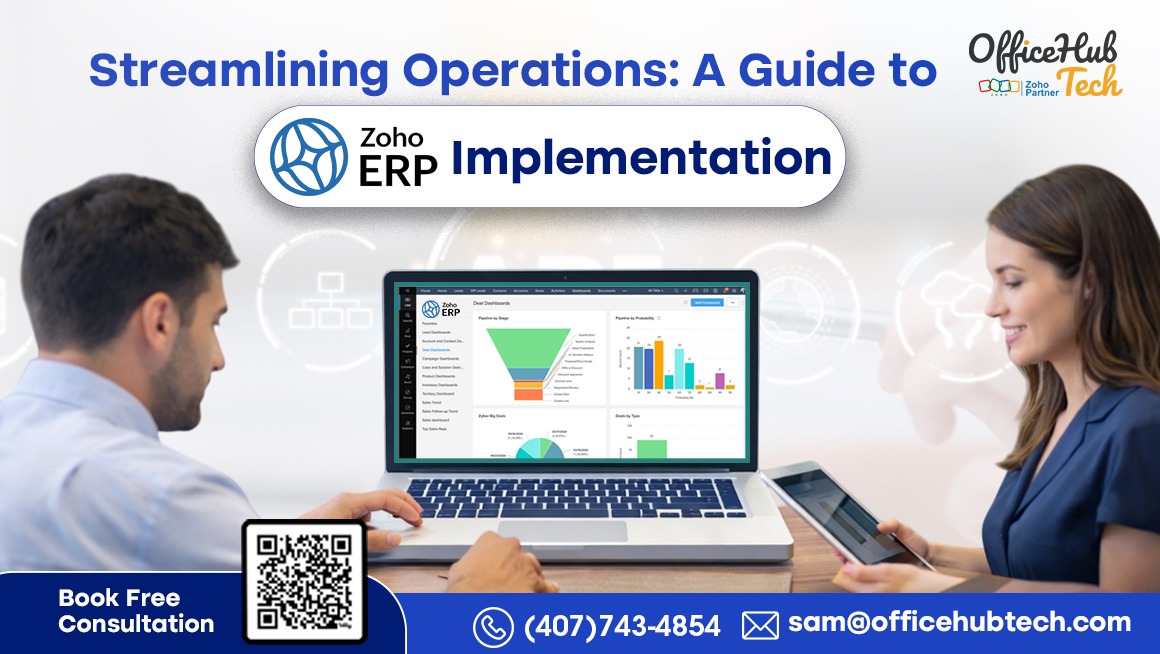
Streamlining Operations: A Guide to Zoho ERP Implementation
Why Operational Streamlining Can No Longer Be Optional
In many growing organizations, operational complexity creeps in quietly. One department uses a standalone accounting tool. Another relies on spreadsheets for procurement. Sales teams operate inside a CRM that never fully speaks to finance. Over time, data fragmentation becomes institutionalized. Reporting slows. Errors multiply. Strategic decisions rely on partial visibility.
Enterprise Resource Planning (ERP) was designed to correct this fragmentation. Modern cloud platforms such as Zoho ERP take this concept further by combining operational control, financial governance, and intelligent automation inside a single digital framework. The objective is not merely digitization. It is structural coherence.
When implemented correctly, Zoho ERP becomes the operational backbone of the enterprise. It aligns financial records with project execution, inventory flows with procurement strategy, and workforce data with payroll compliance. The result is clarity. Processes shorten. Decision-making becomes grounded in evidence rather than approximation.
Operational streamlining is not about software adoption alone. It is about reengineering the enterprise to function as an integrated organism rather than a collection of disconnected departments.
The Structural Foundation of Zoho ERP
Financial Control and Compliance Architecture
Financial management remains the central nervous system of any ERP environment. Zoho ERP integrates tools such as Zoho Books and Zoho Billing to create a unified financial ledger. Accounts payable, receivable, tax computation, and multi-entity consolidation operate within a synchronized accounting structure.
Compliance requirements, including regional tax regulations, digital invoicing mandates, and statutory reporting standards, are embedded directly into transaction workflows. Bank reconciliation can be automated across multiple financial institutions and currencies. Budget tracking becomes visible in real time. Finance teams gain a panoramic view of liquidity, cost centers, and revenue trends without assembling reports from disparate systems.
Such integration reduces reconciliation errors and accelerates financial closing cycles. It also supports stronger audit trails and improved regulatory adherence.
Inventory, Procurement, and Supply Chain Coordination
Inventory misalignment is one of the most expensive operational inefficiencies. Zoho Inventory integrates stock management, vendor procurement, and order fulfillment in a coordinated manner. Purchase orders can trigger automated inventory updates. Reorder thresholds can be configured to prevent stockouts.
Batch tracking, serialized inventory management, and warehouse-level visibility allow organizations to monitor movement across locations. Integration with billing modules ensures that fulfillment and invoicing remain synchronized.
This coordination produces measurable improvements in carrying cost control and procurement transparency.
Workforce and Payroll Governance
Zoho People and Zoho Payroll bring workforce administration into the ERP environment. Attendance tracking, leave management, statutory deductions, and payroll processing are consolidated into one structured framework.
This integration simplifies compliance reporting and reduces manual intervention. It also allows leadership teams to analyze workforce cost structures alongside operational revenue metrics.
Commerce, Billing, and Revenue Lifecycle Management
Revenue processes frequently involve multiple touchpoints: proposal generation, order confirmation, billing, subscription management, and collections. Zoho ERP connects these activities into a coherent lifecycle.
With Zoho CRM integrated into ERP, deals can convert directly into invoices. Subscription billing logic can automate recurring charges. Customer payment data can update financial ledgers instantly. This alignment shortens the order-to-cash cycle and strengthens revenue predictability.
Strategic Preparation Before Implementation
Process Mapping and Operational Diagnostics
ERP implementation begins long before system configuration. Organizations must conduct structured process mapping exercises. Each workflow should be documented in detail, from lead generation to final settlement.
This diagnostic stage identifies inefficiencies, duplication, and unnecessary approvals. It also clarifies which processes require redesign rather than replication. Without this analysis, ERP risks digitizing flawed procedures.
Governance, Ownership, and Change Leadership
Successful implementation requires executive sponsorship and defined ownership. Department heads must agree on performance metrics, system usage protocols, and escalation procedures.
Change management strategies, including communication plans and phased adoption, mitigate resistance. Employees need clarity regarding why the transformation is necessary and how it enhances their daily responsibilities.
Phased Rollout Strategy and Risk Mitigation
Rather than deploying every module simultaneously, many enterprises adopt a phased approach. Finance and CRM integration may launch first, followed by supply chain automation and advanced analytics.
This structured rollout reduces operational shock and provides space for feedback and optimization.
Technical Deployment and System Configuration
Cloud Infrastructure and Security Framework
Zoho ERP operates on a cloud-based infrastructure with encryption protocols, multi-factor authentication, and role-based access controls. Sensitive financial and HR data can be segmented according to user permissions.
Cloud deployment eliminates on-premise server maintenance and enhances scalability.
Data Migration, Cleansing, and Master Data Governance
Migrating from legacy ERP platforms such as SAP, Infor, or Acumatica demands careful planning. Data must be cleansed, standardized, and validated before import.
Master data governance policies prevent duplication and ensure consistent naming conventions. Without disciplined governance, reporting accuracy deteriorates quickly.
Customization with Zoho Creator and Extended Applications
Every enterprise has unique requirements. Zoho Creator enables low-code development of custom applications that extend ERP capabilities. Equipment rental management, warranty tracking, solar project scheduling, or legal case management modules can be built to align with operational specificity.
These custom components integrate directly into the ERP ecosystem without compromising structural integrity.
Enterprise Integrations and Workflow Orchestration
CRM, Finance, and Productivity Integrations
Zoho CRM integration synchronizes pipeline forecasting with financial reporting. QuickBooks connectivity can facilitate hybrid accounting environments. Microsoft Dynamics 365, HubSpot, Pipedrive, and Gmail integrations enable seamless lead and communication tracking.
This unified ecosystem is powered by Zoho 3rd Party Integration, ensuring secure and structured data exchange across external platforms.
This interoperability prevents data silos and enhances transparency across departments.
Industry-Specific and Vertical Application Integrations
Beyond standard CRM and accounting platforms, Zoho ERP supports integration with specialized industry applications and proposal management tools. Through structured API connectivity, project documentation, bills of materials, change orders, and operational data can synchronize directly with ERP modules.
This ensures that approvals, procurement workflows, inventory allocation, and billing milestones update automatically based on real-time business activity—eliminating duplication and improving cross-functional alignment.
API Connectivity, Webhooks, and n8n Automation
Webhooks and REST APIs enable real-time communication between systems. n8n orchestration can automate complex multi-step workflows—such as triggering procurement approvals when inventory falls below threshold or sending milestone notifications to clients.
Such orchestration reduces administrative overhead and enhances operational fluidity.
AI-Powered ERP: From Automation to Intelligence
Zia AI and Predictive Insights
Zia, Zoho’s embedded intelligence engine, plays a critical role in advancing AI ERP capabilities within the enterprise ecosystem. By embedding artificial intelligence directly into ERP workflows, Zia transforms traditional automation into predictive, data-driven intelligence.
It continuously analyzes transactional patterns, financial movements, procurement behavior, and operational metrics to forecast revenue trends, detect anomalies, and identify potential inefficiencies before they escalate. Through contextual recommendations, Zia supports optimized budgeting, improved demand forecasting, and proactive risk mitigation.
As part of a modern AI ERP framework, these predictive insights empower leadership teams to transition from reactive management to anticipatory strategy—enabling faster decisions, stronger financial control, and sustained operational resilience.
AI Agents for Project-Driven Businesses
AI Agents can continuously monitor workflows, track timelines, detect bottlenecks, and dynamically adjust resource allocation based on real-time data. By analyzing operational patterns, these intelligent systems help organizations maintain consistency, reduce delays, and improve overall execution efficiency.
AI logic can also synchronize data across CRM, finance, inventory, and project management modules, ensuring unified information flow and eliminating discrepancies between departments. This level of coordination enhances accuracy, accelerates response times, and supports data-driven decision-making across the enterprise.
Real-Time Analytics and Executive Dashboards
Real-time analytics provide leadership with immediate visibility into critical performance indicators across the organization. Executive dashboards consolidate metrics such as profit margins, resource utilization, vendor performance, revenue trends, and cash flow velocity into a centralized, structured view.
These interactive visualizations transform raw operational data into actionable intelligence, enabling faster strategic decisions, improved forecasting accuracy, and proactive performance management grounded in live, continuously updated information.
Industry-Specific ERP Deployment Models
- Zoho ERP For Manufacturing: Manufacturing enterprises rely on ERP systems for Material Requirements Planning (MRP), bill-of-material (BOM) management, production scheduling, and shop-floor coordination. Integrated modules enable precise demand forecasting, raw material planning, and real-time visibility into production cycles—ensuring operational continuity and cost control.
- Zoho ERP For Retail & Distribution: Retail and distribution businesses benefit from omnichannel inventory synchronization, warehouse management, and logistics coordination. ERP integration connects point-of-sale systems, procurement workflows, and fulfillment operations, enabling accurate stock visibility and improved order accuracy across multiple sales channels.
- Zoho ERP For Solar & Project-Based Industries: Solar companies and project-driven organizations require structured project tracking, milestone-based billing, and regulatory or subsidy compliance monitoring. ERP systems centralize installation schedules, vendor coordination, and financial reconciliation within a unified framework.
- Zoho ERP For Legal & Professional Services: Legal firms leverage ERP-integrated case management, trust accounting compliance, billing automation, and document governance. By aligning financial controls with case workflows, firms maintain regulatory adherence while enhancing operational transparency.
-
Zoho ERP For Nonprofits: Non-profit organizations require structured fund accounting, donor management, grant tracking, and program-based budgeting. Zoho ERP enables transparent financial reporting, multi-fund allocation, regulatory compliance, and impact measurement within a centralized system. Integrated dashboards provide visibility into donations, expenditures, and operational efficiency—ensuring accountability while supporting mission-driven growth.
Adoption, Optimization, and Long-Term Scalability
Successful ERP implementation extends beyond deployment; it requires structured adoption. Training programs should be role-specific and practical. Finance teams must develop proficiency in ledger configuration, compliance controls, and financial reporting structures. Operations managers, on the other hand, need mastery over procurement workflows, inventory controls, and approval hierarchies to ensure process consistency.
Optimization should be continuous rather than episodic. Periodic system audits, KPI reviews, and workflow refinements allow organizations to enhance efficiency over time. Performance metrics evolve as the business matures, and the ERP environment must adapt accordingly.
Scalability is inherent within cloud architecture. As organizations expand into new regions, introduce additional service lines, or increase transaction volumes, ERP configurations can be recalibrated without disruptive infrastructure changes—ensuring sustainable, long-term growth.
Measuring ROI and Business Impact
The return on investment from ERP implementation becomes evident in tangible operational improvements. Organizations typically experience reduced inventory carrying costs through optimized stock management, accelerated billing cycles driven by automation, strengthened cash flow visibility, and a measurable decline in manual data processing.
Beyond cost efficiencies, advanced analytics provide quantitative performance validation. Real-time dashboards and financial intelligence tools enable leadership to track margin improvement, resource utilization, procurement efficiency, and revenue velocity with precision.
ERP success is not abstract. It is reflected in stronger profit margins, improved operational ratios, shorter process cycles, and enhanced organizational agility.
Conclusion
Zoho ERP has positioned itself among the Best Enterprise Resource Planning (ERP) Systems In India by offering an integrated, AI-enhanced, cloud-native framework capable of transforming fragmented operations into cohesive digital ecosystems. Its strength lies not only in modular functionality but in its ability to unify finance, supply chain, HR, CRM, and analytics into a single intelligent architecture that scales with enterprise growth.
Organizations seeking structured implementation, advanced integrations, and AI-powered automation can benefit significantly from partnering with a Top Zoho Consultant, Zoho ERP Developer and Implementation Partner In India, USA, UAE and KSA. Office Hub Tech delivers comprehensive ERP deployment, legacy modernization, AVSI integrations, AI workflow orchestration, and continuous optimization services designed to convert operational complexity into measurable efficiency.
FAQ
Q1. What is Zoho ERP and how does it work?
Ans: Zoho ERP is a unified, cloud-based enterprise resource planning platform that centralizes finance, supply chain, human resources, CRM, and analytics within a single ecosystem. It works by synchronizing data across departments in real time, eliminating silos and enabling coordinated, automated workflows across the organization.
Q2. How long does ERP implementation take?
Ans: Implementation timelines vary based on organizational complexity, data migration requirements, customization scope, and integrations. On average, a structured deployment typically ranges between three to five week, including configuration, testing, and user training.
Q3. What is the cost of ERP implementation?
Ans: ERP implementation costs depend on selected modules, customization depth, integration requirements, and user volume. Cloud-based ERP significantly reduces infrastructure and maintenance expenses compared to traditional on-premise systems.
Q4. Can Zoho ERP integrate with legacy ERP systems?
Ans: Yes. Zoho ERP supports integration with legacy systems through APIs, webhooks, and middleware orchestration tools such as n8n. This enables phased migration, hybrid deployments, and seamless data synchronization across platforms.
Q5. Is Zoho ERP suitable for manufacturing businesses?
Ans: Yes. Zoho ERP supports manufacturing operations through MRP functionality, bill-of-material management, batch tracking, procurement coordination, and production planning workflows designed to improve efficiency and cost control.
Q6. What industries benefit most from Zoho ERP?
Ans: Industries such as manufacturing, AVSI (Audio-Visual System Integration), retail, distribution, solar, legal, healthcare, and professional services benefit significantly from its modular and scalable architecture.
Q7. What is AI ERP?
Ans: AI ERP refers to the integration of artificial intelligence within ERP systems to enable predictive analytics, anomaly detection, automated decision support, and intelligent workflow recommendations.
Q8. How does Zoho ERP support supply chain management?
Ans: Zoho ERP streamlines supply chain management through integrated inventory control, vendor performance tracking, demand forecasting, procurement automation, and logistics monitoring—all within a centralized system.
Q9. What are ERP implementation best practices?
Ans: Best practices include conducting detailed process audits, adopting a phased deployment approach, ensuring stakeholder alignment, establishing strong data governance policies, and providing structured, role-based training programs.
Q10. Why choose a Zoho ERP implementation partner?
Ans: A specialized implementation partner ensures structured deployment, precise integrations, regulatory compliance, performance optimization, and long-term scalability aligned with strategic business objectives.