
ERP Has Shifted from Software to Strategy
As organizations approach 2026, ERP is no longer a background system quietly managing finance or inventory. ERP has become a strategic platform that directly impacts speed, resilience, and competitiveness. Businesses today operate in an environment defined by real-time customer expectations, remote and hybrid workforces, global supply chains, and continuous disruption.
In this environment, slow systems create slow businesses.
Yet many organizations still depend on ERP platforms built for an era of predictable workflows, centralized teams, and limited integrations. These legacy systems were designed to record transactions—not to orchestrate operations or drive intelligent decision-making. As a result, they struggle with modern demands such as real-time automation, cross-system coordination, and AI-driven insights.
Modern ERP architecture is not a cosmetic upgrade. It represents a fundamental rethinking of how enterprise systems are designed, extended, and governed. By 2026, the gap between businesses running intelligent ERP ecosystems and those relying on static ERP systems will be impossible to ignore.
The Evolution of ERP: From Systems of Record to Systems of Action
Historically, ERP systems functioned as systems of record. They captured data after business events occurred—sales closed, invoices issued, inventory received. Reporting was backward-looking, and decision-making relied heavily on human interpretation.
Modern ERP platforms are evolving into systems of action.
Instead of waiting for users to review reports, modern ERP ecosystems:
- Respond to events in real time
- Coordinate workflows across multiple systems
- Trigger actions automatically
- Provide predictive and prescriptive insights
This shift requires a new architectural model—one that goes far beyond traditional monolithic ERP design.
Modern ERP Architecture in 2026: A Layered Enterprise Platform
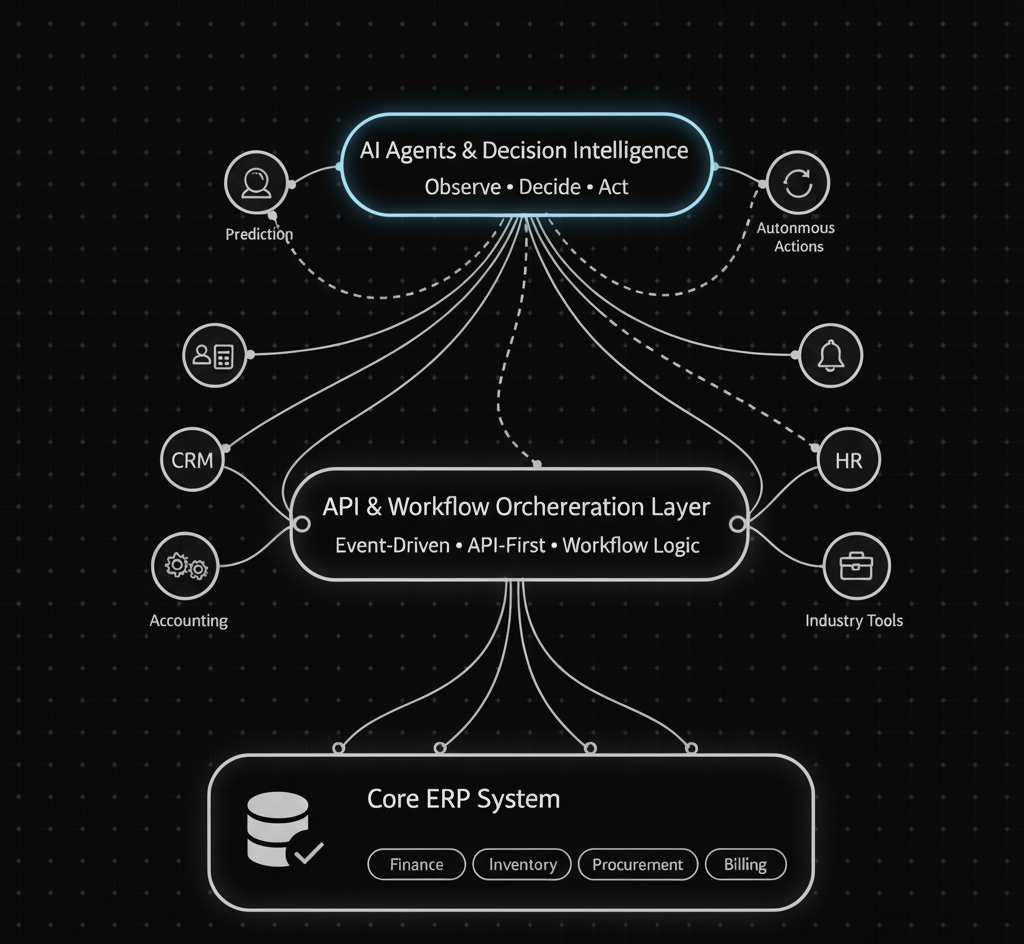
The most effective way to understand modern ERP architecture is as a layered platform, where each layer plays a distinct role.
Core ERP Layer – The Transactional Foundation
At the foundation is the core ERP layer, typically cloud-native and modular. Finance, procurement, inventory, projects, manufacturing, and reporting operate as independent yet connected modules. This modularity allows organizations to scale, replace, or enhance functionality without destabilizing the entire system.
Cloud-first deployment ensures:
- High availability and performance
- Lower infrastructure and maintenance costs
- Continuous updates and security improvements
- Anywhere access for distributed teams
However, core ERP alone is no longer sufficient to manage enterprise complexity.
Integration Layer – Connecting the Enterprise Ecosystem
Modern businesses rely on dozens of applications: CRM, HR, accounting, industry tools, eCommerce platforms, logistics systems, and more. ERP must connect seamlessly with all of them.
Modern ERP platforms adopt API-first architecture, enabling secure and scalable integrations. APIs allow data to flow between systems, ensuring consistency across departments and eliminating manual data entry.
But as the number of systems grows, simple integrations are not enough. This is where many ERP initiatives fail.
API Orchestration: The Missing Link in Most ERP Systems
Traditional ERP integrations rely heavily on point-to-point connections. While functional at small scale, these integrations quickly become fragile and difficult to maintain as systems grow. Each new connection increases dependency, complexity, and risk.
API orchestration introduces a more resilient approach. Instead of systems talking directly to each other, an orchestration layer coordinates workflows, manages sequencing, transforms data, and enforces business logic across multiple applications.
Platforms like n8n serve as powerful orchestration engines within modern ERP ecosystems. They enable event-driven automation, advanced conditional logic, retries, monitoring, and exception handling—capabilities that native ERP automation alone cannot deliver.
With orchestration in place:
- ERP workflows become event-driven rather than manual
- Systems remain loosely coupled and replaceable
- Data flows in near real time across the enterprise
- Automation scales without creating technical debt
In 2026, ERP systems without orchestration are not future-ready—they are simply integrated silos.
The ERP Intelligence Layer: Where AI Agents Transform Operations
Above orchestration sits the most transformative component of modern ERP architecture: the ERP Intelligence Layer.
This layer is powered by AI agents—autonomous digital entities that observe data across ERP, CRM, finance, and operational systems, interpret context, and take action. Unlike traditional rule-based automation, AI agents operate continuously and adaptively.
AI agents embedded into ERP ecosystems can:
- Analyze sales pipelines and trigger proactive follow-ups
- Detect project risks by monitoring budgets, timelines, and dependencies
- Forecast inventory demand and initiate procurement actions
- Generate real-time client updates without manual input
- Recommend next-best actions for finance, operations, and leadership
This intelligence layer transforms ERP from a passive system of record into an active system of execution. ERP no longer waits for humans to act—it assists, recommends, and in some cases, acts autonomously.
By 2026, organizations that fail to introduce AI agents into their ERP stack will find themselves reacting to problems rather than anticipating them.
Low-Code Platforms: Enabling Continuous ERP Evolution
Low-code platforms are a critical enabler of modern ERP architecture. They bridge the gap between rigid enterprise systems and the need for rapid innovation.
With low-code development, organizations can:
- Build custom ERP extensions quickly
- Adapt workflows as business needs evolve
- Create industry-specific applications
- Reduce dependency on specialized development teams
Zoho Creator plays a central role in ERP modernization by providing a scalable, integration-friendly platform for extending ERP systems. Businesses can design custom modules, embed automation, and integrate AI-driven logic—all without disrupting the ERP core.
Low-code platforms ensure ERP systems remain adaptable long after implementation, making them a strategic asset rather than a fixed investment.
ERP Modernization: Extension First, Replacement When Necessary
ERP modernization does not always require full system replacement. In many cases, replacing a legacy ERP introduces unnecessary risk, cost, and operational disruption.
A smarter approach is Legacy ERP modernization through extension. By layering low-code applications, orchestration, and AI agents around existing ERP platforms, organizations can modernize incrementally while preserving core functionality that still delivers value.
This phased strategy allows businesses to:
- Improve user experience without reimplementation
- Introduce automation and intelligence gradually
- Modernize high-impact processes first
- Maintain business continuity during transformation
Full ERP replacement becomes a strategic choice rather than a forced response to system limitations.
Automation and Integration: The Foundation of Scalable ERP
Automation and integration are foundational pillars of modern ERP ecosystems. Manual processes slow operations, introduce errors, and prevent scalability.
Modern ERP platforms automate:
- Approvals and notifications
- Data synchronization
- Compliance workflows
- Reporting and dashboards
At the same time, API-driven integration ensures data consistency across systems. ERP, CRM, finance, HR, and operational tools function as a connected ecosystem rather than isolated platforms.
When combined with orchestration and AI agents, automation becomes intelligent—capable of adjusting to real-world conditions rather than following static rules.
Real-World Impact Across Industries
Modern ERP architecture delivers tangible value across industries.
- Manufacturing organizations gain predictive visibility into production bottlenecks, quality issues, and inventory risks.
- Retail and distribution businesses optimize supply chains using real-time data and AI-driven demand forecasting.
- Service-based organizations streamline project governance, billing, and resource allocation through intelligent automation.
- System integrators and construction firms coordinate projects, procurement, and service operations through orchestrated ERP workflows.
In each case, success is driven not by ERP alone—but by the intelligence layered on top of it.
Traditional ERP vs Intelligent ERP: A Strategic Comparison
Traditional Legacy ERP systems Like Like SAP, Infor, and Acumatica prioritize stability and control. They rely on rigid workflows, manual oversight, and costly customization. While reliable, they struggle to adapt.
Modern intelligent ERP platforms prioritize agility. Cloud-native deployment, modular design, API orchestration, low-code extensibility, and AI agents enable ERP systems to evolve continuously.
The result is:
- Faster implementation
- Lower total cost of ownership
- Improved operational efficiency
- Stronger alignment between technology and business strategy
Building Intelligent ERP Ecosystems with OfficeHub Tech
As businesses move toward 2026, ERP systems can no longer remain static platforms built only for transaction processing. To stay competitive, organizations need ERP ecosystems that are intelligent, orchestrated, and capable of autonomous execution—systems that continuously adapt to change, scale with growth, and actively support decision-making across the enterprise.
OfficeHub Tech specializes in delivering exactly this next generation of ERP architecture. Recognized as the Best Legacy ERP Modernization and Extension Services Provider in the US, India, UAE and Saudi Arabia OfficeHub Tech helps organizations transform rigid, outdated ERP environments into modern, future-ready platforms. By combining Zoho’s cloud and low-code ecosystem, n8n-powered API orchestration, and AI-driven agents, OfficeHub Tech designs ERP systems that go far beyond basic automation. These intelligent ERP ecosystems coordinate workflows across multiple applications, eliminate data silos, and introduce real-time intelligence that enables businesses to move faster with confidence.
Rather than forcing risky full ERP replacements, OfficeHub Tech takes a strategic, extension-first approach—modernizing existing systems incrementally while preserving business continuity. The result is an ERP platform that doesn’t just record what happened, but actively helps decide what should happen next.
From legacy ERP modernization and low-code ERP extensions to enterprise orchestration and AI-powered automation, OfficeHub Tech empowers organizations to move beyond rigid systems and build ERP platforms that think, act, and scale alongside the business—today and well into the future.
FAQs
Q: What defines modern ERP architecture in 2026?
Ans: Modern ERP architecture is modular, cloud-native, API-orchestrated, and enhanced with AI agents that enable intelligent automation and autonomous execution.
Q: Why is API orchestration essential for ERP systems?
Ans: API orchestration ensures scalable, resilient integrations and enables complex workflows across multiple systems without tight coupling.
Q: How do AI agents improve ERP operations?
Ans: AI agents move ERP beyond automation into proactive decision-making, predictive insights, and autonomous action.
Q: Is ERP modernization better than full replacement?
Ans: In many cases, yes. Modernization through extension reduces risk, cost, and disruption while delivering faster value.
Q: How does OfficeHub Tech support ERP transformation?
Ans: OfficeHub Tech delivers end-to-end ERP modernization using low-code platforms, API orchestration, and AI agents to build future-ready ERP ecosystems.