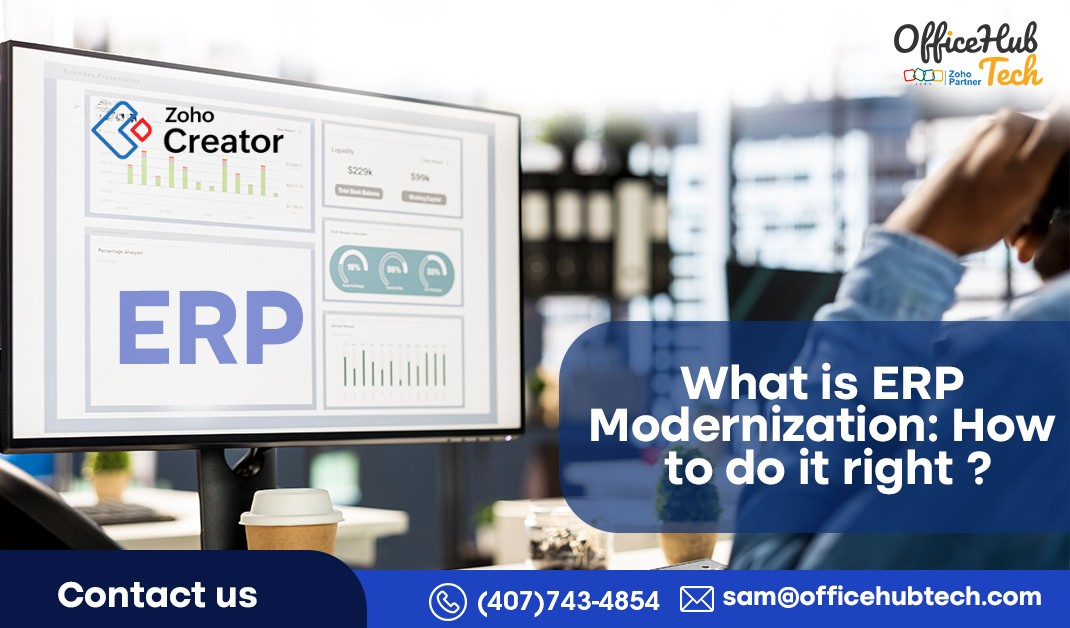
What Is ERP Modernization — And How to Do It Right?
For many organizations, the systems that manage their finance, procurement, inventory, HR, logistics, and field operations were built to support a very different era of business. They were developed at a time when workflows were stable, integrations were rare, data volumes were modest, and competitive pressures were predictable. Those systems formed the backbone of the enterprise for years. Yet, as industries accelerate into a world shaped by automation, API ecosystems, mobile workforces, AI-driven forecasting, and constantly shifting market pressures, those same legacy ERPs have quietly become one of the biggest constraints to growth.
This evolution has sparked a global shift toward ERP Legacy Modernization. Organizations across manufacturing, distribution, AV system integration, healthcare, retail, construction, and professional services are rethinking the architectural foundation of their systems. Modernization is no longer simply an upgrade; it is a strategic re-engineering of business infrastructure to support speed, scalability, real-time decision intelligence, and continuous innovation.
Research reflects this urgency. Analysts note that nearly seventy percent of enterprises now consider legacy systems a direct barrier to innovation. Maintenance costs continue to increase as older technologies become harder to support. Integration challenges slow down digital initiatives. And as modern cloud platforms evolve rapidly, the gap between what businesses need and what their ERP can deliver grows wider each year.
ERP modernization has become the practical response to this widening gap. But it is a process that requires clarity, architectural understanding, and strategic discipline.
Understanding What ERP Modernization Really Means
ERP modernization involves replacing or transforming outdated systems so they can operate with modern performance standards, integrate with contemporary platforms, and support data-driven automation. This transformation may take different forms depending on an organization’s existing architecture.
Many companies still operate on on-premises ERPs such as Infor, Acumatica, SAP ECC, Epicor, and older Oracle-based systems — platforms originally designed long before cloud ecosystems, mobility requirements, modern APIs, and AI-driven automation became standard. These systems often form the core modernization challenge, as their architecture limits speed, connectivity, and scalability.
Some enterprises keep parts of their ERP but modernize critical workflows. Others extend the system using low-code platforms such as Zoho Creator to add mobile apps, automation frameworks, or modern reporting layers. And in cases where the system has reached its technical limits, businesses choose to rebuild or replace it entirely with a cloud-powered alternative.
Technically, modernization means moving away from monolithic architectures, rigid business logic, outdated SQL structures, and non-extensible modules. Modern environments operate on flexible API-driven frameworks that can communicate with platforms like Microsoft Dynamics 365, HubSpot, QuickBooks, Magento, G-Suite, D-Tools, and hundreds of other applications. They support AI capabilities, mobile access, modular workflows, and intelligent automation — delivering the agility that older ERP environments cannot.
ERP modernization is therefore not simply a technology project—it is an architectural redesign of the enterprise’s operational nervous system.
Why Modernization Has Become a Non-Negotiable Priority
The question today is not why modernization is needed—it is why organizations waited so long. In past years, many businesses tolerated limitations because legacy systems “still worked.” But working and enabling growth are no longer the same.
Legacy systems struggle because they were not designed for real-time analytics or multi-application connectivity. They lack the ability to ingest large volumes of data, automate cross-department workflows, or run cloud-native workloads. They cannot adapt quickly to new product lines, additional locations, new service models, or sudden changes in supply chain dynamics. In many cases, they cannot even be safely or affordably upgraded due to outdated coding languages and shrinking developer availability.
Meanwhile, modern cloud ERP environments offer predictive intelligence, embedded AI assistants, bi-directional integrations, advanced data modeling, low-code automation engines, and centralized control systems. These capabilities do not simply make operations more efficient—they redefine what operational excellence can look like.
Every industry is now being reshaped by data speed, system connectivity, and operational agility. Businesses that continue operating on outdated ERP infrastructure eventually reach a point where the system becomes more expensive to maintain than to modernize.
How Modernization Actually Happens: A Technical Perspective
While every modernization journey is different, the technical approach follows a clear logic. The first step involves examining the ERP’s core limitations—where workflows break down, where data visibility is insufficient, where performance slows, and where integrations are impossible. This diagnostic step reveals which parts of the system should be modernized, extended, rebuilt, or fully replaced.
In many cases, organizations begin by modernizing or extending high-impact operational areas. For example, a company may keep its legacy financial module but modernize procurement, inventory, or service operations using Zoho Creator. The ability to design applications with custom logic, clean UI, automation, and mobile accessibility allows businesses to revitalize old processes without rewriting the ERP from scratch.
In other scenarios, modernization requires rebuilding outdated modules entirely. When workflows are tightly coupled or dependent on outdated code, rebuilding them on a cloud-based platform becomes more efficient than attempting to salvage them. Rebuilds often focus on areas such as supply chain management, production, quality checks, or field operations—functions where speed and accuracy are critical.
Full replacement becomes the preferred approach when the ERP is no longer structurally viable. In such cases, organizations adopt modern ERP frameworks built using Zoho One or Zoho Creator, integrating them with financial systems like Zoho Books or QuickBooks, and connecting them with third-party tools across CRM, logistics, e-commerce, HR, and analytics. This ensures that the new ERP is unified, modular, scalable, and future-ready.
In all cases, modernization requires rigorous data migration planning, workflow remapping, API design, security alignment, and phased rollouts to protect business continuity.
Practical Industry Use Cases: Where Modernization Delivers Real Impact
ERP modernization is best understood through practical examples—real transformations taking place across industries today.
In manufacturing, many organizations still run legacy MRP modules that cannot support real-time machine data or predictive maintenance. By modernizing plant-floor operations through Zoho Creator apps that integrate with sensors, production schedules, and quality workflows, manufacturers achieve a dramatic improvement in throughput, traceability, and operational control. What was once a static ERP becomes a dynamic ecosystem capable of decision automation.
In retail and e-commerce, legacy ERPs often fail to synchronize inventory across online platforms, physical stores, and warehouses quickly enough. Modernization efforts integrate platforms like Magento and Shopify directly with cloud-based inventory and fulfillment systems. Businesses gain unified stock visibility, automated reordering, and real-time financial reconciliation that eliminates costly operational delays.
AV and System Integration firms face their own unique challenges. Many rely on individual tools like D-Tools for project design, QuickBooks for finance, spreadsheets for scheduling, and outdated ERPs for materials and labor. Modernizing their ERP by building a central Zoho Creator-based system allows AV companies to unify project workflows, track equipment movement, manage rentals, predict procurement delays, and monitor labor allocation with far greater precision.
In the healthcare sector, modernization replaces paper-heavy administrative workflows with digital applications for patient intake, claims processing, appointment scheduling, and compliance documentation. Integrated dashboards provide real-time insight into operations, greatly reducing administrative overhead.
Construction companies modernize their ERPs to manage subcontractors, RFIs, material requisitions, and progress reporting from the field. With Zoho Creator, these organizations build digital site-management frameworks that feed back into their ERP systems, improving transparency and accountability throughout the project lifecycle.
Across every industry, modernization eliminates manual friction, strengthens integration capability, and unlocks intelligent automation.
Why Zoho Creator Has Become a Modernization Powerhouse
Zoho Creator stands at the center of many successful modernization initiatives because it blends enterprise-grade architecture with rapid low-code development. It allows organizations to model complex workflows, design ERP-grade applications, integrate legacy systems using APIs, and build cloud-native extensions that operate securely and efficiently.
Creator’s advantage lies in its ability to replicate any ERP process at scale while remaining flexible enough to evolve with the business. It supports advanced business rules, custom logic, mobile accessibility, and role-based controls. Integrations with Zoho’s ecosystem—CRM, Books, Inventory, Analytics, Projects—create a unified ERP environment. When combined with external connections to Dynamics 365, HubSpot, QuickBooks, Magento, D-Tools, or custom line-of-business systems, Creator becomes the modernization layer that bridges all systems into one cohesive architecture.
Most importantly, it avoids the need for high-cost custom development, making modernization achievable for organizations of any size.
OfficeHub Tech: Engineering Modern ERP Environments with Precision
Modernizing an ERP requires architectural experience, platform expertise, and a strong understanding of how operations function across industries. OfficeHub Tech serves this role as a specialized transformation partner. As the Top Zoho AI Implementation and Integration Partner in the US, India, and UAE, the company helps organizations modernize their ERP systems using a structured, scalable, and industry-proven methodology.
OfficeHub Tech supports every stage of modernization—from assessing legacy systems and designing new ERP layers to rebuilding outdated modules, extending capabilities through Zoho Creator, integrating mission-critical systems, and executing large-scale migration and deployment work. The firm provides ERP Legacy Modernization, ERP Extension, and ERP Rebuild or Upgrade Services, each tailored to the organization’s operational reality.
Whether a business needs modern automation layers, industry-specific workflows, a complete ERP rebuild, or an end-to-end digital transformation, OfficeHub Tech accelerates the transition with minimal disruption and maximum long-term value.
Move Beyond Legacy Systems. Modernize with Confidence.
ERP modernization is no longer optional—it is a foundational investment in long-term performance and scalability. OfficeHub Tech helps organizations modernize legacy ERP systems using Zoho Creator, Zoho One, and enterprise integrations that connect data, automate workflows, and unify operations in real time.
As the Best Zoho Creator Developer, and a specialized provider of Customized ERP Solution, OfficeHub Tech ensures your modernization journey is executed with precision, security, and zero complexity.
FAQs
Q1. What makes ERP modernization different from a regular upgrade?
Ans: Upgrades refresh software versions; modernization redesigns the ERP architecture to align with today’s scalability, automation, and integration needs.
Q2. Can a legacy system integrate with modern cloud tools?
Ans: Yes, with the right API strategy, even older systems can be extended using modern low-code platforms like Zoho Creator.
Q3. Is it better to rebuild or replace an outdated ERP?
Ans: The answer depends on how much of the existing system can be salvaged. If core modules are stable but slow, rebuild. If the system is structurally obsolete, replace.
Q4. How long does modernization typically take?
Ans: Most projects range from six to twelve months depending on data complexity, cross-system dependencies, and internal adoption needs.
Q5. Does modernization reduce operating costs?
Ans: Yes. Modern ERPs reduce maintenance expenses, eliminate manual processes, and consolidate multiple tools into unified systems.