Zoho Creator for Legacy ERP Extension Explained
Why Legacy ERP Extension Is Becoming a Business Priority
Modern businesses are operating in an environment where operational speed, integration flexibility, automation, cloud accessibility, and real-time visibility are becoming critical for long-term scalability. However, many organizations still depend heavily on legacy ERP systems that were originally designed years ago for traditional operational environments. These ERP systems continue to manage finance, procurement, inventory, manufacturing, and operational transactions effectively, but they often struggle to support today’s digital business requirements.
Many businesses across manufacturing, logistics, retail, healthcare, construction, and distribution industries continue using ERP systems such as SAP ECC, Oracle E-Business Suite, Microsoft Dynamics NAV/AX, Sage ERP, Epicor ERP, Infor ERP, and various custom-built ERP systems. The primary reason is simple: these systems are deeply integrated into business operations and replacing them completely introduces significant operational risk, infrastructure disruption, and migration complexity.
The challenge is that legacy ERP environments are no longer aligned with modern operational expectations. Businesses today require mobile access, workflow automation, API-driven integrations, AI readiness, cloud connectivity, and faster reporting systems. Traditional ERP platforms often lack the flexibility needed to support these operational demands efficiently.
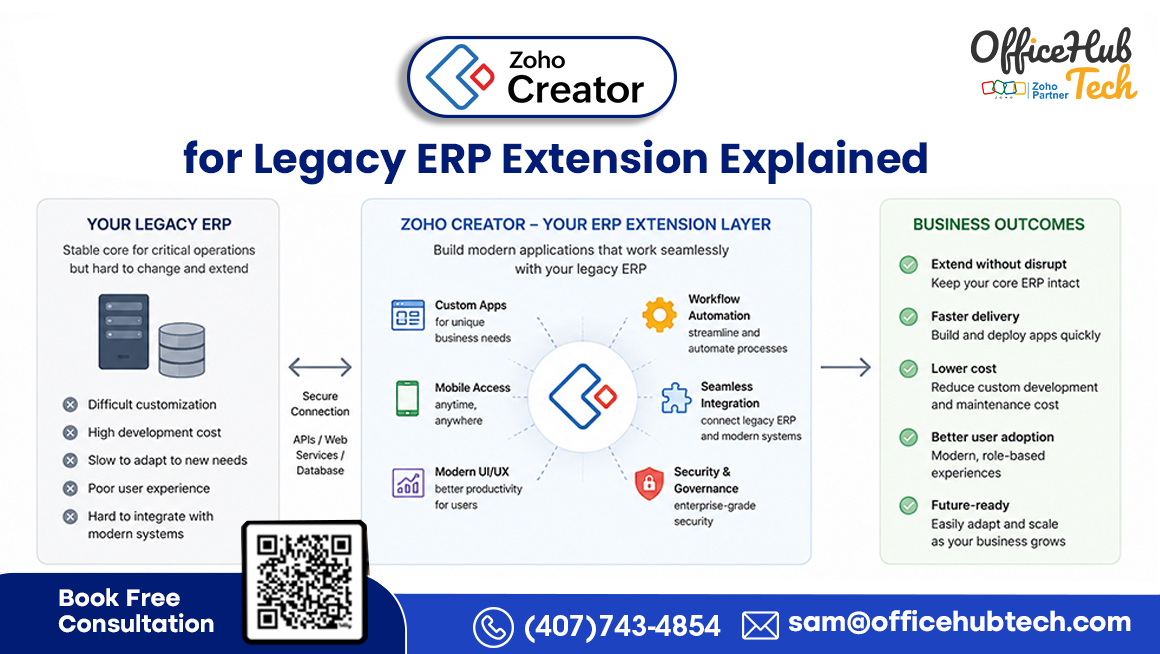
This is where Legacy ERP System Extension on Zoho Creator becomes highly important. Instead of replacing ERP systems completely, businesses can extend ERP capabilities externally using low-code applications, workflow automation, dashboards, mobile apps, integrations, and operational portals.
In this guide, we will explain how Zoho Creator technically extends legacy ERP systems, how ERP extension architecture works, implementation timelines, workflow automation strategies, integration methods, scalability planning, modernization differences, and the future of low-code ERP ecosystems.
UNDERSTANDING LEGACY ERP EXTENSION
What Is Legacy ERP Extension and Why Businesses Are Moving Toward It
Legacy ERP Extension refers to the process of improving and expanding ERP operational capabilities without replacing the ERP core infrastructure itself. Instead of rebuilding the entire ERP environment, businesses extend workflows, automation, reporting systems, dashboards, integrations, and mobile applications externally while allowing the ERP system to continue handling core transactional processing.
This strategy has become increasingly popular because businesses no longer want high-risk “replace everything” ERP modernization projects. Traditional ERP replacement often involves long implementation timelines, expensive migration efforts, retraining complexity, operational disruption, and major infrastructure transformation. Many businesses prefer preserving stable ERP systems while modernizing operational layers separately.
The operational layer and transactional layer now serve different purposes in modern ERP ecosystems. The ERP transactional layer manages finance, inventory, procurement, and business-critical data processing. The operational extension layer built using Zoho Creator handles workflow automation, user interfaces, mobile operations, approvals, dashboards, and integration-driven operational workflows.
Legacy ERP systems still exist widely because businesses have invested heavily in ERP infrastructure over many years. These systems are deeply connected to internal operations, vendor relationships, compliance processes, inventory systems, and business reporting structures. In many industries, ERP customization is highly industry-specific, making complete replacement difficult.
Businesses are therefore shifting toward incremental ERP transformation strategies. Instead of large monolithic modernization projects, organizations are adopting modular operational ecosystems where low-code ERP extension improves agility without disrupting stable ERP infrastructure.
This API-driven operational architecture allows businesses to modernize continuously while reducing transformation risk and maintaining operational continuity.
Legacy ERP Extension vs Legacy ERP Modernization — What Is the Difference?
Although Legacy ERP Extension and ERP Modernization are often discussed together, they represent two very different business transformation strategies. ERP Modernization focuses on transforming the ERP system itself. This usually involves rebuilding ERP architecture, upgrading infrastructure, migrating to cloud ERP platforms, restructuring databases, or completely replacing existing ERP software. The primary goal of modernization is to create a new ERP environment capable of supporting future business operations. While this approach can improve long-term scalability and technology readiness, it often requires large investments, long implementation timelines, complex data migration, and significant operational disruption.
Legacy ERP Extension follows a more practical and lower-risk approach. Instead of replacing the ERP core, businesses keep the existing ERP system stable and extend operational capabilities externally using platforms like Zoho Creator. Organizations add workflow automation, mobile applications, dashboards, reporting systems, API integrations, approval workflows, and operational portals around the ERP environment without disturbing core transactional processing. This allows businesses to modernize operations faster while preserving stable ERP infrastructure.
Most businesses choose ERP Extension when their ERP system still works reliably but operational flexibility, automation capability, integration readiness, and reporting visibility are limited. Many organizations also combine both approaches by using ERP Extension as the first phase of long-term ERP Modernization. This phased strategy reduces migration risk, improves operational continuity, and allows businesses to modernize incrementally instead of executing a large-scale ERP replacement project all at once.
HOW ZOHO CREATOR HELPS IN LEGACY ERP EXTENSION
Why Zoho Creator Is Becoming a Preferred Platform for Legacy ERP Extension
-
Faster ERP Modernization Without Heavy Customization:
Traditional ERP customization projects are often slow, expensive, and dependent on ERP vendors or specialized development teams. Even small workflow modifications may require long development cycles, testing processes, and deployment coordination. This limits operational agility and delays digital transformation initiatives for businesses relying on legacy ERP systems.
-
Low-Code Development Improves Operational Flexibility:
Zoho Creator helps businesses modernize workflows through low-code architecture that simplifies application development, automation, and system integration. Organizations can rapidly build operational applications, automate approvals, create dashboards, and connect multiple business systems without rebuilding ERP infrastructure entirely. This allows businesses to improve operational efficiency while reducing development complexity.
-
Businesses Need Faster and Scalable ERP Extension:
Modern organizations increasingly require faster operational modernization, easier workflow customization, rapid deployment cycles, better integration flexibility, and mobile accessibility across departments. Zoho Creator supports these requirements through workflow automation systems, mobile operational applications, API-driven integrations, real-time reporting dashboards, and cloud-ready operational architecture designed for scalable ERP extension environments.
-
Incremental Modernization Reduces Business Risk:
Businesses also prefer Zoho Creator because ERP extension projects become more manageable and scalable over time. Organizations can modernize operational workflows incrementally instead of executing large-scale ERP replacement projects simultaneously. This improves operational continuity, accelerates adoption, reduces transformation risk, and creates a flexible foundation for future-ready ERP modernization strategies.
How Zoho Creator Technically Extends Legacy ERP Systems
ERP Extension Architecture
Zoho Creator functions as an operational extension layer built around existing ERP infrastructure without replacing the ERP database or transactional engine. In most ERP extension environments, the ERP system continues managing finance, procurement, inventory, compliance-sensitive data, and core business transactions, while Zoho Creator handles workflow automation, operational applications, dashboards, approvals, and mobile workflows. Middleware platforms often act as orchestration layers that manage communication between ERP systems and external operational applications.
Integration & Synchronization Framework
Businesses use multiple integration approaches depending on ERP architecture and operational requirements. Modern ERP environments commonly use REST APIs for real-time communication, while older systems may rely on SOAP APIs, database connectors, CSV/XML synchronization, webhooks, or middleware integration platforms. Some organizations implement real-time synchronization for instant operational visibility, whereas others use scheduled synchronization models to reduce ERP processing load and improve infrastructure stability.
Security & Governance Structure
Security and governance remain critical during Legacy ERP Extension projects. Businesses typically implement role-based access control, API authentication standards, audit tracking systems, secure integration policies, and centralized data governance frameworks to maintain operational security and controlled ERP accessibility. As ERP ecosystems continue evolving toward API-first and automation-driven architecture, low-code operational extension layers are becoming essential for scalable modernization strategies.
WHAT BUSINESSES ACTUALLY EXTEND USING ZOHO CREATOR
Key Business Processes Commonly Extended Outside Legacy ERP Systems
Businesses extending legacy ERP systems usually focus on operational workflows that require greater flexibility, automation, mobility, and reporting visibility. Instead of rebuilding every ERP function externally, organizations strategically modernize high-impact operational areas using Zoho Creator.
Workflow automation is one of the most commonly extended operational areas. Businesses frequently automate:
- Procurement approvals
- Purchase request systems
- Vendor onboarding workflows
- Service request approvals
- Internal operational escalations
Operational visibility systems are another major extension priority. Many legacy ERP systems provide limited dashboard capabilities or delayed reporting visibility. Businesses therefore build:
- Executive dashboards
- Real-time KPI monitoring systems
- Cross-department reporting applications
- Operational analytics environments
Mobile and field operations represent another major extension category. Traditional ERP systems were not designed for mobile-first operational environments. Businesses commonly develop:
- Technician workflow apps
- Delivery tracking systems
- Warehouse operation tools
- Field service management applications
- Mobile inspection workflows
Customer and vendor operational systems are also frequently extended externally. Businesses create:
- Vendor self-service portals
- Customer request management systems
- Support ticket workflows
- Service coordination platforms
Department-level operational apps are becoming increasingly common as well. HR workflows, inventory visibility systems, maintenance operations, compliance tracking, and project coordination apps are frequently developed using Zoho Creator.
The primary objective of ERP extension is not ERP duplication. Instead, businesses strategically improve operational agility while preserving stable ERP transactional infrastructure.
How Long Does Legacy ERP Extension Take?
One of the biggest advantages of using Zoho Creator for Legacy ERP Extension is significantly faster deployment compared to full ERP replacement projects. However, implementation timelines depend heavily on technical complexity, workflow scope, integration requirements, and ERP readiness.
Several factors directly affect ERP extension timelines:
- ERP architecture complexity
- API availability
- Existing customizations
- Data structure quality
- Workflow dependencies
- Number of integrations
Most ERP extension projects begin with ERP assessment and operational analysis. Businesses evaluate ERP limitations, workflow bottlenecks, API readiness, synchronization requirements, and modernization priorities. This phase usually takes one to two weeks.
Architecture planning generally requires one to three weeks depending on integration complexity and middleware requirements. Integration setup often takes two to four weeks based on ERP compatibility and synchronization strategy.
Workflow development timelines vary significantly depending on operational complexity. Smaller workflow automation systems may require only a few weeks, while enterprise-scale operational ecosystems may require several months.
Typical ERP extension timelines often follow this structure:
| Phase | Estimated Timeline |
| ERP Assessment | 1–2 Weeks |
| Architecture Planning | 1–3 Weeks |
| Integration Setup | 2–4 Weeks |
| Workflow Development | 3–8 Weeks |
| Testing & Validation | 1–3 Weeks |
| Rollout & Optimization | Ongoing |
Low-code architecture significantly reduces deployment time because businesses can rapidly develop interfaces, automate workflows, configure dashboards, and deploy integrations faster than traditional software development approaches.
Unlike ERP replacement projects that may continue for years, ERP extension allows businesses to modernize incrementally while maintaining operational continuity throughout implementation.
Important Technical Factors Businesses Must Evaluate Before ERP Extension
Successful Legacy ERP Extension projects require strong technical planning before development begins. Businesses must carefully evaluate ERP readiness, integration architecture, scalability strategy, security frameworks, and operational dependencies to ensure long-term stability.
The first step in any Legacy ERP Extension project is conducting a detailed ERP readiness assessment. Businesses must evaluate API support availability, database accessibility, existing ERP customizations, infrastructure condition, and current ERP performance limitations before planning integrations or workflow extensions. Many older ERP environments were not originally designed for modern API-driven ecosystems, which means organizations may require middleware platforms or custom integration layers to establish stable communication between systems.
Integration architecture planning is equally important because businesses need to define how operational data will move between the ERP system and external applications. This includes evaluating real-time synchronization requirements, scheduled synchronization models, middleware orchestration needs, API rate limitations, and workflow dependencies across departments. Without proper integration planning, organizations may experience data inconsistencies, operational instability, synchronization conflicts, and inaccurate reporting across connected systems.
Scalability planning is equally important. Many businesses initially extend only a few workflows but later expand ERP extension initiatives across multiple departments and operational systems. Organizations therefore need modular architecture capable of supporting long-term growth.
Security and compliance considerations are becoming increasingly important as businesses connect ERP systems with cloud applications and external operational platforms. Businesses must establish:
- Role-based user permissions
- API authentication standards
- Secure external access policies
- Audit logging frameworks
- Compliance governance structures
Workflow standardization is another critical factor. Many businesses attempt to automate inefficient processes without redesigning operational logic first. Successful ERP extension projects focus on process optimization before automation deployment.
Businesses that prioritize technical governance and modular architecture are significantly more successful in building scalable ERP extension ecosystems.
Evaluating ERP Extensions Through Strategy, Cost, Risk & ROI
Legacy ERP Extension using Zoho Creator is not just a technical approach but a business-aligned transformation strategy that balances modernization with operational stability.
Strategy: From a strategy perspective, businesses adopt a phased, modular approach where ERP systems remain intact while operational capabilities are extended through low-code applications, APIs, and automation layers. This reduces disruption and ensures controlled digital transformation.
Cost: From a cost perspective, ERP extension significantly reduces investment compared to full ERP replacement. Organizations avoid heavy licensing, migration, infrastructure rebuilds, and long implementation cycles by leveraging low-code development and reusable integration components.
Risk: The risk factor is also minimized because the core ERP system is not altered. Instead, external layers handle workflows, dashboards, and integrations, reducing the chances of system failure, data loss, or operational downtime. Proper governance and API-based architecture further strengthen system reliability.
ROI: In terms of ROI, businesses achieve faster returns due to quicker deployment cycles, improved operational efficiency, reduced manual effort, and better process visibility. Since value delivery starts in weeks or months rather than years, organizations see measurable productivity gains much earlier compared to traditional ERP modernization approaches.
Common Challenges Businesses Face During Legacy ERP Extension
Although Legacy ERP Extension provides major operational advantages, businesses still encounter technical, operational, and strategic challenges during implementation.
One of the biggest technical challenges involves old ERP database structures. Many legacy ERP systems were built before API-driven architecture became common. Businesses may therefore require middleware integration platforms or custom synchronization frameworks to connect effectively with Zoho Creator.
Limited API support also creates integration complexity. Some ERP environments lack modern REST APIs, forcing organizations to rely on older SOAP services, database-level synchronization, or scheduled file-based integration methods.
Operational challenges frequently emerge during workflow transformation initiatives. Employees who have used traditional ERP workflows for years may initially resist adopting new operational systems. Manual process dependency can also slow automation adoption across departments.
Strategic challenges become important when businesses attempt over-customization. Some organizations try extending every ERP function externally instead of focusing on high-impact operational workflows. This increases maintenance complexity and creates governance issues.
Scalability challenges often appear when businesses extend workflows without long-term architecture planning. Excessive integrations, poorly designed synchronization logic, and uncontrolled operational customization can create infrastructure instability over time.
Successful businesses solve these challenges by following:
- Modular implementation strategies that simplify long-term ERP scalability and maintenance.
- Middleware-driven architecture for stable communication between ERP and operational systems.
- Phased deployment models that reduce operational disruption and implementation risk.
- Workflow standardization frameworks to improve automation consistency across departments.
- Strong governance policies for maintaining security, compliance, and controlled customization.
ERP extension projects become significantly more successful when businesses prioritize operational scalability instead of short-term customization alone.
BUSINESS VALUE & FUTURE OF ERP EXTENSION
Strategic Benefits of Legacy ERP Extension Using Zoho Creator
Businesses adopting Legacy ERP Extension strategies achieve operational, technical, and strategic advantages that traditional ERP customization alone often cannot provide efficiently.
One of the biggest operational benefits is workflow acceleration. Businesses reduce manual approvals, spreadsheet dependency, disconnected communication, and repetitive operational tasks through automation systems built using Zoho Creator.
Operational visibility improves significantly as well. Businesses can build centralized dashboards that provide real-time reporting across procurement, inventory, field operations, approvals, service workflows, and multi-location operations.
Technical benefits are equally important because Legacy ERP Extension creates an API-driven operational architecture that is more scalable, easier to integrate with external business systems, cloud-ready for future digital transformation initiatives, and better suited for automation ecosystems, workflow orchestration, and connected operational environments.
Businesses also gain flexibility to integrate CRM systems, analytics tools, AI services, and automation platforms into operational environments.
Strategically, ERP extension reduces modernization risk substantially. Instead of forcing organization-wide ERP replacement, businesses modernize incrementally while preserving stable ERP infrastructure. This phased approach improves operational continuity while reducing transformation complexity.
Another major advantage is future readiness. Legacy ERP Extension architecture prepares businesses for AI workflow integration, predictive operational analytics, intelligent automation, mobile-first operations, and cloud transformation initiatives while helping organizations build scalable and connected operational ecosystems. As businesses increasingly adopt composable operational architecture, ERP extension is becoming one of the most practical strategies for long-term digital transformation and operational scalability.
The Future of Legacy ERP Extension and Low-Code ERP Ecosystems
The future of ERP modernization is moving toward modular, API-driven, and low-code operational ecosystems. Businesses no longer want rigid monolithic ERP systems controlling every operational process independently. Instead, organizations are building connected operational environments where ERP systems integrate seamlessly with automation platforms, analytics systems, cloud applications, AI services, and mobile workflows.
One major reason ERP architecture is changing is the growing need for flexibility. Businesses today operate in rapidly changing environments that require faster operational adjustments, continuous workflow improvements, and scalable digital ecosystems.
This shift is driving the rise of composable business systems where organizations build operational capabilities through connected software environments instead of depending on a single ERP platform.
Low-code platforms like Zoho Creator are becoming highly important because they enable faster operational transformation, support workflow-centric modernization, allow rapid application deployment, and encourage business-led innovation without depending entirely on traditional development cycles or large-scale ERP customization projects.
The future of ERP extension will also be heavily influenced by AI and automation as businesses increasingly implement AI-powered workflow systems for intelligent process execution, predictive automation models for proactive operational decision-making, intelligent operational assistants for workflow support and task management, AI-driven reporting environments for advanced business visibility, and automated orchestration systems that improve coordination across connected operational ecosystems.
Zoho Creator fits this future strategy because its low-code architecture supports scalability, API-driven connectivity, cloud readiness, and rapid operational innovation.
The future of ERP modernization is no longer focused entirely on replacing ERP systems. Instead, businesses are building intelligent operational ecosystems around stable ERP foundations using low-code extension strategies and connected architecture models.
Conclusion
Businesses are increasingly adopting Legacy ERP Extension strategies to modernize operations without replacing stable ERP infrastructure entirely. With Zoho Creator, organizations can improve operational agility through workflow automation, mobile applications, dashboards, API integrations, middleware architecture, and scalable low-code operational systems while preserving existing ERP foundations. The discussion also covered ERP extension architecture, deployment timelines, synchronization methods, technical planning, governance strategy, scalability considerations, and the future of API-driven ERP ecosystems supported by Legacy ERP System Extension Services Providers.
As the Certified Zoho Creator Developer and Implementation Company and an Authorized Zoho Partner in USA, India, UAE and KSA, OfficeHub Tech LLC helps businesses build scalable Legacy ERP Extension services using workflow automation, middleware architecture, API integrations, low-code operational applications, and cloud-ready modernization strategies. From ERP assessment and integration planning to advanced operational workflow development, OfficeHub Tech enables organizations to transform rigid ERP environments into flexible, connected, and future-ready digital ecosystems with minimal operational disruption.