

A Unified Pharmacy Experience for Pharmacists & Patients
Hospital pharmacies play a critical role in patient care, where medication availability, prescription accuracy, and timely dispensing directly impact treatment outcomes. Traditional pharmacy operations—manual stock registers, disconnected prescription workflows, paper-based refill requests, and limited patient visibility—often lead to stockouts, dispensing delays, wastage, and administrative inefficiencies.
The Pharmacy Inventory & Prescription Management Portal provides a centralized digital platform to manage drug inventory, prescription processing, refills, and patient updates. With role-based access for pharmacists and self-service features for patients, the portal ensures accurate dispensing, optimized inventory levels, and a seamless medication experience from prescription to delivery.
Designed for multi-specialty hospitals, in-house pharmacies, medical colleges, and healthcare networks, this portal modernizes pharmacy operations while maintaining regulatory compliance and patient safety.
Core Features of the Pharmacy Inventory & Prescription Management Portal
1. Real-Time Drug Inventory Tracking
Pharmacists access live stock levels via dashboards, instantly viewing quantities to reorder before shortages occur. Batch numbers, expiry dates, and lot details are tracked meticulously, supporting first-expired-first-out (FEFO) principles for optimal rotation. Automated low-stock alerts trigger via email or app notifications when levels drop below thresholds, while near-expiry warnings (e.g., 30-60 days out) prompt clearances or returns. This minimizes stockouts of essential drugs, cuts wastage from expired items, and maintains uninterrupted availability for critical medications like antibiotics or vaccines.
2. Digital Prescription Ordering & Validation
The portal ingests electronic prescriptions (e-Rx) directly from hospital doctors’ systems, eliminating paper-based errors and delays. Before dispensing, built-in validation scans for allergies by cross-referencing patient profiles, flags drug duplications, and verifies dosages against clinical guidelines—all configurable per pharmacy protocols. Pharmacists get override options with justifications logged for audits. This boosts prescription accuracy to near 100%, reduces adverse events, and prioritizes patient safety in high-volume settings.
3. Prescription Refill Requests & Approvals
Patients log in via a secure portal or app to submit refill requests for chronic medications, checking eligibility based on prescription validity and stock availability. They track real-time approval status, from pharmacist review to final decision, with flags for issues like dosage changes. Ready refills trigger instant notifications via SMS, email, or push alerts. Pharmacists handle approvals efficiently in bulk queues, slashing counter lines and wait times by up to 70%, improving throughput during peak hours.
4. Medication Dispensing & Delivery Updates
Full order lifecycle tracking covers statuses from “received” to “processed,” “dispensed,” and “delivered,” visible to all stakeholders. Automated notifications alert patients for pickup readiness or home delivery ETAs, with barcode scanning for accurate dispensing. Seamless integrations with in-house couriers or third-parties like Uber Eats ensure reliable logistics. Patients stay informed at every stage, fostering trust through transparency and reducing inquiry calls by enabling self-service updates.
5. Patient Medication History & Access
Secure patient portals display current and historical prescriptions, complete with dosage instructions, frequency, and refill schedules in easy-to-read formats. Billing summaries and invoices are accessible anytime, with export options for insurance claims. Two-factor authentication protects data privacy under HIPAA-like standards. This empowers adherence by letting patients review regimens proactively, spot patterns, and share with caregivers, ultimately lowering readmission risks.
6. Role-Based Access for Pharmacy & Hospital Staff
Pharmacists get modules for inventory adjustments, prescription processing, and dispensing with barcode integration. Pharmacy admins control pricing updates, vendor orders, and audit log exports for financial reconciliation. Hospital admins access analytics reports, compliance dashboards, and API setups for EMR integrations. Granular permissions prevent unauthorized access, with activity trails logging every action. This ensures responsible handling of sensitive data, aligning with regulations like GDPR or local pharmacy laws.
7. Automated Alerts & Compliance Controls
Real-time scans flag expiring drugs for quarantine and recalled batches via FDA/EMA database links, triggering immediate pulls. Patient refill reminders automate adherence outreach, while controlled substance modules monitor schedules II-V with usage thresholds and discrepancy alerts. All events generate immutable audit trails for inspections. This fortifies regulatory compliance, reduces governance risks, and automates what manual checks often miss in busy pharmacies.
Why Hospitals Choose the Pharmacy Inventory & Prescription Management Portal
Improved Medication Availability
Real-time inventory tracking provides live visibility into stock levels across multiple locations, enabling predictive reordering and automated purchase orders to prevent shortages of essential drugs like insulin or chemotherapy agents. Dashboards highlight critical low-stock items instantly, integrating with supplier APIs for seamless restocking. This ensures uninterrupted therapy, reducing emergency sourcing costs and patient delays.
Reduced Drug Wastage
Expiry tracking scans batches daily, flagging items nearing expiration (e.g., 30-90 days out) for priority sales, donations, or returns, enforcing FEFO rotation automatically. Lot-level monitoring identifies slow-movers for bundle promotions or repackaging. Hospitals report up to 40% wastage reduction, translating to significant savings on high-value biologics and vaccines.
Faster Prescription Fulfillment
Streamlined digital workflows automate e-Rx intake, validation, and dispensing queues, cutting processing time from minutes to seconds via barcode scanning and AI-assisted queuing. Bulk approvals for refills and pre-verified orders eliminate bottlenecks during peak hours. Turnaround improves by 50-70%, boosting daily throughput without additional staff.
Enhanced Patient Experience
Online refill requests, real-time delivery updates, and self-service history access empower patients with app notifications for readiness, ETAs, and adherence reminders. Home delivery integrations with tracking links build convenience and trust, especially for chronic care. Satisfaction scores rise as wait times drop and transparency increases.
Regulatory Readiness
Immutable audit trails log every transaction—from inventory moves to controlled substance dispensing—meeting FDA, DEA, or local standards with exportable reports. Automated recall pulls and compliance alerts ensure swift responses to advisories. This prepares facilities for inspections, minimizing fines and enhancing accreditation.
Operational Efficiency
Automation slashes manual tasks like ledger entries and expiry checks, freeing staff for clinical roles while AI flags anomalies for higher accuracy (e.g., 99% dispensing precision). Integrated analytics provide ROI insights on stock velocity and vendor performance. Overall, it cuts labor costs by 30% and errors, scaling operations effortlessly.
Our Pharmacy Portal vs Traditional Pharmacy Systems
| Feature / Capability | Our Portal | McKesson Connect | Epic Willow | Omnicell | BD Pyxi |
| Real-Time Inventory Tracking | ✔ Advanced | ✔ Advanced | ✔ Inventory Management | ✔ Optimization Service | ✔ Perpetual Inventory |
| Prescription Integration | ✔ Hospital-integrated | ✔ Hospital-integrated | ✔ Integrated w/ Epic EHR | Partial (dispensing focus) | ✖ Dispensing-focused |
| Refill Management | ✔ Built-in | ✔ Built-in | ✔ Self-service portal | Limited | ✖ No |
| Delivery Status Updates | ✔ Included | Partial (analytics focus) | ✖ Not emphasized | ✖ No | ✖ No |
| Patient Self-Service | ✔ Secure portal | Limited | ✔ Patient portal | Limited | ✖ No |
Possible Zoho Tech Stack Integration
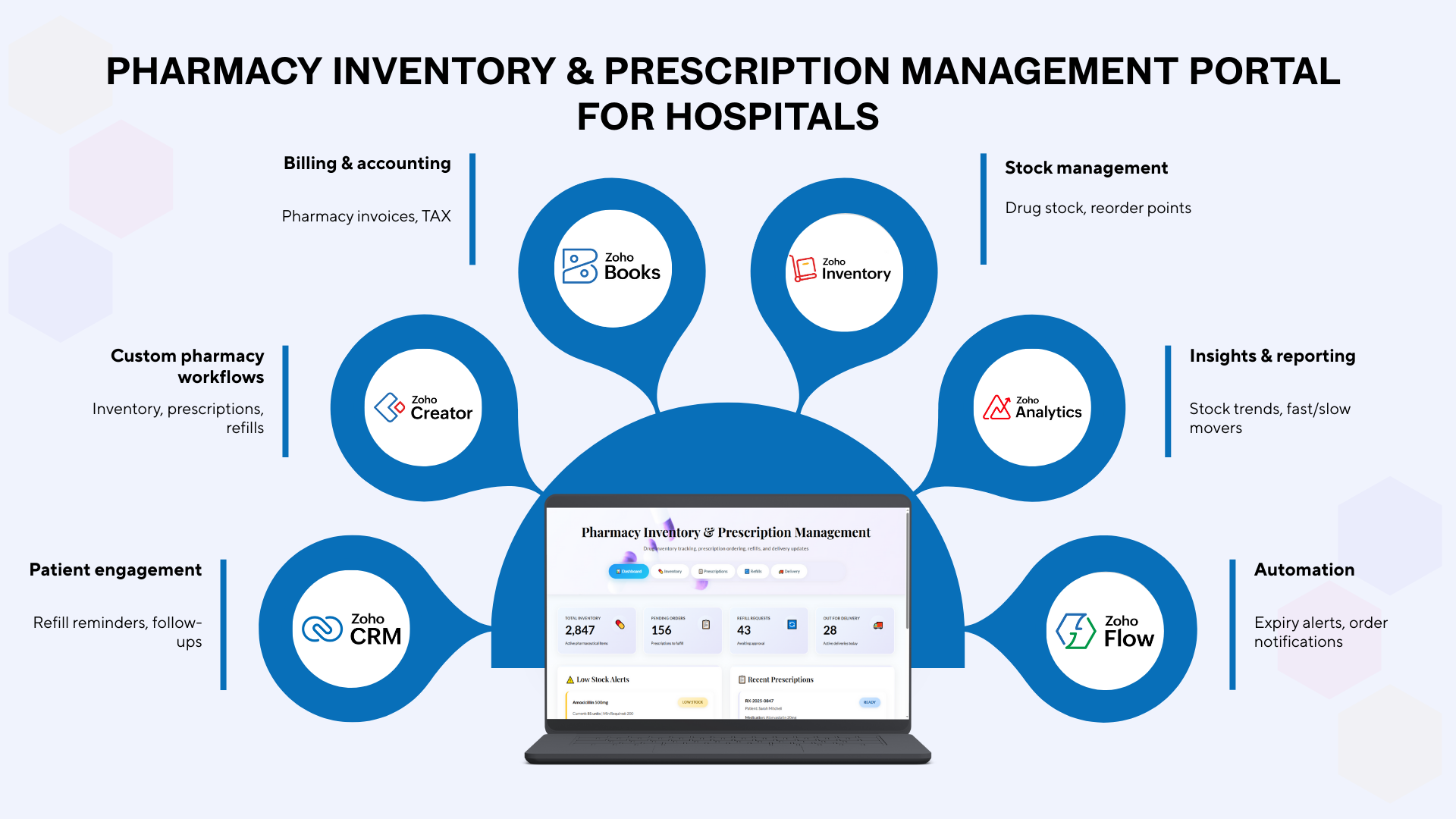
Security & Compliance
The portal is designed with healthcare-grade security:
AES-256 Encryption
All patient records, drug inventories, and transaction data transmit and store using AES-256 encryption, the gold standard for healthcare protecting against breaches. This ensures data remains unreadable even if intercepted, covering everything from prescriptions to billing. Hospitals benefit from this military-grade protection, reducing cyber risks in high-stakes pharmacy operations.
Role-Based Access Control (RBAC)
RBAC assigns granular permissions by user roles—pharmacists access dispensing tools, admins handle audits, and hospital staff view reports—preventing unauthorized actions. Permissions log every access attempt for traceability. This minimizes insider threats and aligns with least-privilege principles for secure multi-user environments.
Multi-Factor Authentication (MFA)
MFA requires biometrics, OTPs, or app approvals alongside passwords for logins, adding layers beyond single credentials. It applies to portals, apps, and admin panels, thwarting credential-stuffing attacks common in healthcare. Implementation boosts login security without disrupting workflows.
Complete Audit Trails
Immutable logs capture every event—dispensing, inventory adjustments, approvals—with timestamps, user IDs, and before/after states for full traceability. Exports support regulatory audits, flagging anomalies automatically. This provides forensic evidence for compliance reviews and dispute resolution.
Secure API Integrations
APIs for HIS/EMR, delivery services, and Zoho CRM use OAuth 2.0, token-based auth, and rate limiting to prevent injection or overload attacks. End-to-end encryption secures data flows. Hospitals integrate seamlessly without exposing core systems.
HIPAA-Ready & GDPR-Aligned
Architecture complies with HIPAA for US operations (access controls, breach notifications) and GDPR for data portability/consent in global use. Regular penetration testing and SOC 2 audits verify adherence. This readies facilities for inspections, fines avoidance, and trust-building with patients.
Ensures medication data integrity, patient privacy, and regulatory adherence.
FAQ
1. Can the portal manage controlled drugs for multi-site compliance?
Yes, controlled substances (e.g., DEA Schedules II-V) receive specialized tracking with mandatory dual approvals, electronic chain-of-custody logs, and automated discrepancy alerts across all hospital sites. Integration with state PDMPs and national registries ensures unified reporting, minimizing diversion risks and simplifying joint commission audits for large networks.
2. Are near-expiry alerts scalable for high-volume hospital inventories?
Yes, enterprise-grade automation scans millions of SKUs daily, delivering customizable alerts (e.g., 30/60/90 days) via centralized dashboards, executive SMS, or ERP feeds. Hospitals configure site-specific thresholds, FEFO prioritization, and auto-quarantine, achieving 40%+ wastage reduction without added staff, ideal for 500+ bed facilities.
3. Does it enable secure patient refill requests in a B2B hospital ecosystem?
Yes, branded patient portals integrate with your hospital app ecosystem, allowing secure refill submissions tied to EMR data, with pharmacist bulk approvals and real-time status syncing to discharge summaries. This offloads 60-70% of routine calls, freeing pharmacy teams for clinical priorities while maintaining HIPAA-compliant patient engagement.
4. Can it support home delivery across hospital networks with third-party logistics?
Yes, API-driven workflows orchestrate pickup/delivery for inpatient/outpatient meds, integrating with enterprise couriers (e.g., your fleet or partners like Amazon Logistics) for GPS-tracked updates and POD verification. Multi-site dashboards provide network-wide visibility, reducing logistics costs by 25% through optimized routing.
5. Is API integration available with hospital EMR/ERP systems like Epic or Zoho?
Absolutely, FHIR/HL7-compliant APIs enable plug-and-play connectivity with EMRs (Epic Willow, Cerner), HIS, and ERPs (Zoho CRM, SAP), automating e-Rx flow, billing reconciliation, and inventory syncing. Onboarding includes dedicated B2B support for custom mappings, ensuring ROI within 3 months for enterprise deployments.