

Modern Hospital Workforce & Compliance Management
Hospitals operate in a high-stakes, 24/7 environment where workforce availability, staff credentials, and regulatory compliance directly impact patient safety and operational efficiency. Traditional scheduling methods—manual rosters, spreadsheets, emails, and disconnected credential records—often lead to staffing gaps, compliance risks, overtime issues, and administrative overload.
The Staff Scheduling & Credential Management Portal provides a centralized, digital solution to manage physician, nursing, and allied healthcare staff schedules while ensuring credentials, licenses, and certifications remain valid and compliant. With role-based access for hospital staff and administrators, the portal enables hospitals to optimize workforce utilization, reduce compliance risk, and improve operational visibility.
Designed for multi-specialty hospitals, medical colleges, healthcare networks, and specialty care centers, this portal modernizes workforce management while supporting regulatory standards and audit readiness.
A Unified Workforce Management Experience
Core Features of the Staff Scheduling & Credential Management Portal
1. Intelligent Staff Scheduling & Shift Planning
Hospital administrators can create and manage:
- Physician, nurse, and technician shift rosters
- Department-wise, ward-wise, and specialty-wise schedules
- Rotational, on-call, emergency, and night shifts
Automated conflict detection prevents overlapping shifts, understaffing, and excessive overtime.
2. Staff Self-Service Schedule Access
Hospital staff can:
- View assigned shifts and duty rosters in real time
- Request shift swaps, leave, or availability updates
- Receive instant notifications for schedule changes
This improves transparency, reduces coordination overhead, and boosts staff satisfaction.
3. Credential, License & Certification Management
The portal securely manages:
- Medical licenses and nursing registrations
- Board certifications and specialty credentials
- Mandatory training, immunization, and compliance documents
Expiry dates are tracked automatically to prevent non-compliant staffing.
4. Automated Compliance Tracking & Alerts
Hospitals receive proactive alerts for:
- Expiring licenses or certifications
- Pending credential renewals
- Mandatory training deadlines
This reduces compliance risk and ensures uninterrupted patient care.
5. Role-Based Access for HR, Admin & Medical Leadership
Secure role-based modules include:
- HR / Medical Administration: Staff onboarding, credential verification, workforce planning
- Department Heads: Shift approvals, coverage oversight, compliance visibility
- Hospital Admin: Policy configuration, audit trails, reporting
Ensures sensitive staff data is accessed only by authorized personnel.
6. Audit Logs & Regulatory Readiness
The portal maintains:
- Complete audit trails for schedule changes
- Credential updates and approvals
- Compliance history for inspections
Hospitals remain fully prepared for internal audits and regulatory reviews.
7. Automated Notifications & Workforce Alerts
System-driven alerts for:
- Shift assignments and changes
- Credential expiry reminders
- Emergency staffing requirements
This minimizes last-minute gaps and improves workforce responsiveness.
Why Choose the Staff Scheduling & Credential Management Portal for Hospitals
Improved Patient Safety
Hospitals prioritize safety by scheduling only verified, credentialed staff like nurses and doctors with active licenses. The portal automates checks against expirations or lapses, preventing unqualified assignments during critical shifts. This minimizes risks like medical errors, enhancing overall care quality.
Operational Efficiency
Manual rostering via spreadsheets or calls wastes hours; the portal uses AI-driven automation for drag-and-drop scheduling and real-time adjustments. Admins cut administrative time by 50-60%, freeing focus for patient care. Shift swaps and conflict alerts streamline daily operations.
Regulatory Compliance
Track licenses, certifications, and vaccinations in one dashboard with automated renewal alerts. Meets Joint Commission, HIPAA, and local standards through audit-ready logs. Hospitals avoid fines and audits by proving continuous compliance effortlessly.
Optimized Staffing
Balance workloads across departments with demand forecasting and skill-matching algorithms. Reduces overtime by 20-30% via fair rotations and fill gaps proactively. Hospitals control labor costs while maintaining coverage during peaks like emergencies.
Staff Satisfaction
Self-service portals let staff view, bid on, or swap shifts transparently via mobile apps. Reduces burnout with equitable scheduling and instant notifications. Higher morale leads to lower turnover and better retention in competitive healthcare staffing.
Scalable Architecture
Cloud-based design handles one hospital or enterprise networks with multi-site syncing. Grows seamlessly—add users, locations, or integrations without downtime. Supports hybrid models for urban/rural expansions.
Staff Scheduling Portal vs Traditional Hospital Systems
| Feature / Capability | Your Portal | ShiftWizard softwareadvice | QGenda sprypt | Modio Health sprypt |
| Automated Shift Scheduling | ✔ Advanced (AI-driven) | ✔ Drag-and-drop, skills-based | ✔ Centralized, forecasting | Limited (scheduling secondary) |
| Credential Tracking | ✔ Built-in (licenses, CME) | Partial (certifications) | ✔ Integrated credentialing | ✔ Full automation, alerts |
| Compliance Alerts | ✔ Automated (renewals) | Limited notifications | ✔ Real-time monitoring | ✔ Primary source verification |
| Staff Self-Service Portal | ✔ Full (swaps, bids, mobile) | ✔ Mobile app, shift swaps | ✔ Self-scheduling | ✔ Provider self-serve |
| Audit Readiness | ✔ Complete logs | ✔ Reporting/analytics | ✔ Compliance reports | ✔ Dashboards, monitoring |
| Healthcare-Specific Design | ✔ Yes (hospital networks) | ✔ Nurse/shift focus | ✔ Physician/hospital | ✔ Multi-site credentialing |
Possible Zoho Tech Stack Integration
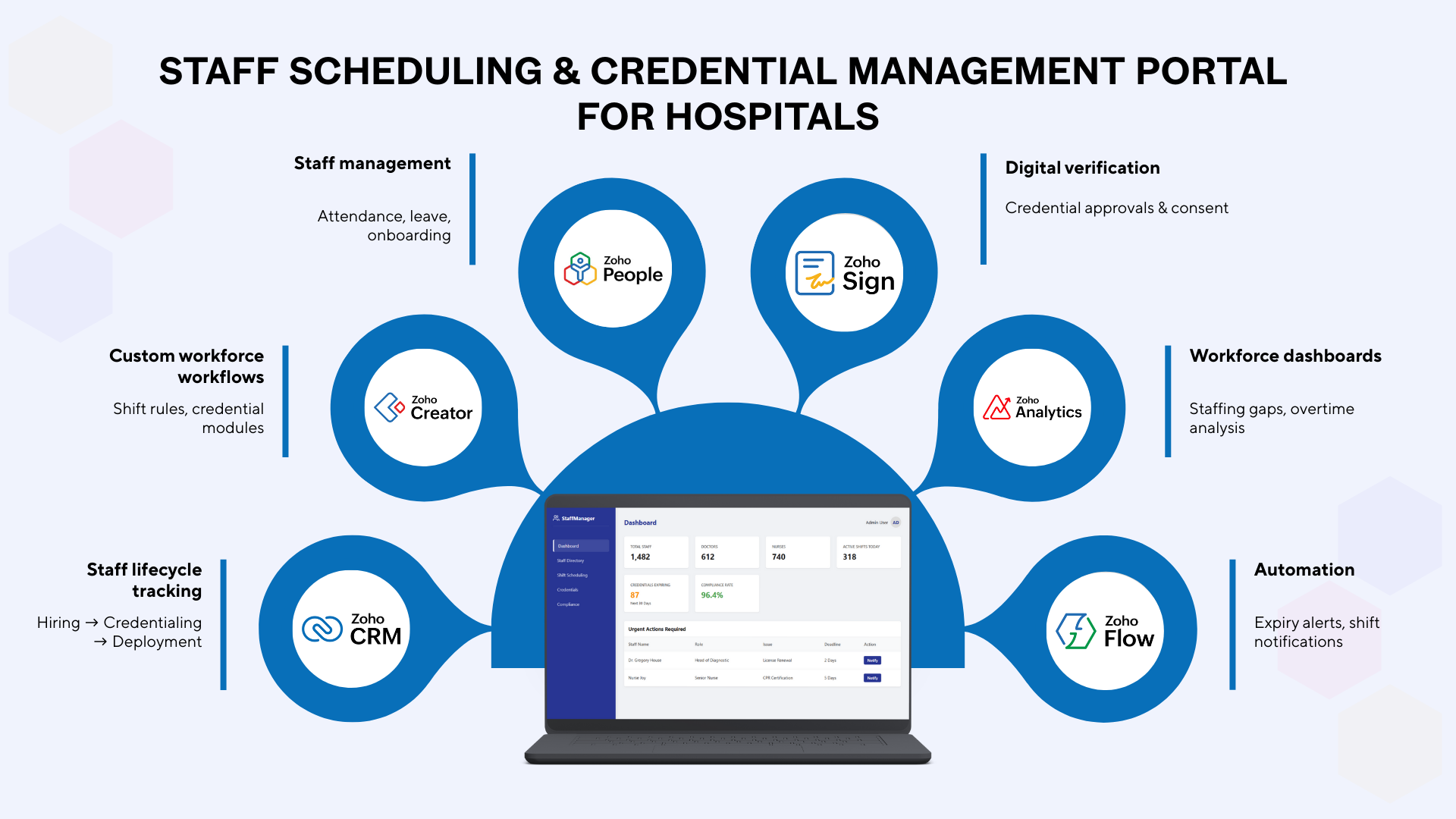
Security & Compliance
The portal employs hospital-grade protections to safeguard sensitive staff data like credentials and schedules. AES-256 encryption secures records at rest and in transit, while Role-Based Access Control (RBAC) limits views—e.g., admins see audits, staff access only personal shifts. Multi-Factor Authentication (MFA) adds login layers, complete audit trails log all actions for reviews, and secure APIs enable safe integrations.
This HIPAA-ready and GDPR-aligned setup ensures data confidentiality, prevents breaches, and meets regulatory demands like Joint Commission standards. Hospitals maintain compliance effortlessly, reducing legal risks in multi-site operations.
FAQ
Q1. How does the portal help hospitals manage staff scheduling efficiently?
Ans: The portal automates shift planning for doctors, nurses, and healthcare staff with conflict detection, overtime controls, and real-time schedule updates, reducing manual rostering errors.
Q2. Can hospital staff access their schedules and request changes themselves?
Ans: Yes. Staff can view assigned shifts, request shift swaps, apply for leave, and receive instant notifications through a secure self-service portal, improving transparency and satisfaction.
Q3. Does the portal track licenses, certifications, and credential expirations?
Ans: Absolutely. The system securely tracks medical licenses, certifications, training records, and expiry dates, sending automated alerts to prevent compliance gaps.
Q4. How does the portal support regulatory compliance and audits?
Ans: The portal maintains complete audit trails for scheduling, credential updates, and approvals, ensuring hospitals remain audit-ready and compliant with healthcare regulations.
Q5. Is the portal suitable for multi-hospital or multi-location healthcare networks?
Ans: Yes. It is designed to scale across multiple hospitals, departments, and locations with centralized visibility and role-based access for administrators and leadership teams.
Q6. How secure is staff and credential data in the portal?
Ans: The portal uses AES-256 encryption, role-based access control, multi-factor authentication, and secure APIs to protect sensitive workforce and credential data.