Meshines India, a manufacturing solutions company based in Coimbatore, India, was experiencing growing operational challenges as its customer base expanded. While the company had adopted Zoho applications as part of its evolving Manufacturing ERP strategy, inconsistencies between CRM and accounting systems were creating data misalignment, reporting gaps, and inefficiencies in tracking customer interactions and financial performance.
Customer records contained inconsistencies in names and information across systems. Sales pipeline tracking lacked clarity. Reporting using CRM reporting tags was limited. Grouping customers based on invoice aging periods was difficult. As a result, leadership lacked accurate insights into sales and financial performance.
To address these challenges, Meshines India partnered with OfficeHub Tech to restructure, optimize, and integrate Zoho CRM and Zoho Books into a unified and automated operational framework aligned with Zoho Solutions For Manufacturing.
The transformation resulted in measurable improvements across time efficiency, reporting accuracy, cost savings, and revenue growth.
Executive Summary
Client: Meshines India
Location: Coimbatore, Tamil Nadu, India
Industry: Manufacturing Solutions
Zoho Partner: OfficeHub Tech
Zoho Applications Used: Zoho CRM, Zoho Books
Project Completion: 05-Feb-2026
Meshines India operates in a manufacturing-driven environment where customer data accuracy, invoice tracking, and pipeline visibility directly influence business growth within their Zoho CRM For Manufacturing Industry framework, invoice tracking, and pipeline visibility directly influence business growth. As operations scaled, disconnected CRM and accounting processes began limiting efficiency.
OfficeHub Tech was engaged to design a structured sales pipeline, enhance CRM–Books integration, improve reporting capabilities, and eliminate inconsistencies in customer records to strengthen Zoho For Manufacturing Operations, enhance CRM–Books integration, improve reporting capabilities, and eliminate inconsistencies in customer records.
“OfficeHub Tech provided excellent support and service throughout our engagement. The team was professional, responsive, and easy to work with. They ensured everything was handled smoothly.”
— Deepak, Meshines India
Problem Statement and Key Challenges
Before engaging OfficeHub Tech, Meshines India was operating with Zoho CRM and Zoho Books in place, but without a properly aligned data architecture or workflow configuration. While the tools existed, they were not structured to support consistent data flow, reporting accuracy, or operational visibility required for a scalable Zoho ERP For Manufacturing Companies environment, reporting accuracy, or operational visibility.
As transaction volumes and customer interactions increased, the gaps between systems became more pronounced.
1. Inconsistent Customer Data Between CRM and Books
Customer records in Zoho CRM and Zoho Books were not fully synchronized or standardized. Variations in naming conventions, duplicate records, and inconsistent formatting created mismatches between sales and accounting data.
This led to several operational challenges:
- Duplicate customer entries across systems
- Difficulty reconciling invoices with CRM deals
- Confusion during follow-ups due to inconsistent contact records
- Reduced trust in system-generated reports
Because sales and finance relied on separate interpretations of customer data within their existing Zoho Books For Manufacturing Finance Solution, reporting lacked reliability, reporting lacked reliability. Over time, this created friction between teams and reduced confidence in data-driven decisions.
2. Unstructured and Under-Automated Sales Pipeline
Although Zoho CRM was implemented, the sales pipeline lacked clearly defined stages aligned with Meshines India’s actual sales lifecycle. Opportunities were tracked, but without consistent stage logic or automated triggers.
This resulted in:
- Manual follow-up tracking
- Inconsistent deal progression
- Missed reminders and delayed responses
- Limited visibility into stalled opportunities
Without workflow automation for follow-up emails or status changes, the sales team depended heavily on manual reminders. As lead volume increased, this approach became unsustainable and reduced conversion efficiency.
3. Reporting Architecture Limitations
CRM reporting tags were present but not strategically configured to support management-level reporting.
The system lacked structured tagging logic that would allow:
- Grouping customers by financial behavior
- Tracking invoice aging within CRM context
- Segmenting customers based on revenue contribution
- Generating consolidated performance reports
As a result, leadership could not easily answer key business questions such as:
- Which customers fall into specific aging brackets?
- What is the revenue trend across tagged segments?
- How do sales pipeline metrics correlate with invoicing data?
Reporting required manual adjustments and cross-checking between CRM and Books, reducing efficiency and increasing risk of error.
4. Limited Operational Visibility Between CRM and Books
While Zoho CRM and Zoho Books were both deployed, they were not optimized to function as an integrated operational ecosystem.
Financial reports generated in Zoho Books were not easily accessible inside CRM. Sales teams lacked direct visibility into invoice status, payment history, and outstanding balances while managing customer relationships.
This separation created:
- Delays in financial follow-ups
- Manual system switching between CRM and Books
- Limited real-time insight during sales conversations
- Reduced alignment between sales and accounting teams
Without embedded financial visibility within CRM, decision-making was slower and less informed.
Business Impact of These Challenges
Individually, each issue created friction. Collectively, they:
- Reduced operational efficiency
- Increased manual workload
- Slowed down sales follow-ups
- Compromised reporting accuracy
- Limited strategic visibility
Although Zoho tools were already in place, they were not configured to operate as a structured, automated, and insight-driven Custom ERP For Manufacturing Workflow solution.
The business required not just tool usage, but architectural refinement, workflow automation, data alignment, and reporting optimization to unlock their full potential
Evaluation and Discovery Process
Rather than immediately modifying configurations, OfficeHub Tech began with a structured diagnostic assessment of Meshines India’s existing Zoho environment. The objective was to identify not only surface-level inefficiencies, but also underlying architectural gaps in data structure, workflow logic, and system integration.
The evaluation focused on five core areas:
1. Data Structure and Record Normalization
A detailed review of customer records in both Zoho CRM and Zoho Books revealed inconsistencies in:
- Naming conventions
- Record formatting
- Duplicate entries
- Field mapping between systems
The lack of standardized data validation rules had resulted in misaligned records across platforms. This misalignment impacted reporting accuracy and financial reconciliation.
The assessment concluded that customer data required normalization and standardized field mapping to ensure consistency between CRM and Books.
2. Sales Pipeline Architecture Review
The existing CRM pipeline was examined to understand how leads progressed through stages. While opportunities were being recorded, there was:
- No clearly defined stage criteria
- No structured probability mapping
- No automation triggers based on stage transitions
- Limited accountability in follow-up sequencing
The absence of stage-based automation meant that sales progress depended largely on manual effort rather than system-enforced workflow logic.
The discovery process highlighted the need for:
- Defined pipeline stages aligned with the actual sales lifecycle
- Automated follow-up triggers
- Structured activity logging
- Stage-based reporting consistency
3. Workflow Automation Assessment
OfficeHub Tech analyzed the use of workflow rules within CRM. It was observed that:
- Follow-up emails were not automated
- Task reminders were not system-driven
- Deal progression lacked automated checkpoints
This created inefficiencies as sales representatives manually managed communication and reminders. In a growing business environment, such dependency on manual tracking reduces scalability.
The evaluation recommended implementing event-based workflow automation triggered by stage changes and predefined time intervals.
4. Reporting Framework and Tag Architecture Analysis
CRM reporting tags existed but were not configured with a strategic schema. There was no standardized tagging logic tied to financial segmentation or customer grouping.
Additionally:
- Invoice aging visibility was not aligned with CRM reporting
- Financial segmentation required manual reconciliation
- Reports lacked cross-platform consolidation
The diagnostic review identified the need for:
- Structured reporting tag logic
- Tag-based grouping architecture
- Alignment between CRM segmentation and Books financial data
5. CRM–Books Integration Gap Analysis
Although integration between Zoho CRM and Zoho Books was active, it was not optimized for operational visibility.
Key gaps identified:
- Limited financial report visibility inside CRM
- Lack of invoice status transparency during sales engagement
- Absence of consolidated reporting dashboards
The system required deeper integration refinement, including enhanced invoicing agent setup and embedded financial reporting access within CRM.
Strategic Conclusion of Evaluation Phase
The discovery process revealed that the challenge was not tool adoption, but system optimization. Zoho CRM and Zoho Books were capable platforms; however, they were not configured as a unified operational architecture.
Meshines India required:
- Data standardization
- Structured pipeline logic
- Automation-driven workflow
- Integrated reporting schema
- Seamless CRM–Books financial visibility
With this structured assessment, OfficeHub Tech developed a solution roadmap designed to transform the existing Zoho setup into a cohesive, automated, and insight-driven End To End Manufacturing Business Operation Solution
Proposed Solution and System Architecture
OfficeHub Tech implemented a structured and integrated Zoho framework tailored to Meshines India’s operational needs.
Zoho CRM – Structured Sales Pipeline & Automation
A redesigned CRM sales pipeline was implemented with clearly defined stages aligned to the company’s sales lifecycle.
Enhancements included:
- Standardized lead and deal stages
- Workflow automations for follow-up emails
- Improved customer record structure
- Elimination of duplicate or inconsistent records
This created better visibility into deal progress and reduced manual tracking.
Zoho Books – Financial & Invoice Reporting Optimization
Zoho Books was configured to:
- Improve invoice reporting accuracy
- Standardize financial reporting formats
- Enable better expense tracking
- Align financial data with CRM sales records
Invoice data became more structured and easier to analyze.
Enhanced CRM–Books Integration
One of the most impactful changes was enabling stronger visibility between CRM and Books through invoicing agent setup.
This allowed:
- Zoho Books reports to be visible inside CRM
- Sales teams to access financial information without switching systems
- Better coordination between sales and accounting
Advanced Reporting & Tag-Based Insights
Custom reporting tag configurations were implemented to enable:
- Customer grouping
- Invoice grouping by aging periods
- Detailed financial segmentation
- Previously unavailable reporting capabilities
This significantly improved management reporting and operational insight.
Implementation
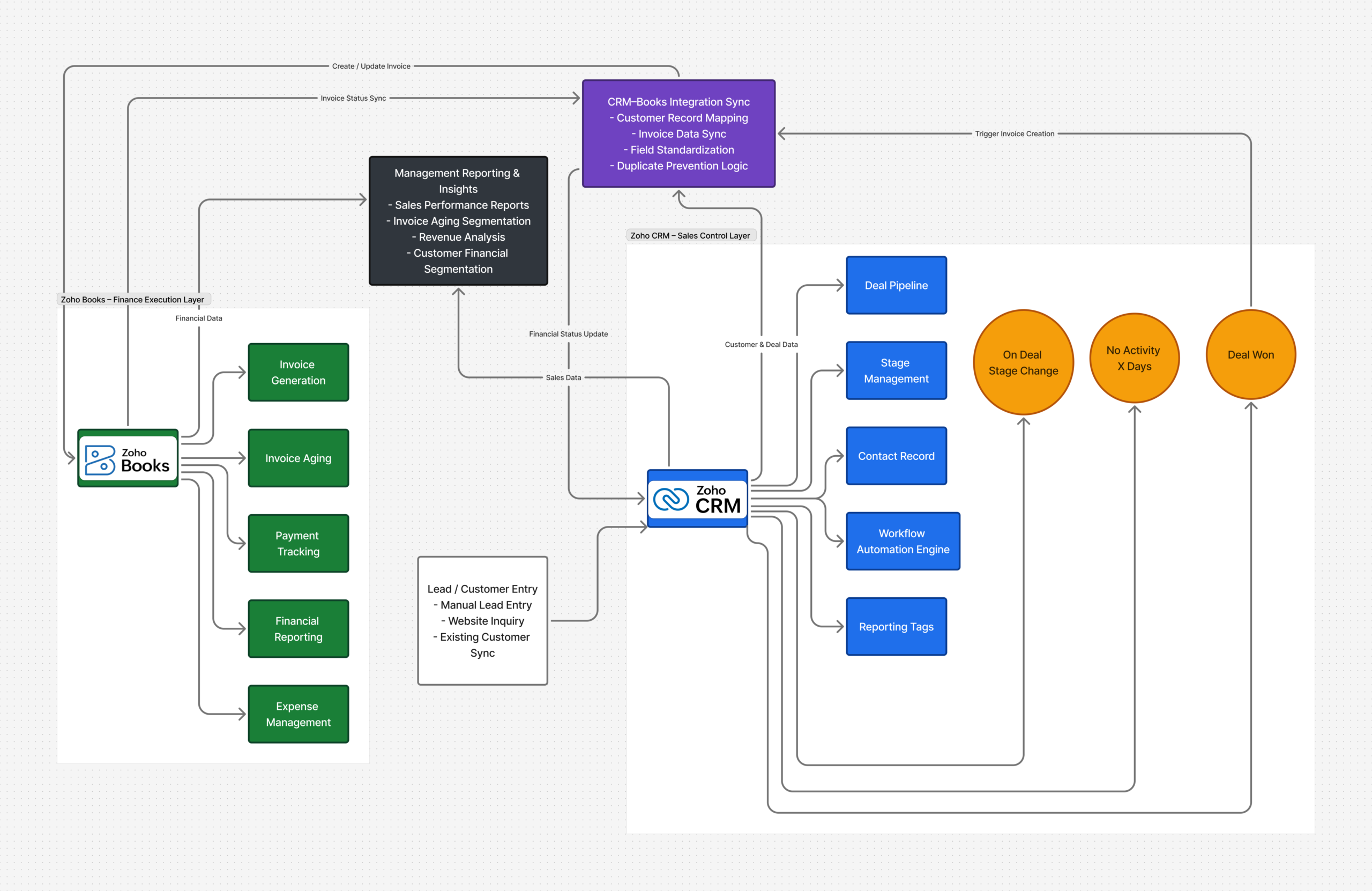
This workflow illustrates how Zoho CRM acts as the operational control layer, Zoho Books functions as the financial execution layer, and structured automation ensures synchronized, real-time visibility across sales and finance operations.
The project was executed in structured phases:
- Data cleanup and record alignment
- CRM pipeline restructuring
- Automation rule implementation
- Books financial configuration
- CRM–Books integration enhancement
- Reporting setup and validation
- User training and post-implementation support
Throughout the engagement, OfficeHub Tech maintained consistent communication and support.
Client satisfaction ratings included:
- 10/10 likelihood to recommend
- 5/5 overall project delivery
- 5/5 communication and responsiveness
Results and Business Impact
Following implementation, Meshines India reported measurable improvements:
| Metric | Result |
| Time Saved | 80% |
| Cost Saved | 50% |
| Increase in Efficiency | 70% |
| Growth in Leads / Revenue | 50% |
Operational Improvements
- Accurate customer data across CRM and Books
- Faster follow-up and deal progression
- Improved invoice visibility
- Stronger financial reporting
- Data-driven sales decision-making
The integration eliminated silos between sales and accounting, enabling smoother internal coordination.
Client Feedback
“We give a 10/10 because of the excellent support and cooperation provided by the OfficeHub Tech team. They were approachable, responsive, and attentive to our needs. The overall engagement was pleasant and well-managed.” — Deepak, Meshines India
Conclusion
Meshines India’s transformation illustrates how structured system optimization can unlock measurable business impact in the manufacturing sector. By refining CRM architecture, strengthening Books integration, and implementing automation-driven workflows, the company transitioned from fragmented processes to a cohesive operational framework. The integration of Zoho Tools For Manufacturing Operations improved visibility across sales and finance, reduced manual effort, and enhanced reporting accuracy. Through strategic system alignment and process redesign, OfficeHub Tech delivered practical zoho and ERP consultation for Manufacturing Business that enabled scalability, operational discipline, and sustainable revenue growth.
OfficeHub Tech continues to support manufacturing organizations seeking structured digital transformation and ERP optimization. As a Top Zoho Consultant In USA, India, UAE and KSA, the team specializes in building scalable Zoho ecosystems that align technology with real operational workflows. If your manufacturing business is facing data inconsistencies, reporting limitations, or integration gaps, now is the time to act. Let’s design a system that supports efficiency, clarity, and growth. Schedule your consultation today and discover how the right Zoho framework can strengthen your entire operation.
Ready to Strengthen Your Sales and Financial Systems?
If your Manufacturing business is struggling with CRM inconsistencies, accounting integration gaps, or reporting limitations, OfficeHub Tech can help you design a structured and scalable Zoho ecosystem.
Contact Us:
OfficeHub Tech LLC
2480 Cherry Laurel Dr, STE #179, Sanford, FL 32771
Email: sam@officehubtech.com
Phone: (407) 743-4854 (USA)
Call/ WhatsApp : +91 9384999342 (IN)
Website: www.officehubtech.com
Schedule a consultation: https://calendly.com/officehubtech