The Operational Chaos Behind Many AV Integration Businesses
Every AV integrator knows the frustration.
A proposal gets approved in XTEN-AV or D-Tools or Portal.io or Wequote or Portal.io.
Then someone rebuilds the same project in Monday.com or ClickUp or Sugar CRM or Zoho CRM.
Inventory teams recreate equipment lists in Tracknicity or Zoho Inventory or Rev.io.
Finance teams enter the same data again in QuickBooks or Xero or Zoho Books.
The same project gets rebuilt four or five times across different platforms.
For AV dealers, installers, designers, technicians, manufacturers, and AV system integration business leaders, this repetitive process is more than an inconvenience. It directly impacts project timelines, operational efficiency, and profit margins.
Modern AV organizations rely on a wide range of specialized tools to manage their operations. Customer relationship management platforms track leads and opportunities. Proposal tools generate detailed system quotes and equipment lists. Design software produces system architecture diagrams. Project management platforms coordinate installations, while accounting systems handle invoicing and financial reporting.
Individually, these tools are powerful. But most of them do not communicate with each other.
The result is a fragmented operational environment where information must be repeatedly transferred across systems. Engineers rebuild proposals. Project managers recreate project structures. Finance teams re-enter billing data.
This constant duplication slows down operations, introduces errors, and reduces visibility across the business.
For AV companies aiming to scale their operations efficiently, disconnected workflows create a major operational barrier.
This is where Anything-to-Anything Integration becomes transformative. By connecting proposal tools, CRM systems, design platforms, project management software, inventory systems, and accounting platforms, AV businesses can convert disconnected workflows into intelligent operational ecosystems.
This approach represents the foundation of Smart Workflow Automation For AV System Integrators, enabling AV professionals to move from manual coordination toward fully connected business operations.
Understanding the Modern AV System Integrator Workflow
AV system integration projects involve multiple stages that require coordination across several teams. What begins as a client inquiry quickly develops into a structured workflow involving sales teams, engineers, project managers, technicians, and finance departments.
The process typically starts with lead generation and client consultation. Sales teams identify customer requirements and define project scope before handing the opportunity to engineering teams.
Engineers then design the AV solution and prepare system proposals that include equipment lists, system architecture, and cost estimates. Once the proposal is approved, project managers begin coordinating project execution.
This stage includes installation planning, technician scheduling, equipment procurement, and site deployment. After installation, the project moves into commissioning, documentation, and client handover.
Many AV companies also provide ongoing services such as maintenance agreements, warranty support, and system upgrades.
Because each stage relies on information from the previous step, smooth coordination between teams is essential. When workflows are not properly connected, delays and communication gaps can affect project timelines and overall operational efficiency.
The Fragmented Technology Stack in the AV Industry
To manage these workflows, AV system integrators rely on a wide range of specialized software tools. Different platforms are used for sales management, proposal creation, project planning, inventory tracking, and financial operations.
For example, customer relationships are often managed through CRM systems such as Pipedrive, HubSpot, Salesforce, Zoho CRM, SugarCRM or Rev.io. Engineers create system proposals using platforms like XTEN-AV, D-Tools, Jetbuilt, Wequote or ProjX360.
Project managers coordinate installations through tools such as Monday.com, ClickUp, Asana, Jira or Smartsheet, while procurement and inventory teams track equipment through systems like Fishbowl, Zoho Inventory, Odoo Inventory, EZOfficeInventory or Asset Panda. Financial operations are handled through accounting platforms such as QuickBooks, Xero, Zoho Books, or NetSuite.
Although each tool performs its specific function well, these systems rarely communicate directly with one another. As a result, teams must manually transfer information between platforms.
For instance, once a proposal is approved in a proposal tool, project managers often need to recreate the same project in a project management system. Equipment lists must then be copied into inventory platforms, and billing data entered again in accounting software.
This disconnected technology environment slows operations and increases the risk of errors.
To overcome this challenge, many AV companies are adopting Multisoftware Integration for AV System Integrator environments that connect these systems into a unified operational workflow.
Operational Pain Points Faced by AV Professionals
Despite rapid technological advancements in the AV industry, many integration businesses still struggle with operational inefficiencies caused by disconnected software systems. These challenges affect every level of the organization—from field technicians and project managers to AVSI CEOs and financial leaders.
One of the most common problems is repetitive data entry. Engineers create detailed proposals in tools such as XTEN-AV, Jetbuilt, or D-Tools, but once the proposal is approved, the same information must be manually transferred into project management systems. Equipment lists are copied again into inventory systems, while finance teams recreate billing data within accounting software.
This repetitive workflow wastes valuable engineering and administrative time.
Another major challenge involves limited operational visibility. When project data exists across multiple systems, leadership teams struggle to obtain a unified view of project progress, financial performance, and resource allocation. Without centralized information, decision-making becomes slower and less accurate.
Project execution can also become vulnerable to errors. Even small discrepancies between systems—such as incorrect product quantities or outdated pricing—can lead to procurement mistakes, installation delays, and billing inconsistencies.
Financial tracking is another critical concern. AV projects often involve complex budgets that include hardware costs, labor charges, subcontractor expenses, and service agreements. Without connected systems, reconciling these costs with revenue becomes a time-consuming process.
These inefficiencies are not minor inconveniences; they have measurable operational impact.
Organizations that rely on disconnected workflows often experience:
- up to 70% longer proposal-to-project setup time
- 80% more manual data entry across departments
- 40% higher risk of operational errors
- 60% delays in billing and financial reconciliation
For AV system integrators operating in competitive markets, these inefficiencies directly affect profitability.
Implementing AVSI Business Automation Solution frameworks allows AV companies to eliminate redundant processes, improve data accuracy, and provide leadership teams with real-time operational insights.
By transforming manual workflows into automated processes, AV organizations can significantly improve project efficiency while reducing operational overhead.
The Concept of Multi-Software Integration: “Anything-to-Anything Integration”
For many AV companies, the main operational challenge is not the availability of software but the lack of connectivity between the tools they already use. Sales teams manage leads in CRM platforms, engineers create proposals using AV proposal tools, project managers track installations in project management systems, and finance teams handle billing through accounting software.
When these systems operate independently, teams must manually transfer information between platforms. This leads to repetitive data entry, delays, and operational inefficiencies.
Multi-software integration addresses this problem by connecting different business platforms into a unified digital environment. This approach—known as Anything-to-Anything Integration—allows any system in the workflow to communicate with another without requiring companies to replace their existing tools.
Through this model, AV organizations can achieve AV Project Automation and Integration, ensuring that operational data moves automatically across departments.
The Four Layers of Anything-to-Anything Integration
- Data Integration: Customer records, proposal details, product lists, and project information synchronize across platforms such as HubSpot, Zoho CRM, XTEN-AV, D-Tools, and project management tools. This eliminates the need to repeatedly enter the same information.
- Workflow Integration: Operational events trigger automated processes. For example:
Proposal Approved → Project Created → Inventory Updated → Invoice Generated.
Automation reduces manual work and speeds up project execution. - Operational Integration: Departments such as sales, engineering, procurement, finance, and service teams operate within a connected ecosystem where information flows seamlessly between systems.
- Intelligence Integration: Connected systems generate centralized dashboards that provide real-time insights into project progress, resource allocation, and revenue performance.
Together, these layers form the foundation of AV System Integration business workflow solutions, helping AV companies streamline operations and make better strategic decisions.
Transforming the AV Workflow: From Lead to Project Execution
When AV companies connect their operational systems, the entire project lifecycle becomes significantly more efficient. Instead of manually transferring data between platforms, information flows automatically from one stage of the workflow to the next.
The process typically begins when a potential client inquiry is captured inside a CRM platform such as HubSpot, Salesforce, or Zoho CRM. Sales teams qualify the opportunity and gather the client’s requirements.
Engineering teams then prepare system proposals using AV proposal tools such as XTEN-AV, D-Tools, Jetbuilt, or ProjX360. These platforms generate equipment lists, pricing structures, and technical specifications required for the project.
Once the proposal is approved, integrated workflows can automatically create a project inside platforms like Monday.com, ClickUp, Asana, or Smartsheet. Tasks, installation timelines, and resource assignments are generated instantly, eliminating manual project setup.
Equipment lists can also synchronize with inventory and procurement systems such as Fishbowl, Zoho Inventory, Asset Panda, or Sortly, ensuring that the correct hardware is ordered for installation.
At the financial level, accounting platforms like QuickBooks, Xero, Zoho Books, or NetSuite can automatically generate invoices based on project milestones or equipment delivery.
This connected workflow enables AV Project Automation and Integration, allowing AV organizations to manage projects more efficiently while reducing manual administrative work.
Connecting AV Design, Engineering, and Deployment Systems
Engineering and system design are critical components of AV integration projects. AV designers and engineers develop the technical architecture that ensures systems perform reliably after installation.
This stage typically uses professional design tools such as AutoCAD, WireCAD, SketchUp, Revit, Stardraw, AVSnap, or Visio. These platforms help engineers create system diagrams, rack layouts, wiring schematics, and signal flow documentation.
However, in many AV organizations these engineering tools operate separately from business systems such as CRM platforms, project management tools, and procurement systems.
As a result, equipment lists and technical specifications created during the design phase must often be manually transferred into proposal platforms, project management tools, and inventory systems. This manual handoff slows down operations and increases the likelihood of errors.
Through integrated workflows, engineering outputs can connect directly with operational systems. Equipment lists generated during the design stage can automatically populate proposal tools, project plans, and procurement workflows.
For example:
Design Software → Proposal Platform → Project Management Tool → Inventory System
This integration ensures that product information, quantities, and system configurations remain consistent throughout the project lifecycle.
Such connectivity supports AV System Integration Design Software Integration with CRM, allowing engineering teams to collaborate more effectively with sales, project management, and procurement departments.
By connecting engineering systems with the broader operational ecosystem, AV organizations can reduce administrative workload, accelerate proposal preparation, and improve overall project accuracy.
Financial Intelligence Through Accounting and ERP Integration
Financial management is one of the most critical aspects of running a successful AV integration business. Every project involves multiple financial components including hardware procurement, labor costs, subcontractor payments, installation expenses, and ongoing service contracts.
Without proper financial visibility, AV companies can easily lose control of project profitability.
In many organizations, accounting systems operate separately from project management and proposal platforms. Finance teams often receive project data manually from project managers or engineers. Equipment costs, labor hours, and billing details must be re-entered into accounting platforms.
This manual process introduces delays and increases the risk of discrepancies between operational data and financial records.
Integrated financial workflows solve this challenge by connecting operational systems with accounting platforms such as QuickBooks, Xero, Zoho Books, NetSuite, or Sage.
When proposal tools and project management systems integrate directly with accounting software, financial information flows automatically across the organization.
For example, once a proposal is approved:
Proposal Platform → Accounting System → Invoice Generated
Equipment purchases can automatically generate purchase orders. Project milestones can trigger invoice creation. Payment status can synchronize with project dashboards.
This level of automation enables AV Accounting & and AV Finance Integration, ensuring that finance teams always work with accurate, real-time project data.
For larger AV organizations, integration may extend even further through enterprise resource planning platforms. These solutions allow companies to centralize operational, financial, and inventory data within a single management environment.
This is where Custom ERP For AV System Integration Industry becomes valuable. ERP systems connect sales, engineering, procurement, finance, and service operations within a unified digital infrastructure.
With integrated financial systems, AV executives gain clear visibility into project margins, revenue forecasting, and operational performance. Instead of relying on fragmented reports, leadership teams can monitor the financial health of their business in real time.
This level of financial intelligence enables AV companies to make better strategic decisions while maintaining strong project profitability.
Warranty, AMC, and After-Sales Service Automation
AV system integration projects do not end once installation is completed. In fact, for many AV companies, the long-term value of a project lies in the ongoing service relationships that follow deployment.
Clients often require continuous support for system monitoring, maintenance, troubleshooting, software updates, and equipment replacement. Many AV integrators therefore offer long-term service contracts, including Annual Maintenance Contracts (AMC), warranty management, and remote system support.
Managing these services manually can quickly become complicated.
Service teams must track installed equipment, warranty periods, maintenance schedules, and service history for every client system. Without integrated systems, this information is often scattered across spreadsheets, project documents, and internal service platforms.
This lack of centralized information creates several operational challenges. Service teams may struggle to locate equipment details when responding to support requests. Warranty expiration dates may be overlooked. Maintenance schedules may be missed, leading to reduced service quality.
Integrated workflows solve these problems by connecting project installation data with asset management and service platforms.
Once an AV project is completed, all installed equipment can automatically be recorded within asset management systems. Each device is linked to its serial number, warranty period, installation location, and service history.
This enables automated lifecycle tracking of every installed component.
Integrated systems can also generate automated service workflows such as:
- automatic AMC renewal reminders
- scheduled preventive maintenance notifications
- automated service ticket creation
- technician assignment and dispatch
- historical device performance tracking
This functionality supports AV System Integration Inventory & AV System Integration Asset Management Software Integration, allowing AV companies to manage the full lifecycle of installed systems.
For AV service teams, this level of automation significantly reduces administrative workload while improving response times and service reliability.
For AV business leaders, integrated service management creates new opportunities for recurring revenue through structured maintenance programs and long-term client relationships.
Real-World Case Studies: How Multi-Software Integration Transforms AV Businesses
Case Study 1 — Mid-Size Commercial AV Integrator
Company: NexusAV Technologies
A mid-sized commercial AV integration company, NexusAV Technologies, operating across corporate offices and conference room deployments relied on multiple disconnected tools.
Their technology stack included:
CRM – HubSpot
Proposal Tool – XTEN-AV
Project Management – Monday.com
Accounting – QuickBooks
Although each system functioned well individually, the lack of integration created operational bottlenecks.
Once a proposal was approved, project managers manually recreated the project structure in Monday.com. Equipment lists had to be manually transferred to procurement teams. Finance teams manually entered invoices in QuickBooks.
This repetitive process increased administrative workload and delayed project kickoff.
After implementing integrated workflows, the company connected all operational platforms into a unified system.
Proposal approvals automatically created project plans. Equipment lists synchronized with procurement systems. Accounting platforms generated invoices based on project milestones.
The results were significant:
- 70% reduction in proposal-to-project setup time
- 40% improvement in project delivery efficiency
- 60% faster invoicing cycles
This transformation demonstrates the impact of AV Project Automation and Integration across operational systems.
Case Study 2 — Residential Smart Home Integrator
Company: Lumina Smart Living
Lumina Smart Living, a residential AV and smart home automation company specializing in luxury home theaters and automation systems, faced similar operational challenges.
Their technology stack included:
CRM – Zoho CRM
Proposal Tool – Jetbuilt
Project Management – ClickUp
Accounting – Xero
Before integration, once a proposal was approved, the operations team manually created project structures and procurement lists. Accounting teams also recreated billing records manually.
This manual process slowed project initiation and increased the risk of data discrepancies.
By implementing integrated workflows:
- approved proposals automatically generated project plans
- equipment lists synchronized with procurement systems
- invoice drafts were automatically created in the accounting system
The operational improvements were substantial:
- 60% faster project kickoff
- 30% reduction in accounting errors
- improved operational visibility across departments
This level of connectivity reflects the value of CRM Integration for AV System Integrator environments.
Case Study 3 — Enterprise AV Integration Company
Company: Apex Integrated Systems
Apex Integrated Systems, a large AV integration company working on enterprise deployments, used a more complex technology stack.
CRM – Salesforce
Proposal Tool – D-Tools
ERP System – NetSuite
Project Management – Smartsheet
The company struggled with fragmented data between engineering, operations, and finance departments.
Once proposals were approved, engineering data had to be manually transferred into ERP systems. Procurement teams manually processed equipment orders, while finance teams manually generated invoices.
Through multi-software integration, the organization connected all operational systems.
Proposal approvals automatically triggered procurement workflows. Equipment lists synchronized with ERP systems. Financial data updated automatically within NetSuite.
The improvements included:
- 80% reduction in manual data entry
- 40% faster project planning
- improved financial forecasting and reporting accuracy
These results highlight the power of 3rd Party Tools Integration for AV System Integrators environments that connect operational software across the organization.
Strategic Benefits of Intelligent AV Workflow Integration
For AV companies operating in competitive markets, operational efficiency is no longer just an internal improvement—it is a strategic advantage. Businesses that successfully connect their operational systems can deliver projects faster, reduce administrative workload, and improve financial visibility.
When AV organizations implement integrated workflows, they eliminate many of the repetitive processes that traditionally consume engineering and administrative time. Instead of manually recreating projects across multiple platforms, teams operate within a single connected ecosystem where information flows automatically between systems.
This transformation enables AV companies to focus more on innovation, client relationships, and business growth rather than administrative coordination.
One of the most immediate benefits of integration is improved project efficiency. Automated workflows ensure that project information moves seamlessly from proposal tools into project management platforms and financial systems.
This dramatically reduces project setup time.
Organizations that adopt integrated operational environments typically experience measurable improvements such as:
- 70% reduction in proposal-to-project setup time
- 80% reduction in manual data entry across departments
- 40% decrease in operational errors
- 60% faster billing and financial reconciliation
These improvements directly translate into better project margins and more predictable business performance.
Integration also improves operational visibility for leadership teams. AVSI CEOs, CTOs, and operations leaders gain access to centralized dashboards that provide real-time insight into project status, team workloads, and financial performance.
This level of visibility enables better decision-making across the organization.
Executives can monitor project profitability, identify resource bottlenecks, forecast revenue, and evaluate operational efficiency using real-time data.
In addition to operational improvements, integrated systems also provide greater scalability. As AV companies grow and expand into new markets, their operational infrastructure can support larger project volumes without requiring proportional increases in administrative staff.
These advantages illustrate why many modern AV organizations are investing in AV System Integration business workflow solutions designed to unify their technology ecosystems and enable long-term operational growth.
The Future of AV Operations: Integration, Automation, and Intelligence
The AV industry is rapidly moving toward a more digital and data-driven future. As AV systems become increasingly sophisticated, the operational environments that support these systems must evolve as well.
Modern AV businesses are no longer just installation companies. They are technology service providers managing complex ecosystems that include smart automation systems, enterprise collaboration technologies, digital signage networks, and connected infrastructure.
To manage this level of complexity efficiently, AV organizations must rely on connected operational systems that allow information to flow seamlessly across departments.
Integration forms the foundation of this transformation.
When business platforms such as CRM systems, proposal tools, project management software, accounting platforms, and inventory systems are connected, organizations gain access to a continuous stream of operational data. This connected data environment opens the door to advanced technologies such as artificial intelligence and predictive analytics.
With integrated systems in place, AV companies can begin using data to improve operational decision-making.
AI-powered analytics can help organizations:
- predict project timelines based on historical performance
- forecast project margins before execution begins
- identify resource allocation challenges across engineering and installation teams
- detect potential service issues within installed systems
Integrated operational data also enables intelligent dashboards that provide leadership teams with real-time insights into business performance.
Instead of waiting for monthly reports, executives can monitor operational metrics such as project progress, revenue forecasts, service contract performance, and technician workloads in real time.
For AV companies seeking long-term growth, the combination of integration, automation, and data intelligence will become a defining competitive advantage.
Organizations that adopt connected operational ecosystems today will be better positioned to scale their businesses, manage increasingly complex projects, and deliver higher-value services to their clients in the future.
The Role of AI Agents, Automation Platforms, and MCP Servers in Modern AV Integration
As AV system integration businesses continue to adopt automation, newer technologies such as AI Agents, workflow automation platforms, and MCP servers are becoming powerful components of connected business ecosystems.
Tools like n8n allow organizations to build flexible automation workflows that connect multiple platforms without requiring complex custom development. Through automation platforms, AV companies can connect CRM systems, proposal tools, project management platforms, inventory software, and accounting systems into a single operational workflow.
AI agents take this a step further by enabling intelligent automation. Instead of simply transferring data between systems, AI agents can monitor workflows, trigger actions based on conditions, generate reports, or assist teams in managing operational tasks.
Another emerging concept is the Model Context Protocol (MCP) server, which allows AI-powered systems to securely access data across different tools and applications. With MCP architecture, AI agents can interact with multiple business systems while maintaining structured access to operational data.
When combined with multi-software integration, these technologies enable AV organizations to move beyond simple automation toward intelligent operational ecosystems, where workflows, data, and decision-making processes are increasingly automated.
Example Architecture: Intelligent AV Workflow Integration
To understand how modern integration works in practice, it helps to visualize the architecture of a connected AV business ecosystem. Instead of operating as isolated platforms, different tools can be connected through an automation layer and intelligent agents.
Below is a simplified example of how AV companies can structure their operational systems.
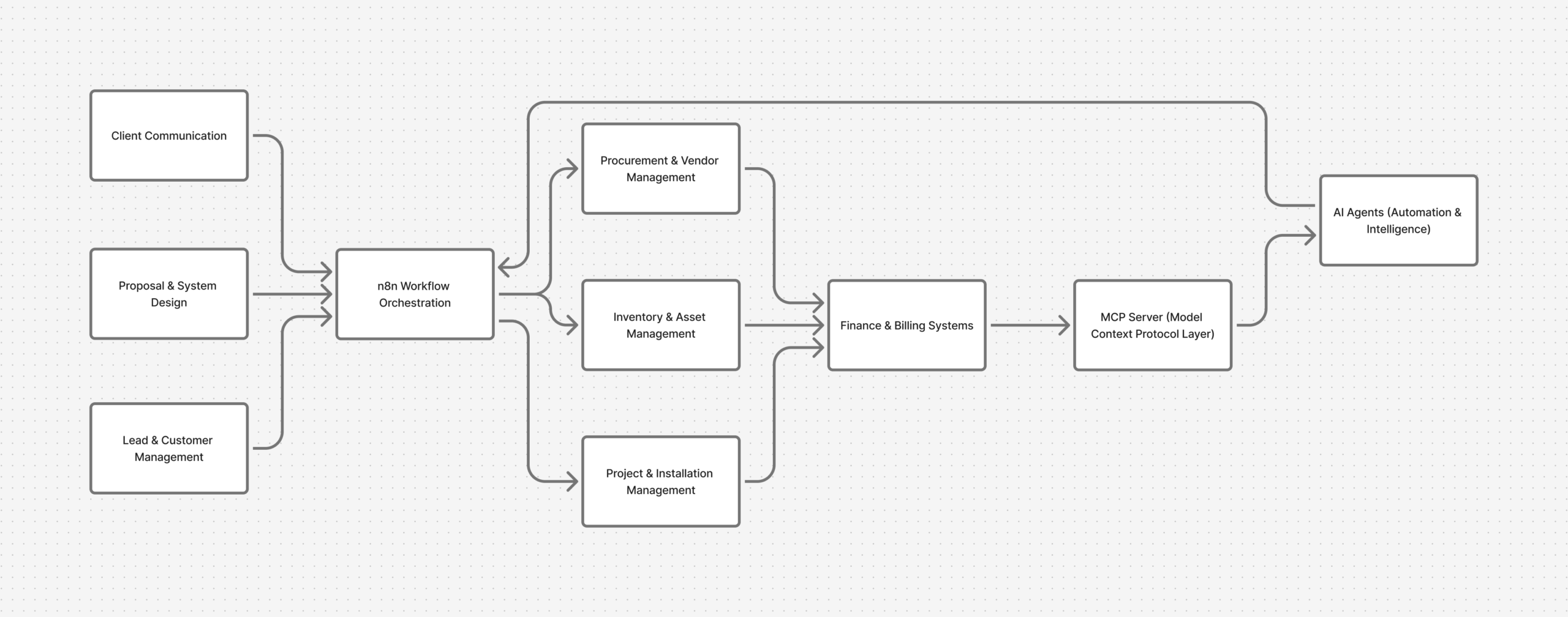
This type of architecture enables AV companies to build intelligent operational ecosystems, where systems, workflows, and business insights are fully connected.
Conclusion
The modern AV industry operates within a highly interconnected technological landscape. From lead management and proposal development to project execution, financial management, and after-sales service, every stage of the AV lifecycle depends on multiple software platforms working together. When these systems remain disconnected, operational inefficiencies inevitably arise—creating delays, errors, and lost profitability. By implementing intelligent Multi-Software (Anything-to-Anything) Integration, AV organizations can unify their entire software ecosystem, automate critical workflows, and transform operational complexity into streamlined efficiency.