
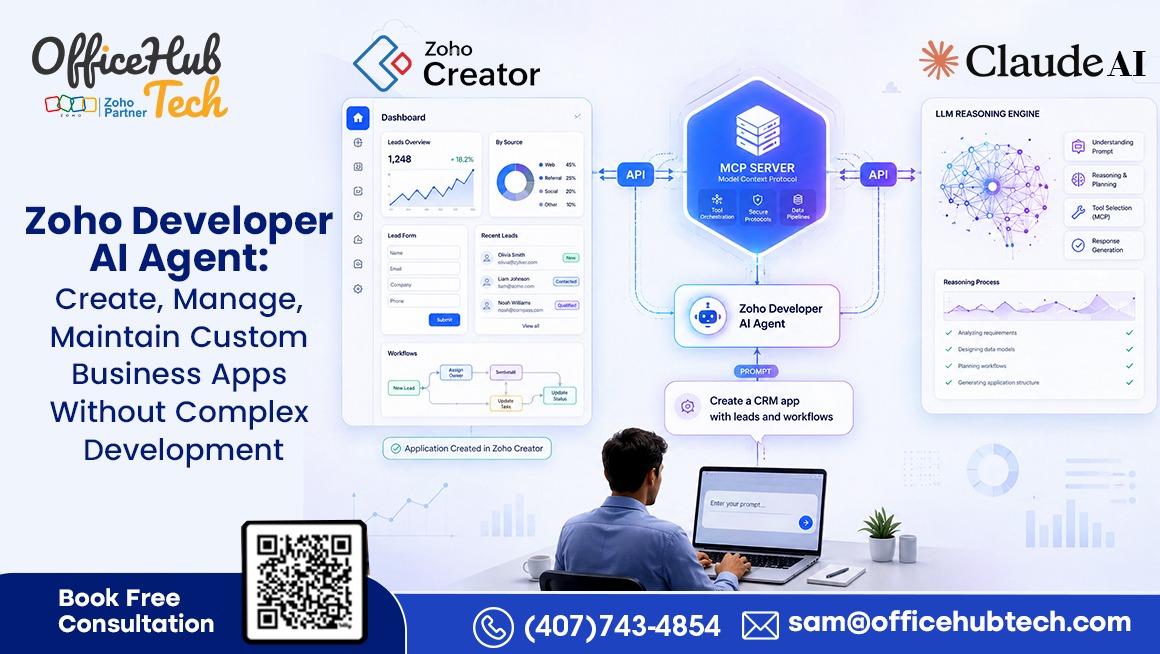
Zoho Developer AI Agent: Create, Manage, Maintain Custom Business Apps Without Complex Development
Redefining Application Development with Zoho Developer AI Agent
Application development is no longer constrained by coding complexity—but it is still limited by manual configuration.
Even with platforms like Zoho Creator, businesses continue to rely on step-by-step processes—creating forms, defining workflows, configuring logic, and managing data through interfaces. As systems scale, this approach introduces friction, slows execution, and increases operational overhead.
The Zoho Developer AI Agent redefines this model by introducing a prompt-driven execution framework, where applications are not built manually—but executed directly from intent.
At its core, this approach is powered by:
- Claude AI (LLM) for intent interpretation
- Model Context Protocol (MCP) for structured tool exposure
- Zoho Creator APIs for real-time system execution
This architecture enables a seamless transition from:
Idea → Prompt → Execution → Application
Instead of navigating multiple screens or configuring systems manually, users can define requirements in natural language, and the system translates them into real, executable actions—creating applications, workflows, and data structures instantly.
This is not an incremental improvement to low-code.
It is a shift from configuration-driven development to AI-driven system execution.
In this blog, we explore how the Zoho Developer AI Agent enables businesses to create, manage, and scale applications through prompts, backed by a robust execution architecture and real-world use cases.
What is Zoho Developer AI Agent? From Assistance to Execution
The Zoho Developer AI Agent is not a traditional AI assistant—it is an execution layer that enables direct interaction with systems through prompts.
In conventional low-code environments like Zoho Creator, users still need to manually configure every component—forms, fields, workflows, and integrations. While coding effort is reduced, execution remains dependent on UI-driven actions.
The Zoho Developer AI Agent removes this dependency.
It introduces a prompt-driven system interaction model, where users define requirements in natural language, and the system executes them directly within Zoho Creator.
Core Architecture
The system is built on three tightly integrated components:
- Claude AI (LLM)
Interprets user prompts, extracts intent, and structures the required actions - Model Context Protocol (MCP)
Exposes Zoho Creator operations (e.g., create app, add fields, update data) as structured, callable tools - Zoho Creator APIs
Execute these actions in real time—creating applications, configuring workflows, and managing data
From Prompt to Execution
When a user provides a prompt such as:
“Create a project management app with tasks, deadlines, and status tracking”
The system does not suggest steps—it executes them:
- Application structure is created
- Forms and fields are defined
- Workflow logic is configured
- Data operations are enabled
A Shift in System Interaction
This transforms Zoho Creator from a development platform into an AI-powered execution environment, where:
- Intent replaces manual configuration
- APIs replace UI interactions
- Execution replaces assistance
The Zoho Developer AI Agent enables businesses to move beyond building applications step by step—and instead operate systems that execute based on prompts, delivering speed, consistency, and scalability.
How Zoho Developer AI Agent Works: From Prompt to Real-Time Execution
The Zoho Developer AI Agent operates on a structured execution pipeline that transforms natural language prompts into real system actions inside Zoho Creator.
Unlike traditional low-code workflows, where users manually configure each component, this model enables direct execution through prompts, eliminating dependency on UI navigation.
Execution Flow: Prompt → MCP → API
When a user provides a prompt such as:
“Create a CRM app with Customers, Leads, and automated follow-ups”
The system processes it through the following stages:
-
Intent Interpretation (LLM Layer)
Claude AI analyzes the prompt and identifies key components:
- Application type (CRM)
- Entities (Customers, Leads)
- Required fields and relationships
- Workflow logic (follow-ups, automation)
The prompt is converted into a structured representation of actions.
-
Tool Mapping (MCP Layer)
The Model Context Protocol (MCP) exposes Zoho Creator operations as callable tools.
- Create Application
- Create Forms
- Add Fields
- Configure Workflows
- Perform Data Operations
Based on the interpreted intent, the system selects and prepares the required tool calls.
- Execution (Zoho Creator APIs)
These MCP tool calls are executed through Zoho Creator APIs:
- Application is created in real time
- Forms and data models are structured
- Fields are mapped to appropriate data types
- Workflow automation is configured
- Initial data handling logic is applied
Continuous Interaction Model
The process does not stop at creation.
Users can continue interacting through prompts:
- Modify application structure
- Update workflows and logic
- Manage and clean data
- Extend applications with new features
From Manual Steps to System Execution
This architecture replaces:
- Manual configuration → Prompt-driven execution
- UI navigation → API-level interaction
- Static workflows → Dynamic, intent-based operations
The result is a system where applications are not built step by step—but executed, managed, and evolved through prompts, enabling faster development cycles and scalable application management.
Technical Architecture: Why Zoho Developer AI Agent is Different from Traditional Systems
The Zoho Developer AI Agent is not just an enhancement to low-code—it introduces a new execution architecture where intelligence, system interaction, and application logic are tightly orchestrated.
At a high level, the architecture operates across three core layers:
- LLM Layer (Claude AI) → Interprets intent
- MCP Layer (Model Context Protocol) → Standardizes system operations as tools
- Execution Layer (Zoho Creator APIs) → Performs real actions in the system
This separation ensures that reasoning and execution are decoupled, making the system both flexible and reliable.
Key Architectural Characteristics
- Metadata-Driven Execution
Applications are not hard-coded. Instead, forms, workflows, and data models are generated through structured configurations, allowing dynamic updates without redevelopment. - Modular System Design
Each operation—such as form creation, workflow logic, or data handling—is executed as an independent module. This enables scalability and easier maintenance. - API-First Interaction Model
All actions are executed through Zoho Creator APIs, eliminating dependency on UI-based interactions and enabling real-time system control. - State-Aware Workflow Processing
The system understands application state (e.g., status, transitions, triggers) and adapts workflows dynamically based on real-time conditions.
How It Differs from Traditional Approaches
- Traditional Low-Code
Requires manual configuration of every component through UI - RPA / Automation Tools
Execute predefined rules but lack adaptability - Zoho Developer AI Agent
Interprets intent and executes actions dynamically using MCP and APIs
Why This Matters
This architecture enables a shift from process-driven systems to intent-driven systems, where:
- Systems adapt without redesign
- Execution happens instantly from prompts
- Applications evolve continuously without rebuild cycles
By combining LLM intelligence, MCP-based orchestration, and API-driven execution, the Zoho Developer AI Agent transforms Zoho Creator into an AI-powered application execution platform , capable of building and managing systems at scale
From Creation to Continuous Evolution: Managing Applications with Zoho Developer AI Agent
While the initial impact of the Zoho Developer AI Agent is seen in rapid application creation, its real strength lies in enabling complete lifecycle management—from creation to continuous optimization—within Zoho Creator.
Traditional low-code platforms simplify development but still require manual intervention for updates, maintenance, and scaling. As applications grow, managing them becomes increasingly complex and time-consuming.
The Zoho Developer AI Agent eliminates this complexity by enabling prompt-driven lifecycle operations, allowing applications to evolve continuously without manual reconfiguration.
Application Creation (Initial Execution)
- Generate full applications from prompts
- Define forms, fields, and relationships automatically
- Configure workflows, validations, and business logic
- Enable integrations through APIs and connectors
Application Management (Ongoing Operations)
- Modify application structure dynamically (add/update fields, forms)
- Update workflows, approvals, and automation logic
- Perform data operations (create, update, bulk processing)
- Generate and refine reports, dashboards, and views
Application Maintenance & Scaling
- Adapt applications as business requirements evolve
- Maintain consistency through standardized execution
- Handle increasing data volume and user load seamlessly
- Optimize performance using AI-driven insights
Continuous Interaction Model
Instead of periodic development cycles, users interact with the system through prompts:
- “Add approval workflow to sales module”
- “Update lead status logic and notifications”
- “Create report for monthly performance”
Each instruction is executed directly—without navigating interfaces or reconfiguring systems manually.
From Static Applications to Living Systems
This transforms applications from static builds into continuously evolving systems, where:
- Changes are executed instantly
- Systems adapt in real time
- Maintenance becomes part of normal interaction
By enabling creation, management, and maintenance through a single execution model, the Zoho Developer AI Agent ensures that applications remain aligned, scalable, and efficient throughout their lifecycle.
Business Impact: Speed, Efficiency, and Measurable ROI with Zoho Developer AI Agent
The value of the Zoho Developer AI Agent extends beyond technical innovation—it directly impacts how businesses build, operate, and scale applications within Zoho Creator.
By shifting from manual configuration to prompt-driven execution, organizations can significantly reduce development time, operational overhead, and dependency on specialized resources.
Faster Time-to-Execution
Traditional development—even in low-code—requires multiple steps: design, configuration, testing, and deployment.
With the Zoho Developer AI Agent:
- Applications can be created in minutes through prompts
- Changes can be implemented instantly without reconfiguration
- Iteration cycles become faster and more efficient
Operational Efficiency Gains
- Reduced manual effort
No need for repetitive configuration of forms, workflows, and logic - Lower dependency on technical teams
Business users can directly define and execute requirements - Standardized execution
Reduces inconsistencies and human errors
Productivity Across Teams
- Business teams define requirements directly
- Developers focus on advanced logic and integrations
- Faster collaboration with minimal back-and-forth
Scalability and Adaptability
- Applications evolve with changing business needs
- No need for redevelopment cycles
- Systems scale without increasing operational complexity
Return on Investment (ROI)
Organizations implementing this model typically experience:
- Reduced development and maintenance costs
- Faster time-to-market for new applications
- Increased output with smaller teams
- Improved system efficiency and reduced downtime
Strategic Advantage
This is not just a productivity gain—it is a shift in how businesses operate:
- From building applications → to executing systems
- From manual processes → to intelligent automation
- From static systems → to adaptive, evolving platforms
The Zoho Developer AI Agent enables businesses to move faster, operate smarter, and scale efficiently—making it a critical component of modern AI-driven digital transformation strategies.
The Future of Application Development: From Low-Code to AI-Driven Execution
Application development is entering a new phase—where systems are no longer built manually but executed through intent.
Low-code platforms like Zoho Creator have already simplified development, but they still depend on manual configuration. The next evolution is driven by AI-powered execution models, where applications can be created, modified, and managed through prompts.
The Zoho Developer AI Agent represents this transition.
What the Future Looks Like
- Applications will be prompt-driven, not configuration-driven
- Systems will evolve continuously without redevelopment cycles
- AI will orchestrate workflows across CRM, Finance, Inventory, and external systems
- Business and technical teams will operate within a unified execution environment
Beyond a Single Platform
With architectures based on LLM + Model Context Protocol (MCP) + APIs, this approach can extend beyond Zoho Creator:
- CRM systems
- Financial platforms
- Inventory and supply chain tools
- Third-party APIs and enterprise applications
This creates a connected ecosystem where AI-driven workflows operate seamlessly across systems.
A New Operating Model
Low-code made development faster.
AI-driven execution makes it adaptive, scalable, and intelligent.
Organizations that adopt this model early will gain:
- Faster innovation cycles
- Reduced operational complexity
- Greater flexibility to adapt systems in real time
- Stronger alignment between business intent and execution
Implementing Zoho Developer AI Agent: Practical Setup and Integration Approach
While the concept of prompt-driven execution is powerful, its real impact depends on how effectively it is implemented within an organization’s existing ecosystem. The Zoho Developer AI Agent is designed to integrate seamlessly into current workflows, leveraging APIs, structured tool layers, and system orchestration through MCP.
Successful implementation requires aligning three key elements: AI interpretation, execution mapping, and system connectivity.
Step 1: Defining Business Use Cases
The implementation begins by identifying high-impact use cases where manual effort is highest:
- CRM workflow automation
- Proposal and project management systems
- Inventory and asset tracking
- Financial process automation
Each use case is translated into prompt-driven workflows, defining how users will interact with the system.
Step 2: MCP Tool Configuration
The Model Context Protocol (MCP) acts as the backbone of execution.
At this stage:
- Zoho Creator operations are exposed as tools
- APIs are mapped to structured actions
- Input/output schemas are defined
- Security and access controls are configured
Examples of MCP tools:
- Create Application
- Add Form / Field
- Update Workflow
- Fetch Records
- Execute Data Operations
This ensures that every action the AI performs is controlled, structured, and scalable.
Step 3: API Integration Layer
The Zoho Developer AI Agent integrates with:
- Zoho Creator APIs
- CRM systems
- Financial tools
- Third-party platforms via REST APIs and webhooks
This enables cross-system execution, where workflows are not limited to a single platform.
Step 4: Prompt Design and Optimization
Prompts are not random inputs—they are structured instructions.
Organizations define:
- Standard prompt templates
- Workflow-specific instructions
- Validation conditions
Over time, prompts are refined to improve accuracy, consistency, and execution speed.
Step 5: Monitoring and Continuous Improvement
Once deployed:
- System performance is monitored
- Execution logs are analyzed
- AI outputs are refined
This ensures that the system evolves and improves continuously.
Implementation Outcome
With this structured approach, businesses can:
- Deploy AI-driven systems without disrupting existing workflows
- Reduce manual effort across operations
- Scale application development and management efficiently
Real-World Case Study: Transforming Manual Workflows into AI-Driven Execution
To understand the practical impact of the Zoho Developer AI Agent, consider a mid-sized systems integration company—“Apex Integrations” (fictional example)—managing CRM, project execution, and inventory through multiple disconnected tools.
Initial Challenges
Before implementing an AI-driven system, the organization faced:
- Manual creation of CRM records and project structures
- Repetitive configuration of workflows for each new client
- Delays in generating reports and tracking progress
- Data inconsistencies across systems
- High dependency on skilled resources for system updates
Even with Zoho Creator, teams were spending significant time navigating interfaces and configuring systems manually.
Implementation of Zoho Developer AI Agent
The company implemented a prompt-driven execution model using:
- Claude AI for intent interpretation
- Model Context Protocol (MCP) for tool orchestration
- Zoho Creator APIs for real-time execution
Execution in Action
Instead of manual steps, teams began using prompts such as:
- “Create a new client project with tasks, timelines, and assigned resources”
- “Generate monthly project performance report with status breakdown”
- “Update inventory records and notify procurement for low stock items”
Each instruction was executed directly—without navigating multiple systems.
Results Achieved
Within weeks of implementation:
- 70% reduction in manual configuration effort
- Faster project setup time (minutes instead of hours)
- Improved data consistency across systems
- Reduced dependency on technical teams
- Enhanced visibility through real-time reporting
Operational Transformation
The organization moved from:
- Manual workflows → Prompt-driven execution
- Fragmented systems → Connected AI-driven ecosystem
- Reactive operations → Real-time decision-making
Key Takeaway
The Zoho Developer AI Agent is not just a development tool—it is an operational execution system that enables businesses to streamline workflows, reduce complexity, and scale efficiently.
AI vs Low-Code vs RPA: Understanding the Shift to Prompt-Driven Execution
To fully understand the value of the Zoho Developer AI Agent, it is important to compare it with existing approaches such as traditional low-code development and Robotic Process Automation (RPA). While all three aim to improve efficiency, their underlying capabilities and limitations differ significantly.
Traditional Low-Code Development
Platforms like Zoho Creator simplify application development by reducing the need for coding. Users can create forms, workflows, and integrations through visual interfaces.
However, low-code still requires:
- Manual configuration of every component
- Step-by-step setup through UI
- Continuous user interaction for updates and maintenance
Limitation:
Execution remains configuration-driven, making it slower as complexity increases.
Robotic Process Automation (RPA)
RPA tools automate repetitive tasks by mimicking human actions within applications. They are useful for structured, rule-based processes such as data entry or report generation.
However, RPA systems:
- Depend on predefined workflows
- Lack contextual understanding
- Break easily when interfaces change
- Cannot adapt dynamically to new requirements
Limitation:
Automation is static and rule-based, not adaptive.
Zoho Developer AI Agent (Prompt-Driven Execution)
The Zoho Developer AI Agent introduces a fundamentally different approach:
- Interprets intent using LLM (Claude AI)
- Uses MCP to map actions dynamically
- Executes operations directly via Zoho Creator APIs
- Adapts workflows in real time based on prompts
Key Comparison
| Capability | Low-Code | RPA | Zoho Developer AI Agent |
| Execution Model | Manual Configuration | Rule-Based Automation | Prompt-Driven Execution |
| Flexibility | Medium | Low | High |
| Adaptability | Limited | Static | Dynamic |
| UI Dependency | High | High | None |
| Scalability | Moderate | Limited | High |
Why This Shift Matters
The transition from low-code and RPA to AI-driven execution represents a shift from:
- Manual setup → Intelligent execution
- Static workflows → Adaptive systems
- User interaction → System autonomy
Strategic Implication
Organizations adopting prompt-driven systems gain a competitive advantage:
- Faster innovation cycles
- Reduced operational complexity
- Greater system flexibility
- Improved alignment between business intent and execution
The Zoho Developer AI Agent does not replace low-code—it evolves it. By combining low-code foundations with AI-driven execution, it creates a new category of systems where applications are not just built, but continuously executed and optimized through prompts.
Summary: From Low-Code Development to AI-Driven Application Execution
The evolution of application development is no longer defined by how quickly systems can be built, but by how efficiently they can be executed, managed, and adapted. While platforms like Zoho Creator have simplified development through low-code approaches, they still rely on manual configuration and UI-driven workflows.
The Zoho Developer AI Agent introduces a fundamental shift by enabling prompt-driven execution, powered by Claude AI (LLM), Model Context Protocol (MCP), and Zoho Creator APIs. This architecture allows businesses to move from traditional development processes to a model where applications are created, modified, and maintained through intent rather than manual steps.
Throughout this blog, we explored how this system:
- Transforms idea-to-application execution through prompts
- Enables full application lifecycle management (create, manage, maintain)
- Uses MCP to standardize and control system interactions
- Integrates seamlessly with APIs, CRM, finance, and third-party tools
- Delivers measurable business outcomes in speed, efficiency, and scalability
The comparison with traditional low-code and RPA further highlights that this is not just automation—it is a transition to intelligent, adaptive systems capable of executing operations dynamically.
The Zoho Developer AI Agent redefines application development by shifting from configuration-driven workflows to AI-driven system execution, enabling businesses to operate faster, scale efficiently, and continuously evolve their applications without complexity.
Conclusion: Building Intelligent, Scalable Systems with Zoho Developer AI Agent
Application development is undergoing a fundamental transformation. What once required extensive coding and manual configuration is now evolving into a model where systems can be executed, managed, and continuously optimized through intent.
The Zoho Developer AI Agent represents this shift by combining Claude AI (LLM), Model Context Protocol (MCP), and Zoho Creator APIs to enable prompt-driven execution. Instead of building applications step by step, businesses can now define requirements and allow the system to execute them directly—creating, modifying, and scaling applications in real time.
This approach not only accelerates development but also simplifies long-term management. Applications become adaptive, workflows evolve dynamically, and organizations gain the ability to respond quickly to changing business needs without increasing complexity.
Build Your AI-Driven Application System with OfficeHub Tech
For organizations ready to move beyond traditional low-code and adopt AI-driven application execution, the opportunity lies in implementing solutions that are aligned with real-world workflows and scalable for future growth.
At OfficeHub Tech, we design and deliver Custom Agentic AI solutions tailored to your business—integrating platforms like Zoho Creator with AI-driven execution frameworks to create intelligent, connected systems across CRM, Sales, Finance, Project Management, and Inventory.
If you’re looking to build or implement Zoho Developer AI Agent for your business, let’s connect and design a solution tailored to your workflows.
Frequently Asked Questions (FAQs)
Que 1. What is Zoho Developer AI Agent?
Ans: Zoho Developer AI Agent is a prompt-driven execution system that allows users to create, manage, and maintain applications in Zoho Creator using natural language instructions instead of manual configuration.
Que 2. How does Zoho Developer AI Agent work?
Ans: It operates using Claude AI (LLM) + Model Context Protocol (MCP) + Zoho Creator APIs, where user prompts are interpreted and executed as real actions such as app creation, workflow setup, and data management.
Que 3. Can I build apps in Zoho Creator using AI prompts?
Ans: Yes, with Zoho Developer AI Agent, you can build apps using prompts, including creating forms, fields, workflows, and reports without manual setup.
Que 4. What is Model Context Protocol (MCP)?
Ans: Model Context Protocol (MCP) is a framework that allows AI models to interact with systems like Zoho Creator by exposing actions (such as creating apps or updating data) as structured tools.
Que 5. Is Zoho Creator an AI-powered low-code platform?
Ans: Zoho Creator is a low-code platform, but when combined with Zoho Developer AI Agent, it becomes an AI-powered application execution platform.
Que 6. Can Zoho Developer AI Agent automate workflows?
Ans: Yes, it can automate workflows such as approvals, notifications, and data processing by executing actions directly through prompts.
Que 7. Do I need coding skills to use Zoho Developer AI Agent?
Ans: No, business users can define requirements through prompts, while developers can focus on advanced logic and integrations if needed.
Que 8. Can I manage and update apps using Zoho Developer AI Agent?
Ans: Yes, you can modify applications, update workflows, manage data, and maintain systems through prompts without manual configuration.
Que 9. Does Zoho Developer AI Agent support API integrations?
Ans: Yes, it integrates with Zoho Creator APIs, CRM systems, financial tools, and third-party platforms using REST APIs and webhooks.
Que 10. How is Zoho Developer AI Agent different from traditional automation tools?
Ans: Unlike traditional automation or RPA tools that rely on predefined rules, Zoho Developer AI Agent enables dynamic, intent-driven execution, where systems respond to prompts in real time.