- Home
- How a Fleet-Driven Fundraising Company Streamlined Operations and Improved Efficiency with Zoho Creator
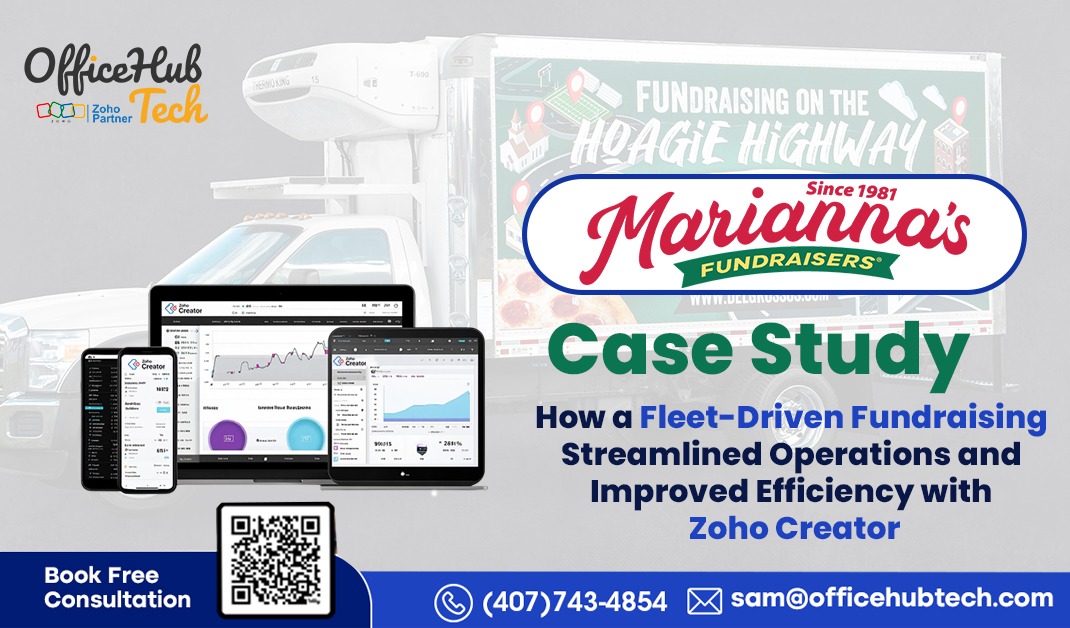
How a Fleet-Driven Fundraising Company Streamlined Operations and Improved Efficiency with Zoho Creator
Marianna’s Fundraisers, a Pennsylvania-based organization specializing in food fundraising programs, was experiencing increasing operational complexity as its business continued to grow. With operations heavily dependent on coordinating bookings, production schedules, delivery routes, and fleet capacity, managing day-to-day activities became progressively more challenging.
While the company had established internal processes using spreadsheets, shared calendars, and manual coordination, these systems were not designed to handle growing operational volume. Scheduling required cross-checking multiple sources, routing decisions lacked centralized visibility, and customer and booking data were distributed across different tools. As a result, inefficiencies began to impact response time, operational accuracy, and overall productivity.
Booking management lacked structure, delivery scheduling required manual validation, and fleet utilization decisions were based on limited visibility. This made it difficult to scale operations while maintaining consistency and efficiency.
To address these challenges, Marianna’s Fundraisers partnered with OfficeHub Tech to design and implement a centralized, custom-built application using Zoho Creator. The objective was to replace fragmented workflows with a unified system that could streamline scheduling, improve route planning, integrate with existing systems, and provide real-time operational visibility.
The transformation resulted in improved coordination across departments, reduced manual workload, and a more structured approach to managing bookings, routing, and delivery operations. This transformation highlights the impact of a custom Zoho Creator solution for fleet-driven and operations-intensive businesses.
Executive Summary
Client: Marianna’s Fundraisers
Location: Pennsylvania, USA
Industry: Fundraising / Food Distribution / Fleet Operations
Zoho Partner: OfficeHub Tech
Zoho Applications Used: Zoho Creator, Zoho Analytics
Integrations: Sage 100, Google Maps
Marianna’s Fundraisers operates in a coordination-intensive business environment where booking accuracy, delivery scheduling, and fleet utilization directly influence operational performance. Each fundraising campaign requires precise alignment between customer bookings, production timelines, delivery routes, and available truck capacity. As operational demand increased, the company’s reliance on spreadsheets and disconnected systems began limiting efficiency and slowing decision-making.
Scheduling processes required manual validation across multiple sources, routing decisions lacked centralized visibility, and customer and booking data were not consistently aligned across systems. This created delays in booking confirmations, reduced operational clarity, and increased dependency on manual coordination.
OfficeHub Tech was engaged to design and implement a centralized system using Zoho Creator that could align booking, scheduling, routing, and customer data into a single operational framework. The solution was designed to eliminate fragmented workflows, reduce manual effort, and provide real-time visibility into fleet operations.
By restructuring the operational workflow into a unified system, Marianna’s Fundraisers was able to improve coordination across teams, enhance scheduling efficiency, and create a scalable foundation for managing future growth.
Problem Statement and Key Challenges
Before engaging OfficeHub Tech, Marianna’s Fundraisers was operating with a combination of spreadsheets, shared calendars, and internal coordination methods to manage its core operations. While these tools supported day-to-day activities at a smaller scale, they were not structured to handle increasing operational complexity or provide consistent visibility across workflows.
As booking volumes and delivery requirements grew, the limitations of these systems became more pronounced. Scheduling, routing, and customer data management were not centralized, leading to inefficiencies, delays, and increased dependency on manual coordination.
1. Manual Scheduling and Fleet Coordination
Scheduling deliveries required coordination across multiple tools, including spreadsheets and calendars, without a centralized system to validate availability or capacity.
Each new booking required manual verification of:
- Existing delivery schedules
- Truck availability and capacity
- Route feasibility based on location
- Production and delivery timelines
This process was time-intensive and introduced operational bottlenecks. As scheduling complexity increased, it became difficult to maintain accuracy while responding quickly to new booking requests.
2. Fragmented Data Across Systems
Customer information, booking details, and delivery schedules were stored across separate systems without consistent structure or synchronization.
This resulted in:
- Duplicate data entry across tools
- Inconsistent customer and booking records
- Difficulty accessing accurate, real-time information
Without a single source of truth, teams relied on manual cross-checking, which increased workload and reduced operational reliability.
3. Limited Visibility into Scheduling and Routing
The organization lacked a centralized view of daily operations, including delivery schedules, routes, and fleet utilization.
Key visibility gaps included:
- No consolidated scheduling dashboard
- Limited insight into route planning and optimization
- Lack of real-time capacity tracking
- Difficulty identifying scheduling conflicts
As a result, decision-making relied heavily on experience and manual coordination rather than structured, system-driven insights.
4. Inefficient Booking and Response Process
Processing new bookings required checking multiple data sources, which slowed response times and affected customer experience.
The absence of a structured booking system led to:
- Delays in confirming availability
- Increased risk of scheduling conflicts
- Limited ability to handle high booking volumes efficiently
This created challenges in maintaining service consistency as demand increased.
5. Lack of Integration with Core Business Systems
Although Sage 100 was used for accounting and CRM functions, it was not integrated with operational workflows such as scheduling and routing.
This resulted in:
- Repetitive data entry across systems
- Lack of synchronization between operations and finance
- Increased administrative effort
Without integration, operational efficiency was limited, and data consistency could not be maintained across platforms.
Business Impact of These Challenges
Individually, each of these issues introduced operational inefficiencies. Collectively, they:
- Increased manual workload across teams
- Slowed scheduling and booking processes
- Reduced visibility into fleet operations
- Limited data accuracy and consistency
- Restricted the organization’s ability to scale operations efficiently
Although foundational systems were in place, they were not configured to operate as a structured, integrated operational framework. The organization required a centralized solution that could align scheduling, routing, customer data, and reporting into a cohesive system.
Evaluation and Discovery Process
Rather than immediately implementing changes, OfficeHub Tech initiated the engagement with a structured evaluation of Marianna’s Fundraisers’ existing operational workflows. The objective was to identify not only visible inefficiencies, but also underlying gaps in workflow design, data structure, and system integration.
The assessment focused on how bookings were managed, how scheduling decisions were made, how routing and fleet allocation were handled, and how data flowed between operational and financial systems.
The evaluation was structured across five key areas:
1. Data Structure and Centralization Assessment
A detailed review of customer records, booking data, and delivery schedules revealed that information was distributed across spreadsheets, calendars, and internal tools without a standardized structure.
Key observations included:
- Inconsistent data entry formats across systems
- Duplicate records for customers and bookings
- Lack of centralized data validation rules
- No unified database for operational information
This fragmentation made it difficult to maintain accuracy and created dependency on manual reconciliation.
The assessment concluded that a centralized data model was required to ensure consistency and reliability across all operational workflows.
2. Scheduling and Booking Workflow Analysis
The scheduling process was examined to understand how bookings were confirmed and how delivery timelines were assigned.
It was observed that:
- Scheduling decisions required manual cross-referencing of multiple sources
- No automated validation for availability or capacity
- No standardized workflow for booking approval
- High dependency on individual knowledge and experience
The absence of a structured scheduling system limited the organization’s ability to scale operations efficiently.
The evaluation identified the need for:
- A centralized booking system
- Real-time scheduling visibility
- Automated validation of delivery constraints
- Structured workflow for booking confirmation
3. Fleet and Route Planning Evaluation
Routing and fleet allocation processes were analyzed to determine how delivery planning was executed.
Key gaps identified:
- No centralized route visualization
- Limited ability to optimize delivery routes
- No system-driven allocation of truck capacity
- Difficulty balancing delivery loads across available vehicles
Routing decisions were primarily manual, which reduced efficiency and increased planning time.
The evaluation recommended implementing:
- Map-based route visualization
- Capacity-based fleet allocation logic
- Integrated routing and scheduling workflows
4. Workflow Automation Assessment
OfficeHub Tech reviewed the level of automation across operational processes.
It was observed that:
- Booking confirmations were not automated
- Scheduling updates required manual communication
- No automated notifications for internal teams or customers
- Limited use of system-driven triggers
As operational volume increased, the lack of automation created delays and increased administrative workload.
The assessment recommended implementing event-based automation to:
- Trigger notifications for bookings and scheduling updates
- Reduce manual communication effort
- Ensure consistency across workflows
5. System Integration and Data Flow Analysis
The interaction between operational systems and Sage 100 was evaluated to understand how data moved across platforms.
Key findings:
- No direct synchronization between booking and accounting data
- Repetitive data entry across systems
- Lack of real-time data flow between operations and finance
- Limited visibility into financial data from an operational perspective
The absence of integration created inefficiencies and increased the risk of data inconsistencies.
The evaluation identified the need for:
- Seamless integration between Zoho Creator and Sage 100
- Automated data synchronization
- Unified visibility across operational and financial systems
Strategic Conclusion of Evaluation Phase
The discovery process revealed that the primary challenge was not the absence of tools, but the lack of a structured and integrated operational framework. Existing processes were heavily dependent on manual coordination and lacked the system-driven logic required for scalability.
Marianna’s Fundraisers required:
- Centralized data management
- Structured booking and scheduling workflows
- Automated routing and fleet allocation
- Workflow-driven automation
- Integrated system architecture
Based on these findings, OfficeHub Tech developed a solution roadmap to transform the existing processes into a unified, automated, and scalable operational system.
Proposed Solution and System Architecture
Based on the findings from the evaluation phase, OfficeHub Tech designed and implemented a centralized, workflow-driven system using Zoho Creator tailored to Marianna’s Fundraisers’ operational requirements.
The solution was built to unify booking management, scheduling, routing, fleet utilization, and customer data into a single operational platform, while integrating with existing systems such as Sage 100 and external services like Google Maps.
Zoho Creator – Centralized Operations and Workflow Platform
Zoho Creator was implemented as the core application layer, acting as a centralized system to manage all operational workflows. The platform was designed to replace fragmented tools with a structured, scalable, and automation-driven environment.
The application architecture was modular, ensuring flexibility while maintaining consistency across workflows.
Key Modules and Functional Components
1. Booking Management System (Core Module)
A centralized booking module was developed to capture and manage all fundraiser-related data within a structured format.
Key capabilities included:
- Standardized capture of customer and event details
- Centralized storage of booking and delivery information
- Validation of required fields to ensure data consistency
- Elimination of duplicate or incomplete booking records
This module served as the foundation of the system, ensuring that all downstream processes operated on accurate and consistent data.
2. Scheduling and Calendar Management
A dynamic scheduling system was implemented to provide real-time visibility into delivery timelines and booking availability.
Enhancements included:
- Interactive calendar views for delivery scheduling
- Centralized visibility of all scheduled events
- Identification of scheduling conflicts and overlaps
- Improved coordination between booking and delivery planning
This enabled faster and more accurate scheduling decisions without relying on manual cross-referencing.
3. Route Planning and Mapping Integration (Google Maps)
To improve delivery efficiency, the system was integrated with Google Maps for route visualization and planning.
Key functionalities:
- Visualization of delivery locations on a map interface
- Route-based planning aligned with scheduling data
- Improved geographic coordination of deliveries
- Support for more efficient route allocation
This significantly enhanced the ability to plan deliveries based on location and logistics constraints.
4. Fleet Capacity and Delivery Management Dashboard
A dedicated dashboard was designed to provide visibility into fleet utilization and delivery capacity.
Capabilities included:
- Monitoring of truck capacity and load distribution
- Allocation of deliveries based on available resources
- Visibility into daily and future delivery commitments
- Improved planning of fleet utilization
This allowed the organization to make informed decisions regarding resource allocation and delivery planning.
5. Customer and Data Management System
A centralized customer data module was implemented to maintain a single source of truth for all customer-related information.
Key features:
- Unified database for customer records
- Historical tracking of bookings and interactions
- Elimination of duplicate data entries
- Improved accessibility of customer information across teams
This ensured consistency and reliability of data across all operational workflows.
6. Workflow Automation and Notification System
Automation was integrated into the system to reduce manual effort and improve communication.
Automation logic included:
- Event-based triggers for booking confirmations
- Automated notifications for scheduling updates
- Internal alerts for operational changes
- Reduction of manual communication across teams
This improved efficiency and ensured consistency in communication.
7. Reporting and Analytics (Zoho Analytics Integration)
Zoho Analytics was integrated to provide advanced reporting and operational insights.
Capabilities included:
- Real-time dashboards for operational performance
- Visibility into booking trends and delivery metrics
- Data-driven decision-making support
- Consolidated reporting across operational data
This enabled leadership to monitor performance and make informed strategic decisions.
8. Sage 100 Integration
To ensure continuity with existing financial systems, Zoho Creator was integrated with Sage 100.
Integration benefits:
- Automated data synchronization between systems
- Elimination of repetitive data entry
- Consistent data flow between operations and finance
- Improved alignment between booking and financial records
This created a unified system where operational and financial data remained aligned.
System Architecture Overview
The final system architecture positioned Zoho Creator as the central operational platform, connecting booking, scheduling, routing, and customer data with external integrations and reporting tools.
- Zoho Creator → Operational control layer
- Google Maps → Route planning layer
- Sage 100 → Financial and CRM integration layer
- Zoho Analytics → Reporting and insights layer
This structured architecture ensured seamless data flow, improved visibility, and reduced dependency on manual processes.
Implementation
The implementation of the Zoho Creator-based system for Marianna’s Fundraisers was carried out through a structured and phased approach to ensure minimal disruption to ongoing operations while maintaining alignment with real-world workflow requirements.
OfficeHub Tech worked closely with the client throughout the engagement, focusing on iterative development, validation, and user adoption.
Implementation Phases
1. Workflow Mapping and Requirement Alignment
The project began with a detailed mapping of existing operational workflows, including booking processes, scheduling logic, routing coordination, and fleet management practices.
This phase involved:
- Identifying gaps in current processes
- Defining system requirements based on real operational needs
- Aligning stakeholders on workflow structure and priorities
- Establishing data flow between operational and financial systems
The objective was to ensure that the system design reflected how the business actually operated, rather than imposing rigid software structures.
2. Application Design and Development (Zoho Creator)
Based on the defined requirements, OfficeHub Tech designed and developed a custom Zoho Creator application with modular architecture.
Development included:
- Creation of booking, scheduling, and routing modules
- Implementation of structured data models
- Development of dashboards and operational views
- Configuration of workflow automation and validation logic
Each module was built to integrate seamlessly within the broader system architecture.
3. Integration Setup (Sage 100 & Google Maps)
To ensure seamless data flow across systems, integrations were configured during the development phase.
This included:
- Connecting Zoho Creator with Sage 100 for data synchronization
- Integrating Google Maps for route visualization and planning
- Ensuring consistent data exchange between systems
- Validating data accuracy across platforms
These integrations eliminated the need for repetitive data entry and improved overall system efficiency.
4. Testing and System Validation
Before deployment, the system underwent multiple rounds of testing to ensure accuracy, reliability, and usability.
Testing activities included:
- Validation of booking workflows and scheduling logic
- Verification of data consistency across modules
- Testing of automation triggers and notifications
- Simulation of real-world operational scenarios
Feedback from the client team was incorporated to refine workflows and improve usability.
5. User Training and Adoption
OfficeHub Tech conducted structured training sessions to ensure that users could effectively adopt the new system.
This phase focused on:
- Demonstrating system functionality and workflows
- Training staff on booking, scheduling, and reporting processes
- Addressing user queries and operational concerns
- Ensuring confidence in using the new platform
The goal was to enable smooth transition from manual processes to a system-driven workflow.
6. Post-Implementation Support and Optimization
Following deployment, OfficeHub Tech provided ongoing support to monitor system performance and address any issues.
This included:
- Continuous system monitoring and refinement
- Optimization based on real-time usage patterns
- Support for user feedback and enhancements
- Ensuring long-term system stability and scalability
Implementation Approach and Collaboration
Throughout the project, OfficeHub Tech maintained close collaboration with Marianna’s Fundraisers to ensure that the solution aligned with operational realities.
The implementation approach emphasized:
- Practical system design over theoretical workflows
- Incremental validation to reduce risk
- Continuous communication and feedback
- Flexibility to adapt to evolving requirements
This collaborative methodology ensured successful deployment and strong user adoption.
Results and Business Impact
Following the implementation of the Zoho Creator-based system, Marianna’s Fundraisers experienced measurable improvements across operational efficiency, scheduling accuracy, and overall workflow management.
The transition from manual coordination to a centralized, system-driven approach enabled the organization to streamline core processes and improve decision-making across teams.
Operational Improvements
The team saw the most immediate impact in day-to-day operational activities:
- Scheduling and booking processes became faster and more structured
- Manual coordination across spreadsheets and calendars was significantly reduced
- Improved visibility into delivery schedules and fleet allocation
- Reduced duplication of data across systems
- Enhanced coordination between sales, operations, and delivery teams
The centralized system allowed teams to access accurate, real-time information without relying on manual validation.
Workflow Efficiency Gains
The introduction of automation and structured workflows improved overall efficiency:
- Booking confirmations and scheduling updates became more consistent
- Reduced dependency on manual follow-ups and internal communication
- Faster response times for new booking requests
- Improved accuracy in delivery planning and execution
These improvements enabled the organization to handle higher operational volume without increasing administrative workload.
Fleet and Resource Optimization
The system provided better control over fleet utilization and delivery planning:
- Improved allocation of truck capacity based on delivery requirements
- Better route planning through map-based visualization
- Reduced scheduling conflicts and overlaps
- More efficient use of available resources
This resulted in more predictable and optimized delivery operations.
Data Accuracy and Visibility
With centralized data management and system integration:
- Customer and booking data became consistent and reliable
- Real-time visibility into operational metrics was established
- Reduced errors caused by duplicate or outdated information
- Improved reporting accuracy through structured data
Leadership gained clearer insights into operational performance, enabling more informed decision-making.
System-Level Impact
At a broader level, the implementation delivered:
- A unified operational platform replacing fragmented systems
- Improved alignment between operations and financial systems through integration
- Scalable infrastructure to support future growth
- Reduced operational risk associated with manual processes
The system now functions as a structured, integrated environment supporting both daily operations and long-term business planning.
Overall Business Transformation
The shift from manual, disconnected workflows to a centralized Zoho Creator system fundamentally changed how Marianna’s Fundraisers manages its operations.
The organization moved from reactive coordination to proactive, system-driven management, enabling greater efficiency, consistency, and scalability across all operational areas.
Client Feedback
Todd Hill, President of Marianna’s Fundraisers, shared that the implementation of the Zoho Creator system significantly improved how the organization manages its day-to-day operations. He highlighted that the transition from spreadsheets and manual coordination to a centralized platform brought much-needed clarity and structure to their workflow.
He emphasized that one of the most valuable aspects of the solution was the ability to visualize scheduling, routing, and fleet capacity in a single system. This reduced the need for constant cross-checking and made it easier for the team to make informed decisions quickly.
Todd also noted that the team built the system around their actual operational needs rather than forcing adaptation to rigid software processes. This made adoption smoother and ensured that the platform was practical for everyday use.
The team described the collaboration with OfficeHub Tech as responsive, flexible, and highly aligned with the business. The team’s ability to understand the workflow in detail and translate it into a functional system played a key role in the success of the project.
“Having everything centralized—from scheduling to routing and fleet capacity—has completely changed how we operate. What used to take multiple steps and constant cross-checking is now clear, structured, and much easier to manage. The system was built around how we actually work, and that made all the difference for our team.”
— Todd Hill, President, Marianna’s Fundraisers
Overall, the team viewed the experience as a positive transformation in both operational efficiency and productivity.
Conclusion
Marianna’s Fundraisers’ transformation highlights how a structured, custom-built system can significantly improve operational efficiency in a fleet-driven business environment. By centralizing booking management, scheduling, routing, and customer data into a single Zoho Creator platform, the organization was able to move away from fragmented workflows and manual coordination. The implementation enabled better visibility into daily operations, improved decision-making, and reduced dependency on spreadsheets and disconnected systems. This case demonstrates how aligning technology with real operational processes can create a more efficient, scalable, and reliable workflow framework.
OfficeHub Tech continues to support organizations that require practical, workflow-driven solutions tailored to their business operations. As a Certified Zoho Creator Developer and consulting partner In USA, India, UAE and KSA, the team focuses on building systems that integrate seamlessly with existing processes while enabling long-term scalability. If your business relies on scheduling, logistics, or operational coordination and is facing challenges with manual processes or system limitations, it may be time to rethink your approach. Let’s build a solution that works the way your business operates. Schedule a consultation today to explore how a customized Zoho solution can support your growth.
Contact Us:
OfficeHub Tech LLC
2480 Cherry Laurel Dr, STE #179, Sanford, FL 32771
Email: sam@officehubtech.com
Phone: (407) 743-4854 (USA)
Call/ WhatsApp : +91 9384999342 (IN)
Website: www.officehubtech.com
Schedule a consultation: https://calendly.com/officehubtech