From Clicking Through Systems to Simply Asking
AV system integrators rely heavily on tools like D-Tools SI to manage projects, clients, and technical data. But despite having structured systems in place, accessing the right information at the right time is still a challenge. Teams often spend valuable time navigating dashboards, applying filters, and switching between modules just to retrieve a single piece of project information.
This creates a hidden inefficiency—where the tool designed to improve productivity becomes a bottleneck for decision-making.
In this blog, we will explore how D-Tools Agentic AI transforms this experience by allowing users to retrieve complete AV project information using simple natural language prompts. We will break down the limitations of traditional interfaces, explain how D-tools Agentic AI works using Claude AI and MCP (Model Context Protocol), and explore the technical architecture behind it. We will also look at real-world use cases, business impact, and how AV businesses can move toward a more intelligent, AI-driven operational model.
The Problem: Why Accessing AV Project Data is Still Slow
Even with advanced platforms like D-Tools, retrieving project data is not as efficient as it should be. The issue lies in how systems are designed—structured for storage, not for intuitive retrieval.
Manual Navigation Across Systems
Users often need to navigate through multiple layers within D-Tools to find project details. This includes searching by project ID, applying filters, and drilling into different modules. While the data exists, accessing it requires time and familiarity with the system.
Dependency on Specific Roles
In many AV organizations, only certain team members are comfortable retrieving detailed project data. This creates dependency on operations or admin teams, slowing down decision-making for sales, management, or field teams.
Fragmented Data Access
Project-related data—such as client details, product lists, and financial information—may reside in different sections. Users must piece together information manually instead of accessing a unified view.
Impact on Business Agility
These inefficiencies lead to delays in responding to clients, planning resources, and making strategic decisions. In fast-moving AV projects, even small delays can impact overall delivery timelines.
Why Traditional Approaches Fail
Traditional systems are built around structured navigation and predefined workflows. While effective for data entry and storage, they fall short when it comes to flexible data retrieval.
Search-Based Interfaces Are Limited
Most systems rely on keyword-based search. If the query is not structured correctly, users may not get accurate results. These interfaces do not understand intent—they only match inputs.
Additionally, search results are often limited to surface-level data, requiring users to manually open multiple records to gather complete information. This increases the time required to derive meaningful insights, especially in complex AV projects.
Static Dashboards and Reports
Dashboards provide fixed views of data, and reports require configuration. They are not designed for dynamic queries like “Show me all delayed projects for Client X with pending invoices.”
Another limitation is that dashboards are built based on predefined assumptions. As business requirements change, these dashboards quickly become outdated, forcing teams to rely on manual analysis or request new reports—slowing down decision-making cycles.
Lack of Contextual Intelligence
Systems do not connect user intent with available data. They require users to know where and how to search, rather than guiding them.
More importantly, traditional systems fail to establish relationships between different datasets. For example, they cannot automatically correlate project delays with inventory shortages or financial constraints, leaving users to interpret data manually.
No Natural Language Interaction
Perhaps the biggest limitation is the absence of conversational interfaces. Users must adapt to the system instead of the system adapting to the user.
This creates a learning curve, especially for non-technical users, and limits accessibility across teams. As a result, valuable data remains underutilized simply because it is not easy to access.
Limited Real-Time Responsiveness
Traditional systems often rely on scheduled updates or manual refresh cycles, which means the data available to users may not reflect the latest changes.
In fast-paced AV environments, this delay can lead to outdated insights, affecting project planning, inventory decisions, and client communication.
Disconnected Actionability
Even when users successfully retrieve data, taking action is not seamless. They must navigate to different modules or systems to perform updates or trigger workflows.
This separation between data retrieval and execution creates inefficiencies and breaks the natural flow of operations.
What is D-Tools Agentic AI?
D-Tools Agentic AI introduces a fundamentally new interaction model—where systems understand, process, and act on user intent.
The Agentic AI Loop:
Understands → Thinks → Acts → (loops back)
At its core, Agentic AI operates on a three-step intelligence loop:
- Understands: Interprets natural language prompts and identifies intent
- Thinks: Applies logic to determine the correct action and data relationships
- Acts: Executes actions by invoking system tools and retrieving results
This is what differentiates Agentic AI from traditional automation. It is not just executing predefined workflows—it is dynamically making decisions based on context.
Role of MCP (Model Context Protocol)
MCP acts as the backbone of this system. It exposes business actions—such as retrieving projects, updating records, or accessing inventory—as tools.
Beyond connectivity, MCP provides a secure, scalable, and reliable integration layer, handling authentication, request validation, and system orchestration. This ensures enterprise-grade stability even as operations scale.
Claude AI as the Interaction Layer
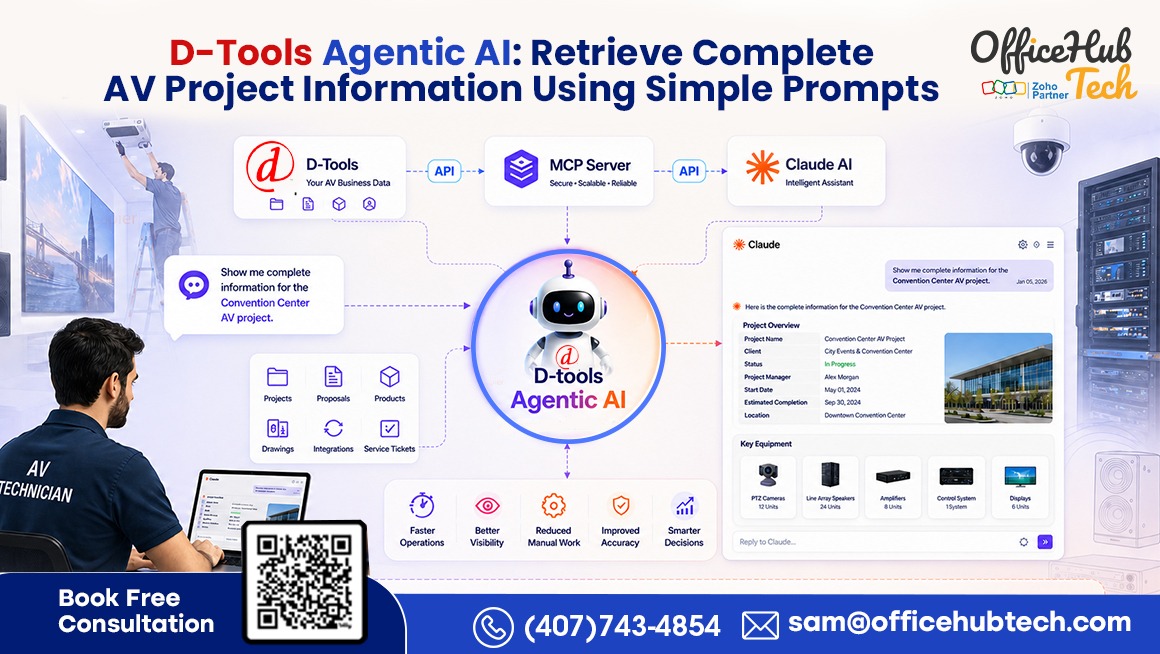
Using Claude AI + MCP Server + D-tools Integration, users can interact with D-Tools conversationally. Instead of navigating interfaces, they simply ask questions—and the system responds intelligently.
From Interface to Intelligence
Instead of clicking through menus, users can type queries like:
“Show me all active projects for Client A”
or
“Get full details of Project XYZ”
The system interprets the intent and retrieves the data instantly.
How It Works: From Prompt to Action
The workflow behind Agentic AI is both simple for the user and technically structured behind the scenes.
Step-by-Step Flow:
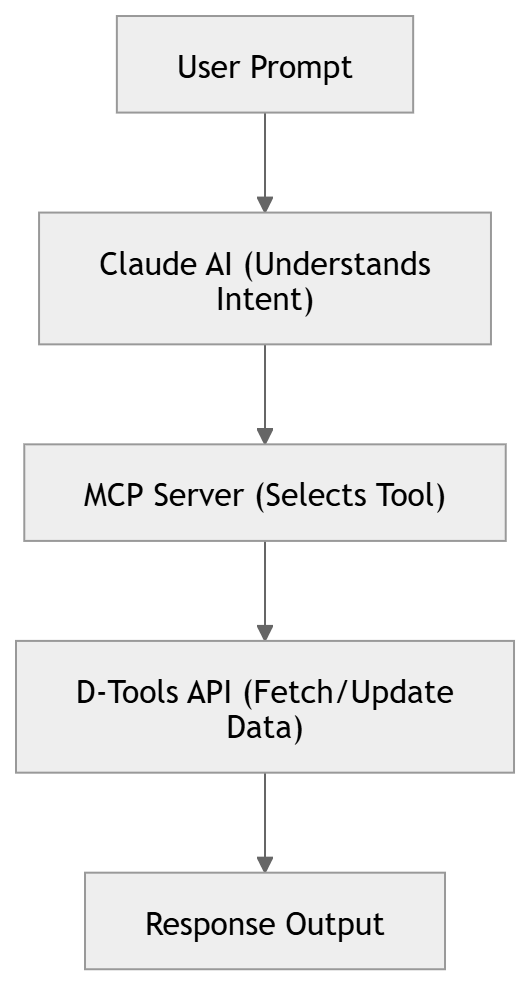
A user enters a prompt in natural language. Claude AI interprets the request and identifies the intent. Based on this intent, MCP selects the appropriate tool. That tool then interacts with D-Tools via API to fetch or update data. The response is processed and presented back to the user in a readable format.
Technical Foundation
The MCP server is built using Python and acts as the orchestration layer. Tools are defined within the system to handle specific actions like project retrieval or client lookup. Each tool communicates with D-Tools APIs and ensures structured data exchange.
Why This Matters
This creates a direct mapping between prompt → business outcome, reducing friction and enabling faster action.
This approach removes the need for manual system navigation and replaces it with intelligent automation. It allows users to interact with complex systems in a simple and intuitive way.
Key Capabilities of D-Tools Agentic AI
D-Tools Agentic AI extends beyond basic queries and enables real-time interaction with business data.
Users can retrieve complete project information, including scope, status, and financial details. They can search projects based on client name, progress status, or budget. The system also allows creation and updating of projects using prompts, reducing dependency on manual workflows.
Additionally, users can access product catalogs, retrieve specifications, and perform inventory lookups. These capabilities make it possible to handle both operational and strategic tasks through a single conversational interface.
To better understand its real impact, here are some of the key advanced capabilities:
Context-Aware Data Retrieval
The system does not just fetch isolated data—it understands relationships between different data points. When retrieving project details, it can also present related client information, product configurations, and progress indicators in a single response, eliminating the need for manual cross-referencing.
Multi-Condition Natural Language Queries
Users can combine multiple conditions in one prompt, such as filtering projects by status, timeline, and budget simultaneously. This removes the dependency on predefined reports and enables flexible, real-time data exploration.
Action-Oriented Interaction (Not Just Viewing Data)
D-Tools Agentic AI allows users to take immediate action after retrieving data. Whether updating project details, initiating workflows, or modifying records, actions can be executed directly through prompts without switching interfaces.
Real-Time Data Processing & Response
All interactions are processed instantly, ensuring that users always receive up-to-date information. This is critical for AV businesses where decisions often depend on real-time project and inventory data.
Structured Tool-Based Execution Model
Behind the scenes, each request is executed through a defined tool architecture, ensuring consistency, accuracy, and reliability even for complex queries.
Together, these capabilities transform D-Tools from a static system of record into an intelligent, interactive platform aligned with modern AV business needs.
Before vs After: The Transformation in AV Workflows
Before Agentic AI, AV workflows are fragmented. Teams rely on multiple tools, manual updates, spreadsheets, and emails to coordinate operations. Data is scattered, and visibility is limited.
In this environment, even simple questions—like checking project status or verifying inventory—require multiple steps, often involving different team members. This creates delays, increases dependency, and introduces inconsistencies in how information is accessed and interpreted.
After implementing Agentic AI, a single intelligent layer sits on top of all systems. Projects provide real-time insights, proposals stay updated automatically, inventory remains synchronized, and reports become instantly accessible.
More importantly, the way users interact with systems fundamentally changes—from navigating interfaces to simply asking questions and receiving actionable responses.
This transformation can be better understood through a direct comparison:
| Aspect | Before Agentic AI | After Agentic AI |
| Data Access | Requires manual search across multiple modules | Instant retrieval using natural language prompts |
| Workflow Execution | Multi-step, dependent on different tools | Single-step, AI-driven execution |
| Decision Making | Based on delayed or partial data | Based on real-time, context-aware insights |
| User Dependency | Relies on system experts or admins | Accessible to all team members |
| System Interaction | Interface-driven (clicks, filters, navigation) | Conversation-driven (ask → get results) |
| Operational Speed | Slower due to manual coordination | Faster due to automation and real-time processing |
Beyond efficiency, this shift introduces a more predictable and scalable operational model. Teams no longer spend time searching for information—they act on it immediately. This not only improves internal productivity but also enhances responsiveness to clients, ultimately driving better project outcomes and business growth.
Real AV Business Use Cases
Instant Project Insights
With D-Tools Agentic AI, a project manager can instantly retrieve the status of multiple projects without navigating dashboards, improving response time and planning accuracy. Beyond basic status updates, this capability enables quick identification of delays, resource gaps, or potential risks across projects. Instead of relying on multiple reports, managers gain consolidated insights in seconds, allowing them to take proactive decisions and maintain better control over project execution.
Sales Enablement
D-Tools Agentic AI empowers sales teams to access proposal and project data in real time during client conversations. This ensures that every discussion is backed by accurate, up-to-date information, improving trust and confidence with clients. It also allows sales teams to respond instantly to changes in scope, pricing queries, or technical feasibility, reducing dependency on internal teams and accelerating the overall sales cycle.
Inventory & Procurement Visibility
Using D-Tools Agentic AI, operations teams can check product availability in real time, ensuring better planning and avoiding delays. More importantly, it allows teams to align inventory with project timelines, identify shortages early, and make informed procurement decisions. This level of visibility reduces last-minute disruptions and helps maintain consistent project execution across multiple engagements.
AI-Driven Project Creation
With D-Tools Agentic AI, new projects can be created directly from simple prompts, significantly reducing onboarding time and ensuring consistent data entry. This eliminates manual setup errors and standardizes project initiation processes. By capturing critical details such as scope, client information, and budget accurately from the start, businesses create a strong foundation for smoother execution and better tracking.
How Agentic AI Redefines Execution in AV Workflows
Shift from Interface-Based to Intent-Driven Execution
The real impact of D-Tools Agentic AI goes beyond faster data access—it fundamentally changes how work is executed in AV businesses. Instead of navigating multiple systems, users now operate through intent-driven commands, enabling a more natural and efficient interaction model.
From Multi-Step Processes to Single Prompt Execution
In traditional environments, even simple tasks require multiple steps—login, navigation, search, verification, and execution. With Agentic AI, this entire sequence is compressed into a single prompt, eliminating unnecessary steps and significantly reducing operational friction.
Cross-System Orchestration Through MCP
With MCP (Model Context Protocol), the system goes beyond data retrieval. It enables cross-platform execution, where a single instruction can:
- Retrieve project data
- Validate client information
- Check inventory availability
- Align financial details
All without switching between systems—creating a truly connected workflow environment.
Execution Driven by Intent, Not Tools
This introduces a new operational model where execution is no longer dependent on specific tools. Instead, workflows are driven by user intent, allowing teams to initiate outcomes directly rather than managing processes step-by-step.
From Integration to Intelligent Orchestration
This is not just about connecting systems—it’s about intelligent workflow orchestration. Businesses gain:
- Greater control over processes
- Reduced dependency on manual coordination
- Improved scalability across operations
Structured, Scalable, and Predictable Operations
For AV system integrators, this goes beyond just improving efficiency. It creates a structured and predictable workflow environment, where actions are executed seamlessly and decisions are supported by real-time, connected data.
Technical Architecture Overview
The architecture of D-Tools Agentic AI is designed to be modular and scalable.
The diagram below illustrates how D-Tools Agentic AI connects user prompts with real-time system actions through a structured and scalable architecture:
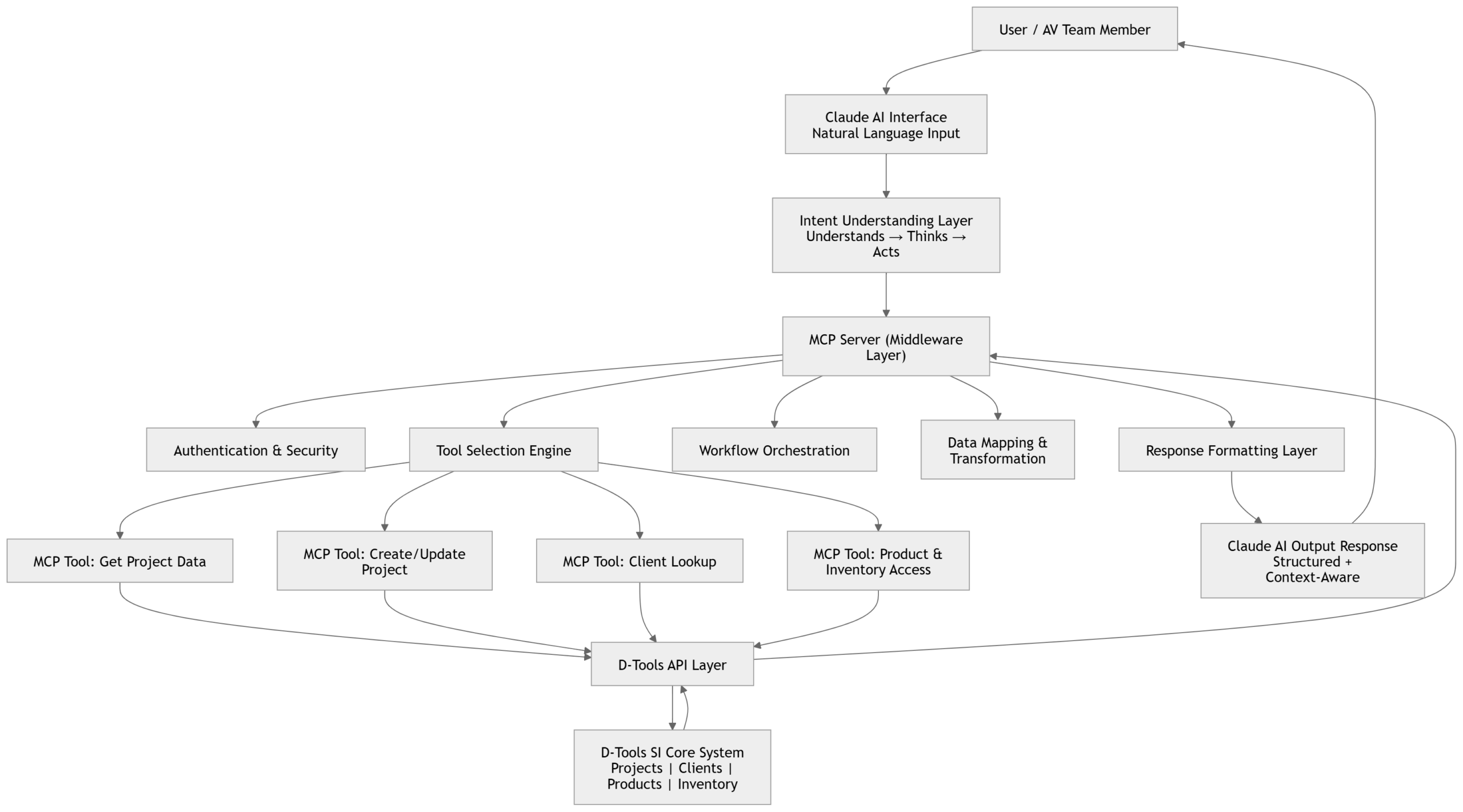
The diagram below illustrates how D-Tools Agentic AI connects user prompts with real-time system actions through a structured and scalable architecture
Understanding the Architecture Layers
1. User Interaction Layer
This is where the interaction begins. AV team members enter simple natural language prompts instead of navigating through multiple system screens. This layer removes dependency on technical expertise and allows any user to access complex system data easily.
2. AI Intelligence Layer (Claude AI)
This layer is responsible for understanding what the user actually wants. It interprets the prompt, identifies intent, and applies reasoning before taking action. Unlike traditional systems, it does not rely on fixed commands—it understands context and meaning behind user queries.
3. MCP Middleware Layer (Core Orchestration Engine)
The MCP server acts as the central control layer of the system. It decides which action needs to be performed, manages workflows, and ensures secure communication between systems. This layer also handles authentication, request validation, and orchestration, making the system scalable and reliable.
4. MCP Tools Layer (Business Action Layer)
Each MCP tool represents a specific business function such as retrieving project data, updating records, or accessing inventory. These tools are dynamically selected based on user intent, allowing flexible and real-time execution of operations without manual intervention.
5. API Integration Layer
This layer enables communication between MCP and D-Tools. It sends requests, retrieves data, and ensures that all system interactions happen in real time. APIs act as the bridge that connects the AI layer with actual business systems.
6. D-Tools Core System (Data Source Layer)
This is where all business data resides, including projects, clients, products, and inventory. It acts as the single source of truth, ensuring that all responses generated by the system are accurate and up to date.
7. Response & Output Layer
Once the data is retrieved, this layer formats it into a structured and user-friendly response. Instead of raw data, users receive meaningful insights that help them take immediate action.
Download for Free to explore how this architecture is implemented in practice, you can access the working setup and MCP server configuration here:
Business Impact & Benefits
The introduction of Agentic AI changes how AV businesses operate. It reduces dependency on system expertise and allows any team member to access critical information instantly.
Decision-making becomes faster because data is available on demand. Operational efficiency improves as manual workflows are replaced by automated processes. Teams can focus more on execution and less on system navigation.
This shift also enhances customer experience by enabling quicker responses and more accurate project insights.
Future of AV Operations with Agentic AI
The AV industry is moving toward intelligent, AI-driven systems where automation and decision-making go hand in hand. D-Tools Agentic AI represents a shift from static tools to dynamic systems that understand and act on user intent.
Looking ahead, AV platforms will evolve from reactive systems into proactive operational assistants. Instead of waiting for user input, D-Tools Agentic AI will continuously analyze project data, resource allocation, and timelines to recommend next steps, flag potential risks, and optimize execution workflows. This means project delays, inventory shortages, or budget overruns can be identified and addressed before they impact outcomes.
Another key advancement will be deeper contextual awareness. Systems will not only process commands but also understand business priorities, enabling more intelligent suggestions aligned with operational goals. This will allow AV businesses to move from task-based execution to outcome-driven operations.
As adoption grows, D-Tools Agentic AI will also enable seamless collaboration across departments by providing a unified intelligence layer, ensuring every team works with consistent, real-time insights. This evolution will empower AV system integrators to scale efficiently, reduce operational complexity, and maintain a competitive edge in an increasingly data-driven industry.
Conclusion: The Shift Toward Intelligent AV Systems
D-Tools Agentic AI is redefining how AV businesses interact with their data. By enabling natural language-based access to complex systems, it removes friction from workflows and improves overall efficiency. The shift toward D-Tools Agentic AI for AV project data retrieval is not just a technological upgrade—it represents a fundamental transformation in how AV operations are managed and executed.
As AV projects become more complex and data-driven, businesses can no longer rely on traditional navigation-based systems. The future lies in AI-powered AV workflow automation, where systems understand intent, execute actions, and deliver insights in real time. This evolution allows teams to move from reactive operations to proactive decision-making, improving both speed and accuracy across the organization.
More importantly, this approach introduces a unified layer of intelligence across tools, enabling seamless coordination between sales, design, operations, and finance. With intelligent AV system integration, businesses gain the ability to access, analyze, and act on data without delays or dependencies. This creates a more agile and scalable operational environment, essential for long-term growth in the AV industry.
Why Choose OfficeHub Tech for Agentic AI & AV Integration
As a Best AV Business Workflow Solution, Consultation, Agentic AI and Tools Implementation Provider Company In USA, and an Authorised Zoho Partner and n8n partner, OfficeHub Tech brings deep expertise in delivering AI-driven AV integration and Business Process solutions tailored for real-world AV business challenges.
We specialize in building intelligent systems that go beyond basic integrations—leveraging technologies like MCP, AI agents, and low-code platforms to create scalable, future-ready solutions. Our experience with platforms like D-Tools allows us to design custom AV automation workflows that align with your business processes and operational goals.
If you’re ready to move beyond traditional systems and embrace next-generation AV automation with Agentic AI, now is the time. Book a consultation with OfficeHub Tech and explore how we can transform your workflows into a fully connected, intelligent ecosystem built for scale.