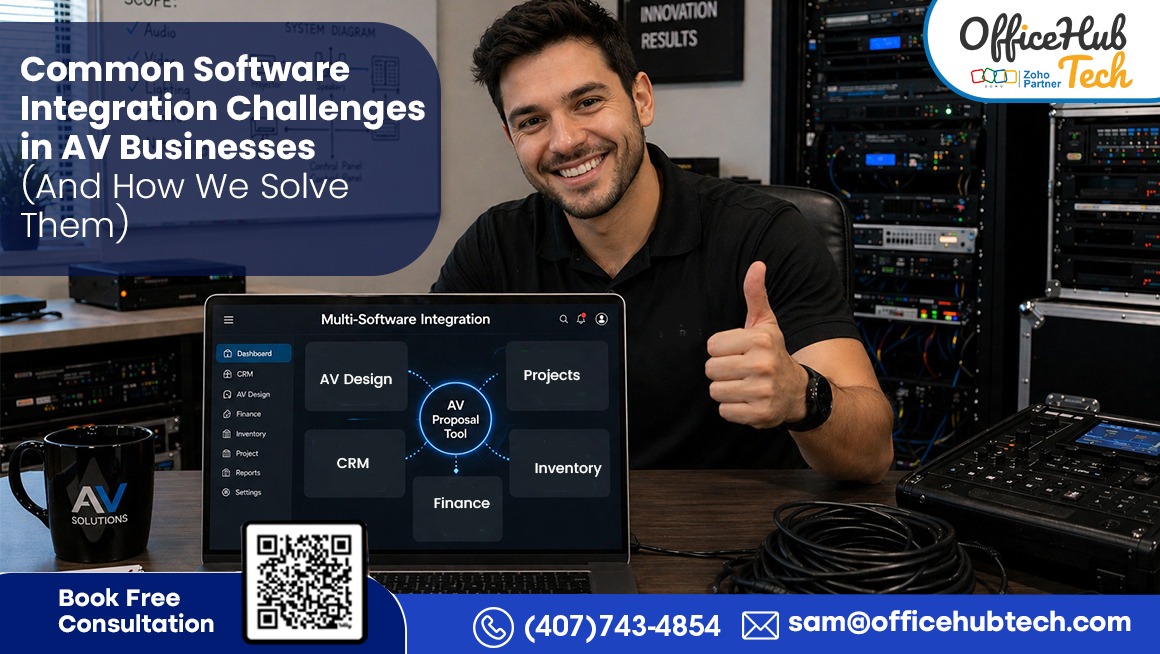
Common Software Integration Challenges in AV Businesses (And How We Solve Them)
Why AV Businesses Struggle Despite Using Advanced Software
AV system integrators today operate with some of the most advanced and specialized tools available. Platforms like D-Tools Cloud and XTEN-AV handle detailed proposals, while CRMs such as Salesforce and Zoho CRM manage customer relationships. On top of that, businesses invest in ERP systems like Oracle NetSuite, project tools like ClickUp, and accounting platforms like QuickBooks to cover every operational need.
Individually, these tools are powerful. Collectively, they create complexity.
The real challenge emerges in day-to-day execution—where teams depend on consistent data flow, quick decision-making, and seamless handoffs between departments. Instead of enabling efficiency, disconnected systems often introduce friction at critical stages like sales-to-project transition, procurement planning, and financial reconciliation.
What looks like a “complete tech stack” on paper often behaves like isolated islands in practice. Teams spend more time coordinating between systems than actually using them to drive outcomes.
This blog focuses on uncovering these hidden inefficiencies and explaining how AV businesses can move from tool-heavy operations to process-driven systems using multi software integration. We’ll explore where the gaps occur, how they impact growth, and what it takes to build a connected, future-ready infrastructure that supports scale without adding operational burden.
Understanding the Software Landscape in AV Businesses
AV system integrators operate in a highly specialized environment where different business functions rely on purpose-built tools. While this improves efficiency within individual teams, it creates a layered software ecosystem that becomes difficult to manage as operations grow.
CRM & Customer Management Platforms
Sales teams use systems like Salesforce, Zoho CRM, and HubSpot to manage pipelines and customer interactions. These platforms are strong at tracking opportunities, but they often stop at the sales stage—without extending visibility into execution or delivery.
Proposal & AV-Specific Estimation Tools
Pre-sales teams depend on tools such as D-Tools Cloud, XTEN-AV, and Jetbuilt to build detailed proposals and system configurations. They contain highly structured technical and pricing data, which becomes difficult to reuse efficiently outside the proposal phase.
Design & Engineering Software
Technical teams work with platforms like AutoCAD, Revit, and WireCAD to create system layouts and documentation.
These tools focus on precision and visualization, but their outputs are rarely aligned with operational or financial systems.
ERP & Business Management Systems
Core operations are managed through ERP systems such as Oracle NetSuite, SAP S/4HANA, and Odoo.
They are designed for control and reporting, but depend heavily on accurate upstream data to function effectively.
Project, Inventory & Financial Systems
Execution relies on tools like Monday.com and ClickUp, along with inventory platforms such as Fishbowl Inventory and accounting systems like QuickBooks and Xero. These systems drive delivery and financial outcomes, but often operate on delayed or manually transferred data.
While each category plays a critical role, these systems are built with different data models and workflows. This diversity is what makes integration challenging—not because tools are lacking, but because they are not naturally aligned to function as a unified system across the AV business lifecycle.
Common Software Integration Challenges in AV Businesses
Despite investing in advanced tools across sales, design, operations, and finance, most AV businesses continue to face recurring inefficiencies. The issue is not the lack of software—but the lack of integration between them.
Challenge 1: Data Silos That Break the Flow of Information
One of the most critical issues in AV businesses is the existence of data silos. Every system stores its own version of data, creating fragmentation across the organization.
For example, when a lead is captured in a CRM system like HubSpot or Pipedrive, that data does not automatically sync with proposal tools such as ProjX360 or Simply Reliable. Once a proposal is finalized, the same data is often manually transferred into ERP systems like SAP S/4HANA or Oracle NetSuite.
This duplication leads to inconsistencies. Sales teams, project managers, and finance teams may all be working with slightly different datasets, resulting in errors in pricing, scope, or timelines.
From a technical perspective, the issue stems from the absence of a unified data layer. Most platforms support APIs, but without a structured integration architecture, these APIs remain underutilized.
Multi-software integration solves this by creating a centralized data synchronization model. Data entered in one system automatically reflects across all connected platforms, ensuring a single source of truth.
Challenge 2: Manual Workflows That Slow Down Operations
Manual data entry is one of the most underestimated problems in AV businesses. It consumes time, introduces errors, and reduces overall efficiency.
A common scenario involves capturing a deal in Zoho CRM, creating a proposal in XTEN-AV, and then manually setting up the project in ClickUp or Jira. Each step requires re-entering the same information.
This is not just inefficient—it is risky.
From a technical standpoint, this happens because workflows are not automated through API integrations or event-driven triggers. Systems operate independently instead of responding to actions in other platforms.
Multi-software integration introduces automation across workflows. For instance, when a deal is marked as “closed” in a CRM, it can automatically trigger project creation, inventory allocation, and even financial entries.
This eliminates redundancy and ensures consistency across the entire lifecycle.
Challenge 3: Lack of Real-Time Visibility Across Teams
AV projects involve multiple teams working simultaneously. Without integration, each team operates in isolation, leading to poor visibility.
Project managers using tools like Smartsheet or Trello may not have real-time insights into inventory levels tracked in Snipe-IT or EZOfficeInventory. Similarly, finance teams working in FreshBooks or Zoho Books may not have access to live project cost data.
This creates delays in decision-making.
Technically, this issue arises due to asynchronous systems that do not communicate in real time. Without webhook-based triggers or event-driven architectures, updates are delayed or completely missed.
Multi-software integration enables real-time data flow. By connecting systems through APIs and automation tools, businesses can create centralized dashboards that provide complete visibility across operations.
Challenge 4: Complexity in Integrating Specialized AV Tools
AV businesses rely heavily on specialized design and engineering tools such as AutoCAD, SketchUp, Revit, and WireCAD. These tools are essential for creating accurate system designs but are not inherently designed for integration.
Design outputs often need to be manually interpreted and transferred into proposal or ERP systems. This creates a disconnect between design and execution.
The technical challenge lies in data format differences. These tools generate complex design files that are not easily consumable by business systems.
Multi-software integration addresses this through middleware and transformation layers. These systems convert design data into structured formats that can be used across proposal, ERP, and project management tools.
This ensures continuity from design to execution.
Challenge 5: Misalignment Between Project Execution and Resource Planning
Project management tools are widely used in AV businesses, but without integration, they fail to align with other operational systems.
For example, a project may be scheduled in Monday.com without verifying inventory availability in Asset Panda or procurement timelines in ERP systems. This leads to delays and resource conflicts.
The root cause is disconnected workflows.
When systems do not share data, project planning becomes reactive rather than proactive.
Multi-software integration connects project management tools with CRM, ERP, and inventory systems. This ensures that project timelines, resource allocation, and procurement are all aligned in real time.
Challenge 6: Financial Systems Operating in Isolation
Financial tracking is often disconnected from operational workflows in AV businesses.
Accounting tools like QuickBooks, Xero, and NetSuite Accounting operate independently from project and ERP systems. This makes it difficult to track profitability accurately.
Project costs, resource expenses, and procurement data are not always reflected in financial systems in real time.
From a technical perspective, this is due to the lack of integration between transactional systems and accounting platforms.
Multi-software integration bridges this gap by synchronizing financial and operational data. This enables real-time visibility into revenue, costs, and margins.
Why Traditional Integration Approaches Fail
Limitations of Native Integrations
Many platforms offer built-in integrations, but these are often limited to basic data syncing. For example, a native integration might sync contact information between CRM and proposal tools but fail to transfer detailed line items, pricing structures, or project timelines.
This partial integration creates a false sense of connectivity while leaving critical workflows disconnected.
Heavy Dependence on Custom Development
Custom API integrations between tools like Oracle ERP Cloud and ConnectWise Sell can be powerful but require significant development effort. These integrations are difficult to maintain, especially when software updates or business requirements change.
Over time, businesses find themselves dependent on developers for even minor changes, reducing agility and increasing costs.
Spreadsheet-Based Workarounds
In the absence of proper integration, many teams resort to exporting data into spreadsheets and manually importing it into other systems. While this approach may work temporarily, it is not scalable and introduces delays and errors.
Spreadsheets also lack audit trails and real-time synchronization, making them unsuitable for modern AV operations.
The Solution: Multi Software Integration for AV Businesses
Multi software integration is the process of connecting all business-critical tools into a centralized ecosystem where data flows seamlessly between systems. Instead of isolated applications, businesses operate with a unified data backbone that ensures consistency and real-time updates.
How It Works in an AV Environment
In a well-integrated system, proposal data from XTEN-AV or Jetbuilt automatically syncs with CRM platforms like Zoho CRM or Salesforce. Once a deal is closed, project management tools such as Monday.com or ClickUp are triggered to create project workflows.
Inventory systems update automatically, and accounting tools like QuickBooks generate invoices without manual intervention.
Role of Zoho Creator as Integration Layer
A low-code platform like Zoho Creator acts as the central integration layer. It connects different systems through APIs, automates workflows, and ensures data consistency across the organization.
This approach eliminates the need for heavy coding while providing flexibility to adapt to changing business needs.
AI and Automation in Integration
AI-driven automation enhances integration by handling exceptions, validating data, and triggering intelligent workflows. This ensures that processes run smoothly without constant human intervention.
Key Benefits of Multi Software Integration
Multi software integration transforms AV business operations by eliminating inefficiencies and creating a streamlined, connected workflow across the entire lifecycle.
Reduced Manual Effort and Operational Overhead
Manual data entry across systems is one of the biggest hidden costs in AV businesses. With integrated workflows, data captured in one system automatically flows to others, eliminating repetitive tasks. This not only reduces administrative workload but also minimizes the risk of human error that can impact project accuracy.
Real-Time Synchronization Across All Systems
In a disconnected setup, data is often delayed or outdated by the time it reaches the next system. Multi software integration ensures that updates happen in real time across CRM, proposal, project, and finance platforms. This creates a consistent and up-to-date data environment across all departments.
Faster Project Execution and Improved Timelines
Project delays often stem from gaps between sales, operations, and procurement. When systems are integrated, project creation, resource allocation, and task assignments are triggered automatically. This removes bottlenecks and accelerates the transition from sales to execution.
Accurate Financial Tracking and Reporting
Financial discrepancies usually arise when operational data and accounting systems are not aligned. Integration ensures that project costs, procurement data, and billing information are synchronized with financial platforms. This leads to more accurate reporting and better control over profitability.
Better Collaboration Between Teams
In most AV businesses, teams operate in silos due to disconnected tools. Integration creates a shared data environment where sales, design, operations, and finance teams work with the same information. This improves coordination and reduces miscommunication across departments.
Scalable Infrastructure for Future Growth
As AV businesses grow, adding new tools and processes becomes inevitable. A well-integrated system provides a flexible architecture where new software can be connected without disrupting existing workflows. This ensures that the business can scale without increasing operational complexity.
The most significant advantage is the creation of a single source of truth, enabling leadership teams to make informed decisions based on real-time, reliable data rather than fragmented insights.
Use Case: From Disconnected Workflow to Integrated System
Consider an AV integrator using D-Tools Cloud for proposals, HubSpot for sales, Asana for execution, and Xero for finance.
Before integration, each system operates independently. Sales closes a deal, but operations must manually recreate the project, often leading to inconsistencies in scope or timelines. Finance teams generate invoices separately, sometimes working with outdated or incomplete data, which impacts billing accuracy.
After implementing multi software integration, the workflow becomes connected and event-driven. Proposal data flows into the CRM, updates deal stages, and automatically triggers project creation with predefined tasks and timelines. Financial entries are generated based on approved data, ensuring consistency across the lifecycle.
Additional Real-World Use Cases in AV Businesses
-
Sales to Design Alignment
When a deal is finalized, system configurations from proposal tools can automatically sync with design platforms. This ensures that engineering teams work with accurate specifications, reducing rework and improving design accuracy.
-
Inventory & Procurement Synchronization
As soon as a project is initiated, inventory requirements are validated against available stock. If components are unavailable, procurement workflows can be triggered automatically, preventing last-minute delays.
-
Project Milestone-Based Billing
Integration enables billing to be aligned with project milestones. As execution progresses, financial systems can generate invoices based on predefined triggers, improving cash flow and reducing manual intervention.
-
Service & Maintenance Workflow Automation
Post-installation, system data can flow into service management tools, enabling automated scheduling of maintenance activities and faster response to support requests.
This transformation goes beyond automation—it creates a structured, predictable workflow where every system contributes to a unified operational process, ultimately improving efficiency, accuracy, and customer experience.
Technical Insight: How Integration Actually Works
At a technical level, multi software integration is built on APIs, middleware, and workflow automation working together as a unified system. Each software exposes APIs that allow structured data exchange, while a central layer like Zoho Creator acts as middleware—orchestrating how and when data moves across platforms.
API Connectivity & Data Exchange
Modern AV tools such as D-Tools Cloud, CRM systems, and ERP platforms communicate through REST APIs. These APIs enable real-time or scheduled data transfer, ensuring that critical information—such as project scope, pricing, or customer details—flows consistently between systems without manual input.
Data Mapping & Transformation Layer
Each platform stores data differently, which creates compatibility challenges. Integration platforms introduce a data mapping layer that aligns fields across systems. For example, structured product data from Specifi.io can be transformed into formats suitable for inventory and accounting systems, ensuring consistency across workflows.
Workflow Automation & Event Triggers
Automation is driven by event-based triggers. When a specific action occurs—such as a deal being marked “closed” in CRM—it can initiate a chain of processes, including project creation, procurement checks, and financial updates. This removes dependency on manual coordination between teams.
Error Handling, Monitoring & Scalability
A robust integration framework includes retry mechanisms, validation rules, and logging systems to handle failures and maintain data accuracy. Monitoring tools provide visibility into system performance, helping businesses identify bottlenecks and optimize workflows over time.
This architecture creates a scalable and resilient integration environment, enabling AV businesses to manage complex operations with greater control, reliability, and efficiency.
Conclusion: The Future of AV Businesses Lies in Integration
The absence of connection between tools causes software integration challenges in AV businesses, not the lack of tools. The shift toward multi software integration for AV businesses is no longer optional—it is essential for growth, scalability, and operational efficiency.
As AV projects become more complex and customer expectations increase, businesses that invest in integrated systems will gain a significant competitive advantage. The future belongs to organizations that can unify their tech stack and operate as a single, connected ecosystem.
Why Choose OfficeHub Tech for AV Software Integration
As a Trusted Zoho Consultation and implementation Company for AVSI industry in USA and an official Zoho Partner and n8n partner, OfficeHub Tech specializes in designing and implementing multi software integration solutions tailored for AV system integrators.
With deep expertise in AV-specific tools like D-Tools, XTEN-AV, and Jetbuilt, combined with strong capabilities in CRM, ERP, and automation platforms, we deliver solutions that go beyond basic integration.
Our approach focuses on building a centralized data backbone that connects all systems, eliminates manual work, and enables real-time decision-making. Whether you are looking to streamline operations, improve visibility, or scale your business, we provide end-to-end support from strategy to implementation.
Let’s Build Your Connected AV Ecosystem
If your AV systems are still disconnected, you’re losing efficiency every day. Let’s fix that with a tailored integration strategy. Book a consultation with OfficeHub Tech and discover how multi software integration can transform your AV operations into a fully connected, automated ecosystem.