Legacy ERP System Extension With Zoho Creator for Businesses (Strategy, Cost, Risk and ROI Explained)
Why Businesses Are Reconsidering Full ERP Replacement
Legacy ERP systems still power the core operations of thousands of businesses across manufacturing, logistics, distribution, finance, and service industries. These systems manage accounting, procurement, inventory, payroll, production, and transactional workflows that businesses depend on every day. However, modern operational demands have changed dramatically. Businesses now require real-time reporting, mobile accessibility, workflow automation, AI-driven processes, multi-software integrations, and cloud-ready operational environments. Unfortunately, many traditional ERP systems struggle to support these evolving requirements efficiently.
For years, ERP replacement was considered the default modernization strategy. But today, organizations are realizing that replacing an ERP system introduces significant operational disruption, migration complexity, financial risk, and implementation uncertainty. Large ERP transformation projects often take years to complete while consuming substantial resources. More importantly, businesses risk interrupting stable operational processes that are already deeply embedded across departments.
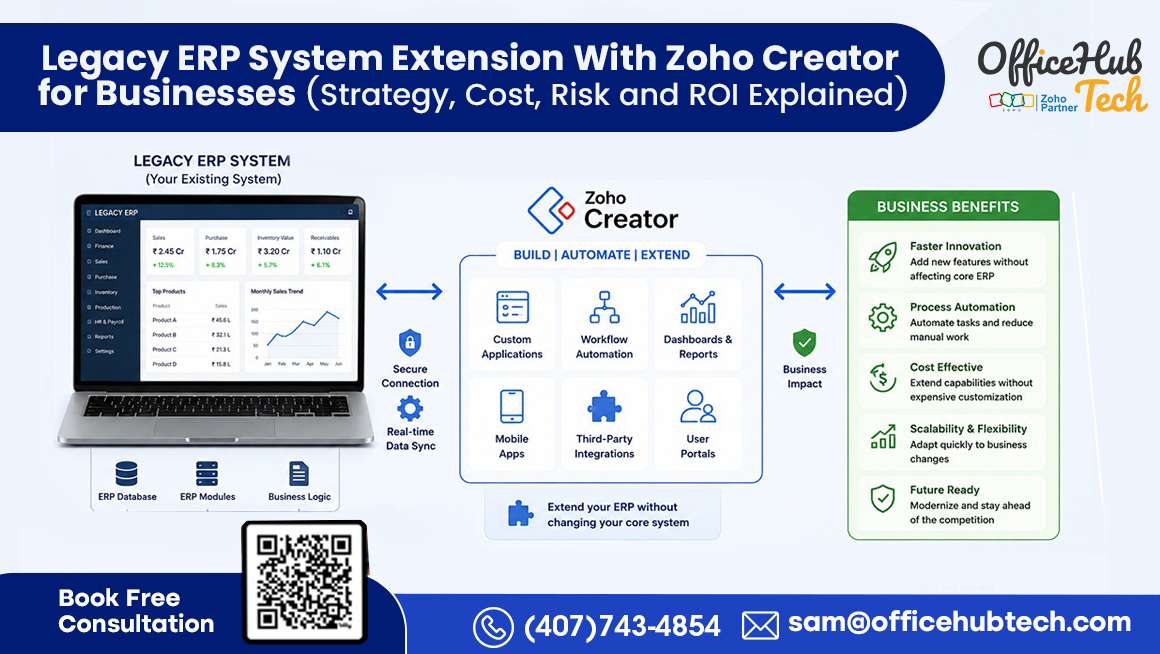
This is why Legacy ERP Extension with Zoho Creator is becoming a preferred modernization strategy. Instead of replacing the ERP core, businesses extend existing systems using low-code applications, API integrations, middleware architecture, workflow automation, and modern operational interfaces. This strategy enables businesses to upgrade operations gradually without affecting the stability of their core ERP system.
In this blog, we will discuss the complete strategy behind ERP extension, including modernization frameworks, implementation planning, technical architecture, cost analysis, operational risk management, scalability considerations, and how businesses measure ROI from low-code ERP modernization initiatives.
The Strategic Foundation of Legacy ERP Extension
Legacy ERP Extension is not simply about connecting a few applications to an old ERP system. It is a strategic modernization framework designed to extend operational capabilities without disturbing the ERP foundation responsible for critical business transactions. This strategy becomes extremely important for businesses that rely heavily on stable ERP environments but require faster operational innovation.
Traditional ERP systems were designed primarily for centralized data processing and structured business workflows. While these systems remain operationally valuable, they often lack flexibility for modern business requirements such as mobile operations, cross-platform integrations, workflow automation, customer portals, AI-driven analytics, and real-time visibility.
ERP extension solves this challenge through modular modernization. Instead of rebuilding the entire ERP environment, businesses extend operational workflows externally using low-code platforms like Zoho Creator. The ERP continues managing core transactional processes while modern applications handle automation, reporting, approvals, mobile workflows, and integration orchestration.
Strategically, this approach provides several advantages. Businesses minimize transformation risk by avoiding complex, large-scale ERP migration initiatives. Operational continuity remains stable while departments modernize incrementally. Organizations also gain flexibility to improve workflows continuously without depending entirely on ERP vendors for every customization requirement.
Modern businesses are increasingly moving toward composable business architecture where systems communicate through APIs instead of functioning as isolated software environments. ERP extension supports this transformation by enabling organizations to integrate CRM platforms, finance systems, project management tools, inventory software, customer applications, and operational dashboards into a unified ecosystem.
The future of ERP modernization is no longer centered only around replacing old systems. It is increasingly focused on extending operational capabilities intelligently while preserving stable business infrastructure.
Why Zoho Creator Is Emerging as a Powerful Platform for Legacy ERP Extension
Zoho Creator plays a critical role in modern ERP extension strategies because it allows businesses to build scalable operational applications rapidly without depending entirely on traditional software development models. Unlike heavy ERP customization projects, Zoho Creator enables organizations to create flexible business applications that operate alongside legacy ERP systems.
One of the biggest strategic advantages of Zoho Creator is low-code development speed. Traditional ERP customization often requires specialized developers, long testing cycles, vendor dependency, and expensive implementation processes. In contrast, Zoho Creator allows businesses to build workflows, dashboards, approval systems, mobile applications, and automation environments significantly faster.
Technically, Zoho Creator functions as a business orchestration layer between operational users and legacy ERP infrastructure. It can integrate with ERP systems using REST APIs, SOAP APIs, database connectors, middleware platforms, webhooks, and external integration services. This architecture enables real-time or scheduled synchronization between systems while reducing direct ERP customization dependency.
Another important factor is operational flexibility. Businesses can modernize specific workflows independently without affecting ERP stability. For example:
- Manufacturing businesses can automate production approvals
- Logistics companies can build mobile delivery workflows
- Service organizations can create technician management systems
- Finance teams can implement automated procurement approvals
Zoho Creator also supports future-focused modernization initiatives such as AI integrations, workflow intelligence, predictive automation, and centralized operational dashboards. This makes it highly suitable for businesses preparing long-term digital transformation strategies.
As organizations continue adopting multi-software operational environments, low-code ERP extension platforms are becoming essential modernization tools. Businesses no longer require a single monolithic ERP system to manage every operational function. Instead, they need scalable systems that integrate efficiently while supporting continuous operational innovation.
ERP Extension Strategy Framework Businesses Should Follow
Businesses often fail ERP modernization projects because they focus heavily on technology while ignoring operational strategy. A successful Legacy ERP Extension initiative requires a structured framework that aligns modernization goals with operational realities, integration architecture, scalability planning, and business priorities.
The first stage of ERP extension strategy is ERP dependency assessment. Businesses must identify which ERP modules remain operationally stable and which workflows create bottlenecks. In many cases, accounting, inventory control, procurement, and finance modules continue functioning effectively, while approvals, reporting, mobile operations, and cross-department collaboration become inefficient.
The second stage involves process prioritization. Not every workflow should move outside the ERP system. Businesses should identify high-impact operational areas where modernization can generate immediate value. Common extension candidates include:
- Workflow automation
- Customer/vendor portals
- Reporting dashboards
- Mobile field operations
- Approval management
- Inventory visibility systems
- Cross-platform integrations
The third stage focuses on technical architecture planning. Businesses must evaluate API readiness, middleware requirements, synchronization models, security frameworks, and data governance policies. Poor integration architecture is one of the biggest reasons ERP extension projects fail operationally.
After architecture planning, organizations begin phased modernization using Zoho Creator. Instead of deploying large-scale transformation all at once, businesses modernize department by department. This phased rollout reduces operational risk while improving user adoption.
Future-ready ERP extension strategies also include scalability planning. Businesses should design modular application environments that can support AI workflows, cloud integrations, operational analytics, and future automation requirements. ERP modernization is no longer a one-time project. It is becoming a continuous operational transformation strategy.
The Real Cost Structure of Legacy ERP Extension
One of the biggest misconceptions about ERP modernization is that software licensing represents the largest expense. In reality, the true cost of ERP transformation comes from operational disruption, migration complexity, infrastructure changes, customization dependency, and long implementation cycles.
Legacy ERP Extension with Zoho Creator changes the financial structure of modernization projects by allowing businesses to modernize incrementally instead of replacing everything simultaneously.
The direct cost components of ERP extension typically include:
- Low-code platform licensing
- API integration development
- Middleware setup
- Workflow automation configuration
- Mobile application development
- Dashboard and reporting systems
- Testing and deployment
However, businesses must also consider indirect operational costs. These include user training, governance management, change adoption planning, process redesign, integration monitoring, and long-term optimization activities.
Infrastructure costs also vary depending on architecture strategy. Businesses connecting cloud-based systems may require API gateways, integration platforms, or middleware environments. Organizations using on-premise ERP systems may require secure connectors, hybrid infrastructure, or dedicated synchronization services.
Compared to full ERP replacement, ERP extension usually offers significantly lower upfront investment because businesses preserve existing ERP assets. There is no large-scale migration of all historical data, no complete operational shutdown, and no immediate need to retrain every department simultaneously.
Another major financial advantage involves deployment speed. Businesses implementing low-code ERP extension often achieve operational improvements much faster than organizations executing traditional ERP replacement projects. Faster deployment directly impacts operational ROI because businesses begin seeing efficiency improvements earlier.
The future financial benefit of ERP extension lies in modernization flexibility. Organizations can continue evolving workflows gradually without repeatedly investing in large ERP transformation cycles every few years.
Why ERP Extension Is Financially More Practical Than ERP Replacement
ERP replacement projects often appear attractive from a modernization perspective, but financially they introduce very high risk. Large ERP transformation initiatives require significant capital investment, extended implementation timelines, specialized consulting resources, infrastructure restructuring, and operational retraining across departments.
One of the biggest financial problems with ERP replacement is delayed time-to-value. Businesses may spend years implementing new ERP systems before achieving measurable operational benefits. During this period, organizations often experience productivity slowdowns, operational confusion, workflow instability, and additional support costs.
Legacy ERP Extension with Zoho Creator offers a much more practical modernization model because businesses modernize selectively instead of rebuilding the entire operational ecosystem. Existing ERP systems continue handling transactional processing while modern applications improve operational efficiency externally.
This approach dramatically reduces business disruption. Employees continue using familiar ERP processes while gradually adopting modern workflows through low-code applications. Businesses also avoid large-scale migration risk because core ERP data remains operationally stable.
Another major financial advantage involves customization efficiency. Traditional ERP customization projects are expensive because businesses depend heavily on ERP vendors or specialized developers. Low-code ERP extension reduces this dependency by allowing organizations to build and modify workflows much faster.
Businesses also achieve long-term operational savings through automation. Workflow approvals, reporting systems, operational dashboards, mobile workflows, and cross-platform integrations reduce manual work, spreadsheet dependency, and repetitive operational tasks.
Financially, ERP extension supports incremental budgeting strategies. Instead of allocating massive capital for one large transformation project, organizations can modernize operational areas gradually based on business priorities. This improves financial predictability while reducing modernization pressure.
As businesses increasingly move toward API-driven operations and modular software ecosystems, ERP extension is becoming one of the most cost-effective modernization strategies available for organizations managing legacy infrastructure.
The Biggest Risks Businesses Face During ERP Modernization
ERP modernization initiatives often involve major technical and operational challenges, particularly when organizations pursue large-scale transformation without clear governance frameworks, integration strategy, or aligned business processes. Understanding these risks is essential before implementing any ERP extension strategy.
One of the biggest risks in full ERP replacement projects is operational disruption. Businesses depend heavily on ERP systems for procurement, finance, inventory, manufacturing, payroll, and customer operations. Even small migration errors can impact multiple departments simultaneously. This is why many ERP replacement projects experience delays, user resistance, or operational instability.
ERP extension projects also carry risks if businesses implement them without proper architecture planning. Weak API design, unstable synchronization logic, and poor integration governance can create duplicate records, inconsistent reporting, and disconnected workflows.
Another common problem involves over-customization. Businesses sometimes attempt to replicate every ERP function externally instead of modernizing operational workflows strategically. This creates unnecessary complexity while increasing maintenance overhead.
Security risks are equally critical. Legacy ERP systems contain sensitive operational data, financial information, procurement records, and customer details. Poorly managed integrations can expose systems to API vulnerabilities, unauthorized access, and compliance issues.
Operational adoption risk is another major challenge. Employees accustomed to manual processes or traditional ERP workflows may resist modernization initiatives if changes are introduced too aggressively. Businesses therefore require phased rollout strategies combined with workflow training and operational validation.
The future risk landscape will become even more complex as organizations integrate AI systems, automation platforms, cloud services, and external operational tools into ERP environments. Businesses that fail to establish proper integration governance today may struggle with scalability and system stability later.
Successful ERP extension requires balancing innovation with operational control. Businesses must modernize carefully while preserving stability across core business operations.
How Businesses Reduce ERP Extension Risks Using Zoho Creator
Risk reduction is one of the strongest advantages of Legacy ERP Extension compared to full ERP replacement. Instead of forcing businesses into a complete operational transformation, ERP extension enables controlled modernization through modular deployment and phased implementation strategies.
One of the most effective risk mitigation methods is modular architecture. Businesses using Zoho Creator can modernize specific workflows independently without affecting the ERP core. This prevents organization-wide disruption if a workflow requires adjustment or optimization.
API governance also plays a major role in reducing technical risk. Businesses should establish controlled integration frameworks that manage authentication, synchronization rules, error handling, and data validation. Middleware platforms are often used to centralize integration management and improve operational reliability.
Another important strategy is phased rollout implementation. Instead of deploying modernization initiatives across all departments simultaneously, businesses validate workflows incrementally. This allows organizations to identify operational issues early while improving user adoption gradually.
Low-code flexibility also reduces customization risk. Businesses can modify workflows rapidly without long ERP customization cycles. This improves adaptability while reducing dependency on large development teams or ERP vendors.
Operational visibility becomes another major advantage. Businesses can build centralized dashboards, workflow monitoring systems, approval tracking environments, and reporting interfaces that improve transparency across departments. Better visibility directly reduces operational uncertainty and decision-making delays.
From a future perspective, ERP extension with Zoho Creator creates scalable modernization environments that support AI integrations, cloud migration strategies, automation platforms, and composable business architecture. Businesses no longer need to redesign their ERP environment every time operational requirements evolve.
Organizations that prioritize governance, modularity, integration stability, and phased transformation are significantly more successful in reducing ERP modernization risks while accelerating operational innovation.
How Businesses Measure ROI From ERP Extension
The ROI of Legacy ERP Extension is not limited only to technology savings. Businesses measure ROI across operational efficiency, workflow acceleration, employee productivity, reporting visibility, scalability, and modernization flexibility.
One of the fastest ROI indicators is reduced manual work. Businesses extending ERP systems with Zoho Creator often eliminate repetitive data entry, spreadsheet dependency, email-based approvals, and disconnected reporting processes. Employees spend less time managing operational inefficiencies and more time executing business-critical activities.
Another major ROI factor is workflow speed. Automated approvals, real-time notifications, centralized dashboards, and integrated operational systems significantly reduce delays between departments. Faster execution directly improves operational performance and customer responsiveness.
Businesses also achieve ROI through visibility improvements. Traditional ERP systems often struggle to provide real-time operational analytics across multiple software environments. Modern ERP extension solutions address this issue by bringing reporting, operational visibility, and workflow monitoring together through centralized dashboard systems.
Financial ROI becomes visible through reduced customization dependency. Instead of repeatedly investing in expensive ERP modifications, businesses can rapidly build operational workflows using low-code development environments. This reduces implementation cost while accelerating deployment timelines.
Strategically, ERP extension also improves business agility. Organizations gain the ability to adapt workflows quickly, integrate new systems faster, and modernize operations incrementally without destabilizing core ERP infrastructure.
The long-term ROI of ERP extension becomes even more valuable as businesses move toward AI-driven operations, predictive automation, and API-based ecosystems. Organizations that establish scalable ERP extension architecture today are better prepared for future digital transformation initiatives.
ERP modernization is no longer only about replacing old software. The real business value comes from building flexible operational environments that support continuous innovation while maintaining stability.
ROI Comparison: ERP Replacement vs ERP Extension With Zoho Creator
When businesses compare ERP replacement with ERP extension, the difference becomes clear across implementation speed, operational disruption, modernization flexibility, and financial efficiency. Full ERP replacement projects often require extensive planning, infrastructure migration, business process redesign, data transformation, and organization-wide retraining. These projects may continue for years before businesses achieve stable operational performance.
ERP extension offers a much more controlled modernization path. Businesses preserve their ERP foundation while extending operational workflows externally using low-code applications and integration architecture. This significantly reduces modernization complexity.
From an ROI perspective, ERP extension usually delivers faster operational returns because businesses improve high-impact workflows incrementally instead of waiting for a complete ERP deployment cycle. Automation, reporting visibility, mobile operations, and workflow optimization begin generating measurable value much earlier.
Another major difference involves scalability. Traditional ERP systems often become rigid over time because every operational change depends heavily on vendor customization. In contrast, low-code ERP extension environments allow businesses to expand workflows continuously without rebuilding the ERP core repeatedly.
Operational risk also differs significantly. ERP replacement projects affect the entire organization simultaneously, while ERP extension allows controlled modernization through modular deployment. This improves stability while reducing transformation pressure across departments.
The future business landscape will demand continuous operational innovation, AI integration, workflow intelligence, and multi-platform connectivity. Businesses using flexible ERP extension architecture will adapt much faster than organizations relying entirely on rigid ERP environments.
ERP extension is no longer viewed as a temporary workaround. It is becoming a long-term modernization strategy for organizations seeking operational agility, lower transformation risk, and scalable digital transformation capabilities.
The Future of ERP Modernization: Modular, API-Driven and Low-Code
The future of ERP modernization is moving away from monolithic software ecosystems toward modular, API-driven operational architecture. Businesses no longer want a single ERP system controlling every operational function. Instead, organizations are building connected ecosystems where specialized platforms communicate through integrations, automation layers, and middleware services.
This shift is happening because business operations evolve faster than traditional ERP systems can adapt. Companies now require flexible workflows, mobile-first operations, real-time analytics, AI integration, customer portals, automation engines, and cloud-ready scalability. Rigid ERP environments cannot support these requirements efficiently without significant customization complexity.
Low-code platforms like Zoho Creator are becoming central to this modernization model Organizations can quickly develop business applications, streamline workflows, connect various systems, and implement scalable operational solutions without relying heavily on lengthy traditional software development processes.
API-driven architecture is also transforming ERP strategy. Instead of isolated software systems, businesses are building connected operational ecosystems where CRM platforms, ERP systems, project management tools, finance software, customer applications, and automation services exchange data continuously.
AI integration will further accelerate this transformation. Future ERP extension environments will include intelligent workflows, predictive automation, conversational interfaces, operational AI agents, and automated decision-support systems.
Businesses that continue relying entirely on rigid ERP customization models may struggle to innovate quickly in this environment. In contrast, organizations adopting modular ERP extension architecture today are positioning themselves for continuous modernization.
The future of ERP strategy is not about replacing every legacy system immediately. It is about creating flexible operational ecosystems capable of evolving continuously with changing business requirements.
Conclusion
Businesses no longer need to choose between keeping outdated ERP systems or executing expensive, high-risk replacement projects. Modern ERP extension strategies allow organizations to improve operational agility, automate workflows, integrate multiple business systems, and build scalable digital processes while preserving stable ERP foundations. With the support of low-code platforms, businesses can modernize incrementally, reduce operational disruption, improve visibility across departments, lower customization dependency, and achieve faster ROI through flexible and future-ready operational architecture. Businesses are increasingly looking for the Best Legacy ERP Extension and modernization Services Provider to build scalable, integration-ready, and future-proof operational ecosystems without disrupting existing ERP environments.
As the Certified and expert Zoho Creator Developer and Implementation Company, and an official Zoho Partner and n8n partner in USA, India, UAE and KSA, OfficeHub Tech LLC helps businesses design scalable Legacy ERP Extension strategies using workflow automation, API integrations, middleware architecture, AI-ready low-code applications, and enterprise operational modernization solutions. From ERP integration planning to custom business workflow development, OfficeHub Tech enables organizations to transform rigid ERP environments into flexible, future-ready digital ecosystems while minimizing operational disruption and modernization risk.
Get Started with Zoho Creator to Modernize Your Legacy ERP
Future-proof your existing ERP with Zoho Creator’s powerful low-code platform. Build modern business applications, digitize manual processes, connect legacy systems with today’s business tools, and deliver new capabilities—all while continuing to leverage the ERP your business already relies on.
Create your Zoho Creator account today using the link below and start building solutions that evolve with your business. If you need expert guidance on ERP modernization, custom application development, integrations, or workflow automation, OfficeHub Tech’s Experts are here to help.
Sign up now👉
✏️ Get Started with Zoho Creator