
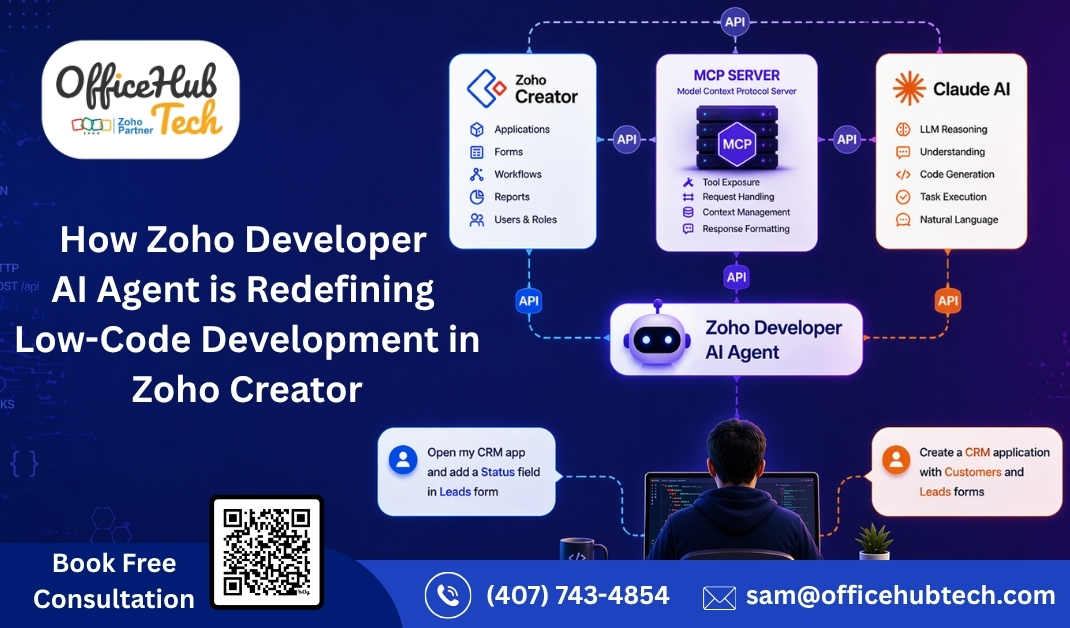
How Zoho Developer AI Agent is Redefining Low-Code Development in Zoho Creator
The Evolution of Low-Code Development in Zoho Creator
Low-code development has significantly transformed how businesses build applications, and platforms like Zoho Creator have been at the forefront of this shift. By enabling faster development through visual interfaces, reusable components, and minimal coding, low-code platforms have helped organizations reduce dependency on traditional development cycles and accelerate digital transformation.
However, as business requirements continue to evolve, even low-code development is beginning to show its limitations.
While Zoho Creator simplifies application building, it still requires users to manually design workflows, configure forms, define logic, and manage data structures. This means that although development is faster compared to traditional coding, it is still process-driven and human-dependent. As applications grow in complexity and scale, these manual steps can introduce delays, inconsistencies, and operational overhead.
This is where a new paradigm begins to emerge—AI-driven application execution.
With the introduction of Zoho Developer AI Agent, the role of low-code platforms is being fundamentally redefined. Instead of building applications step by step, users can now describe their requirements, and the system can interpret and execute those instructions directly within Zoho Creator. This shifts the focus from how to build to what needs to be built.
In this new model, Zoho Creator evolves from a development platform into an execution environment powered by AI, enabling businesses to move faster, reduce manual effort, and build applications with unprecedented efficiency.
What is Zoho Developer AI Agent? From Assistance to Execution
The introduction of AI into low-code platforms is often misunderstood as incremental improvement—something that enhances productivity through suggestions or automation. However, the Zoho Developer AI Agent represents a far more significant shift. It is not designed to assist development—it is designed to execute it.
Within the ecosystem of Zoho Creator, the Zoho Developer AI Agent acts as an intelligent execution layer powered by LLMs and an AI Agent (Python-based logic). Instead of guiding users through the development process, it directly performs actions inside the platform based on natural language instructions.
This distinction is critical.
Traditional low-code tools simplify development by reducing coding effort, but they still rely on users to define every component—forms, fields, workflows, and data structures. The Zoho Developer AI Agent eliminates this dependency by interpreting intent and translating it into executable steps.
For example, a user can provide a prompt such as “Create a CRM application with customer and lead management”. The system does not respond with recommendations—it initiates execution. Applications are created, forms are structured, fields are defined, and initial data configurations can be applied automatically.
From a technical standpoint, this capability is achieved through a layered architecture where:
- LLMs handle intent understanding and task decomposition
- The AI Agent translates structured instructions into executable actions
- Zoho Creator serves as the application layer where execution occurs
This transforms the role of low-code platforms from development environments into intelligent execution systems, where applications are not built manually but generated through intent.
Architecture Behind Zoho Developer AI Agent: LLM + MCP + Zoho Creator
The Zoho Developer AI Agent is powered by a tightly integrated architecture that connects LLM (Large Language Model), Model Context Protocol (MCP), and Zoho Creator. This combination enables a seamless transition from user intent to real execution inside the platform.
- LLM (Large Language Model): Interprets natural language prompts and structures user intent
- MCP (Model Context Protocol): Exposes Zoho Creator capabilities as standardized, callable tools
- Zoho Creator: Executes actions such as application creation, form design, and workflow configuration
Execution Flow
When a user provides a prompt—such as “Create a CRM application with Customers and Leads”—the system processes it through a structured pipeline:
- Intent Interpretation (LLM)
The prompt is analyzed to identify application structure, forms, and required logic. - Tool Mapping (MCP)
MCP maps the interpreted intent to predefined Zoho Creator operations such as creating apps, forms, and fields. - Execution (Zoho Creator)
The system executes these operations directly—applications, forms, fields, and configurations are created in real time.
Watch Demo: See Zoho Developer AI Agent create and manage applications in real time:
Why This Architecture Matters: Beyond Automation to Intelligent Execution
The integration of LLM, Model Context Protocol (MCP), and Zoho Creator is not just a technical enhancement—it represents a shift from static automation to dynamic, intent-driven execution systems.
Traditional automation tools, including workflow engines and RPA solutions, operate on predefined rules. Every action must be explicitly configured in advance, making systems rigid and difficult to adapt when requirements change.
In contrast, this architecture enables real-time interpretation and execution, where actions are not pre-programmed but dynamically selected based on user intent.
Key Technical Advantages
- Intent-to-Action Mapping
User prompts are directly translated into executable operations without manual configuration. - Dynamic Tool Invocation (via MCP)
Instead of fixed workflows, the system selects appropriate Zoho Creator operations at runtime. - Elimination of UI Dependency
Actions are executed through structured system interaction rather than manual navigation. - Standardized Execution Framework
MCP ensures all operations follow a controlled and consistent structure.
Comparison with Traditional Approaches
- Low-Code Only
Requires manual configuration of forms, workflows, and logic - RPA / Automation Tools
Automates predefined steps but lacks adaptability - Zoho Developer AI Agent Architecture
Interprets intent and executes actions dynamically in real time
Strategic Impact
This architecture enables businesses to move from process-driven systems to intent-driven systems, where:
- Systems adapt based on requirements instead of rigid workflows
- Execution happens instantly without redesigning processes
- Applications evolve continuously without redevelopment cycles
This is not incremental automation—it is a transition toward intelligent execution systems, where software responds to intent rather than instructions.
A New Execution Model
Instead of building applications step by step, users can define requirements through prompts and allow the system to execute them directly. This transforms Zoho Creator from a development platform into an AI-driven execution environment, redefining how applications are built and managed.
From Prompt to Application: Real Execution Flow in Zoho Creator AI
The core capability of the Zoho Developer AI Agent is not limited to generating suggestions—it enables direct execution of application logic inside Zoho Creator through structured prompts. This transforms traditional low-code development into a prompt-driven application execution model.
In a standard low-code workflow, building an application involves multiple manual steps—creating forms, defining fields, configuring workflows, and inserting data. Even though simplified, this process still requires time, navigation, and validation.
With the Zoho Developer AI Agent, this process is executed in a single interaction.
Download Zoho Developer AI Agent (FREE & Open Source)
Example Execution Flow
A user provides a prompt such as:
“Create a CRM application with Customers and Leads, including Name, Email, Phone, and Status fields.”
The system executes this request inside Zoho Creator:
- Application structure is created automatically
- Forms such as Customers and Leads are generated
- Fields are defined and mapped to appropriate data types
- Initial configurations and relationships are applied
Beyond Initial Creation
The system also supports ongoing operations such as:
- Updating existing applications and modifying schema
- Managing records and performing bulk data operations
- Generating reports, dashboards, and filtered views
- Executing workflow logic such as notifications and approvals
From Interaction to Execution
This approach removes the dependency on manual configuration and UI navigation. Instead of interacting with multiple screens, users interact with the system through intent.
Why This Matters
- Reduces application setup time from hours to minutes
- Enables faster iteration and continuous improvement
- Bridges the gap between business requirements and execution
- Positions Zoho Creator as an AI-powered application development platform
This model represents a fundamental shift—from building applications step by step to executing them directly through prompts, enabling faster, more scalable, and intelligent application development.
Beyond Creation: Managing and Maintaining Applications with Zoho Developer AI Agent
While application creation is the most visible capability of the Zoho Developer AI Agent, its true value lies in how it enables continuous management, maintenance, and evolution of applications within Zoho Creator.
Traditional low-code environments still require manual intervention for updates, schema changes, workflow modifications, and data operations. As applications grow, this creates operational overhead and slows down adaptability.
The Zoho Developer AI Agent eliminates this friction by enabling lifecycle management through prompts—allowing teams to manage and maintain applications without navigating complex interfaces.
Application Management Capabilities
- Schema Updates
Add or modify fields, forms, and relationships dynamically - Workflow Modifications
Update approvals, notifications, and automation logic - Data Operations
Insert, update, or bulk-manage records - Reports & Views
Create and modify reports and dashboards as needed
Maintenance and Optimization
- Continuous Updates
Modify applications as requirements evolve without rebuilding - Consistency & Accuracy
Reduce errors caused by manual changes - Scalability
Expand applications as business complexity increases
This shifts applications from static builds to continuously evolving systems, where changes can be executed instantly through intent rather than manual configuration.
Operational Impact
From an operational perspective, this changes how teams interact with systems:
- Business users can define requirements without technical translation
- Developers can focus on complex logic rather than repetitive setup
- Applications can be created and updated in significantly less time
This shift from manual configuration to prompt-driven execution enables organizations to move faster, reduce operational friction, and build applications that evolve continuously with business needs.
Why Zoho Developer AI Agent Redefines Low-Code Development
Low-code platforms have already improved development speed and accessibility, but they still operate within a configuration-driven model. Users must design, structure, and manage every component manually, even if the process is simplified. This creates a ceiling on how fast organizations can truly move.
The Zoho Developer AI Agent breaks this limitation by introducing an execution-driven model.
Instead of asking how to build, users can define what needs to be built. This distinction is critical. It shifts application development from a step-by-step process to a goal-oriented execution system, where outcomes are generated directly from intent.
From Configuration to Execution
Traditional low-code workflow:
- Define forms manually
- Configure fields and logic
- Set up workflows step by step
- Test and iterate
With Zoho Developer AI Agent:
- Provide a prompt
- System interprets intent
- Execution happens automatically inside Zoho Creator
This eliminates multiple layers of manual effort while maintaining control and flexibility.
Key Differentiators
- Intent-driven development instead of UI-driven configuration
- Real-time execution of application components
- Reduced dependency on technical expertise
- Consistent and structured application design
- Faster iteration cycles without rework
Why This Matters for Businesses
For organizations, this is more than a productivity gain—it is a strategic advantage:
- Faster response to changing business requirements
- Reduced development backlog and operational delays
- Ability to experiment and deploy solutions rapidly
- Improved alignment between business needs and system execution
A Fundamental Shift
Low-code simplified development.
Zoho Developer AI Agent redefines it.
By moving from configuration to execution, businesses can transition from building applications manually to orchestrating systems through intent, enabling a new level of speed, scalability, and operational efficiency.
Understanding the Boundaries: Where Human Control Still Matters
While the Zoho Developer AI Agent introduces a powerful shift toward prompt-driven execution, it is important to understand that it does not eliminate the need for human oversight. Instead, it redefines the role of users—from manual builders to system orchestrators who guide, validate, and refine outcomes.
Even in an execution-driven model, application development requires structured thinking. Prompts must be clear, requirements must be well-defined, and outputs must be reviewed for accuracy and alignment with business logic. The system accelerates execution, but precision still depends on input quality.
Where Human Intervention is Essential
- Requirement Definition
Clear articulation of application structure, workflows, and expected outcomes ensures accurate execution. - Validation and Testing
Applications created within Zoho Creator still require validation to confirm correctness and usability. - Complex Logic Handling
Advanced business rules, edge cases, and multi-system dependencies may require refinement beyond initial execution. - Governance and Security
Access controls, compliance requirements, and data governance must be configured and monitored carefully.
Managing Limitations Effectively
While the system can automate a large portion of application setup and modification, it operates within defined capabilities:
- Execution depends on available tools and integrations
- Highly complex workflows may require iterative prompts
- Domain-specific logic may need customization
These are not limitations of capability, but rather boundaries that ensure controlled and reliable execution.
Balanced Approach to Adoption
Organizations that succeed with this model adopt a hybrid approach:
- Use AI-driven execution for speed and scalability
- Apply human expertise for validation and optimization
- Continuously refine prompts and workflows
The Zoho Developer AI Agent does not replace developers or business users—it amplifies their capabilities. By combining automation with human oversight, organizations can achieve faster outcomes while maintaining accuracy, control, and long-term scalability.
The Future of Low-Code: AI-Driven Application Development with Zoho Creator
Low-code platforms have already accelerated how applications are built, but the next phase of evolution is being defined by the integration of AI-driven execution models. Platforms like Zoho Creator are no longer just low-code tools—they are becoming AI-powered application development platforms.
The introduction of systems like the Zoho Developer AI Agent signals a shift from manual configuration to intelligent, prompt-driven execution, where applications can be created, modified, and managed through interaction rather than traditional development workflows.
Key Trends Shaping the Future
- AI-Driven App Development
Applications will increasingly be built using natural language prompts instead of manual configuration. - Continuous Application Evolution
Systems will evolve dynamically based on business requirements without redevelopment cycles. - End-to-End Workflow Automation
AI will orchestrate complete business processes across CRM, finance, inventory, and operations. - Unified Development and Execution Layer
The gap between business users and developers will continue to shrink.
Expansion Beyond Single Platforms
This model is not limited to Zoho Creator. With architectures built on LLM and MCP, organizations can extend execution across:
- CRM systems
- Financial tools
- Inventory and supply chain platforms
- Third-party APIs and enterprise systems
This creates a connected ecosystem where AI-driven workflows operate across multiple systems seamlessly.
From Low-Code to AI Platforms
Low-code simplified development.
AI transforms it into adaptive, intelligent, and scalable execution systems.
Strategic Outlook
Businesses that adopt this model early will gain:
- Faster innovation cycles
- Reduced operational complexity
- Greater flexibility to adapt systems in real time
- Stronger alignment between business intent and system execution
The future of application development is not just low-code—it is AI-driven, intent-based execution, where platforms like Zoho Creator evolve into intelligent systems capable of building and managing applications autonomously.
Real Business Impact: ROI, Productivity, and Scalable Application Execution
The adoption of the Zoho Developer AI Agent is not just a technical upgrade—it delivers measurable business outcomes across development speed, operational efficiency, and long-term scalability. By shifting from manual configuration to AI-driven application execution within Zoho Creator, organizations can significantly reduce effort while increasing output.
Faster Time-to-Deployment
One of the most immediate benefits is the reduction in development time. Applications that typically require days or weeks of setup can now be created in minutes using structured prompts.
- Rapid prototyping and deployment
- Faster response to business requirements
- Reduced backlog of development requests
Operational Efficiency and Cost Reduction
- Reduced manual effort
Automated creation of forms, workflows, and data structures - Lower dependency on specialized developers
Business users can initiate application execution - Minimized rework
Standardized execution reduces inconsistencies
Productivity and Team Impact
- Business teams can define requirements directly
- Developers focus on advanced logic and integrations
- Faster collaboration across departments
Scalability and Continuous Optimization
- Applications can be updated and expanded through prompts
- Systems evolve without redevelopment cycles
- Easy adaptation to changing business needs
Return on Investment (ROI)
Organizations implementing this model typically achieve:
- Significant reduction in development costs
- Faster delivery cycles leading to quicker business impact
- Improved system efficiency and reduced operational delays
- Higher output with smaller teams
Strategic Advantage
By combining low-code flexibility with AI-driven execution, businesses move from building applications manually to operating intelligent systems that execute based on intent.
This enables a scalable, future-ready operating model where speed, accuracy, and adaptability are built into the system—not dependent on manual effort.
Conclusion: From Low-Code Development to AI-Driven Execution
Low-code platforms have already transformed how businesses approach application development—making it faster, more accessible, and more flexible than traditional methods. Platforms like Zoho Creator have played a critical role in enabling organizations to build and scale applications without heavy dependency on complex coding.
However, as business demands continue to evolve, even low-code development reaches a point where manual configuration becomes a limiting factor. This is where the next transformation begins.
The Zoho Developer AI Agent redefines this model by shifting from configuration-driven development to AI-driven execution. Instead of building applications step by step, businesses can now define requirements through prompts and allow the system to execute them directly. This enables faster development cycles, improved consistency, and reduced operational overhead.
This is not just an enhancement to low-code—it is a fundamental shift in how applications are created, managed, and scaled.
Build Your Own AI-Driven Application System
For organizations looking to move beyond traditional development and fully leverage AI-driven execution, the opportunity lies in implementing solutions that align with real business workflows.
At OfficeHub Tech, we specialize in designing and delivering Custom Agentic AI solutions that integrate seamlessly with platforms like Zoho Creator. Whether it’s CRM, Sales, Finance, Project Management, or Inventory systems, we build solutions that are tailored to your operational needs and scalable for future growth.
OfficeHub Tech is a Certified Zoho Creator Developer and Implementation Services Provider in USA, India, UAE, KSA, and an Authorized Zoho & n8n Partner—trusted by businesses to design, implement, and scale intelligent, AI-driven systems that deliver real operational impact.
Create your Zoho Creator account today using the link below and discover a faster, smarter approach to application development.
FAQs:
Q1. What is Zoho Developer AI Agent?
Ans: Zoho Developer AI Agent is an AI-driven execution system that allows users to create, modify, and manage applications in Zoho Creator using natural language prompts instead of manual configuration.
2. How does Zoho Developer AI Agent work with Zoho Creator?
Ans: It connects LLM + Model Context Protocol (MCP) + Zoho Creator, where user prompts are interpreted and executed as real actions such as app creation, form setup, and workflow automation.
Q3. Can I build apps in Zoho Creator using AI?
Ans: Yes, with Zoho Developer AI Agent, you can build apps using AI prompts, including forms, workflows, fields, and reports without manual setup.
Q4. Is Zoho Creator an AI-powered low-code platform?
Ans: Zoho Creator is a low-code platform, but with AI integration like Zoho Developer AI Agent, it becomes an AI-powered app development platform enabling prompt-driven execution.
Q5. What is MCP (Model Context Protocol) in AI integration?
Ans: MCP is a protocol that allows AI models to interact with external systems like Zoho Creator by exposing actions (like create app, update data) as structured tools.
Q6. Can Zoho Developer AI Agent automate workflows?
Ans: Yes, it can automate workflows such as approvals, notifications, and data updates by executing actions directly inside Zoho Creator based on user prompts.
Q7. Is Zoho Developer AI Agent free and open source?
Ans: Yes, the Zoho Developer AI Agent is available as a free and open-source solution, allowing businesses to customize and implement it based on their needs.
Q8. What are the benefits of using AI in low-code platforms?
Ans: AI enhances low-code by enabling:
-
Faster app development
-
Reduced manual effort
-
Real-time execution
-
Better alignment with business requirements