
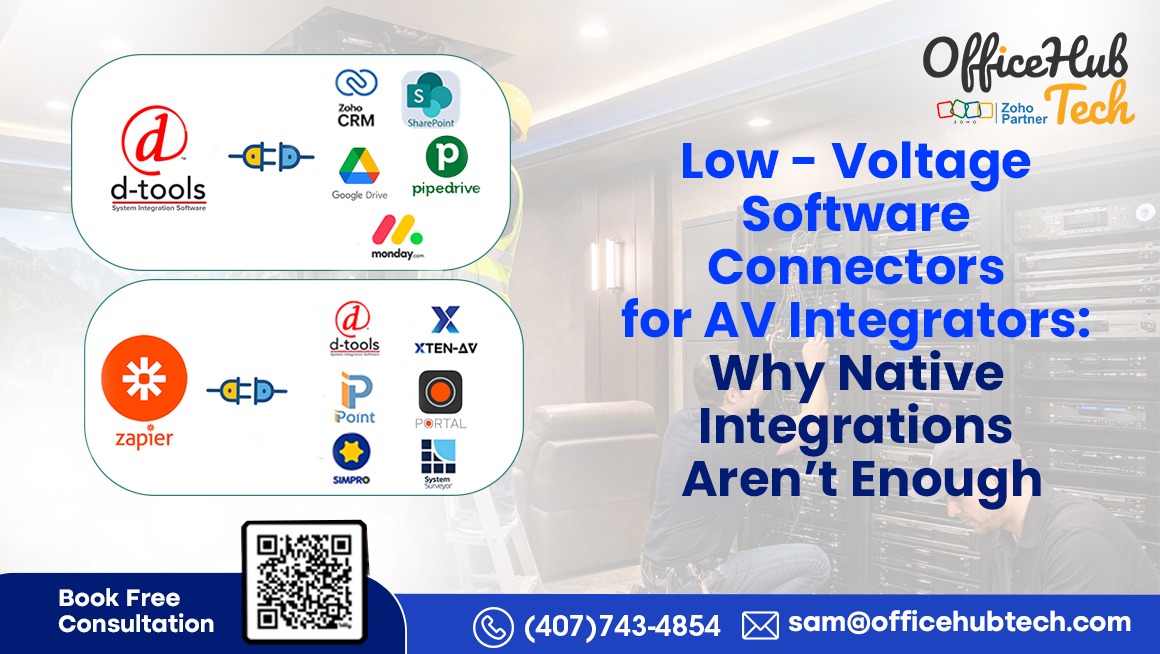
Low-Voltage Software Connectors for AV Integrators: Why Native Integrations Aren’t Enough
Low-Voltage Software Connectors: The Missing Link in AV Workflows
What if the biggest bottleneck in your AV business isn’t your team, your tools, or your projects—but the lack of connection between them?
Across residential and commercial AV environments, operations are becoming increasingly complex. Projects now involve layered workflows—starting from lead management and proposal design to documentation, procurement, execution, and final handover. On the surface, most AV businesses appear well-equipped with modern tools. CRM systems, design platforms, document storage, and project management software are all in place.
Yet, beneath this structured setup lies a critical gap.
These systems operate in isolation.
Data does not flow seamlessly. Updates are not synchronized in real time. Teams rely on manual coordination to bridge gaps between platforms. The result is a fragmented workflow where efficiency is compromised, errors are amplified, and scalability becomes difficult to sustain.
This is exactly where most AV businesses begin to feel operational strain—not because they lack capability, but because their systems lack cohesion.
This article explores why native integrations fail to address these challenges and how purpose-built connectors redefine operational efficiency. It will break down real-world workflow gaps, uncover hidden inefficiencies, and demonstrate how modern integration strategies can transform daily operations for AV Pros.
More importantly, it will provide practical insights into how AV Project Automation and Integration enables a unified, intelligent workflow—eliminating redundancy, improving visibility, and creating a scalable foundation for growth in both residential and commercial AV projects.
Native Integrations: Promise vs Practical Limitations
Native integrations often present themselves as the simplest path to connectivity. They are easy to enable, require minimal configuration, and create an initial impression of a connected ecosystem. For many AV businesses, this becomes the default assumption—activate the integration, and the workflow will take care of itself.
That assumption rarely survives real-world operations.
The fundamental issue is not that native integrations fail—it is that they are not designed for the depth and complexity of AV workflows. They operate at a surface level, transferring limited data without understanding the sequence, dependencies, or context in which that data is used.
In a typical AV project, workflows are not static—they evolve continuously.
- A proposal is revised multiple times
- Bill of Materials (BOM) changes impact procurement instantly
- Drawings and system designs are updated during execution
- Client approvals alter scope mid-cycle
Native integrations are not built to handle this level of dynamism.
Where native integrations break down in AV environments:
- Shallow Data Synchronization
Only basic fields such as contacts or deal stages are transferred, while critical project data—BOMs, revisions, documentation structures—remains isolated - Lack of Workflow Awareness
Systems do not recognize lifecycle stages. A “closed deal” does not automatically translate into a fully structured project environment - No Event-Driven Automation
Actions such as task creation, document organization, or team notifications are not triggered automatically - Inability to Handle Iterative Changes
When designs evolve, updates are not consistently reflected across systems, leading to version conflicts and execution errors
The result is not just inefficiency—it is operational risk.
Teams compensate manually. Data is re-entered. Documents are re-shared. Coordination becomes dependent on individuals rather than systems. This introduces delays, increases the probability of errors, and creates a fragile workflow that cannot scale.
Over time, these limitations begin to affect core business outcomes—project timelines extend, rework increases, and client confidence diminishes.
This is precisely why relying solely on native integrations creates a false sense of operational maturity.
To truly align systems with the realities of AV workflows, businesses require more than basic connectivity. They need integration frameworks that understand how projects evolve, how data interrelates, and how actions should be triggered across systems.
This is where Low Voltage Software Connectors for AV System Integrator fundamentally change the equation—by replacing static, shallow integrations with intelligent, workflow-driven connectivity that aligns with the real operational demands of AV businesses.
Anatomy of an AV Workflow (Without Connectors)
On paper, an AV workflow appears structured and sequential. In practice, it is highly dynamic—driven by continuous revisions, approvals, and real-time changes across multiple teams. Without a connected system, this workflow does not operate as a unified process, but as a series of disconnected handoffs.
A typical AV project lifecycle includes:
- Lead capture and qualification in CRM
- Proposal and system design in D-Tools SI
- BOM creation and pricing adjustments
- Document storage and sharing across platforms
- Task management and project tracking
- Procurement and vendor coordination
- Execution, revisions, and final handover
While these stages appear linear, the real challenge lies in the transitions between them.
Key breakdown points:
- Sales to Design Disconnect
Closed deals must be manually recreated in design systems, introducing delays and inconsistencies - BOM & Revision Misalignment
Design updates are not reflected across procurement or execution teams, leading to errors and rework - Document Fragmentation
Multiple file versions across systems create confusion and increase the risk of using outdated information - Execution Delays
Field teams lack real-time visibility into updates, resulting in inefficient site visits and missed timelines - Task Gaps
Project milestones do not automatically convert into actionable tasks
The impact is cumulative. A single design change can cascade into procurement errors, installation delays, and increased operational costs.
Over time, teams spend more effort managing inconsistencies than delivering projects. This fragmentation limits scalability and reduces overall efficiency.
This clearly highlights the need for AV System Integration business workflow solutions—where workflows are no longer dependent on manual coordination, but are seamlessly connected, synchronized, and executed in real time.
Hidden Operational Costs in AV Businesses
Operational inefficiencies in AV businesses rarely appear as immediate failures. Instead, they manifest subtly—through delays, inconsistencies, and incremental losses that accumulate over time. Without connected systems, these hidden costs become embedded in daily operations, often going unnoticed until they significantly impact profitability and scalability.
Key areas where these costs emerge:
- Time Leakage
Teams spend a considerable portion of their day performing repetitive administrative tasks—copying data between systems, searching for the latest documents, or reconciling discrepancies. This reduces the time available for high-value activities such as design, client engagement, and execution. - Error Multiplication
Manual data handling increases the likelihood of errors. A single incorrect entry—whether in pricing, specifications, or client details—can propagate across multiple systems, leading to rework, delays, and potential financial loss. - Delayed Project Timelines
When systems are not synchronized, updates are not reflected in real time. This creates bottlenecks between teams, slowing down approvals, procurement, and execution phases. - Lack of Real-Time Visibility
Without unified data, tracking project progress becomes challenging. Decision-making is based on fragmented information, often resulting in reactive rather than proactive management. - Client Experience Degradation
Delayed responses, inconsistent updates, and document mismatches directly affect client trust and satisfaction.
These inefficiencies are not isolated—they compound as the business grows. What works for a small number of projects becomes unsustainable at scale.
This is where AVSI Business Automation Solution plays a critical role. By eliminating manual dependencies and introducing system-driven workflows, it addresses these hidden costs at their root—transforming operational inefficiency into structured, scalable execution.
What Are Low-Voltage Software Connectors?
Low-voltage software connectors are not just integrations—they are structured, intelligent frameworks designed to unify complex AV workflows across multiple platforms. Unlike basic connectors that simply pass data from one system to another, these are engineered to understand the context, sequence, and dependencies of AV operations.
At a technical level, these connectors operate through a combination of APIs, middleware layers, and event-driven architectures. This enables systems to communicate in real time, trigger actions automatically, and maintain consistency across the entire workflow lifecycle.
Core functional capabilities include:
- Bi-directional data synchronization
Ensures that updates in one system are instantly reflected across all connected platforms - Event-based automation
Triggers actions such as project creation, document syncing, or task assignment based on specific events - Structured data mapping
Aligns fields, formats, and hierarchies between different systems to eliminate inconsistencies - Workflow orchestration
Coordinates multiple systems to function as a single operational unit rather than isolated tools
For AV businesses, this means that when a deal is closed, a project can be automatically created, documents structured, tasks assigned, and teams notified—without manual intervention.
More importantly, these connectors are designed with industry-specific logic. They account for project revisions, documentation hierarchies, and multi-stage workflows unique to AV environments.
This is where Custom Software Connectors for AV System Integrators deliver true value. They go beyond generic automation, providing tailored integration frameworks that align precisely with how AV businesses operate—ensuring accuracy, efficiency, and scalability at every stage of the workflow.
Why AV Businesses Need Purpose-Built Connectors
Not all integrations are created equal—and in the AV industry, this distinction becomes critical. Generic integrations are designed for broad applicability, often prioritizing simplicity over depth. While they may connect systems at a surface level, they fail to accommodate the intricacies of AV workflows.
AV operations are inherently complex. They involve continuous design iterations, layered documentation, multi-stage approvals, and close coordination between teams. Each project evolves dynamically, requiring systems to adapt in real time rather than follow static processes.
Key complexities unique to AV workflows include:
- Frequent design revisions that must reflect across all systems instantly
- Hierarchical document structures (drawings, BOMs, proposals, revisions)
- Cross-functional dependencies between sales, design, procurement, and execution
- Project-specific customization rather than standardized workflows
Generic integrations lack the contextual intelligence to handle these variables. They do not understand project lifecycles, nor do they adapt to the iterative nature of AV work. As a result, businesses are forced to rely on manual coordination to fill the gaps.
Purpose-built connectors, however, are engineered with these challenges in mind. They are designed to align with real-world AV processes—ensuring that every update, revision, and transition is accurately reflected across systems.
This is where Custom ERP For AV System Integration Industry becomes a strategic enabler. When combined with specialized connectors, it creates a unified operational environment where systems are not just connected—but synchronized with business logic.
The result is a workflow that is not only efficient, but also resilient, scalable, and aligned with the evolving demands of modern AV integration.
Connector Stack for AV Integrators (Purpose-Built Ecosystem)
A modern AV business does not struggle due to lack of tools—it struggles due to lack of orchestration between those tools. Most systems are individually powerful, yet collectively inefficient. This inefficiency stems from disconnected workflows, where data must be manually transferred, verified, and restructured at every stage of the project lifecycle.
A purpose-built connector ecosystem eliminates this fragmentation by creating a synchronized operational environment. Instead of isolated platforms, it establishes a unified workflow architecture where every system communicates in real time, every update is propagated instantly, and every team operates with complete contextual visibility.
Unlike generic integrations, these connectors are engineered specifically for AV workflows—understanding project hierarchies, document structures, revision cycles, and cross-functional dependencies.
Below is the structured Low Voltage Connector ecosystem designed for AV integrators:
Core D-Tools SI Integrations (Operational Backbone)
These integrations form the central nervous system of AV operations, ensuring seamless continuity from sales to execution.
-
D-Tools SI ↔️ Zoho CRM
This connector eliminates the traditional disconnect between sales and project teams. Once a deal progresses within the CRM, relevant data—including client details, project scope, and opportunity information—is automatically synchronized into D-Tools SI.
- Removes manual project creation
- Ensures data consistency across systems
- Accelerates sales-to-design transition
-
D-Tools SI ↔️ SharePoint
Document management is one of the most critical yet error-prone aspects of AV projects. This connector automates the creation of structured document repositories.
- Auto-generates project-specific folder hierarchies
- Syncs drawings, proposals, and revisions in real time
- Enforces version control and access permissions
-
D-Tools SI ↔️ Google Drive
For teams operating in distributed environments, this integration enables seamless collaboration.
- Real-time document synchronization
- Centralized access for internal and external stakeholders
- Eliminates duplication and file mismanagement
-
D-Tools SI ↔️ Pipedrive
This connector ensures that sales pipelines directly influence project workflows.
- Aligns deal stages with project initiation
- Improves forecasting accuracy
- Maintains continuity between sales and operations
-
D-Tools SI ↔️ Monday.com
Execution efficiency depends on clear task management. This integration translates project data into actionable workflows.
- Auto-creates tasks based on project milestones
- Assigns responsibilities dynamically
- Tracks progress in real time
-
D-Tools SI ↔️ Zapier
This connector acts as an extensibility layer, enabling D-Tools SI to integrate with a broader ecosystem of tools.
- Triggers automation workflows across platforms
- Enables event-based actions
- Expands integration capabilities without rebuilding systems
Extended Automation via Zapier (Scalability Layer)
This layer enhances flexibility, allowing AV businesses to integrate specialized tools into their workflow ecosystem.
-
Zapier ↔️ XTEN-AV
Bridges proposal and design workflows between platforms.
- Synchronizes proposal data
- Reduces duplication in design processes
- Ensures consistency across estimation tools
-
Zapier ↔️ Ipoint
Optimizes procurement and inventory alignment.
- Automates data transfer between systems
- Improves accuracy in material planning
- Reduces delays in procurement cycles
-
Zapier ↔️ Portal.io
Enhances client communication and project transparency.
- Automates project updates to client portals
- Improves collaboration and visibility
- Reduces dependency on manual reporting
-
Zapier ↔️ Simpro
Strengthens job management and field service coordination.
- Syncs job data and schedules
- Improves technician alignment
- Enhances operational efficiency in execution
-
Zapier ↔️ System Surveyor
Automates survey data integration into project workflows.
- Captures and syncs site data
- Reduces manual documentation effort
- Improves accuracy in system planning
When these connectors operate collectively, they create more than just integrations—they establish a fully synchronized digital infrastructure.
The result is a transformation in how AV businesses operate:
- End-to-end workflow automation from lead to project completion
- Single source of truth across all systems
- Real-time synchronization eliminating delays and errors
- Scalable architecture that grows with the business
This ecosystem is the practical implementation of AV System Integration business workflow solutions, where technology is no longer fragmented but unified—enabling AV businesses to operate with precision, efficiency, and complete operational control.
Real-World Workflow Transformations (Connector-Driven Execution)
The true value of any integration strategy is not defined by its architecture—but by its impact on real operations. When low-voltage connectors are implemented correctly, the transformation is not theoretical. It is measurable, visible, and operationally decisive.
To understand this, consider how AV businesses function before and after implementing a connected ecosystem.
Case Study 1: NovaEdge AV (Residential Integration Firm)
Initial Challenges:
- Disconnected sales and design workflows
- Manual document handling across multiple platforms
- Frequent version mismatches during execution
Connector Implementation:
- D-Tools SI ↔️ Zoho CRM
- D-Tools SI ↔️ Google Drive
- D-Tools SI ↔️ Monday.com
Operational Transformation:
- Once a deal was marked “closed,” project data was automatically created in D-Tools SI
- Structured folders were generated instantly in Google Drive with real-time file syncing
- Project milestones triggered automatic task creation in Monday.com
Results:
- 65% reduction in manual data entry
- Zero document version conflicts
- 30% faster project turnaround time
The team shifted focus from administrative coordination to actual project execution.
Case Study 2: CoreAxis Technologies (Commercial AV Integrator)
Initial Challenges:
- Lack of visibility across large-scale projects
- Delays in procurement and execution due to disconnected systems
- Inefficient communication between departments
Connector Implementation:
- D-Tools SI ↔️ SharePoint
- D-Tools SI ↔️ Zapier
- Zapier ↔️ Simpro
- Zapier ↔️ System Surveyor
Operational Transformation:
- Centralized document management with automated folder structures and version control
- Real-time synchronization between design updates and field execution
- Automated job scheduling and survey data integration
Results:
- 40% improvement in project tracking accuracy
- 25% reduction in execution delays
- Significant improvement in cross-team coordination
Key Takeaways from These Transformations:
- Manual dependencies are eliminated, not reduced
- Data becomes proactive, triggering actions instead of waiting for input
- Workflows become predictable and scalable
These are not isolated improvements—they represent a systemic shift in how AV businesses operate.
This is the practical impact of AV Project Automation and Integration, where connectors move beyond technical enhancements and become operational drivers—enabling AV businesses to execute faster, with greater accuracy, and with significantly less friction across every stage of the project lifecycle.
Quantifying the Impact: Metrics That Matter
Most AV businesses acknowledge inefficiencies—but very few quantify their impact. Without measurable visibility, operational problems remain underestimated. The real transformation begins when these inefficiencies are translated into tangible metrics.
When disconnected systems are replaced with a connector-driven workflow, the improvement is not marginal—it is operationally significant.
1. Reduction in Manual Workload
Before integration:
- Teams spend 3–5 hours daily on data entry, document tracking, and coordination
After connectors:
- Data flows automatically across systems
Measured Impact:
- 50–70% reduction in manual effort
- Teams reallocate time to design, execution, and client delivery
2. Faster Sales-to-Execution Conversion
Before:
- Project setup delays of 1–3 days after deal closure
After:
- Instant project creation and data synchronization
Measured Impact:
- 60–80% faster transition from sales to project execution
3. Reduction in Costly Errors & Rework
Before:
- BOM mismatches, outdated drawings, incorrect specifications
After:
- Real-time updates across all systems
Measured Impact:
- Near elimination of version conflicts
- 30–40% reduction in rework costs
4. Improved Project Timeline Accuracy
Before:
- Delays caused by missing updates and coordination gaps
After:
- Automated task creation and real-time tracking
Measured Impact:
- 25–40% improvement in on-time project delivery
5. Increased Operational Scalability
Before:
- Growth leads to chaos (more projects = more inefficiency)
After:
- Systems handle increased workload without additional manual effort
Measured Impact:
- Ability to scale 2x project volume without proportional team expansion
These metrics clearly demonstrate that integration is not a technical upgrade—it is a business transformation.
This is the real impact of AVSI Business Automation Solution, where operational efficiency is no longer dependent on manual coordination, but driven by a fully synchronized, intelligent workflow system.
From Chaos to Control: Building a Connected AV Stack
Implementing a connected AV ecosystem is not about adding more tools—it is about engineering how those tools work together. Many AV businesses attempt to solve inefficiencies by stacking software, but without a defined integration strategy, this only increases complexity.
A structured approach is essential to move from fragmented operations to a controlled, scalable workflow.
1. Workflow Audit: Identifying Real Bottlenecks
Before implementing any connector, it is critical to analyze how work actually flows.
- Where is data being manually entered multiple times?
- Where do delays occur between sales, design, and execution?
- Where do document mismatches or version conflicts arise?
This step reveals operational gaps that directly impact time, cost, and accuracy.
2. Defining System Roles and Data Ownership
Every platform must have a clearly defined responsibility to avoid conflicts.
- CRM → lead and client data
- D-Tools SI → design, BOM, and project structure
- Document systems → file storage and version control
- Project tools → execution and task tracking
Without this clarity, integrations create duplication instead of synchronization.
3. Implementing Core Connectors (High-Impact First)
Focus on connectors that eliminate the most critical inefficiencies:
- Sales-to-project automation
- Document structuring and synchronization
- Task and execution alignment
This delivers immediate operational improvement and builds a stable integration foundation.
4. Extending to Advanced Automation Layers
Once the core is stable, expand workflows across additional systems:
- Automate procurement and inventory coordination
- Sync field execution tools with design updates
- Trigger notifications, approvals, and reporting automatically
This shifts operations from reactive coordination to proactive execution.
5. Continuous Optimization and Scaling
A connected system is not static—it evolves with business growth.
- Refine workflows based on project complexity
- Add new integrations as tools are introduced
- Monitor performance metrics and eliminate emerging inefficiencies
The outcome is not just integration—it is operational control.
AV businesses gain real-time visibility, predictable workflows, and the ability to scale without increasing manual overhead. Systems begin to drive execution instead of teams compensating for system gaps.
This structured approach defines Business Workflow Consultation For Av System Integrator, where the objective is to design a connected, intelligent ecosystem that supports long-term scalability, accuracy, and operational excellence.
The Connector-Led Advantage
The modern AV business operates within an increasingly complex environment where multiple systems, teams, and processes must function in absolute alignment. Yet, without a structured integration layer, even the most advanced tools remain isolated—creating inefficiencies that compound over time.
Throughout this discussion, one pattern becomes clear: the challenge is not the availability of software, but the absence of synchronization between them.
Native integrations offer limited relief. Manual processes introduce risk. Disconnected systems create delays. Together, they form a fragmented operational model that restricts efficiency and scalability.
Low-voltage software connectors address this challenge at its core.
They unify workflows and automate transitions between systems. Also ensure that data is consistent, real-time, and actionable across every stage of the project lifecycle. More importantly, low-voltage software connectors transform operations from reactive coordination to proactive execution.
From sales alignment and document automation to task orchestration and field execution, connectors create a seamless operational continuum. Each update triggers an action. Every system reflects the same reality. Each team operates with clarity.
This is not an incremental improvement—it is a structural shift.
Organizations leveraging Low Voltage Software Connectors For Residential and commercial System Integrators are no longer constrained by operational inefficiencies. Instead, they operate with precision, scalability, and control—enabling them to handle higher project volumes, reduce errors, and deliver superior client experiences without increasing complexity.
In essence, connectors redefine how AV businesses function—turning fragmented workflows into a cohesive, intelligent, and future-ready ecosystem.
Conclusion
The AV integration landscape is rapidly evolving, and operational complexity will only continue to increase. Managing this complexity with disconnected systems and manual processes is no longer sustainable. The need of the hour is a unified, intelligent, and scalable workflow environment that can support both residential and commercial AV operations without friction.
OfficeHub Tech addresses this need with a comprehensive suite of solutions purpose-built for AV businesses. From Turn Key Workflow Solution Build On Zoho Ecosystem to Multi-Software Integration Services For AV System Integrators, from D-Tools Agentic AI For AV System Integrators to Custom Low Voltage Software Connectors & Pre Designed n8n Workflow Templates For AV System Integrators—each offering is designed to eliminate inefficiencies, automate workflows, and create a fully connected operational infrastructure. These solutions are not theoretical frameworks; they are practical implementations that transform how AV businesses operate on a daily basis.
Recognized as a Top Zoho Implementation and Consultation Provider in USA, India, UAE, KSA, OfficeHub Tech is an Authorized Zoho Partner and n8n Partner, delivering advanced integration strategies tailored for the AV industry. With deep expertise in building scalable ecosystems, OfficeHub Tech enables AV businesses to move beyond fragmented operations and adopt a future-ready, connected workflow model that drives efficiency, accuracy, and sustainable growth.