The AV Industry’s Quiet Bottleneck: BOMs That Don’t Travel
In AV system integration, complexity is not introduced by technology alone. It emerges from coordination. Residential smart homes, commercial AV deployments, enterprise campuses, and AV equipment rental operations all rely on one central artifact to translate design into delivery: the Bill of Materials.
D-Tools has become the trusted platform for AV professionals to design systems, build proposals, and generate highly accurate BOMs. It captures engineering intent, pricing logic, labor assumptions, and scope definition with exceptional precision. Yet, in many AV organizations, the value of that BOM begins to decay the moment a proposal is approved.
Once a deal closes, BOMs are often exported, emailed, or converted into spreadsheets. Sales moves on. Operations rebuilds context. Procurement interprets scope. Finance reconciles later. None of these teams are doing poor work. They are compensating for disconnected systems.
This is where growth slows silently. Not because of market conditions, but because operational intelligence is trapped in tools that do not communicate.
Syncing BOMs from D-Tools into Zoho CRM is not an optimization. It is a structural correction. It transforms static proposal data into a living operational backbone.
Why BOM Disconnection Becomes More Dangerous as AV Businesses Scale
At small volumes, disconnected BOM handling feels manageable. Teams rely on experience, memory, and informal communication. As project volume increases, that approach collapses under its own weight.
Margins erode because quoted assumptions are lost during execution. Procurement mistakes occur because data is reinterpreted instead of reused. Project timelines slip because setup takes longer than expected. Finance reviews profitability only after projects are complete, when corrective action is no longer possible.
The underlying issue is not people or process. It is continuity.
When BOMs remain locked inside D-Tools exports, the AV business operates in fragments. Each department works hard, yet the organization lacks a single operational truth. This is precisely the problem that AVSI business workflow solutions are designed to solve.
Zoho CRM as the Operational Spine for AV Businesses
Zoho CRM is often perceived as a sales system. In mature AV organizations, it becomes something far more important: the operational spine that connects commercial intent to execution reality.
A deal in Zoho CRM should not represent just a number. It should represent scope, complexity, risk, margin, and delivery effort. Without BOM data, CRM records lack substance. Leadership sees pipeline value, but not pipeline quality.
When BOMs sync into Zoho CRM, that gap closes. Opportunities gain dimensionality. Sales forecasts reflect actual execution load. Project teams inherit clarity instead of assumptions. Finance gains early visibility into margin exposure.
This is the practical value of Zoho CRM with D-tools integration. It aligns design intelligence with business operations.
D-Tools for Zoho CRM: Where Design Becomes Operational Intelligence
The D-tools For Zoho CRM extension exists to solve a specific and persistent AV industry problem: the loss of design intelligence after proposal approval.
Rather than exporting BOMs and manually recreating them downstream, the extension synchronizes structured BOM data directly into Zoho CRM. Products, quantities, labor, services, and pricing move into CRM as actionable records tied to the deal.
This changes how AV businesses operate. Sales hands off structured scope, not documents. Operations inherits approved assumptions, not interpretations. Automation engines finally have reliable data to act upon.
This is not convenience automation. It is operational architecture.
How BOM Syncing Works in Real AV Environments
In practice, the process is straightforward and resilient. AV teams continue designing and quoting in D-Tools, where they already work efficiently. Once a proposal is approved, the BOM syncs into Zoho CRM automatically.
Behind the scenes, products map to CRM catalogs, labor aligns with service records, and custom attributes remain intact. Revisions and change orders are versioned rather than overwritten, preserving historical accountability.
The result is continuity. The BOM that was designed is the BOM that drives execution, procurement, billing, and service.
This continuity is the foundation of Smart AV Integration.
From Sales Approval to Project Execution Without Rework
Project kickoff is one of the most fragile points in an AV workflow. Without synced BOMs, it often involves clarifications, scope validation, and manual project setup.
With BOM syncing in place, project creation becomes systematic. Scope is inherited directly from the approved deal. Labor assumptions are visible. Equipment lists are definitive. Change orders are contextual rather than disruptive.
This is where AV Project Automation becomes practical rather than aspirational. Projects launch faster, with fewer errors and far less friction between sales and operations.
Inventory, Procurement, and Financial Control Gain Predictability
Procurement is where small mistakes become expensive. Incorrect quantities, delayed orders, and vendor confusion all trace back to unreliable scope data.
When BOMs flow into Zoho CRM and downstream systems, procurement planning becomes proactive. Vendors can be engaged earlier. Lead times are visible. Serialized equipment is tracked accurately. Inventory decisions reflect real project demand.
Financially, this continuity enables cleaner billing and margin tracking. Zoho integrates seamlessly with existing accounting platforms like QuickBooks, allowing AV businesses to modernize operations without disrupting trusted financial workflows.
This balance of innovation and stability is a defining trait of a mature AVSI Business Solution.
Smart Automation for the AVSI Industry
Automation only delivers value when it is driven by accurate data. BOM syncing provides that data foundation.
With structured BOMs inside Zoho CRM, automation workflows can trigger intelligently. Projects can be created automatically. Procurement alerts can fire at the right time. Billing can align with milestones. Service records can inherit equipment context without manual entry.
This is Smart Automation For AVSI Industry in its truest form. Systems handle coordination so teams can focus on design quality, delivery excellence, and customer experience.
Visual Workflow Architecture: Real-Time BOM Sync from D-Tools to Zoho CRM
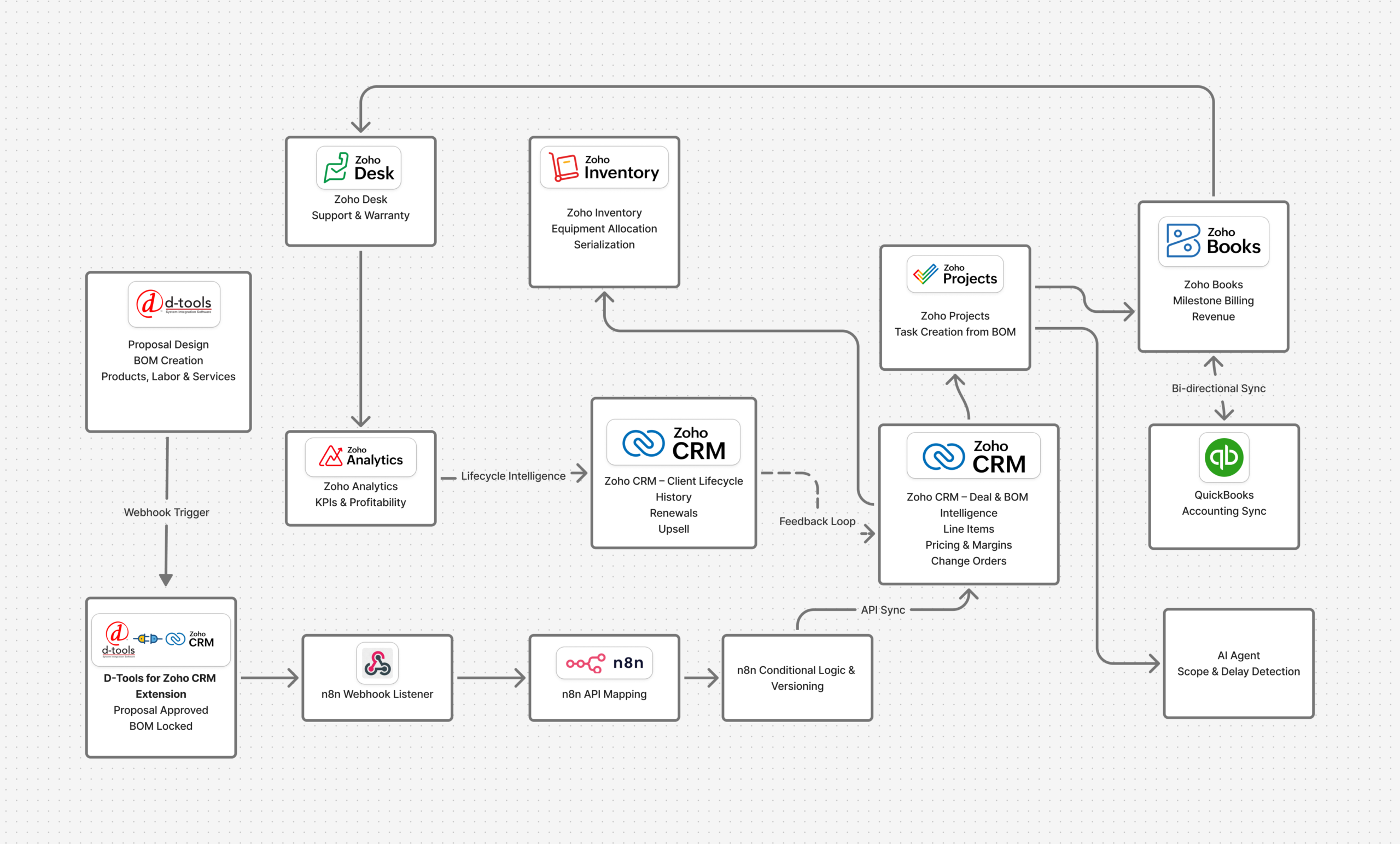
To fully understand the impact of syncing BOMs from D-Tools into Zoho CRM, it is helpful to visualize how information flows through the AV business in real time.
The workflow begins in D-Tools, where proposals and BOMs are designed with engineering precision. Once a proposal is approved, the D-tools For Zoho CRM extension triggers a real-time synchronization. The BOM moves into Zoho CRM as structured deal data, preserving products, quantities, labor, and services.
From Zoho CRM, this data becomes the operational driver. Projects are created with full scope clarity. Inventory and procurement workflows align with actual equipment needs. Billing reflects approved scope and milestones. Service teams inherit accurate installation context for long-term support.
Orchestration platforms such as n8n ensure that updates, revisions, and change orders propagate across systems automatically. What once required emails, spreadsheets, and manual follow-ups now operates as a continuous, system-driven flow.
This architecture transforms BOMs from static documents into operational intelligence.
Why BOM Syncing Is a Leadership Decision
At scale, AV businesses face a choice. Continue operating with disconnected tools and institutional memory, or invest in systems that preserve intelligence across the lifecycle.
Syncing BOMs into CRM is not a technical enhancement. It is a leadership decision that enables predictability, accountability, and controlled growth. This is why modern AVSI business workflow solutions focus on orchestration, not just software selection.
Conclusion: Building a Turnkey AV Business Engine
Turnkey Workflow Solution for AV Businesses
A truly scalable AV business cannot be built by connecting tools reactively. It requires a deliberately designed operating system—one that preserves context from the first lead through long-term service, without manual handoffs or data loss.
OfficeHub Tech delivers a Turnkey Workflow Solution for AV Businesses by architecting Zoho One as the central operational backbone and integrating it seamlessly with AV-specific platforms like D-Tools, accounting systems, and communication tools. Each Zoho application plays a defined role within a single, cohesive workflow.
- Zoho CRM serves as the system of record, managing leads, opportunities, customer data, and synced BOM intelligence from D-Tools across the full lifecycle.
- Zoho Projects transforms approved deals into structured execution plans with tasks, milestones, and dependencies aligned to AV project scope.
- Zoho Inventory manages equipment, serialized devices, procurement workflows, and stock movement based on real project demand.
- Zoho Books enables milestone-based invoicing, vendor bill management, and revenue tracking, while integrating seamlessly with existing accounting systems like QuickBooks.
- Zoho Desk centralizes service tickets, warranties, and post-installation support, ensuring service teams operate with full project and equipment context.
- Zoho Analytics delivers real-time visibility into pipeline health, project profitability, margin performance, and service KPIs for confident decision-making.
- Zoho Mail ensures all client and internal communication is contextually linked to CRM records, projects, and service tickets.
- Zoho Campaigns automates lead nurturing, proposal follow-ups, and service renewal communication with measurable engagement insights.
- Zoho Voice integrates calling directly into business workflows, logging conversations against customers and projects automatically.
- Zoho Flow orchestrates automation across Zoho applications and connected third-party systems, eliminating manual handoffs.
To extend beyond native capabilities, OfficeHub Tech designs advanced integrations using APIs, n8n orchestration, and AI-driven workflows—ensuring that platforms like D-Tools, QuickBooks, Gmail, and vendor systems operate as part of a single, unified AV business ecosystem.
This is not a collection of software implementations. It is an engineered operating model—built to reduce friction, protect margins, and support predictable growth for modern AV system integration businesses.
As Recognized as a Top Zoho Consultant in USA, India, UAE and KSA, OfficeHub Tech brings deep AV domain knowledge and technical execution together. From Zoho Consultation For Av System Integrators to advanced automation and orchestration, every solution is designed for scalability, clarity, and long-term success.
FAQs
Q1: How do I sync a D-Tools BOM with Zoho CRM?
Ans: A D-Tools BOM can be synced with Zoho CRM using a dedicated integration or extension that transfers products, labor, and services as structured CRM data after a proposal is approved.
Q2: Why should AV companies sync BOMs from D-Tools into a CRM?
Ans: Syncing BOMs into a CRM eliminates manual data entry, preserves scope accuracy, improves project handoff, and ensures sales, operations, and finance work from the same source of truth.
Q3: Can Zoho CRM replace spreadsheets for AV project handoff?
Ans: Yes. Zoho CRM can centralize BOM data, deal context, and customer information, removing the need for spreadsheets during sales-to-project transitions.
Q4: Does Zoho CRM work with D-Tools for AV system integrators?
Ans: Yes. Zoho CRM can integrate with D-Tools to bring proposal and BOM data into CRM, enabling automation, reporting, and downstream operational workflows.
Q5: How are change orders handled when syncing D-Tools BOMs?
Ans: Change orders can be tracked as revisions, allowing updated BOM data to sync without overwriting original scope or historical records.
Q6: Can synced BOM data be used for procurement and inventory planning?
Ans: Yes. Once BOM data is available in Zoho CRM, it can drive procurement workflows, inventory planning, and vendor coordination with greater accuracy.
Q7: Will syncing BOMs help reduce project errors and delays?
Ans: Yes. Projects start with approved scope and accurate data, reducing miscommunication, rework, and delays caused by manual interpretation.
Q8: Can Zoho integrate with QuickBooks for AV accounting?
Ans: Yes. Zoho can integrate with QuickBooks to sync invoices, payments, and financial data while keeping existing accounting workflows intact.
Q9: Is D-Tools still needed after integrating with Zoho CRM?
Ans: Yes. D-Tools remains the primary tool for AV design and proposal creation, while Zoho CRM serves as the operational and lifecycle management platform.
Q10: Is D-Tools and Zoho CRM integration suitable for small and growing AV companies?
Ans: Yes. The integration is especially valuable for growing AV businesses, as it reduces operational friction and supports scalable, predictable workflows.