
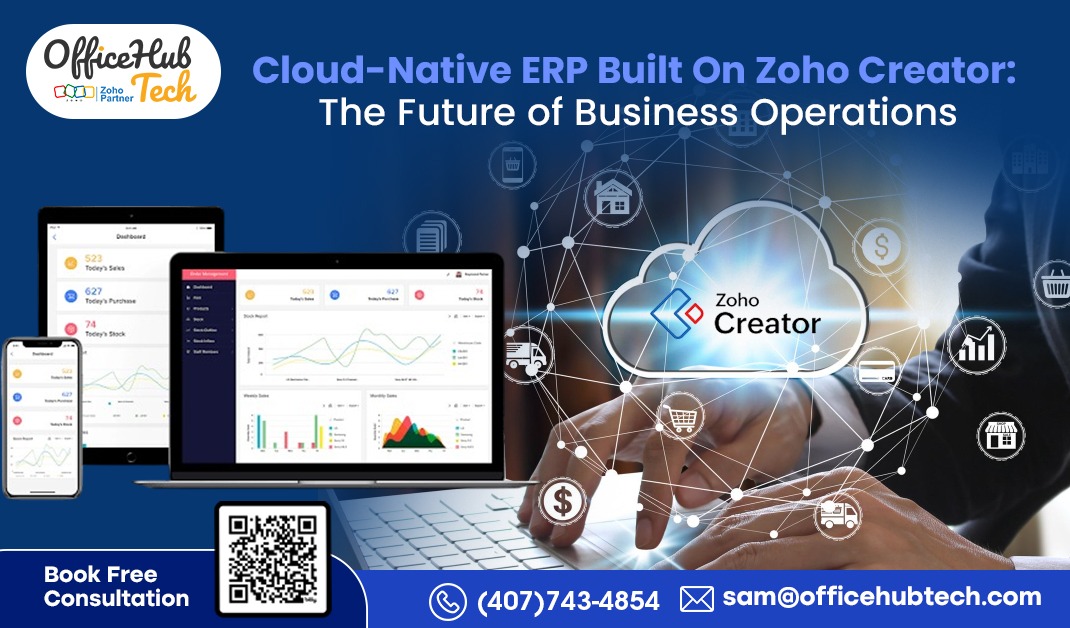
Cloud-Native ERP Built On Zoho Creator: The Future of Business Operations
ERP Systems at a Defining Moment
Enterprise Resource Planning systems were designed to bring order to complexity. For decades, they succeeded. Today, however, the nature of complexity has changed. Markets shift faster. Customer expectations evolve continuously. Regulatory, financial, and operational pressures arrive without warning.
Yet many organizations still rely on ERP platforms architected for a slower, more predictable world. Systems such as SAP S/4HANA, Oracle NetSuite, Infor, Microsoft Dynamics 365, Epicor, SYSPRO, IFS, QAD, and Sage X3 remain powerful, but power alone is no longer enough. Adaptability has become the defining requirement.
This reality has accelerated interest in what many now recognize as the best cloud-native low-code ERP system built on Zoho Creator—an approach that does not merely digitize processes but rethinks how ERP should function in a modern enterprise.
What Cloud-Native ERP Really Means Today
Cloud-native ERP is often misunderstood. It is not a traditional ERP system deployed on cloud infrastructure. That distinction matters.
True cloud-native ERP is built on principles such as elasticity, loose coupling, API-first communication, and continuous deployment. It assumes that change is constant, not occasional. Instead of rigid release cycles, cloud-native systems evolve incrementally. Instead of tightly bound modules, they favor composable services.
Zoho Creator aligns naturally with these principles. It enables ERP systems to be designed as living architectures rather than static applications. Business rules, workflows, integrations, and interfaces can evolve independently, without cascading disruption. This is precisely why Zoho Creator has emerged as a serious foundation for modern ERP initiatives.
The Structural Reality of Legacy ERP Platforms
Legacy ERP platforms are not inherently flawed. They are simply products of their time.
Most were built as monolithic systems, with deeply embedded logic and tightly coupled databases. Over time, organizations customized them extensively to match business needs. Those customizations, while necessary, introduced long-term consequences. Upgrades became complex. Innovation slowed. Costs increased.
For many SAP, Oracle, Infor, Acumatica, or Microsoft Dynamics customers, even small changes now require significant effort. Adding a new workflow, improving user experience, or integrating a modern SaaS tool often feels disproportionate to the value delivered. This creates what many enterprises quietly acknowledge: ERP inertia.
Modernization, therefore, cannot rely solely on upgrading the core. It requires a new architectural layer.
Zoho Creator as an ERP Engineering Platform
Zoho Creator is best understood not as an ERP product, but as an ERP engineering platform.
Low-code, in this context, does not imply simplicity at the expense of rigor. Instead, it abstracts repetitive infrastructure concerns while preserving architectural discipline. Data models remain explicit. Business logic remains transparent. Integrations remain controlled.
This makes it possible to design a low-code ERP system Built on Zoho Creator that reflects how the business actually operates. Processes are modeled around real workflows, not predefined templates. Interfaces are built for usability, not legacy constraints. Governance is embedded, not retrofitted.
ERP becomes something that can be shaped deliberately, rather than endured.
AI Agents and the Emergence of Autonomous ERP
Traditional ERP systems record what happened. Modern ERP systems help decide what should happen next.
Zoho Creator supports the introduction of AI agents that operate within ERP workflows. These agents do not simply automate tasks. They observe patterns, evaluate conditions, and initiate actions based on context. Over time, they reduce human dependency on repetitive decision-making.
Consider inventory systems that anticipate shortages before thresholds are breached, or financial workflows that flag anomalies before audits reveal them. These capabilities represent a shift from procedural automation to operational intelligence.
ERP, in this model, becomes an active participant in the business rather than a passive system of record.
API-First ERP and Modern Orchestration
No ERP exists in isolation anymore. Finance, CRM, procurement, logistics, analytics, and partner ecosystems all intersect.
Zoho Creator is designed as an API-first platform. Every object, workflow, and function can be exposed or consumed programmatically. This allows it to serve as an orchestration layer across systems rather than a siloed application.
When combined with tools like n8n, this orchestration becomes especially powerful. Complex, multi-system workflows can be triggered by events rather than schedules. Data flows in near real time. Processes that once required manual reconciliation become self-coordinating.
This level of orchestration is increasingly essential for organizations operating across multiple platforms and geographies.
Extending Legacy ERP Without Replacing the Core
ERP replacement projects carry risk. They disrupt operations, strain budgets, and often take years to stabilize. For many organizations, replacement is neither necessary nor desirable.
Zoho Creator enables Zoho Creator for Legacy ERP System Extension by introducing modern capabilities around existing ERP cores. User interfaces can be modernized. Mobile access can be added. Reporting and analytics can be enhanced. AI-driven workflows can be layered in.
This approach to Legacy ERP Extension in Zoho Creator respects existing investments while removing barriers to innovation. It allows organizations to modernize incrementally, with clear returns at each stage.
ERP Built for Growth, Scale, and Change
Smaller and mid-sized organizations face a different challenge. They need ERP functionality without the weight of enterprise complexity. Zoho Creator addresses this need directly.
As a cloud-based ERP software for small and medium-sized businesses, it supports rapid deployment, predictable costs, and progressive expansion. Companies can start with essential modules and extend over time. There is no forced complexity, only deliberate growth.
For larger enterprises, Zoho Creator often becomes an innovation layer—allowing departments and business units to evolve independently while maintaining alignment with core systems.
Implementation Philosophy: Build, Extend, and Evolve
ERP success is rarely about software alone. It is about architecture, governance, and execution.
Zoho Creator supports two complementary strategies. One involves building a modern ERP platform from the ground up, tailored precisely to organizational needs. The other focuses on low-code legacy ERP extension, where Zoho Creator enhances existing systems without destabilizing them.
Both strategies benefit from integration with Zoho’s broader ecosystem, including finance, CRM, analytics, and operations tools, as well as third-party platforms such as QuickBooks and external ERP systems.
ERP, in this model, is never finished. It evolves as the business evolves.
Conclusion: ERP as a Living Operating System
ERP is undergoing a quiet transformation. It is no longer a static backbone designed for stability alone. It is becoming a living operating system—responsive, intelligent, and continuously improving.
Cloud-native ERP built on Zoho Creator enables this transformation by combining composable architecture, AI-driven intelligence, and deep integration capabilities. It allows organizations to move beyond the limitations of traditional ERP without discarding what already works.
OfficeHub Tech builds cloud-native ERP systems on Zoho Creator and delivers strategic ERP modernization initiatives across industries. Recognized as a Trusted Zoho Creator Developer and Consultation Company in the US, India, UAE and Saudi Arabia, OfficeHub Tech helps organizations design ERP platforms that are resilient, adaptable, and future-ready.
For businesses ready to move from ERP maintenance to ERP evolution, the next step is clarity—and the right partner.