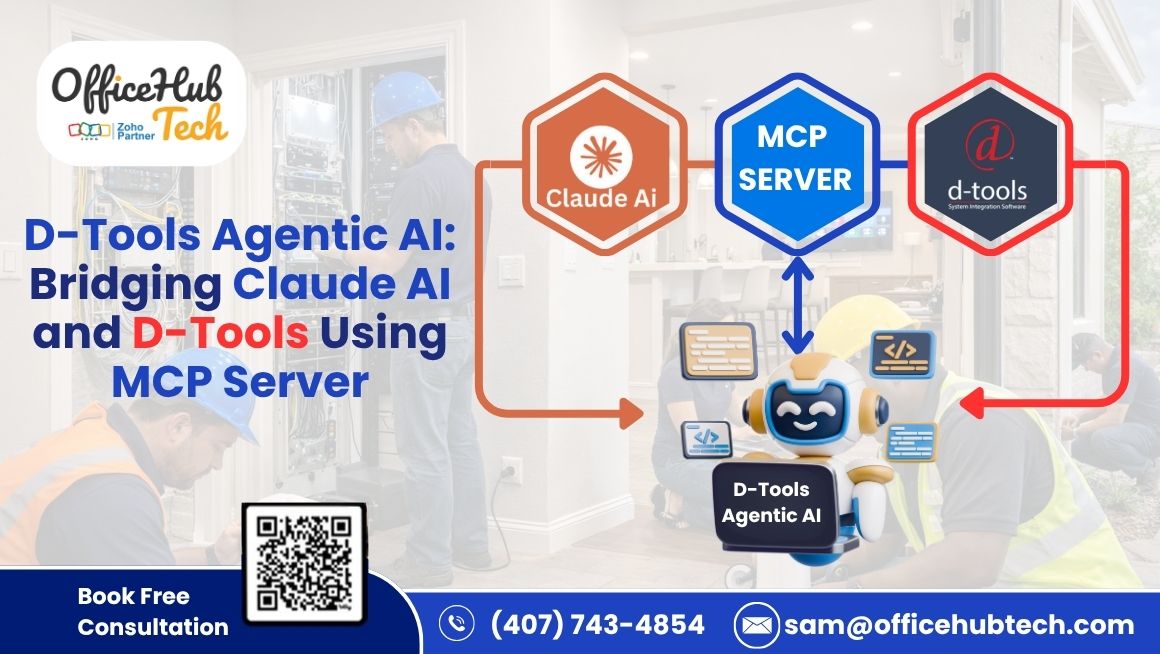
D-Tools Agentic AI: Bridging Claude AI and D-Tools Using MCP Server
How D-Tools Agentic AI Eliminates Bottlenecks in AV System Integration
What if your AV workflow could be executed simply by describing it? Imagine telling an AI to create a project in D-Tools, fetch product details, and generate structured outputs—without opening multiple screens or manually navigating the platform. With D-Tools Agentic AI, powered by Claude AI and connected through a Model Context Protocol (MCP) server, this is no longer theoretical. It represents a practical shift in how system integrators can operate.
Despite advancements in tools like D-Tools SI, most AV and low-voltage workflows remain heavily manual. Creating projects, managing client data, browsing product catalogs, and handling inventory still require step-by-step interaction within the interface. Even for experienced teams, this introduces friction—especially as project complexity increases. D-Tools Agentic AI addresses this gap by introducing an intelligent execution layer that reduces dependency on manual actions.
The gap becomes more evident when scaling operations. Teams are forced to balance speed with accuracy, often compromising one for the other. Manual inputs create inconsistencies. Data retrieval slows down decision-making. Cross-platform coordination becomes increasingly difficult. By leveraging Agentic AI, these inefficiencies can be significantly reduced through intent-driven execution.
The real limitation is not D-Tools itself, but the absence of an intelligent system that can interpret intent and act on it. By integrating Claude AI as the reasoning engine and MCP as the execution bridge, D-Tools Agentic AI enables businesses to move from manual workflows to AI-driven operations—where systems respond to instructions, not clicks.
This shift is not optional—it is rapidly becoming the operational standard for modern system integrators.
Why Traditional Workflows Break at Scale
At a smaller operational level, D-Tools functions efficiently. Projects are manageable, teams remain aligned, and workflows appear controlled. However, as the volume of projects increases and integrations become more complex, the limitations of a purely manual workflow begin to surface.
The challenge is not with capability, but with scalability.
D-Tools is designed to be a powerful system of record, yet it relies heavily on user-driven actions. Every project must be created, configured, and updated manually. Product selections require navigation through extensive catalogs. Client and project data must be searched, verified, and re-entered across different stages of the workflow.
As organizations grow, this approach creates compounding inefficiencies. Teams begin to spend more time operating the system than leveraging it. Proposal timelines extend. Data inconsistencies emerge. Operational dependency on skilled resources increases, making scaling both costly and complex.
When multiple systems are involved—such as CRM platforms, inventory tools, or financial software—the problem intensifies. Data must be synchronized manually or through fragile integrations, leading to delays and errors.
What becomes evident is that traditional workflows are not designed for dynamic, high-volume environments. They lack the ability to interpret intent, automate execution, and adapt in real time.
Bridging D-Tools with an intelligent layer powered by Claude AI and orchestrated through MCP transforms this limitation into an opportunity—shifting from manual operation to intelligent execution at scale.
The Emergence of Agentic AI in System Integration
The evolution from traditional automation to D-tools Agentic AI marks a decisive inflection point in how enterprise systems are operated. In conventional environments, software responds only to explicit user commands. In contrast, Agentic AI introduces systems that can interpret intent, determine actions, and execute workflows autonomously.
This shift is particularly significant for AV system integrators operating within platforms like D-Tools, where operational complexity is high and workflows are deeply interconnected.
From Passive Tools to Active Execution Systems
Traditional tools require users to:
- Navigate interfaces
- Input structured data
- Trigger actions manually
D-tools Agentic systems, powered by Claude AI, eliminate this dependency. They transform natural language into executable instructions, enabling systems to act rather than wait.
Core Characteristics of Agentic AI
Agentic AI systems are defined by their ability to:
- Interpret Context: Understand user intent beyond structured inputs
- Select Actions Dynamically: Identify the appropriate operation without predefined flows
- Execute Across Systems: Perform tasks spanning multiple platforms
- Adapt in Real Time: Adjust workflows based on evolving data
Why This Matters for D-Tools Environments
In a D-Tools-centric workflow, Agentic AI enables:
- Automated project creation based on descriptive prompts
- Intelligent retrieval of product and inventory data
- Seamless orchestration of proposal and estimation workflows
This is not automation in the traditional sense. It is a transition toward systems that operate with a degree of autonomy—where Claude AI provides reasoning and MCP provides execution capability.
The emergence of Agentic AI signals a broader transformation: systems are no longer just tools—they are becoming operational collaborators.
Understanding MCP (Model Context Protocol) in Depth
At the center of this architecture lies MCP—Model Context Protocol—a standardized framework that enables large language models (LLMs) like Claude AI to securely and intelligently interact with external systems. Within D-Tools Agentic AI, MCP acts as the execution bridge that transforms AI intent into structured, real-world actions inside platforms like D-Tools.
While LLMs excel at reasoning and understanding context, they do not inherently execute operations. MCP resolves this limitation by providing a consistent interface through which AI can discover, interpret, and invoke system-level actions.
MCP as an Execution Framework, Not Just Middleware
Unlike traditional middleware that focuses on data exchange, MCP is purpose-built for AI-driven execution. It enables:
- Exposure of business operations as callable tools
- Standardized input-output structures for LLM interaction
- Secure and real-time execution across external systems
Each MCP tool represents a defined capability—such as creating a project in D-Tools or retrieving product data—structured in a way that Claude AI can understand and execute reliably.
How MCP Structures System Interaction
MCP introduces a modular and scalable interaction model:
- Tool Definition Layer: Business operations are exposed as reusable tools
- Execution Layer: Tools interact with systems like D-Tools via APIs or automation layers
- Response Layer: Outputs are formatted for both AI interpretation and user clarity
This structure ensures consistency, scalability, and maintainability across complex workflows.
Why MCP is Critical in Claude AI + D-Tools Agentic AI Integration
When a user provides a prompt, Claude AI does not directly operate D-Tools. Instead, within the D-Tools Agentic AI framework:
- Claude AI interprets the user’s intent
- MCP exposes available tools and their capabilities
- The appropriate tool is selected and invoked
- The action is executed within D-Tools
- Structured results are returned to the user
This controlled interaction ensures precision, flexibility, and reliability.
Strategic Advantage
By implementing MCP within D-Tools Agentic AI, organizations gain:
- Decoupled architecture between AI and operational systems
- Centralized execution control across workflows
- Scalable integration across CRM, inventory, finance, and project tools
In essence, MCP transforms AI from a passive reasoning engine into an actionable execution interface—enabling businesses to operate D-Tools through intent rather than manual interaction.
Bridging Intelligence and Execution: Claude AI + MCP + D-Tools
The true power of this architecture lies not in any single component, but in the orchestration between Claude AI, MCP Server, and D-Tools. Together, they form a unified system where intent is seamlessly converted into execution.
From Prompt to Execution: The Flow
This integration operates through a structured yet dynamic sequence:
- User Input: A natural language prompt is provided
- LLM Interpretation: Claude AI analyzes intent, context, and required outcome
- Tool Mapping: MCP identifies the appropriate tool based on the request
- Execution: The tool interacts with D-Tools via API
- Response Delivery: Structured output is returned to the user
This eliminates the need for manual navigation entirely.
Role of Each Layer
- Claude AI (LLM): Acts as the reasoning engine, understanding complex instructions
- MCP Server: Functions as the execution bridge, translating intent into system actions
- D-Tools SI: Serves as the operational system where actual business processes occur
Each layer is independent, yet tightly integrated—ensuring both flexibility and control.
Operational Impact
This model introduces a new way of interacting with D-Tools:
- Projects can be created without opening the interface
- Product data can be retrieved instantly through queries
- Workflows can be executed without predefined scripts
What once required multiple steps across screens is now reduced to a single instruction.
Demo: See It in Action
To understand the real impact of this integration, it is best experienced visually.
👉 Watch how a simple prompt triggers project creation, product lookup, and workflow execution inside D-Tools through Claude AI and MCP.
Why This Matters
This is not automation in isolation—it is orchestration at scale. By bridging Claude ai intelligence with MCP execution and D-Tools operations, businesses can move from reactive workflows to proactive, AI-driven systems.
Designing an MCP Server for D-Tools: Architecture and Principles
A high-performing MCP implementation is not merely a technical connector—it is an engineered execution framework. The design of the MCP server determines how effectively Claude AI can translate intent into reliable, real-world operations within D-Tools.
Foundational Design Principles
To ensure robustness and scalability, the MCP server must be built on:
- Modularity: Each function is isolated as an independent tool
- Deterministic Execution: Every action produces predictable outcomes
- Scalability: New tools and integrations can be added without disruption
- Security Control: Access and operations are governed through structured validation
Layered Architecture Approach
A well-structured MCP server for D-Tools typically follows a layered model:
1. Tool Abstraction Layer
Defines business operations as callable tools such as:
- Create Project
- Update Project Details
- Fetch Project Information
- Search Products
- Retrieve Inventory Data
Each tool encapsulates inputs, logic, and expected outputs.
2. API Orchestration Layer
Acts as the communication bridge with D-Tools SI APIs:
- Handles authentication and request management
- Ensures data consistency and error handling
- Translates tool execution into API calls
3. Execution Control Layer
Ensures operational reliability:
- Validates input parameters
- Applies business rules
- Formats responses for Claude AI
Why This Architecture Matters
Without a structured MCP design, AI-driven execution becomes unreliable. With it, organizations achieve:
- Controlled automation across D-Tools workflows
- Seamless scalability across projects and teams
- Foundation for broader d-tools integration across systems
This architectural discipline is what transforms MCP from a simple connector into a strategic execution engine.
Implementing MCP Tools for D-Tools Operations
The effectiveness of an MCP-driven system is defined by how well its tools are designed and implemented. Each tool represents a discrete business capability, exposed in a way that allows Claude AI to invoke it with precision and context awareness. Poorly structured tools lead to ambiguity; well-designed tools enable seamless execution.
Designing Tools Around Business Outcomes
Rather than mirroring UI actions, MCP tools should be aligned with business intent. This ensures that prompts translate directly into meaningful operations.
Core Tool Categories
- Project Management Tools
Create, update, and retrieve project data with structured inputs such as client, scope, and budget - Client & Opportunity Tools
Search clients, fetch contact details, and link them to projects dynamically - Product & Catalog Tools
Query product databases by manufacturer, model, or category with real-time filtering - Inventory Intelligence Tools
Generate summaries, availability checks, and stock insights
Execution Logic and Parameter Structuring
Each tool must define:
- Clear input parameters (e.g., project name, budget, client ID)
- Validation rules to prevent incorrect execution
- Structured outputs for consistent interpretation by Claude AI
This ensures that even complex requests are handled reliably.
Enabling Intelligent Invocation
When a user provides a prompt, Claude AI evaluates intent and selects the appropriate tool. For example:
- A request to create a project triggers the project creation tool
- A query about product specifications invokes catalog tools
This dynamic mapping is the foundation of d-tools si automation.
Operational Outcome
By implementing MCP tools in this manner, organizations achieve:
- Faster execution of routine tasks
- Reduced dependency on manual workflows
- Consistent and error-free operations
The true power of MCP lies not in the number of tools, but in how intelligently they are designed to reflect real-world business processes.
Connecting Claude AI: Turning Prompts into Execution
The integration of Claude AI with an MCP server marks the transition from static workflows to intent-driven execution. At this stage, the system is no longer dependent on predefined scripts or rigid interfaces. Instead, it becomes responsive, contextual, and operationally intelligent.
From Language to Action
Claude AI functions as the cognitive layer within this architecture. When a user submits a prompt, the model performs:
- Intent Recognition: Understanding what the user wants to achieve
- Context Evaluation: Identifying relevant parameters such as project type, budget, or product category
- Tool Selection: Mapping the request to the appropriate MCP tool
- Execution Trigger: Initiating the operation through the MCP server
This seamless flow enables real-time interaction with D-Tools without direct system navigation.
Configuring Claude for MCP Integration
To enable this capability:
- The MCP server is registered within Claude Desktop
- Tool access is explicitly enabled
- Claude dynamically discovers available tools and their capabilities
Once configured, the system operates as a unified environment where AI can execute business operations.
Practical Interaction Examples
A single prompt such as:
“Create a commercial AV project with a $100K budget and include conferencing systems”
initiates a complete execution cycle—project creation, data structuring, and system updates.
Similarly:
“Show available products from Sony for conference rooms”
triggers product retrieval and filtering instantly.
Operational Significance
This integration enables ai workflow automation at a level where:
- Actions are executed based on intent, not manual input
- Workflows adapt dynamically to user requirements
- System interaction becomes conversational yet precise
Claude AI, when combined with MCP, evolves from a conversational interface into a command-driven operational engine—capable of executing complex workflows inside D-Tools with minimal human intervention.
Real-World Workflow Transformation for AV System Integrators
The true measure of this architecture is not in its design, but in its operational impact. When Claude AI, MCP, and D-Tools are integrated effectively, the transformation is immediate and tangible across daily workflows.
From Manual Execution to Intelligent Operations
Traditional workflows require sequential actions—login, navigate, input, verify, and execute. With MCP-enabled AI, this sequence is compressed into a single interaction.
System integrators can now operate through intent rather than interface.
Key Workflow Transformations
- Project Initiation: Project creation, which typically involves multiple steps, becomes instantaneous. A single prompt defines scope, budget, and client—triggering structured project setup within D-Tools.
- Proposal Acceleration: Proposal generation shifts from manual compilation to automated structuring. Data is fetched, organized, and aligned with project requirements in real time.
- Product & Inventory Intelligence: Instead of navigating catalogs, users can query products conversationally. The system retrieves specifications, availability, and pricing insights without delay.
- Cross-System Coordination: When integrated with CRM, finance, or inventory systems, workflows extend beyond D-Tools—creating a unified operational environment.
Measurable Impact
Organizations implementing this model typically observe:
- Reduced project setup time
- Faster proposal turnaround
- Improved data accuracy
- Lower operational overhead
Strategic Advantage
This transformation represents more than efficiency. It establishes a new operational standard—where Agentic ai agent for system integrators enables businesses to scale without increasing manual effort.
By redefining how work is executed, this architecture allows AV integrators to operate with greater speed, precision, and control—turning everyday workflows into streamlined, intelligent processes.
Extending the Ecosystem: CRM, Finance, and Cross-Platform Automation
While the integration of Claude AI with D-Tools through MCP delivers significant operational gains, its true strategic value emerges when extended across the broader business ecosystem. AV system integrators rarely operate within a single platform. Critical functions are distributed across CRM, finance, inventory, and project management systems—each introducing its own layer of complexity.
MCP enables these systems to be unified under a single, intelligent execution layer.
Breaking System Silos
Traditional integrations rely on point-to-point connections, often resulting in fragile workflows and data inconsistencies. MCP replaces this with a centralized orchestration model where:
- CRM systems such as Zoho CRM, Salesforce, or HubSpot manage client and opportunity data
- Finance platforms like QuickBooks or Zoho Books handle billing and financial tracking
- Inventory systems provide real-time product availability
- Project tools such as Monday.com or Asana track execution and timelines
All of these systems can be exposed as MCP tools, enabling Claude AI to operate across them seamlessly.
Unified Workflow Execution
A single instruction can now trigger multi-system operations. For example:
- Creating a project in D-Tools
- Linking it to a CRM opportunity
- Checking inventory availability
- Initiating financial estimates
This level of orchestration defines advanced business automation workflows.
Operational Outcomes
By extending beyond D-Tools, organizations achieve:
- End-to-end workflow visibility
- Elimination of redundant data entry
- Real-time synchronization across systems
- Scalable automation across departments
Strategic Perspective
This is not integration for convenience—it is integration for control. By centralizing execution through MCP, businesses gain the ability to operate as a cohesive system rather than a collection of disconnected tools.
Case Study: From Manual Chaos to Intelligent Operations
To understand the practical impact of this architecture, it is essential to examine how it performs in real operational environments. The transition from manual workflows to MCP-driven execution is not incremental—it is transformational.
Case Study 1: VisionTech AV Solutions
VisionTech, a mid-sized AV system integrator, faced persistent delays in proposal creation and project onboarding. Their team relied heavily on D-Tools for project management, but the process required extensive manual input across multiple stages.
After implementing an MCP-based integration with Claude AI:
- Project creation time reduced by over 60%
- Proposal turnaround improved significantly
- Data consistency increased across teams
- Manual dependency on senior resources decreased
Instead of navigating D-Tools, their team began operating through prompts—allowing Claude AI to execute actions via MCP tools.
Case Study 2: SecureWave Integrators
SecureWave specialized in security and low-voltage systems, managing high volumes of projects across multiple clients. Their primary challenge was coordinating data between D-Tools, CRM, and inventory systems.
By deploying an integrated Agentic AI framework:
- CRM and D-Tools workflows were unified
- Inventory lookups became instantaneous
- Cross-platform data synchronization improved
- Operational efficiency increased across departments
Key Takeaways
- Automation reduced operational friction
- AI-driven execution improved speed and accuracy
- Cross-system orchestration eliminated silos
These implementations demonstrate how d-tools automation evolves from a concept into a measurable business advantage—enabling system integrators to operate with precision, speed, and scalability.
Want similar results for your business?
Get started with Your “D-Tools Agentic AI” — Free & Open Source
Strategic Challenges and How to Engineer Around Them
While the integration of Claude AI, MCP, and D-Tools unlocks significant operational advantages, its implementation requires careful architectural and strategic planning. Organizations that approach this transformation without a structured framework often encounter avoidable friction.
Challenge 1: API Complexity and System Constraints
D-Tools and similar platforms expose APIs that may vary in depth, structure, and limitations. Direct integration without abstraction can lead to rigid and error-prone workflows.
Solution:
Implement a well-defined MCP abstraction layer that standardizes inputs and outputs. This ensures that Claude AI interacts with a consistent interface, regardless of underlying API variations.
Challenge 2: Data Integrity and Validation
Automated execution introduces the risk of incorrect or incomplete data being processed at scale.
Solution:
Incorporate validation mechanisms within the MCP execution layer. Every tool should enforce parameter checks, business rules, and fallback logic to maintain data accuracy.
Challenge 3: User Adoption and Workflow Transition
Teams accustomed to manual workflows may resist AI-driven systems due to lack of familiarity or trust.
Solution:
Adopt a phased implementation strategy. Begin with high-impact use cases such as project creation or product lookup, then expand gradually. Training and clear usage guidelines are critical.
Challenge 4: Security and Access Control
Allowing AI to execute operations across systems raises concerns around unauthorized access and data exposure.
Solution:
Implement role-based access control, secure authentication protocols, and audit logging within the MCP server to ensure controlled execution.
Challenge 5: Scalability Across Systems
As integrations expand to CRM, finance, and inventory platforms, maintaining consistency becomes increasingly complex.
Solution:
Design MCP as a centralized orchestration layer capable of managing multi-system interactions—forming the foundation for scalable ai automation architecture.
Strategic Perspective
These challenges are not limitations—they are engineering considerations. When addressed correctly, they strengthen the system, ensuring that automation is not only powerful but also reliable and secure.
The Future: Autonomous AV Workflows with Agentic AI
The integration of Claude AI with D-Tools through MCP is not an endpoint—it is an early manifestation of a broader shift toward autonomous business operations. As systems evolve, the role of human intervention will progressively transition from execution to oversight.
From Assisted Workflows to Autonomous Systems
Current implementations enable AI to execute tasks based on explicit prompts. The next phase will introduce systems capable of:
- Proactive decision-making based on historical data and patterns
- Automated workflow triggering without manual input
- Continuous optimization of project timelines and resource allocation
This evolution transforms workflows from reactive processes into intelligent, self-regulating systems.
Intelligence Layer Across the AV Ecosystem
Future architectures will extend beyond individual platforms. MCP-driven systems will orchestrate operations across:
- D-Tools for project and proposal management
- CRM platforms for opportunity tracking
- Inventory systems for real-time availability
- Financial tools for budgeting and billing
This unified intelligence layer enables seamless coordination across the entire business lifecycle.
Predictive and Context-Aware Operations
With advanced LLM capabilities, systems will not only execute commands but also anticipate needs. For example:
- Recommending products based on project type
- Suggesting budget adjustments based on historical data
- Identifying potential delays before they occur
This represents the emergence of agentic ai for enterprise workflows—where systems actively contribute to decision-making.
Strategic Implication
Organizations that adopt this model early will establish a decisive advantage. They will operate with greater speed, accuracy, and adaptability—while competitors remain constrained by manual processes.
The future of AV system integration is not defined by better tools, but by smarter systems—capable of thinking, acting, and evolving alongside the business.
Conclusion
Bridging D-Tools with Claude AI through MCP represents a fundamental shift from manual, interface-driven workflows to intelligent, execution-driven operations. By introducing an MCP layer, businesses enable LLMs like Claude to not only interpret intent but to act on it—creating projects, retrieving product data, managing workflows, and orchestrating multi-system processes with precision. This architecture eliminates operational friction, reduces dependency on repetitive tasks, and establishes a scalable foundation for modern AV system integration.
At OfficeHub Tech, this vision is realized through D-Tools Agentic AI for AV System Integrators—a purpose-built solution that transforms how AV, low-voltage, and security businesses operate. By combining LLM intelligence, MCP execution, and D-Tools integration, organizations can move beyond traditional limitations and adopt a model where workflows are faster, smarter, and inherently scalable.
Custom Agentic AI Solutions Across CRM, Sales, Finance, Projects, and Inventory
The next phase of business efficiency is no longer driven by isolated tools, but by intelligent systems that can operate, adapt, and execute across the entire organization. This is where custom-built Agentic AI becomes a strategic advantage. At OfficeHub Tech, the focus is not just on implementing automation, but on designing AI-driven systems that align with real-world business workflows and deliver measurable outcomes.
From core business operations to advanced workflow automation, our Custom Agentic AI solutions are designed to address specific functional needs across departments:
Key Solutions We Offer
- CRM Management Agentic AI
Enables intelligent customer interaction management, real-time pipeline visibility, and automated lead tracking to improve relationship management and conversion efficiency. - Sales Management Agentic AI
Accelerates deal execution, enhances forecasting accuracy, and streamlines sales processes through data-driven insights and intelligent automation. - Finance Management Agentic AI
Provides accurate, real-time financial tracking, reporting, and analysis—ensuring better control over budgets, cash flow, and financial decision-making. - Project Management Agentic AI
Ensures seamless coordination across teams, automates task execution, and maintains delivery timelines with enhanced operational visibility. - Inventory Management Agentic AI
Offers complete visibility into stock levels, availability, and procurement workflows—enabling efficient inventory control and demand planning.
What differentiates OfficeHub Tech is the ability to integrate these systems into a unified architecture—connecting platforms, automating processes, and enabling AI-driven decision-making across departments. Each implementation is designed for scalability, ensuring that as business complexity grows, the system evolves alongside it.
Recognized as a leading Custom Agentic AI Developer and Implementation Provider across USA, India, UAE, and KSA, OfficeHub Tech delivers solutions that move beyond automation—creating intelligent ecosystems that empower businesses to operate with speed, precision, and control.
Get Your Custom Agentic AI System