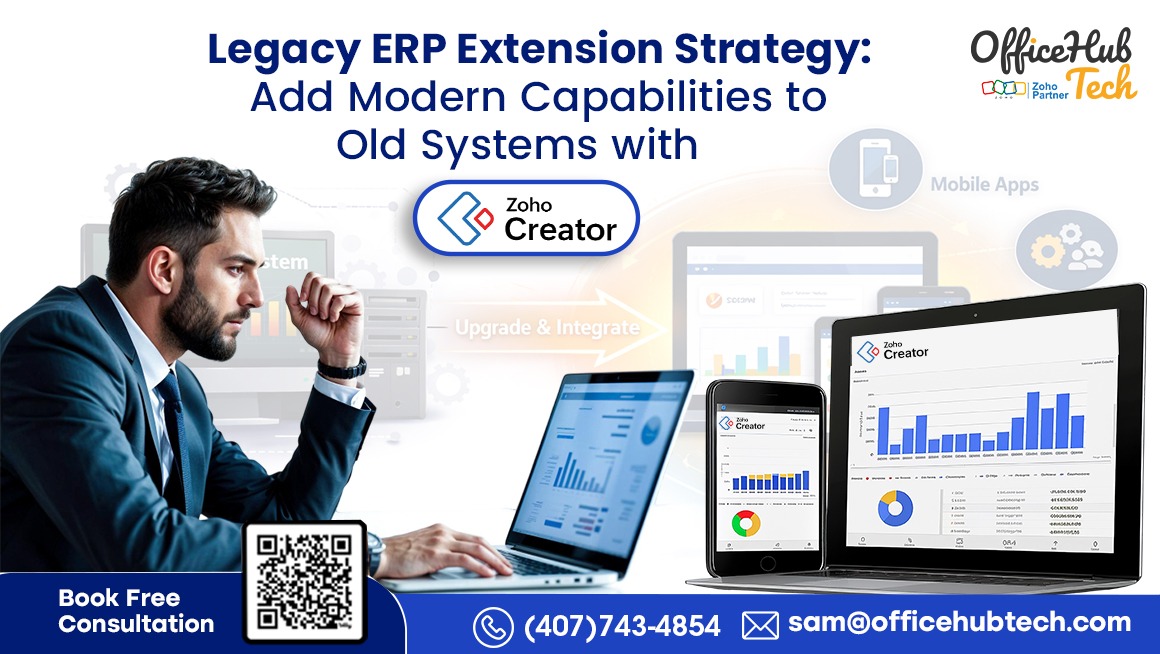
Legacy ERP Extension Strategy: Add Modern Capabilities to Old Systems with Zoho Creator
Modernizing Legacy ERP Without Replacement: A Scalable Extension Strategy with Zoho Creator
The Legacy ERP Dilemma: Stability vs. Innovation
Legacy ERP systems continue to serve as the operational backbone of enterprises, delivering transactional accuracy, compliance, and process standardization. Platforms like SAP, Infor, Acumatica, and Microsoft Dynamics 365 are deeply embedded in business operations.
However, their architecture introduces a critical limitation.
Most legacy ERP systems are monolithic, tightly coupled, and not designed for API-first or event-driven environments. While they perform well as systems of record, they struggle to support real-time processing, advanced automation, and seamless integrations. Enhancements often require heavy customization, leading to increased technical debt and slower release cycles.
This creates a clear gap between business expectations and system capabilities.
Modern enterprises require agility—real-time insights, connected systems, and intelligent workflows. In contrast, legacy ERPs remain batch-driven and rigid, forcing teams to rely on external tools and manual processes. Over time, this leads to fragmented data, reduced visibility, and operational inefficiencies.
Replacing ERP systems is rarely practical due to cost and risk. Instead, organizations are adopting Zoho Creator For Legacy ERP Extension to bridge this gap.
By introducing a low-code extension layer using Zoho Creator, businesses can enable automation, integrations, and modern applications without altering the ERP core.
The challenge is no longer about replacing legacy systems—but extending them intelligently to support modern enterprise needs.
Why Traditional ERP Modernisation Strategies Fail
ERP modernisation has traditionally followed two paths: full system replacement or deep customization of existing systems. While both approaches aim to improve capabilities, they often introduce more complexity than value.
ERP replacement is typically a high-risk, high-cost initiative. It involves multi-year timelines, extensive data migration, and significant operational disruption. Even after implementation, organizations frequently face process misalignment, requiring further adjustments that delay ROI.
On the other hand, customization within legacy ERP systems creates long-term technical challenges. Custom code tightly coupled with core modules leads to:
- Upgrade complications and higher maintenance costs
- Increased dependency on specialized resources
- Reduced system flexibility over time
Instead of enabling agility, customization often locks organizations deeper into rigid architectures.
The core issue is strategic—not technical.
Legacy ERP systems are designed to function as systems of record, ensuring transactional integrity and compliance. Forcing them to also serve as systems of innovation creates inefficiencies, slows development, and increases risk.
This is why both replacement and customization approaches fail to deliver sustainable outcomes.
Modern enterprises are shifting toward a more balanced model—extension-first architecture. Rather than modifying or replacing the ERP, innovation is externalized through modular applications and integration layers.
This is where Zoho Creator legacy ERP Modernisation becomes relevant.
Using Zoho Creator, organizations can:
- Build new capabilities without altering ERP core logic
- Integrate systems using APIs and webhooks
- Deliver faster iterations without dependency on ERP release cycles
This approach reduces risk, accelerates innovation, and preserves existing ERP investments.
ERP modernisation does not fail due to lack of technology—it fails due to misaligned strategy. The shift toward extension resolves this by separating stability from innovation.
Rethinking ERP: The Rise of Extension-First Architecture
The traditional view of ERP as a central, all-encompassing system is rapidly changing. Modern enterprises no longer rely on ERP as the primary driver of innovation. Instead, ERP is repositioned as a stable system of record, while innovation is delivered through external, modular layers.
This shift has led to the rise of extension-first architecture.
In this model, new capabilities are not built داخل (inside) the ERP. Instead, they are developed as independent applications that integrate with ERP through APIs and event-driven mechanisms. This reduces dependency on core ERP structures and allows faster innovation cycles.
The result is a move from monolithic systems to composable ecosystems.
Organizations adopting this approach can:
- Decouple business applications from ERP constraints
- Introduce new workflows without affecting core stability
- Scale capabilities independently based on business needs
This is especially critical when transforming a legacy ERP system to cloud business apps, where flexibility and speed are essential.
Zoho Creator plays a key role in enabling this architecture. It allows businesses to build and deploy modular applications that operate alongside ERP systems while maintaining seamless data synchronization.
Instead of forcing ERP systems to evolve beyond their design limitations, enterprises can extend them intelligently.
This aligns with Extend legacy ERP with Zoho Creator, where:
- ERP continues to handle transactions and data integrity
- Extension layers manage automation, user experience, and integrations
The outcome is a more agile and scalable architecture that supports continuous improvement without disrupting existing operations.
Extension-first architecture is not just a technical shift—it is a strategic redefinition of how ERP systems are used in modern enterprises.
Zoho Creator as a Strategic Extension Layer
In an extension-first architecture, the platform defines how effectively innovation can scale. It must support rapid development, seamless integration, and controlled execution—without introducing risk to the ERP core.
Zoho Creator serves as a dedicated extension layer, enabling organizations to modernize legacy ERP environments without intrusive changes.
From Low-Code Tool to Extension Framework
Zoho Creator goes beyond basic low-code development. It functions as an application and integration layer, allowing enterprises to build and deploy solutions that interact directly with ERP systems.
Its capabilities include:
- API-first integration for connecting ERP and external systems
- Custom logic through Deluge scripting for workflow control
- Pre-built connectors for faster deployment
- Cloud-native scalability for enterprise workloads
This makes it highly effective for Zoho Creator ERP extension initiatives.
Separation of Core and Innovation Layers
Zoho Creator enables a clear architectural split:
- ERP (System of Record): manages transactions and structured data
- Extension Layer: handles automation, applications, and integrations
This separation allows businesses to Extend legacy ERP with Zoho Creator without impacting system stability or upgrade paths.
Core Capabilities Delivered
With Zoho Creator, organizations can:
- Build custom business applications aligned to real workflows
- Automate processes using event-driven triggers
- Enable real-time data exchange via APIs and webhooks
- Deliver mobile-ready and user-friendly interfaces
- Integrate AI-driven logic into operations
Modernising Without Migration
Instead of replacing ERP systems, organizations can evolve toward cloud apps from a legacy ERP system. New capabilities are layered externally, allowing continuous improvement without disruption.
This approach transforms ERP modernization into a controlled, incremental process, where innovation is delivered faster and with significantly lower risk.
Core Pain Points in Legacy ERP Environments
Legacy ERP systems provide stability, but they also introduce structural limitations that restrict agility, integration, and scalability. These challenges become more evident as organizations attempt to align with modern, digital-first operations.
Data Silos and Fragmentation
ERP systems often operate in isolation, with data distributed across modules and external tools. Over time, this creates fragmented data environments, inconsistent reporting, and heavy reliance on manual reconciliation. The lack of a unified data layer slows decision-making and reduces visibility.
Lack of Real-Time Visibility
Most legacy ERPs rely on batch processing rather than real-time updates. This creates delays between data generation and insight availability. As a result, teams operate reactively, without the ability to respond instantly to operational changes or exceptions.
Limited Automation Capabilities
Automation in legacy systems is typically rigid and confined within specific modules. Cross-functional workflows often require manual intervention, increasing process inefficiencies and the risk of human error. Scaling such processes becomes difficult as business complexity grows.
Integration Constraints
Legacy ERP systems are not designed for API-first ecosystems. Integration with modern applications often requires custom scripts or middleware, leading to increased complexity and maintenance overhead. Real-time connectivity becomes a challenge, limiting system interoperability.
User Experience Gaps
Outdated interfaces and lack of mobile accessibility reduce usability. Employees often rely on external tools to complete tasks, which further fragments the system landscape and impacts productivity.
Addressing These Limitations
These challenges highlight the need for Low-code Platform for Legacy ERP Extension strategies. By using platforms like Zoho Creator, organizations can introduce automation, integrations, and modern applications without modifying the ERP core.
This enables a more flexible approach to Extending legacy ERP systems using Zoho Creator, where limitations are addressed through architecture rather than system replacement.
The Low-Code Advantage in ERP Extension
Traditional ERP enhancements rely on custom development, which is often slow, resource-intensive, and difficult to scale. Low-code platforms introduce a more efficient model—rapid, flexible, and controlled extension without deep changes to the ERP core.
This is where Low-code Platform for ERP Extension becomes a practical enabler of modernization.
Faster Development and Deployment
Low-code platforms significantly reduce development time by allowing applications to be built using visual interfaces and minimal scripting. This enables organizations to respond quickly to evolving business requirements without waiting for long development cycles.
With Zoho Creator, enterprises can implement Zoho Creator ERP Extension use cases in weeks instead of months.
Decoupled Innovation Model
Low-code enables organizations to build applications outside the ERP, connected through APIs. This avoids direct modifications to the ERP system and reduces risks associated with upgrades and system stability.
This approach supports Extend legacy ERP with Zoho Creator, where innovation happens independently of the core system.
Business and IT Collaboration
Low-code platforms allow both developers and business users to participate in application development. This improves alignment between technical implementation and business requirements, reducing delays and miscommunication.
Built-In Integration and Automation
Modern low-code platforms are designed for integration and workflow automation. They support API connectivity, event-driven triggers, and process orchestration, enabling seamless interaction between ERP and other systems.
This allows organizations to Build cloud apps from legacy ERP system processes while maintaining governance and control.
Continuous Modernisation
Low-code transforms ERP modernization into an ongoing process rather than a one-time initiative. Organizations can continuously introduce improvements, automate workflows, and integrate new systems as needed.
This aligns with Zoho Creator legacy ERP Modernisation, where systems evolve incrementally without disruption.
Technical Architecture: How Zoho Creator Extends Legacy ERP
A successful ERP extension strategy depends on a well-structured, integration-driven architecture. The goal is to introduce new capabilities without disrupting the ERP core, using a layered approach built on APIs, events, and orchestration.
Zoho Creator enables this by acting as a central extension layer that connects systems, executes logic, and delivers applications.
API-Driven Integration Layer
APIs form the foundation of ERP extension. Legacy systems expose data and services, which are consumed by external applications built on Zoho Creator.
This allows:
- Real-time data exchange between ERP and applications
- Decoupling of business logic from ERP modules
- Reusable integration across multiple use cases
Through this model, organizations can create cloud apps from a legacy ERP system while maintaining data consistency.
Event-Driven Processing with Webhooks
To move beyond batch processing, modern architectures use event-driven mechanisms. Webhooks trigger actions instantly when specific events occur in the ERP.
This enables:
- Immediate workflow execution
- Real-time notifications and updates
- Faster response to operational events
Workflow Orchestration with n8n
For multi-system processes, orchestration tools like n8n provide a centralized way to manage workflows. They connect ERP, CRM, finance systems, and external services into unified processes.
This reduces integration complexity and supports scalable automation across the enterprise.
AI and Intelligent Processing Layers
Advanced architectures integrate AI agents and context-driven systems to enhance decision-making. These layers analyze ERP data, trigger intelligent workflows, and automate complex decisions.
Unified Extension Architecture
The combined architecture includes:
- ERP as the system of record
- Zoho Creator as the application and logic layer
- APIs and webhooks for connectivity
- n8n and AI for orchestration and intelligence
This structured approach enables organizations to Extend legacy ERP with Zoho Creator in a scalable, secure, and future-ready manner—without introducing instability into the core system.
Extending Enterprise ERP Systems: A Generic Approach
ERP extension strategies must be platform-agnostic. Whether an organization uses SAP, Infor, Acumatica, Microsoft Dynamics 365, or any other system, the extension methodology remains consistent.
The focus is not on the ERP vendor—but on how modern capabilities are layered on top of existing systems.
Abstracting ERP Complexity
Each ERP has its own structure and constraints. Direct customization increases risk and maintenance overhead. Instead, organizations adopt an abstraction approach:
- ERP continues to manage transactions and core data
- External applications handle workflows, interfaces, and integrations
This reduces dependency on ERP-specific logic while enabling flexibility.
Common Extension Use Cases
Across industries and ERP platforms, similar gaps exist. These can be addressed using Zoho Creator as an extension layer:
- Workflow automation for approvals and operations
- Custom applications for internal processes or field teams
- Real-time dashboards and reporting layers
- Integration with CRM, finance, and third-party systems
Standard Integration Model
A typical extension pattern includes:
- ERP exposing data through APIs
- Zoho Creator consuming and processing that data
- Workflows executed externally
- Updates synchronized back into ERP
This ensures bidirectional data flow without modifying core ERP systems.
Scalable and Repeatable Approach
A generic extension strategy allows organizations to standardize development across multiple systems and business units. It reduces complexity, improves scalability, and accelerates implementation.
By following this model, businesses can effectively Extend legacy ERP with Zoho Creator while maintaining consistency across different ERP environments and enabling long-term scalability.
Building Intelligent Cloud Applications from Legacy ERP
Legacy ERP systems are designed for transaction processing, not for delivering flexible, user-centric applications. To meet modern business demands, organizations must convert ERP-driven processes into cloud-based, application-driven workflows.
This is where the ability to Build cloud apps from legacy ERP system becomes essential.
From ERP Transactions to Business Applications
ERP systems store and process data, but they are not optimized for usability or contextual workflows. By using Zoho Creator, organizations can build targeted applications that sit on top of ERP data.
These applications:
- Pull data from ERP via APIs
- Apply business logic externally
- Deliver simplified, task-specific interfaces
This transforms ERP into a data backbone, while applications handle execution.
Use-Case Driven Application Design
Instead of relying on generic ERP modules, organizations can develop focused applications tailored to real business needs—such as approvals, field operations, or reporting.
These applications improve efficiency by aligning directly with how teams work, rather than forcing users to adapt to ERP limitations.
Real-Time Data Synchronization
For cloud applications to be effective, data must remain consistent. Zoho Creator supports real-time synchronization using APIs and webhooks, ensuring that updates flow seamlessly between ERP and applications.
This enables reliable operation of cloud apps from a legacy ERP system without data duplication or delays.
Improved Accessibility and User Experience
Modern applications provide intuitive, role-based interfaces and mobile accessibility. This significantly improves adoption and productivity, especially for distributed teams.
Continuous Expansion of Capabilities
Once the application layer is established, organizations can continuously add new features, workflows, and integrations without impacting the ERP core.
This supports Zoho Creator ERP Extension, where innovation becomes modular, scalable, and ongoing—rather than dependent on large system changes.
AI-Powered ERP Extension: From Automation to Autonomy
ERP systems have traditionally focused on executing predefined processes. However, modern enterprises require systems that can analyze, predict, and act intelligently. This is where AI transforms ERP extension from simple automation into intelligent operations.
From Rule-Based Automation to Intelligent Decisioning
Legacy ERP workflows are rule-driven and static. They execute tasks based on fixed conditions but cannot adapt to changing scenarios.
By integrating AI within Zoho Creator, organizations can introduce context-aware workflows that respond dynamically to data inputs.
This enables:
- Adaptive workflows based on real-time conditions
- Reduced manual intervention in decision-heavy processes
- Continuous learning from historical data
AI Agents as an Operational Layer
AI agents act as a decision-making layer between ERP data and business processes. Instead of simply triggering workflows, they evaluate context and determine the next best action.
Examples include:
- Risk-based approval routing
- Anomaly detection in financial or operational data
- Intelligent prioritization of tasks
This elevates ERP systems from transactional platforms to decision-support systems.
Predictive and Prescriptive Capabilities
AI integration enables organizations to move beyond reporting into forward-looking insights:
- Predictive: Forecast demand, identify risks, and anticipate issues
- Prescriptive: Recommend or automate optimal actions
This shifts ERP usage from reactive analysis to proactive execution.
Embedding AI into Workflows
AI capabilities can be directly embedded into workflows—enhancing approvals, automating responses, and improving process accuracy.
This approach aligns with Zoho Creator for ERP extension, where intelligence is integrated into everyday operations rather than treated as a separate system.
AI-powered ERP extension enables organizations to move toward autonomous operations, where systems not only execute processes but also continuously optimize them based on data and context.
Integration Deep Dive: APIs, Middleware, and Orchestration
ERP extension depends heavily on how well systems communicate and coordinate. Without a structured integration approach, applications remain isolated and workflows break across systems. Modern architectures therefore rely on API-first connectivity, middleware orchestration, and event-driven communication.
API-First Connectivity
APIs serve as the primary interface between ERP systems and external applications. They enable secure, standardized data exchange while keeping systems decoupled.
Using Zoho Creator, organizations can build applications that interact with ERP data through APIs, forming the backbone of Extending legacy ERP systems using Zoho Creator.
Middleware for Orchestration
As the number of systems grows, direct integrations become difficult to manage. Middleware platforms such as n8n provide a centralized orchestration layer.
They help:
- Coordinate workflows across multiple systems
- Transform and route data between applications
- Reduce complexity in integration design
This ensures scalability and maintainability in multi-system environments.
Event-Driven Integration
Modern systems move away from scheduled data sync toward event-driven processing. Webhooks allow systems to respond instantly to changes within the ERP.
This enables:
- Real-time workflow execution
- Immediate data updates across systems
- Faster operational response
End-to-End Workflow Orchestration
Enterprise processes often span multiple platforms. A well-designed integration layer ensures that workflows execute seamlessly across ERP, CRM, finance, and external systems—without manual intervention.
Scalability and Reliability
Integration architecture must support growth. This includes handling higher data volumes, ensuring fault tolerance, and maintaining performance under load.
A strong integration framework transforms ERP from a standalone system into a connected digital core, enabling seamless data flow and scalable process automation across the enterprise.
Governance, Security, and Enterprise Compliance
As ERP systems are extended beyond their core boundaries, governance and security become critical to sustaining control and trust. Data flows across multiple applications, APIs, and cloud environments—making it essential to establish a structured framework for access, integrity, and compliance.
Data Governance and Integrity
In an extended architecture, ERP must remain the single source of truth. All external applications should follow defined data rules to prevent inconsistencies.
This requires:
- Controlled data synchronization between ERP and extension layers
- Validation mechanisms at integration points
- Clear ownership of data across systems
Without governance, fragmented data can quickly undermine decision-making.
Access Control and Identity Management
As new applications are introduced, managing user access becomes more complex. Role-based access control ensures that users only interact with data relevant to their responsibilities.
With Zoho Creator, organizations can enforce structured permissions, ensuring secure access across all extended applications.
API and Integration Security
APIs are essential for ERP extension, but they must be secured properly. This includes authentication protocols, encrypted communication, and monitoring of API usage.
A secure integration layer protects data as it moves between ERP and external systems.
Audit and Compliance Readiness
Enterprises must maintain visibility into system activities for compliance and auditing. This includes tracking data changes, user actions, and integration events.
A well-designed extension strategy ensures that compliance requirements are met even as systems become more distributed.
Controlled Innovation
Low-code platforms enable rapid development, but without oversight, this can lead to uncontrolled application growth. Governance frameworks ensure that all applications follow standard practices and align with enterprise policies.
By combining governance with platforms like Zoho Creator, organizations can extend ERP systems securely while maintaining compliance and operational control.
Measurable Business Outcomes of ERP Extension
ERP extension is not just a technical upgrade—it delivers clear, measurable business impact. By introducing modern capabilities around existing systems, organizations can improve efficiency, reduce costs, and accelerate decision-making without replacing their ERP.
Operational Efficiency
Automation and streamlined workflows reduce manual effort and process delays. Tasks that previously required multiple steps or approvals can be executed faster and with fewer errors.
Using Zoho Creator, organizations can implement Zoho Creator ERP Extension use cases that directly improve operational throughput.
Faster Time-to-Value
Unlike traditional ERP upgrades, extension allows rapid deployment of new capabilities. Businesses can roll out applications and workflows in shorter cycles, enabling quicker response to changing requirements.
This supports continuous improvement under Zoho Creator ERP modernisation and extension strategies.
Improved Decision-Making
Real-time data access and integrated dashboards provide better visibility across operations. Leaders can make faster, data-driven decisions without relying on delayed reports or disconnected systems.
Cost Efficiency
ERP extension eliminates the need for large-scale replacement projects. Organizations reduce capital expenditure while maximizing the value of existing systems.
Higher User Productivity
Modern applications improve usability, making it easier for employees to complete tasks. This leads to higher adoption rates and increased productivity across teams.
Scalable Innovation
New applications and integrations can be added as needed, without affecting the ERP core. This enables organizations to scale innovation in a controlled and sustainable way.
ERP extension shifts the focus from system limitations to business outcomes, enabling organizations to achieve measurable improvements while maintaining stability.
Common Pitfalls and How to Avoid Them
While ERP extension offers a scalable path to modernization, poor execution can introduce complexity instead of efficiency. Most failures are not technical—they stem from lack of structure, governance, and architectural discipline.
Over-Complex Integration Design
A common mistake is creating multiple direct integrations between systems, resulting in a fragmented and hard-to-maintain architecture.
A better approach is to standardize integrations using APIs and middleware, ensuring a clean, scalable integration layer.
Weak Data Governance
When multiple applications interact with ERP data, inconsistencies can arise if governance is not clearly defined.
Organizations must ensure ERP remains the single source of truth, with controlled data flows and validation mechanisms across all extension layers.
Uncontrolled Application Growth
Low-code platforms enable rapid development, but without oversight, this can lead to redundant or overlapping applications.
Establishing development standards and centralized governance helps maintain consistency and avoid fragmentation.
Ignoring Change Management
Even well-designed solutions can fail if users are not properly onboarded. Lack of training and communication reduces adoption and limits the impact of new systems.
Lack of Scalability Planning
Many extension initiatives start small but struggle to scale due to poor architectural planning. Systems must be designed to handle increased data volume, users, and integrations from the beginning.
By using platforms like Zoho Creator within a structured framework, organizations can successfully Extend legacy ERP with Zoho Creator while avoiding these common pitfalls.
A disciplined approach ensures that ERP extension delivers long-term value, scalability, and operational stability—not just short-term improvements.
The Future: Composable ERP and Autonomous Enterprises
ERP systems are evolving from rigid, monolithic platforms into flexible, composable ecosystems. The future is not about replacing ERP, but about redefining how it interacts with surrounding systems.
Composable ERP Architecture
In a composable model, ERP serves as the core system of record, while additional capabilities are delivered through modular applications. These components can be independently developed, deployed, and scaled.
This allows organizations to:
- Introduce new features without disrupting core systems
- Adapt quickly to changing business requirements
- Build a flexible, future-ready architecture
Shift Toward Autonomous Operations
With the integration of AI and automation, enterprises are moving toward self-optimizing processes. Systems can now respond to events, analyze data, and execute decisions with minimal human intervention.
This includes:
- Automated workflows triggered by real-time events
- AI-driven decision-making within business processes
- Continuous optimization based on data patterns
Role of Low-Code Platforms
Low-code platforms like Zoho Creator are central to this evolution. They enable rapid development and deployment of applications that extend ERP capabilities without complexity.
This strengthens Low-code Platform for Legacy ERP Extension strategies, ensuring that legacy systems remain adaptable and relevant.
Continuous Modernisation
ERP transformation is no longer a one-time initiative. Organizations are adopting a model of continuous modernization, where new capabilities are added incrementally over time.
This aligns with Legacy system modernisation and extension with Zoho, allowing businesses to evolve without disruption.
The future of ERP lies in modularity, intelligence, and adaptability—where systems continuously evolve to meet business demands rather than constrain them.
Conclusion
Legacy ERP systems are not outdated—they are foundational systems that require the right extension strategy to remain relevant. The challenge is not replacing them, but enabling them to support modern business demands such as real-time operations, automation, and intelligent decision-making.
By adopting an extension-first approach, organizations can decouple innovation from the ERP core and introduce new capabilities through low-code platforms, APIs, and AI-driven workflows. This allows businesses to overcome limitations like rigid architectures, integration challenges, and lack of agility—without disrupting existing operations.
This approach defines Legacy ERP System Extension using Low Code zoho creator Platform, where enterprises enhance their systems through modular, scalable, and non-invasive layers. Instead of large transformation projects, modernization becomes continuous, controlled, and aligned with business growth.
Organizations looking to implement this strategy need the right expertise and execution model. OfficeHub Tech is a Best Legacy ERP Modernization and Extension Services Provider In USA, India, UAE, KSA, delivering enterprise-grade solutions tailored to complex ERP environments. As a Certified Zoho Creator Developer and Top Zoho Consultation Company, and an official Zoho Partner and n8n partner, OfficeHub Tech helps businesses design and scale intelligent ERP extension ecosystems that drive measurable results and long-term value.