Connected AV Business Operations: Why Multi-Software Integration Is a Competitive Advantage
Why Are Many AV Businesses Struggling Despite Investing in Multiple Software Platforms?
Modern AV businesses rely on multiple software solutions to manage sales, engineering, project execution, inventory, service operations, and finance. While platforms such as CRM systems, proposal tools, ERP software, project management applications, and field service solutions improve individual departmental performance, they often operate independently, creating disconnected workflows and data silos.
As information moves between departments, teams frequently re-enter the same data across multiple systems, leading to errors, delays, miscommunication, and reduced productivity. This lack of connectivity limits operational visibility and makes it difficult for AV companies to scale efficiently.
This is where multi-software integration for AV companies becomes a competitive advantage. By connecting business-critical applications, AV system integrators can create connected AV business operations where data flows automatically between systems in real time. The result is improved efficiency, better collaboration, faster project delivery, and greater visibility across the entire organization. In this article, we’ll explore how integrated software ecosystems help AV businesses streamline operations, support growth, and stay competitive in an increasingly digital industry.
Understanding Connected AV Business Operations
What Does a Connected AV Business Operation Actually Mean?
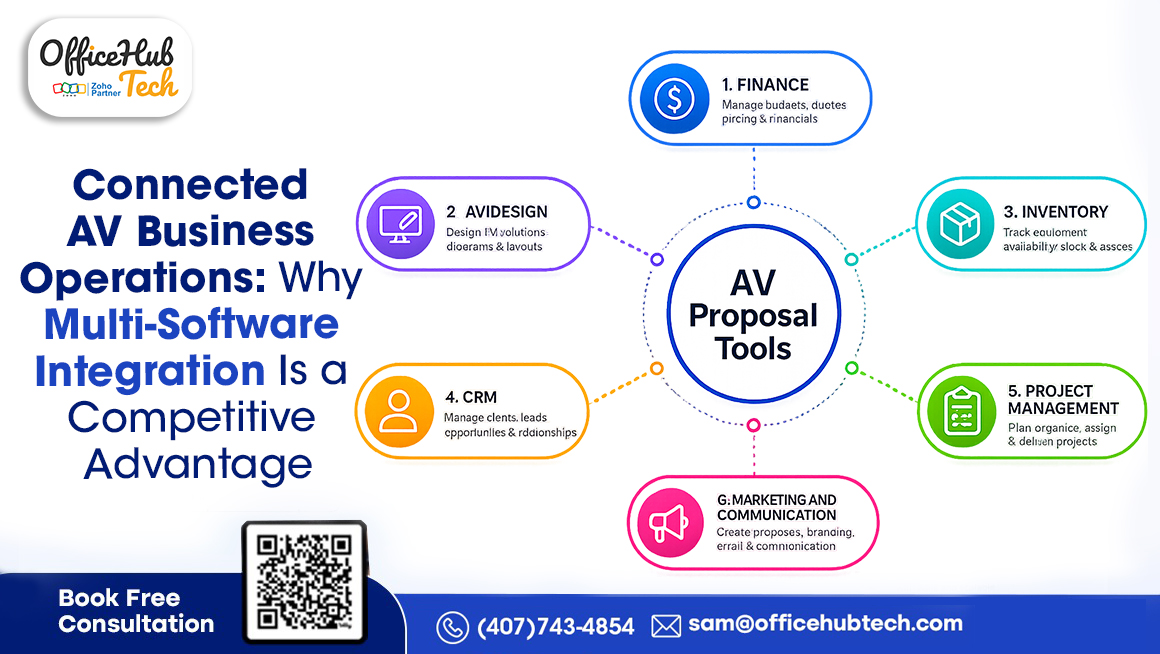
A connected AV business operation is an environment where data flows seamlessly between sales, engineering, project management, inventory, service, and finance systems. Instead of operating in silos, departments work from a shared ecosystem where information is automatically synchronized across business applications.
In many AV organizations, critical data is spread across multiple platforms, forcing teams to manually update records and search for information. Connected operations eliminate these inefficiencies by creating a centralized flow of data throughout the customer lifecycle. For example, approved proposals can automatically trigger project creation, inventory planning, procurement activities, and invoicing workflows.
The result is greater operational visibility, improved collaboration, and faster decision-making. More importantly, connected operations create a strong foundation for scalability by minimizing administrative effort and allowing teams to handle growth more effectively. Simply put, connected AV business operations transform disconnected software into a unified ecosystem that supports efficiency, profitability, and long-term business growth.
The Modern AV Technology Stack Is More Complex Than Ever
Which Software Platforms Are Commonly Used by AV System Integrators?
Modern AV system integrators rely on multiple software platforms to manage different stages of their business operations. While each platform helps improve efficiency within a specific department, they often operate independently, creating disconnected workflows and data silos across the organization.
CRM Systems
Examples:
- Pipedrive
- HubSpot
- Zoho CRM
- Salesforce
Purpose
CRM platforms help sales teams manage leads, opportunities, customer communications, sales pipelines, and account relationships. They serve as the starting point of the customer journey and contain valuable customer and project information.
Proposal & Estimation Platforms
Examples:
- D-Tools
- XTEN-AV
- Jetbuilt
- Wequote
Purpose
These platforms are used to design AV systems, create proposals, generate quotes, and produce engineering documentation. They help bridge the gap between customer requirements and project execution.
Inventory & Asset Management Systems
Examples:
- Fishbowl
- Odoo Inventory
- Zoho Inventory
- Asset Panda
Purpose
Inventory platforms help businesses track product availability, manage warehouse operations, monitor stock levels, and allocate equipment to projects. Accurate inventory visibility is essential for avoiding project delays and procurement issues.
ERP & Financial Systems
Examples:
- QuickBooks
- NetSuite
- Zoho Books
- Microsoft Dynamics 365
Purpose
ERP and accounting platforms manage purchasing, invoicing, financial reporting, vendor management, and profitability tracking. They provide the financial foundation for business operations.
Project Management Platforms
Examples:
- Monday.com
- ClickUp
- Asana
- Jira
Purpose
Project management software helps coordinate resources, schedules, milestones, tasks, and team collaboration throughout the project lifecycle.
Field Service Applications
Examples:
- Simpro
- ServiceTitan
- ConnectWise
Purpose
Field service platforms help manage technician scheduling, dispatching, maintenance activities, service requests, and customer support operations.
Expert Insight
While each system serves a specific purpose, challenges arise when data must be manually transferred between platforms. As AV businesses grow, these disconnected workflows create inefficiencies, delays, and data silos. This is why leading integrators are adopting multi-software integration to connect their technology stack, automate data flow, and create a unified operational ecosystem.
The Operational Challenges Created by Disconnected Software Systems
What Happens When AV Software Systems Don’t Communicate With Each Other?
As AV businesses adopt multiple software platforms for sales, projects, inventory, service, and finance, disconnected systems often create operational challenges. Information must be manually transferred between applications, leading to duplicate data entry, communication gaps, delayed projects, and limited visibility. Over time, these inefficiencies increase administrative workload, impact customer experience, and make it harder to scale operations effectively.
Below are some of the most common challenges AV integrators face when software systems operate in isolation.
Manual Data Entry Across Departments
One of the biggest inefficiencies in disconnected environments is duplicate data entry. Customer information, project details, equipment specifications, and financial data are often entered multiple times across various systems.
Business Impact
- Increased administrative workload
- Higher risk of human error
- Reduced employee productivity
- Time lost on repetitive tasks instead of high-value activities
Information Silos
When systems are disconnected, important business data remains trapped within individual departments. Teams often rely on different sources of information, making collaboration more difficult and reducing operational transparency.
Business Impact
- Inconsistent data across departments
- Communication breakdowns between teams
- Reduced cross-functional collaboration
- Difficulty maintaining a single source of truth
Delayed Project Execution
Project handoffs become slower when information must be manually transferred between sales, engineering, project management, procurement, and service teams. Even small delays at each stage can significantly impact overall project timelines.
Business Impact
- Slower project initiation
- Missed deadlines
- Reduced operational agility
- Increased project management complexity
Inventory Visibility Problems
Inventory teams often struggle to maintain accurate stock visibility when project data, procurement systems, and inventory applications are not connected. This makes forecasting and planning significantly more challenging.
Business Impact
- Material shortages during project execution
- Emergency purchasing costs
- Excess inventory accumulation
- Installation delays caused by unavailable equipment
Financial Reporting Gaps
Disconnected financial and operational systems make it difficult to track project costs, profitability, and cash flow in real time. Finance teams frequently spend considerable effort gathering information from multiple sources before producing reports.
Business Impact
- Delayed invoicing cycles
- Inaccurate profitability tracking
- Limited financial visibility
- Slower business decision-making
Limited Executive Visibility
Business leaders depend on accurate and timely information to make strategic decisions. When data exists across multiple disconnected platforms, obtaining a complete operational picture becomes difficult.
Business Impact
- Lack of real-time business insights
- Reactive rather than proactive decision-making
- Difficulty identifying operational bottlenecks
- Reduced ability to scale effectively
As AV businesses grow, these inefficiencies can impact customer satisfaction, profitability, and scalability. This is why many AV integrators invest in multi-software integration to eliminate data silos, streamline workflows, and improve operational efficiency.
How Does Multi-Software Integration Connect AV Business Operations?
Multi-software integration connects the applications used across an AV business, enabling customer, project, inventory, financial, and service data to flow automatically between systems. Instead of relying on manual data entry, teams work within a connected AV business operation where information remains synchronized, improving efficiency, visibility, and decision-making.
A successful integration framework consists of several key components:
- API Layer – Enables secure, real-time data exchange between software applications.
- Middleware / Orchestration Layer – Acts as the central hub that manages data flow and business rules across systems.
- Workflow Automation Engine – Automates repetitive tasks, approvals, notifications, and project handoffs.
- Data Mapping & Transformation Layer – Maintains data accuracy and consistency while transferring information across multiple platforms.
- Monitoring & Error Handling – Continuously monitors integration activities, identifies potential issues, and enables quick problem resolution.
- AI Orchestration Layer – Uses connected business data to support analytics, forecasting, and intelligent decision-making.
- Unified Operational Visibility – Provides centralized dashboards and reporting, creating a single source of truth across the organization.
Together, these components create a connected operational ecosystem where data flows seamlessly across systems. This centralized data backbone improves efficiency, supports automation, enables scalability, and prepares AV businesses for future AI-driven growth.
Why Multi-Software Integration Is a Competitive Advantage
Multi-software integration is more than an operational improvement—it is a competitive advantage. By connecting business systems, AV companies can streamline workflows, accelerate project delivery, improve customer experiences, and gain real-time visibility across operations. In an industry where customers expect speed, accuracy, and transparency, connected AV business operations help integrators operate more efficiently, scale profitably, and stay ahead of competitors.
Competitive Advantage #1: Faster Project Delivery
Project delays often occur during transitions between departments. Sales teams complete proposals, engineers finalize designs, procurement begins sourcing materials, and project managers coordinate execution. When these handoffs rely on manual processes, delays become inevitable.
Multi-software integration automates the movement of information between systems, allowing projects to move forward faster and with fewer administrative bottlenecks.
Benefits
- Faster project initiation
- Reduced handoff delays
- Improved team coordination
- Accelerated project execution
Competitive Advantage #2: Higher Operational Efficiency
Many AV businesses unknowingly dedicate hundreds of hours each month to repetitive administrative tasks. Employees manually update records, transfer information between systems, and reconcile data discrepancies.
Integrated workflows eliminate much of this manual effort, allowing teams to focus on activities that create greater business value.
Benefits
- Reduced administrative workload
- Increased employee productivity
- Fewer manual errors
- More efficient resource utilization
Competitive Advantage #3: Better Customer Experience
Customers interact with multiple departments throughout a project lifecycle. If teams lack access to consistent information, customers often receive conflicting updates, delayed responses, or inaccurate project status reports.
Connected systems ensure everyone works from the same data, creating a more professional and seamless customer experience.
Benefits
- Faster customer response times
- Improved communication accuracy
- Better service delivery
- Higher customer satisfaction
Competitive Advantage #4: Real-Time Business Visibility
Business leaders cannot make informed decisions without access to accurate operational data. Unfortunately, disconnected software environments often make reporting slow, incomplete, or outdated.
Integrated systems provide real-time visibility into sales performance, project progress, inventory levels, service operations, and financial health.
Benefits
- Live operational dashboards
- Faster decision-making
- Improved forecasting accuracy
- Greater organizational transparency
Competitive Advantage #5: Improved Profitability
Operational inefficiencies directly affect profitability. Manual processes, project delays, procurement errors, and billing inefficiencies all contribute to unnecessary costs.
By streamlining workflows and improving visibility across departments, multi-software integration helps AV companies identify inefficiencies and improve financial performance.
Benefits
- Reduced operational costs
- Better project margin control
- Faster invoicing cycles
- Improved cash flow management
Competitive Advantage #6: Greater Scalability
One of the biggest challenges growing AV businesses face is maintaining efficiency as project volume increases. Without integrated systems, growth often requires hiring additional administrative staff simply to manage operational complexity.
Connected business operations allow organizations to scale more effectively by automating routine processes and standardizing workflows.
Benefits
- Supports business growth
- Reduces dependency on manual processes
- Creates operational consistency
- Enables expansion without excessive overhead
Today’s AV integrators compete on more than installation quality—they compete on speed, efficiency, visibility, and customer experience. Multi-software integration enables connected operations that help AV businesses work smarter, respond faster, and scale for long-term growth.
Why Connected AV Business Operations Are the Future of Competitive Advantage
While multi-software integration improves daily operations, its real value lies in creating a connected AV business that can grow and adapt to changing market demands.
- End-to-End Workflow Visibility: Connect sales, engineering, procurement, installation, service, and finance into a seamless process.
- Stronger Collaboration: Ensure every department works from the same real-time data, reducing communication gaps and delays.
- Better Partner Connectivity: Integrate with suppliers, distributors, and third-party platforms to streamline purchasing and project execution.
- Measurable Business Impact: Reduce manual work, accelerate project delivery, improve resource utilization, and enhance customer satisfaction.
- Scale Without Complexity: Connect existing software instead of replacing it, making growth more efficient and cost-effective.
- Future-Ready Operations: Build a centralized data foundation that supports workflow automation, AI-driven insights, predictive analytics, customer portals, and remote service capabilities.
Connected AV business operations are more than a technology initiative—they provide the operational agility and competitive advantage needed for long-term growth.
Real-World AV Workflow Examples Enabled by Multi-Software Integration
What AV Business Processes Can Be Automated?
Multi-software integration connects business systems, allowing information to flow automatically instead of relying on manual data entry, emails, and spreadsheets. For AV system integrators, this creates faster, more accurate workflows across the customer lifecycle.
Lead to Proposal: CRM data automatically populates proposal platforms, reducing duplicate entry and speeding up proposal creation.
Proposal to Project: Approved proposals generate project records in project management software, improving handoffs between sales and operations.
Project to Inventory: Project requirements sync with inventory systems, helping teams plan materials and avoid shortages.
Inventory to Procurement: Low stock levels can trigger purchasing workflows, improving procurement efficiency and reducing project delays.
Project Completion to Invoicing: Completed milestones automatically update accounting systems for faster invoicing, improved cash flow, and fewer billing errors.
Service Request to Technician Dispatch: Customer requests can generate service tickets, assign technicians, and schedule appointments automatically, improving response times and service quality.
By connecting these workflows through a centralized integration framework, AV businesses create connected operations where departments work from the same data. The result is reduced administrative effort, better operational visibility, improved collaboration, and a more seamless customer experience.
Why Integration Is Becoming Essential for AI-Driven AV Businesses
Artificial intelligence is rapidly becoming a major focus for businesses seeking to improve efficiency, forecasting, decision-making, and customer service. However, many organizations overlook a critical requirement for successful AI adoption: connected and reliable data.
AI systems can only generate meaningful insights when they have access to information from across the organization. If customer records exist in one platform, project information resides in another, inventory data is stored elsewhere, and financial information remains isolated, AI tools cannot develop a complete understanding of business operations.
This is why multi-software integration is becoming a foundational requirement for AI-driven AV businesses.
AI Requires Connected Data
Modern AI solutions perform best when they can analyze information from multiple business functions simultaneously. Connected systems provide the centralized data environment necessary for accurate analysis and intelligent recommendations.
Benefits
- More accurate insights
- Better decision-making support
- Improved operational visibility
- Higher quality business intelligence
Predictive Project Risk Management
AI can analyze historical project data, resource utilization, scheduling patterns, and operational trends to identify projects that may be at risk before problems occur.
Potential Outcomes
- Early risk identification
- Improved project planning
- Reduced schedule overruns
- Better resource allocation
Resource Optimization
Integrated operational data enables AI to recommend how resources should be allocated across multiple projects based on workload, availability, and business priorities.
Potential Outcomes
- Increased productivity
- Improved workforce utilization
- Better project balancing
- Reduced operational bottlenecks
Inventory Forecasting
AI can use sales trends, project pipelines, purchasing history, and inventory data to predict future material requirements.
Potential Outcomes
- Improved inventory planning
- Reduced stock shortages
- Lower carrying costs
- Better procurement forecasting
Service Demand Prediction
Connected service and customer data allows AI to identify patterns that help predict future maintenance and support requirements.
Potential Outcomes
- Proactive service planning
- Improved customer support
- Better technician scheduling
- Reduced service delays
Revenue Forecasting and Executive Decision Support
By analyzing data across sales, projects, finance, and operations, AI can provide leadership teams with more accurate forecasting and strategic recommendations.
Potential Outcomes
- Improved financial planning
- Better growth forecasting
- Increased business visibility
- Faster executive decision-making
The future of AV business operations is not simply about adding AI tools. It is about creating a connected software ecosystem that provides AI with the high-quality data it needs to generate meaningful business value. Organizations that invest in multi-software integration today are building the foundation for the next generation of intelligent, data-driven operations.
Key Considerations Before Starting a Multi-Software Integration Initiative
While the benefits of connected operations are significant, successful integration projects require careful planning. AV businesses that approach integration strategically are far more likely to achieve sustainable results than those that focus solely on technical connections.
Before implementing a multi-software integration initiative, business leaders should evaluate several important factors.
Existing Software Ecosystem
Understanding the current technology environment is the first step. Organizations should identify all software platforms currently used across departments and evaluate how information moves between them.
Key Questions
- Which systems are business-critical?
- Where does duplicate data entry occur?
- Which processes rely on manual intervention?
Data Quality and Consistency
Integration success depends heavily on data quality. Inaccurate or inconsistent information can create problems even after systems are connected.
Key Questions
- Is customer data standardized?
- Are records duplicated across systems?
- Are naming conventions consistent?
Integration Objectives
Organizations should define clear business outcomes before beginning any integration project.
Key Questions
- Are we trying to improve efficiency?
- Do we need better reporting?
- Are we preparing for growth or AI adoption?
Clearly defined goals help guide integration decisions and measure success.
Workflow Documentation
Business processes should be documented before automation begins. Understanding how work currently flows through the organization helps identify improvement opportunities.
Key Questions
- How do departments collaborate today?
- Where are bottlenecks occurring?
- Which workflows should be automated first?
Security and Compliance Requirements
As information moves between systems, security becomes increasingly important.
Key Questions
- Who should have access to specific data?
- How will information be protected?
- What compliance requirements must be met?
Scalability Requirements
Integration strategies should support future growth rather than only addressing current challenges.
Key Questions
- Will additional systems be added later?
- Can the architecture support business expansion?
- Is the integration framework flexible enough for future needs?
Future Automation Goals
Many organizations begin with data synchronization but later expand into workflow automation and AI-driven initiatives.
Key Questions
- Which processes could be automated?
- How will AI fit into future operations?
- What long-term digital transformation goals exist?
A successful multi-software integration initiative begins with business strategy, not technology alone. By evaluating operational needs, data quality, scalability requirements, and future growth objectives, AV businesses can build a connected ecosystem that delivers measurable value today while supporting future innovation.
Case Study 1: Reducing Project Delays Through Connected Operations
Company: Apex Integrated AV Solutions
Apex Integrated AV Solutions was managing more than 150 projects annually using separate CRM, proposal, project management, and accounting systems. Sales teams manually transferred customer and project information between platforms, resulting in frequent data entry errors and project initiation delays.
The company implemented a multi-software integration strategy that connected its CRM, proposal platform, project management system, and accounting software. Once a proposal was approved, project records, customer information, and financial data automatically flowed across systems.
Results After 6 Months
- 70% reduction in manual data entry
- 40% faster project onboarding
- 30% reduction in project administration time
- 25% improvement in project delivery speed
- Improved visibility across sales, operations, and finance teams
By creating connected AV business operations, the company streamlined workflows, reduced operational bottlenecks, and improved overall project execution efficiency.
Case Study 2: Improving Inventory Visibility and Profitability
Company: VisionTech AV Integrators
VisionTech AV Integrators struggled with inventory shortages, emergency purchases, and inconsistent stock visibility due to disconnected inventory, procurement, and project management systems.
The company implemented a centralized integration framework that connected project schedules, inventory management, purchasing workflows, and financial reporting. Inventory requirements were automatically updated based on project activity, enabling proactive purchasing decisions.
Results After 9 Months
- 35% reduction in inventory shortages
- 28% decrease in emergency purchases
- 20% reduction in excess inventory costs
- 15% improvement in project profit margins
- Real-time visibility into inventory and procurement activities
Through multi-software integration, the company improved operational efficiency, reduced procurement risks, and gained better control over project profitability.
How OfficeHub Tech Helps AV Companies Successfully Implement Multi-Software Integration
Successfully implementing multi-software integration for AV businesses requires more than simply connecting applications. AV system integrators often use multiple platforms for CRM, project management, inventory, accounting, proposals, and field service, creating disconnected workflows and data silos. OfficeHub Tech takes a business-first approach by analyzing operational workflows, identifying bottlenecks, and designing a centralized data backbone that enables seamless information flow across the organization.
By connecting critical business systems and automating workflows, OfficeHub Tech helps AV companies eliminate manual data entry, improve operational visibility, and create a single source of truth. Our solutions support real-time reporting, reliable data synchronization, workflow automation, and AI-ready business operations. Whether the goal is improving project delivery, increasing efficiency, or building a connected AV business operation, OfficeHub Tech helps system integrators transform disconnected software environments into scalable, future-ready digital ecosystems that drive growth and competitive advantage.
The Future of Connected AV Business Operations
The future of AV business operations will be defined by connectivity, automation, and intelligence. As projects become more complex and customer expectations continue to rise, disconnected software systems will no longer be sustainable. AV companies that connect their sales, project management, inventory, service, and financial systems will gain the visibility and operational efficiency needed to compete in a rapidly evolving market. Hyper-automation will streamline workflows, reduce administrative effort, and allow teams to focus on higher-value activities that drive business growth.
At the same time, AI will play a growing role in helping AV businesses make smarter decisions. With access to connected business data, organizations will be able to improve forecasting, optimize resources, identify project risks earlier, and deliver better customer experiences. Centralized dashboards, predictive analytics, and end-to-end digital ecosystems will become standard operating models for successful AV integrators. Businesses that invest in multi-software integration today are not simply improving efficiency—they are building the foundation for scalable growth, digital transformation, and future AI-driven innovation.
Conclusion: Integration Is No Longer an IT Project—It’s a Business Strategy
The AV industry has moved beyond spreadsheets, emails, and disconnected software systems. Today, successful system integrators rely on operational efficiency, visibility, and agility to stay competitive. While individual platforms solve specific challenges, their full potential is realized through multi-software integration. By connecting sales, engineering, project management, procurement, inventory, service, and finance, businesses eliminate operational silos and streamline workflows.
Connected AV business operations accelerate project delivery, improve collaboration, increase visibility, reduce administrative overhead, enhance customer experiences, and create a strong foundation for AI-driven decision-making. They also enable organizations to scale efficiently without adding unnecessary complexity. As digital transformation reshapes the AV industry, companies that invest in a multi-software integration strategy will be better positioned to adapt, innovate, and achieve sustainable growth.
The question is no longer whether AV businesses should connect their software systems, but how quickly they can build a connected operational ecosystem for long-term competitive advantage.