From Static Records to Conversational AV Intelligence with D-Tools Agentic AI
Why AV Businesses Must Move Beyond Static Records to Conversational Intelligence
The AV industry has evolved far beyond designing conference rooms and installing audiovisual systems. Today, AV System Integrators manage complex projects involving customers, engineering teams, procurement, technicians, service departments, and multiple software platforms. Every proposal, Bill of Materials (BOM), engineering drawing, installation schedule, customer interaction, and service record generates valuable business data. For many AV businesses, D-Tools serves as the central platform for managing this operational information.
However, in today’s AI-driven world, simply storing data is no longer enough.
The real challenge isn’t collecting information—it’s accessing the right information at the right time to make faster, smarter business decisions. Project managers spend valuable time searching through project records, engineers revisit historical designs, procurement teams verify inventory manually, and leadership often waits for reports before gaining operational visibility. As projects become more complex, these manual processes create bottlenecks that slow productivity and limit business growth.
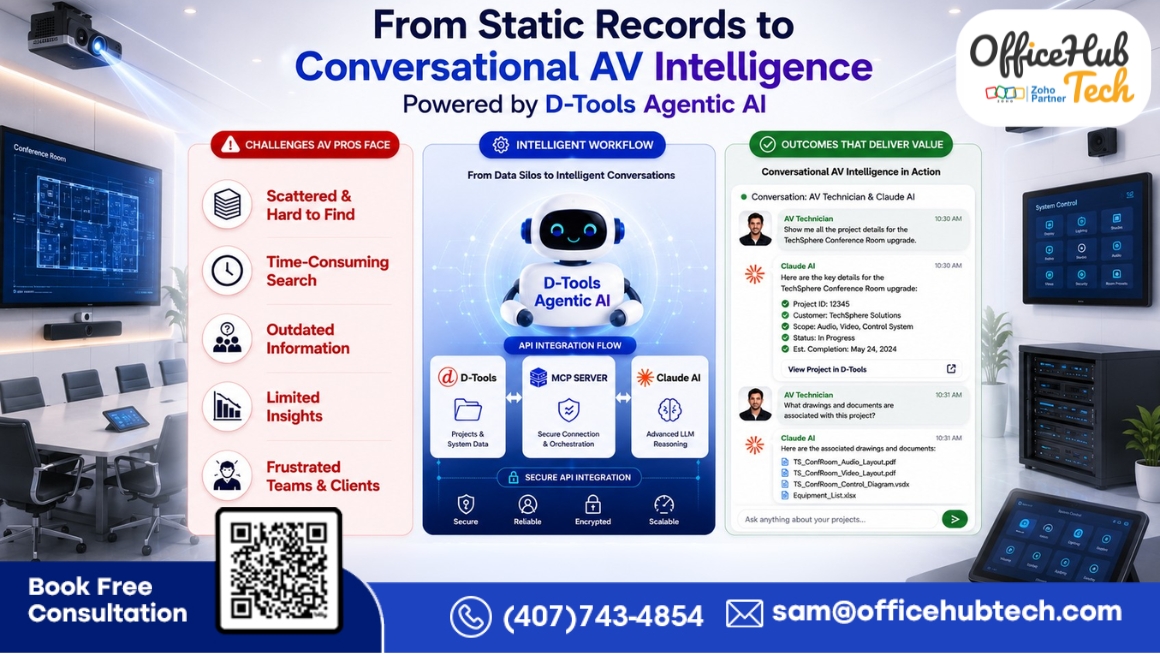
This is where D-Tools Agentic AI, powered by Claude AI and connected through the Model Context Protocol (MCP), transforms the way AV businesses operate.
Rather than acting as a traditional chatbot, Claude AI serves as an intelligent reasoning engine that understands business context, interprets natural language, and securely interacts with D-Tools through MCP. Instead of navigating multiple dashboards and reports, employees can simply ask questions like:
- Which projects are at risk of delay?
- Which equipment shortages will impact upcoming installations?
- Which customers require immediate follow-up?
- Which technicians are overloaded?
Within seconds, AI retrieves relevant information, reasons across connected business data, and delivers actionable insights that help teams make faster decisions.
This shift marks the evolution from static record management to Conversational AV Intelligence—where business data becomes an active operational asset instead of a passive repository. More importantly, it lays the foundation for Agentic AI, where AI doesn’t just answer questions but assists teams by understanding workflows, recommending actions, and supporting intelligent business operations.
The future of AV isn’t about managing more data—it’s about empowering AI to transform that data into intelligent decisions.
What Are Static Records in an AV Business?
Every AV project generates a wealth of business information. Customer details, proposals, Bills of Materials (BOM), engineering drawings, equipment specifications, procurement updates, installation schedules, technician assignments, service records, and project revisions all contribute to the success of a project.
Platforms like D-Tools are excellent at capturing and organizing this information, making them the operational backbone for many AV System Integrators.
The challenge is that most of this data remains static.
Static records are designed to store information, not interpret it. They tell you what happened, but they don’t explain why it’s happening, what it means, or what should happen next.
For example, if a Project Manager wants to understand why an installation is behind schedule, they often need to review project timelines, procurement updates, inventory availability, technician schedules, customer communications, and engineering revisions individually. The information exists—but it’s spread across multiple records and requires someone to manually connect the dots.
As projects, customers, and teams grow, this approach becomes increasingly inefficient. Valuable knowledge becomes trapped inside thousands of records, making it difficult for employees to find answers quickly or make confident decisions.
This is the limitation of static records—they preserve business knowledge but don’t actively use it.
Modern AV businesses need more than a digital filing system. They need operational intelligence that can understand relationships between projects, people, equipment, and workflows, turning raw business data into meaningful insights.
That’s where the shift from static records to Conversational AV Intelligence begins—not by replacing D-Tools, but by making the valuable information already stored inside it easier to understand, access, and act upon.
Why Traditional Data Retrieval Is Slowing Modern AV Operations
As AV businesses grow, managing information becomes just as important as managing projects.
Most AV companies already use powerful software like D-Tools, CRM platforms, project management tools, inventory systems, and accounting applications. While each system performs its role effectively, employees still spend a significant amount of time switching between applications, reviewing reports, and searching for information before they can make a decision.
Consider a simple question:
“Can we complete this installation on schedule?”
Answering it may require checking the project timeline in D-Tools, verifying inventory availability, reviewing procurement status, confirming technician schedules, and checking whether the customer has approved pending changes. Although the information exists, bringing it together is often a manual process.
This fragmented approach creates several operational challenges:
- Valuable time is spent searching instead of executing.
- Departments work with disconnected information.
- Decisions are delayed while teams gather updates.
- Managers rely on reports that quickly become outdated.
- Business knowledge remains dependent on experienced employees.
The problem isn’t the software—it’s the lack of intelligence connecting the information across it.
Modern AV businesses need systems that can understand relationships between projects, customers, resources, and schedules instead of treating every record as an isolated piece of data.
Rather than asking employees to search for answers, the next generation of business operations enables them to simply ask questions and receive contextual insights instantly.
This shift marks the transition from information retrieval to intelligent decision support. Instead of spending time collecting data, teams can focus on solving problems, serving customers, and delivering successful projects.
For growing AV businesses, the real competitive advantage is no longer having more data—it’s being able to use that data faster and more intelligently than the competition.
What Is Conversational AV Intelligence?
Imagine interacting with your business the same way you interact with a knowledgeable colleague.
Instead of opening multiple applications, running reports, or searching through project records, you simply ask:
- Which projects need my attention today?
- Which equipment shortages could delay installations?
- Which customers are waiting for updates?
- What are the biggest risks across active projects?
This is Conversational AV Intelligence.
It enables employees to interact with business systems using natural language, making information instantly accessible without requiring technical expertise or knowledge of where data is stored.
Unlike traditional search tools that return matching records, Conversational AV Intelligence understands the intent behind a question. It connects information across projects, customers, procurement, engineering, and service operations to deliver meaningful answers instead of raw data.
For example, if a project manager asks:
“Which projects are at risk this week?”
The system doesn’t simply display a list of projects. It evaluates multiple operational factors—such as project progress, inventory availability, technician schedules, procurement status, and pending approvals—to identify projects that require immediate attention and explain why.
This transforms AI from an information retrieval tool into a business decision assistant.
For AV System Integrators, this means every team—from Sales and Engineering to Project Management and Leadership—can access the same operational intelligence through simple conversations, reducing delays and improving collaboration across the organization.
Conversational AV Intelligence is also the first step toward Agentic AI. Once AI understands business context and can reason across operational data, it can move beyond answering questions to recommending actions, supporting workflows, and assisting teams with routine operational tasks.
Instead of learning how software works, employees simply focus on their work while AI helps them find answers, identify opportunities, and make better decisions faster.
This is how modern AV businesses transform business data into a strategic advantage—by making intelligence as easy to access as having a conversation.
How D-Tools Agentic AI Works
The true value of D-Tools Agentic AI isn’t that it helps employees search for information faster—it’s that it changes how they interact with their business.
Instead of navigating multiple applications, reviewing reports, or manually connecting information, users simply describe what they need in natural language. Behind the scenes, D-Tools, Claude AI, and the Model Context Protocol (MCP) work together to transform that request into meaningful business intelligence.
Here’s how the process works.
Step 1: Ask a Business Question
Everything begins with a simple prompt.
For example:
- Which projects are at risk this week?
- Which installations are waiting for equipment?
- Show all customers requiring immediate follow-up.
- Which technicians are available for a new project?
There’s no need to know where the information is stored or which report to generate.
Step 2: Claude AI Understands the Intent
Once the request is submitted, Claude AI interprets the business objective behind the question.
Rather than looking for keywords, it understands the context of the request. It determines what information is needed, how different business records are connected, and which systems should be consulted to produce an accurate response.
This reasoning capability is what separates Agentic AI from a traditional chatbot.
Step 3: MCP Connects AI with D-Tools
The Model Context Protocol (MCP) acts as the secure communication bridge between Claude AI and D-Tools.
Instead of manually accessing records, MCP enables Claude AI to retrieve project data, customer information, proposals, BOMs, procurement updates, installation schedules, and other approved business information in a structured and secure manner.
This allows AI to work with live operational data while respecting user permissions and organizational security.
Step 4: AI Generates Operational Intelligence
After gathering the relevant information, Claude AI analyzes the relationships between different business records.
Instead of returning disconnected data, it identifies patterns, highlights potential risks, and provides contextual recommendations.
For example, rather than saying:
“Three projects are delayed.”
It can explain:
“Two projects are delayed because critical displays are backordered, while another is waiting for customer approval. Prioritizing procurement and rescheduling installation resources can help maintain delivery timelines.”
The focus shifts from reporting information to supporting better decision-making.
Step 5: From Insights to Intelligent Actions
Today’s D-Tools Agentic AI helps teams retrieve information, understand operational challenges, and make informed decisions faster.
As Agentic AI capabilities continue to evolve, it can also support business actions such as updating project records, assigning technicians, initiating workflows, generating project summaries, drafting customer communications, and coordinating activities across connected business systems.
Instead of becoming another software application employees must learn, D-Tools Agentic AI becomes an intelligent operational assistant that understands how your business works and helps every team work more efficiently.
This is the evolution from project management software to AI-powered business operations—where conversations replace manual searches, intelligence replaces repetitive tasks, and every decision is supported by connected business data.
How Different AV Teams Benefit from D-Tools Agentic AI
The value of D-Tools Agentic AI isn’t limited to a single department. Every team within an AV business relies on timely, accurate information to make decisions, collaborate effectively, and keep projects moving forward.
By combining D-Tools, Claude AI, and the Model Context Protocol (MCP), every department gains instant access to the operational intelligence they need—without spending valuable time searching through multiple systems.
Sales Team
Sales representatives can instantly access customer history, proposal status, installed systems, project progress, and previous interactions. This helps them respond faster to customer inquiries, identify upsell opportunities, and prepare more informed proposals.
Engineering Team
Engineers can quickly retrieve similar project designs, equipment specifications, and historical project documentation. Instead of recreating solutions from scratch, they can leverage previous work to accelerate system design and improve consistency.
Project Management Team
Project managers gain real-time visibility into project health by identifying delayed installations, pending approvals, resource conflicts, and upcoming risks. This enables proactive decision-making before issues impact delivery schedules.
Procurement & Service Teams
Procurement teams can identify inventory shortages, monitor supplier lead times, and prioritize purchasing decisions, while service teams can instantly access installation history, warranty details, and support records to resolve customer issues more efficiently.
Leadership Team
Executives no longer need to wait for manually prepared reports. They can ask business questions directly and receive real-time operational insights into project performance, resource utilization, business risks, and overall organizational health.
Although each department uses D-Tools Agentic AI differently, the outcome is the same: faster access to information, improved collaboration, reduced manual effort, and better decision-making across the organization.
Instead of working with disconnected data, every team operates from a shared layer of business intelligence—helping the entire organization deliver projects more efficiently and provide a better customer experience.
The Business Impact: Why Agentic AI Delivers Measurable ROI
The success of any technology investment is measured by the value it creates for the business. D-Tools Agentic AI delivers that value by helping AV System Integrators reduce manual work, improve operational efficiency, and make faster decisions using the data they already own.
Instead of spending hours gathering information from multiple systems, teams can access real-time business insights within seconds. This enables project managers to identify risks earlier, procurement teams to prevent inventory shortages, sales teams to respond to customers faster, and leadership to make informed decisions without waiting for reports.
The impact extends across the entire organization:
- Faster project and operational decision-making
- Reduced administrative and reporting effort
- Improved collaboration between departments
- Better resource planning and technician utilization
- Increased project visibility and accountability
- Faster customer response times
- Higher employee productivity
As businesses grow, operational complexity increases. Traditionally, this meant hiring more administrative staff to manage additional projects and information. With Agentic AI, organizations can scale more efficiently by allowing AI to handle repetitive information retrieval, analysis, and workflow support, enabling existing teams to manage larger workloads without proportional increases in overhead.
More importantly, Agentic AI creates a foundation for continuous innovation. As AI capabilities evolve, businesses can expand from intelligent insights to AI-assisted workflows and approved business actions, further improving efficiency across the organization.
Ultimately, the greatest ROI isn’t simply saving time—it’s enabling your teams to spend less time managing information and more time delivering successful projects, serving customers, and growing the business.
Real-World Use Cases of D-Tools Agentic AI
The real value of D-Tools Agentic AI is best understood through practical business scenarios. Rather than simply retrieving data, it helps teams understand situations faster, identify potential risks, and make informed decisions with confidence.
Here are three examples of how AV businesses can benefit from Conversational AV Intelligence.
Scenario 1: Proactively Identifying Project Risks
A Project Manager asks:
“Which projects are at risk of missing their deadlines?”
Instead of reviewing multiple project records manually, Claude AI analyzes project timelines, installation progress, procurement status, technician availability, and pending approvals to identify projects that require immediate attention.
The result is a prioritized list of potential risks with recommendations, allowing project managers to resolve issues before they impact customers.
Scenario 2: Smarter Procurement Planning
A Procurement Manager asks:
“Which upcoming projects could be affected by equipment shortages?”
Rather than comparing inventory reports with project schedules, AI evaluates inventory levels, supplier lead times, purchase orders, and upcoming installations to identify potential shortages.
This enables procurement teams to place orders earlier, avoid project delays, and improve inventory planning without manually reviewing multiple systems.
Scenario 3: Executive Business Intelligence
A business leader asks:
“What are the biggest operational challenges across our active projects?”
Instead of waiting for reports from different departments, AI provides an executive summary highlighting project risks, resource constraints, delayed procurement, customer escalations, and other critical issues.
This gives leadership immediate visibility into business performance, helping them make strategic decisions based on real-time operational intelligence.
These examples demonstrate that the true value of D-Tools Agentic AI goes beyond answering questions. It helps every department understand what is happening across the business, prioritize the right actions, and respond faster to changing operational conditions.
As Agentic AI continues to evolve, these conversational insights will naturally extend into AI-assisted workflows, enabling businesses to automate routine tasks while keeping employees focused on higher-value work.
The Future of AV Operations Is Agentic AI
The AV industry has always embraced innovation—from analog systems to digital collaboration, from on-premise infrastructure to cloud-connected solutions. The next transformation is not about new hardware or another software platform—it’s about intelligent business operations powered by Agentic AI.
Today’s businesses use AI primarily to retrieve information and answer questions. Tomorrow’s businesses will use AI to assist with everyday operations, streamline workflows, and help employees make better decisions in real time.
Imagine an AV business where AI can:
- Identify project risks before they become delays.
- Recommend the best technician based on skills and availability.
- Generate proposals using previous project data.
- Draft customer updates automatically.
- Coordinate procurement based on project schedules.
- Assist teams across Sales, Engineering, Project Management, and Service from a single conversational interface.
This isn’t about replacing people. It’s about eliminating repetitive work so employees can focus on solving problems, building customer relationships, and delivering successful projects.
As Claude AI, D-Tools, and the Model Context Protocol (MCP) continue to evolve, AV businesses will move beyond isolated software applications toward connected AI ecosystems where information flows seamlessly across business systems.
Organizations that begin adopting Agentic AI today will be better prepared for tomorrow’s increasingly connected and data-driven business environment. They will operate with greater visibility, respond faster to change, and scale more efficiently without adding unnecessary operational complexity.
The future of AV operations isn’t defined by how much data a business collects—it’s defined by how intelligently that data is used.
Businesses that embrace Agentic AI today will build the foundation for smarter, faster, and more connected AV operations tomorrow.
Why Choose OfficeHub Tech for an Agentic AI Platform?
Implementing Agentic AI is more than integrating an AI model with your existing software. It requires a deep understanding of AV business processes, enterprise workflows, system integrations, and how AI can deliver measurable business outcomes.
As a Trusted Custom Agentic AI Platform Developer and Implementation Partner for AVSI, OfficeHub Tech helps AV system integrators build intelligent, connected operations using AV proposal tools, Claude AI, and the Model Context Protocol (MCP).
Our approach focuses on enhancing your existing technology investments rather than replacing them. We help businesses transform Av Tools into an AI-powered operational platform that delivers faster access to information, improved decision-making, and intelligent workflow automation.
Our expertise includes:
- D-Tools Agentic AI Development
- Claude AI Integration
- MCP Server Implementation
- Custom AI Agents
- Workflow Automation
- Zoho Integration & Development
- Enterprise System Integrations
- Business Process Optimization
Beyond D-Tools, OfficeHub Tech can connect Agentic AI with XTEN-AV, Jetbuilt, ProjX360, Portal.io, Simply Reliable, iPoint Control, Simpro, Specifi.io, Wequote, as well as with CRM, ERP, Finance, Project Management, Document Management, and other business applications, creating a unified intelligence layer across your organization.
Whether you’re looking to improve project visibility, automate repetitive tasks, or build AI-powered workflows, OfficeHub Tech helps you implement practical AI solutions that increase productivity, improve collaboration, and prepare your business for the future of intelligent operations.
With extensive experience in both the AV industry and enterprise automation, we help businesses move beyond traditional software and embrace the next generation of AI-powered AV operations.
Conclusion
The future of AV business operations isn’t about managing more software—it’s about making your existing software smarter.
While platforms like D-Tools have become essential for managing projects, proposals, BOMs, engineering documentation, installations, and service operations, the next step is enabling AI to transform this operational data into real-time business intelligence.
By combining D-Tools, Claude AI, and the Model Context Protocol (MCP), AV businesses can move beyond static records and manual processes toward a more intelligent way of working. Instead of spending time searching for information, teams can ask questions, gain contextual insights, identify risks earlier, and make faster, data-driven decisions.
As Agentic AI continues to evolve, its role will extend beyond providing answers. It will assist with workflow automation, business process orchestration, and intelligent task execution—helping teams become more productive while improving operational efficiency across the organization.
For AV System Integrators, this represents more than a technology upgrade. It is an opportunity to build a connected, AI-powered business that scales efficiently, responds faster to customers, and stays ahead in an increasingly competitive industry.
The future belongs to AV businesses that don’t just collect data—but use AI to transform it into action.