##Quick Answer
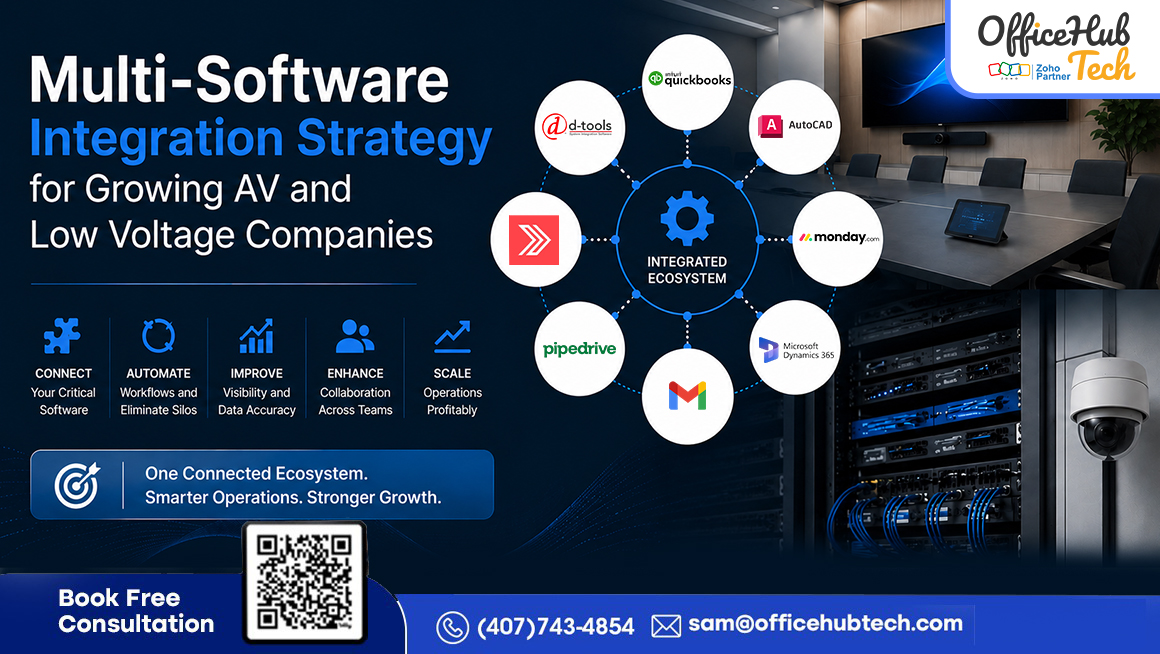
A Multi-Software Integration Strategy is a structured approach to connecting business applications—such as CRM, proposal software, project management, accounting, inventory, and field service—into a unified ecosystem where data flows automatically between systems. Instead of relying on manual data entry and disconnected workflows, businesses can automate processes, improve collaboration, gain real-time operational visibility, and build a scalable foundation for AI-powered automation. For growing AV and Low Voltage companies, a well-planned integration strategy helps reduce operational bottlenecks, improve project delivery, accelerate invoicing, and support long-term business growth.
##Key Takeaways
- Business growth often increases software complexity.
- Start integration with business goals, not technology.
- Connect high-impact workflows across core business systems.
- Centralized orchestration scales better than point-to-point integrations.
- Strong governance, security, and monitoring ensure reliable operations.
- Assess success through business KPIs and operational improvements.
- Connected data enables AI, automation, and smarter business decisions.
Why Growing Businesses Need an Integration Strategy More Than Another Software Platform
Growth brings more customers, projects, technicians, and opportunities—but it also increases operational complexity. As AV and Low Voltage companies adopt software for sales, proposals, project management, accounting, inventory, and field service, disconnected systems often lead to duplicate data entry, manual handoffs, outdated BOMs, delayed invoicing, and communication gaps. These inefficiencies reduce productivity, increase errors, and make it harder to scale efficiently.
This is why a Multi-Software Integration Strategy has become a business priority rather than just an IT initiative. Instead of adding more standalone applications, successful AV and Low Voltage companies are building connected software ecosystems where business-critical systems exchange data automatically, streamline workflows, and improve collaboration across teams.
In this guide, you’ll learn how to develop a scalable integration strategy, prioritize high-impact workflows, design a future-ready integration architecture, measure business outcomes, and prepare your organization for AI-powered operations—all while supporting sustainable business growth.
Why Software Complexity Is Increasing Across the AV and Low Voltage Industry
The AV and Low Voltage industry has become increasingly complex as projects grow and customer expectations rise. Beyond system design and installation, businesses must manage:
- Customer relationships
- Proposals and quotations
- Engineering documentation
- Procurement and inventory
- Vendor coordination
- Project scheduling
- Technician dispatch
- Financial reporting
- Service and customer support
No single platform can efficiently manage every function, leading companies to adopt specialized software. While this improves departmental productivity, it often creates disconnected workflows without a clear integration strategy. As businesses expand, disconnected systems increase manual work, slow project execution, and limit operational efficiency, even as the technology stack continues to grow.
Market Insight: Why Connected Operations Have Become a Business Priority
As AV and Low Voltage companies grow, they adopt specialized software for sales, proposals, projects, inventory, accounting, field service, and customer support. While each application serves a specific purpose, disconnected systems create data silos, manual work, and limited operational visibility.
According to the 2026 MuleSoft Connectivity Benchmark Report, organizations manage an average of 957 applications, yet only 27% are integrated. The report also found that 82% of IT leaders identify data integration as a major AI challenge, while 86% believe AI delivers limited value without proper integration.
For AV and Low Voltage companies, disconnected systems result in duplicate data, slower project execution, delayed invoicing, and poor collaboration. A Multi-Software Integration Strategy connects business-critical systems, enabling automation, real-time visibility, smarter decisions, and AI-ready operations.
Understanding the Modern Software Ecosystem of AV and Low Voltage Companies
Most growing AV and Low Voltage system integrators rely on a diverse software ecosystem to manage different business functions. Sales teams use Zoho CRM, Salesforce, HubSpot, or Microsoft Dynamics 365, while proposal teams work with D-Tools SI, XTEN-AV, Jetbuilt, Portal.io, or WeQuote. Engineering uses tools like AutoCAD, Revit, and WireCAD, project managers depend on Monday.com, ClickUp, Asana, or Jira, and accounting teams use QuickBooks, Zoho Books, Xero, or Oracle NetSuite. Inventory and field operations are managed through platforms such as Fishbowl, Simpro, ServiceTitan, and ConnectWise.
Individually, each application solves a specific business challenge. Collectively, they form a complete operational ecosystem. However, as businesses grow, these systems often evolve independently, creating disconnected workflows, duplicate data, and manual communication between departments. While individual teams become more efficient, the overall business does not.
A Multi-Software Integration Strategy solves this challenge by connecting systems, people, processes, and business data into a unified operational ecosystem that supports collaboration, automation, scalability, and long-term business growth.
Business Signs Your Company Needs a Multi-Software Integration Strategy
Many AV and Low Voltage companies only recognize the need for a Multi-Software Integration Strategy when disconnected systems begin impacting efficiency, customer experience, and business growth.
- Duplicate Data Entry: Customer and project data is repeatedly entered across CRM, project management, procurement, and accounting systems, wasting time and increasing errors.
- Limited Operational Visibility: Data spread across multiple applications makes it difficult to track projects, inventory, technicians, and finances, leading to slower decisions.
- Workflow Delays and Bottlenecks: Disconnected systems slow approvals, project execution, procurement, scheduling, and billing, forcing teams to rely on manual coordination.
- Growth Without Productivity: As businesses grow, teams spend more time managing disconnected systems than delivering projects, limiting productivity.
If your business relies on manual handoffs, inconsistent reporting, delayed updates, or increasing administrative work, it’s a strong sign that a Multi-Software Integration Strategy is essential for scalable growth.
Integration Readiness Assessment: Is Your Business Ready?
Before integrating software, assess your business processes, data, technology, and team readiness. This identifies workflow and data issues early, reduces implementation risks, and ensures integrations deliver measurable business value instead of simply connecting applications.
Key areas to evaluate include:
- Business Process Readiness: Document and standardize critical workflows such as lead management, proposal creation, project execution, procurement, field service, invoicing, and customer support. Consistent processes create reliable integrations.
- Data Readiness: Review customer records, product catalogs, pricing, Bills of Materials (BOMs), inventory, and project data for duplicates, missing information, outdated records, and inconsistent naming conventions.
- Technology Readiness: Assess each application’s API availability, webhook support, authentication methods, data access, integration limitations, and customization capabilities to determine the most suitable integration architecture.
- Operational Readiness: Align department leaders on data ownership, approval workflows, governance policies, security standards, and measurable business objectives to ensure seamless cross-functional collaboration.
Completing this assessment before implementation shortens deployment timelines, minimizes costly rework, and establishes a strong foundation for a scalable and successful Multi-Software Integration Strategy.
Multi-Software Integration Maturity Model
Every AV and Low Voltage company is at a different stage of its integration journey. Some still depend on spreadsheets and manual processes, while others have connected multiple systems. Identifying your current maturity level helps create a realistic roadmap for building a scalable and future-ready software ecosystem.
Stage 1: Disconnected Operations
Business applications operate independently, requiring manual data entry through spreadsheets, emails, or duplicate records. Reporting is slow, and operational visibility is limited.
Stage 2: Basic System Connections
Some applications are connected through native integrations or simple APIs. Manual work is reduced, but integrations remain isolated and difficult to scale.
Stage 3: Connected Business Processes
Core systems such as CRM, proposal software, project management, inventory, accounting, and field service share data through automated workflows, improving collaboration and reducing delays.
Stage 4: Intelligent Workflow Orchestration
A centralized integration platform automates workflows, approvals, notifications, and data synchronization, enabling faster decisions and greater operational efficiency.
Stage 5: AI-Driven Connected Operations
Integrated business data powers AI, predictive analytics, intelligent scheduling, automated recommendations, and real-time business insights.
The goal isn’t to jump directly to Stage 5. Organizations should progress through each stage methodically, building a strong operational foundation that supports sustainable growth and future AI adoption.
The Multi-Software Integration Strategy Framework
Technology alone doesn’t ensure successful integration. AV and Low Voltage companies need a structured strategy that aligns business goals, operational processes, and technical architecture. This seven-step framework provides a scalable roadmap for building a connected software ecosystem.
-
Assess Current Operations
Document existing workflows and identify manual processes, duplicate data entry, delays, and communication gaps to establish integration priorities.
-
Prioritize High-Impact Workflows
Focus on integrations that improve revenue, customer experience, project execution, procurement, and billing to achieve faster ROI.
-
Design the Integration Architecture
Define data ownership, systems of record, APIs, security standards, governance policies, and workflow rules before development begins.
-
Build and Validate
Develop secure integrations using APIs or middleware, and thoroughly test workflows, exceptions, and error scenarios.
-
Govern and Secure
Implement role-based access, encryption, audit trails, monitoring, version control, and change management to ensure long-term reliability.
-
Optimize Continuously
Track business KPIs such as processing time, project delivery, data accuracy, and operational efficiency to refine integrations over time.
-
Scale for Future Growth
Expand the integration ecosystem to support new locations, services, AI capabilities, and future software investments without redesigning the architecture.
By following this framework, organizations transform software integration into a scalable business capability that supports long-term growth and digital transformation.
Software Prioritization Matrix: What Should You Integrate First?
One of the most common questions business leaders ask is, “Which systems should we integrate first?”
The answer depends on business objectives, operational pain points, and workflow complexity. However, most growing AV and Low Voltage companies benefit from prioritizing integrations according to business impact rather than technical simplicity.
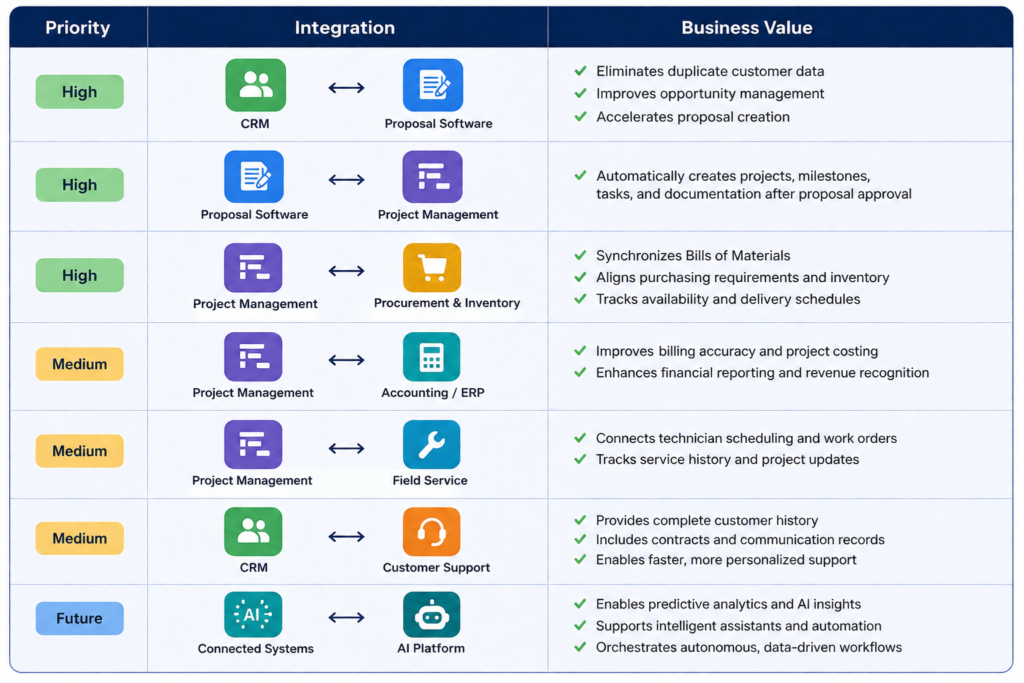
Instead of attempting to integrate every application simultaneously, organizations should focus on high-value workflows that directly improve operational efficiency and customer experience. A phased implementation reduces complexity, minimizes business disruption, and creates measurable ROI that supports future expansion.
The Five Pillars of a Successful Multi-Software Integration Strategy
A successful Multi-Software Integration Strategy is more than connecting APIs. It requires a business-first framework that aligns processes, data, governance, and technology. For AV and Low Voltage companies, these five pillars create a scalable, secure, and future-ready integration ecosystem.
-
Business Process-Driven Integration
Every integration should solve a business problem—not just connect two applications.
Focus on business outcomes such as:
- Eliminating duplicate data entry
- Automating sales-to-project handoffs
- Reducing proposal turnaround time
- Streamlining procurement workflows
- Improving technician scheduling
- Accelerating invoicing and cash flow
Successful companies prioritize workflows over software, ensuring integrations directly support operational efficiency and business growth.
-
Unified Data Architecture
A connected ecosystem depends on consistent and reliable data. Since every application stores information differently, organizations must define data ownership and establish a Single Source of Truth (SSOT).
Key elements include:
- Standard naming conventions
- Master customer records
- Product and inventory identifiers
- Project numbering standards
- Data validation rules
- Synchronization policies
Each system should own specific business data—for example, CRM manages customer information, proposal software owns estimates and BOMs, ERP handles financial data, and project management tracks execution. This reduces duplicate records and reporting inconsistencies.
-
Centralized Workflow Orchestration
Modern integrations should automate complete business processes, not just transfer data.
For example, when a proposal is approved, the integration platform can automatically:
- Update the CRM
- Create the project
- Generate project tasks
- Reserve inventory
- Trigger procurement
- Notify project managers
- Update executive dashboards
This approach minimizes manual work, communication delays, human errors, and project onboarding time while improving collaboration across departments.
-
Governance, Security, and Compliance
A secure integration strategy protects business data while ensuring long-term reliability.
Essential practices include:
- Role-Based Access Control (RBAC)
- Multi-factor authentication
- Secure API authentication
- Data encryption
- Audit logs and monitoring
- Version control and documentation
- Error handling and retry mechanisms
Strong governance keeps integrations secure, scalable, and compliant as systems evolve.
-
Scalability and AI Readiness
Integration should support both current operations and future business growth.
A scalable architecture enables:
- Easy addition of new software
- Expansion into new locations
- Support for new services
- Mobile workforce management
- AI and Agentic AI adoption
When CRM, proposal, project management, inventory, finance, and field service systems are connected, AI gains access to complete business context, enabling predictive insights, intelligent automation, and data-driven decision-making.
Together, these five pillars help AV and Low Voltage companies build a connected software ecosystem that improves operational efficiency today while preparing the business for long-term digital transformation.
The Technical Architecture Behind a Modern Multi-Software Integration Strategy
A successful integration strategy depends on a scalable architecture that securely connects multiple business applications while ensuring performance, reliability, and flexibility. Instead of creating separate integrations for each software pair, businesses use a layered architecture consisting of:
- Business Application Layer: Connects CRM, ERP, proposal, project management, inventory, accounting, and communication systems.
- API Connectivity Layer: Uses APIs, OAuth, and webhooks for secure, automated data exchange.
- Integration & Orchestration Layer: Manages workflow automation, data mapping, business rules, and system coordination through platforms like Zoho Creator, n8n, or middleware.
- Data Intelligence Layer: Consolidates data into real-time dashboards for better operational visibility and decision-making.
- AI & Automation Layer: Enables predictive insights, intelligent automation, conversational reporting, and Agentic AI workflows.
A robust architecture also includes secure authentication, monitoring, version control, and error handling to ensure reliable and scalable integrations.
Centralized Orchestration vs. Point-to-Point Integration: Which Strategy Scales Better?
One of the most important decisions in a Multi-Software Integration Strategy is how business applications communicate. While many organizations start with point-to-point integrations, this approach becomes difficult to manage as more software is added. Choosing the right integration model affects scalability, maintenance, operational efficiency, and future AI adoption.
Point-to-Point Integration
Point-to-point integration connects two applications directly, such as
CRM ↔ Proposal Software, Proposal ↔ Project Management, or Accounting ↔ Inventory.
This approach is simple and cost-effective for businesses using only a few systems.
However, as applications like ERP, inventory, field service, and customer portals are introduced, the number of connections increases rapidly. This creates integration sprawl, leading to duplicated workflows, inconsistent documentation, difficult troubleshooting, and higher maintenance costs whenever a system changes.
Centralized Orchestration
With centralized orchestration, every application connects to a central integration platform instead of communicating directly. The platform manages workflow automation, data transformation, security, monitoring, and business rules from one place.
When new software is introduced, only one additional integration is usually required, while existing systems continue operating without modification. This approach reduces maintenance, simplifies management, improves scalability, and provides a stronger foundation for automation and AI-driven business operations.
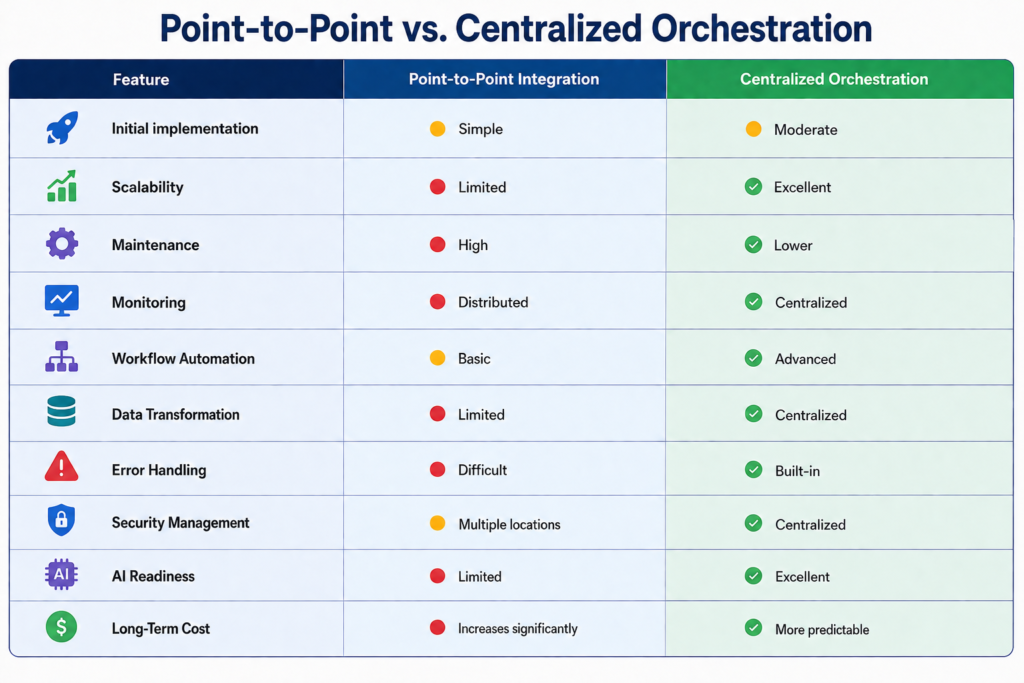
For businesses using only a few applications, point-to-point integration may be sufficient. However, for growing AV and Low Voltage companies, centralized orchestration offers a more scalable and sustainable approach by simplifying integration management and supporting long-term business growth.
Case Study: Multi-Software Integration in Action
To understand the business impact of a Multi-Software Integration Strategy, consider a growing AV system integrator managing around 250 projects annually.
Before Integration
The company used separate systems for CRM, proposal management, project management, inventory, accounting, and field service. While each department worked efficiently, data rarely moved automatically between applications. Sales, project managers, engineering, procurement, finance, and service teams repeatedly entered the same information, resulting in:
- Delayed project onboarding
- Duplicate customer records
- Inventory and procurement delays
- Inconsistent reporting
- Slower invoicing
- Increased administrative effort
Although the company had the right software, its systems operated in isolation.
After Implementing a Multi-Software Integration Strategy
Instead of replacing software, the company connected its applications through a centralized integration platform. Once a proposal was approved, customer validation, CRM updates, project creation, inventory checks, procurement, accounting updates, and stakeholder notifications were automated.
As a result, the company achieved:
- Faster project initiation
- Improved cross-team collaboration
- More accurate reporting
- Reduced manual work
- Better customer communication
- Greater operational visibility
Most importantly, the business built a scalable integration architecture that supported future growth without replacing existing technology.
A Practical 90-Day and 6-Month Integration Roadmap
Successful integration projects are rarely completed overnight.
Organizations that achieve the best outcomes follow a phased implementation strategy that minimizes operational disruption while delivering measurable business value early.
Phase 1 (Days 1–30): Discover and Assess
The first month focuses entirely on understanding current operations.
Activities include:
- Documenting business processes
- Identifying workflow bottlenecks
- Reviewing software ecosystem
- Assessing API capabilities
- Cleaning critical business data
- Defining systems of record
- Identifying quick-win integrations
This discovery phase establishes the foundation for every future integration decision.
Phase 2 (Days 31–60): Design and Develop
Once priorities are established, organizations begin designing the integration architecture.
Activities include:
- Data mapping
- Workflow design
- API development
- Middleware configuration
- Security implementation
- Exception handling
- Logging framework
- Monitoring dashboard creation
Testing begins alongside development to validate workflow accuracy before production deployment.
Phase 3 (Days 61–90): Deploy and Validate
Rather than launching every integration simultaneously, businesses deploy selected workflows incrementally.
Key activities include:
- User Acceptance Testing (UAT)
- Department training
- Production deployment
- Performance monitoring
- Workflow optimization
- Issue resolution
Early success creates confidence while minimizing operational risk.
Months 4–6: Scale the Connected Ecosystem
After core integrations stabilize, organizations begin expanding automation into additional departments.
Typical expansion includes:
- Procurement automation
- Inventory synchronization
- Technician scheduling
- Customer notifications
- Service workflows
- Executive dashboards
- Mobile workforce integration
- AI-ready data preparation
By the end of six months, the company has transitioned from isolated software applications to an interconnected operational ecosystem capable of supporting continued business growth.
Measuring Success: ROI Framework for Multi-Software Integration
The success of a Multi-Software Integration Strategy should be measured by business outcomes—not by the number of applications connected. The true value of integration lies in improving operational efficiency, reducing manual effort, and enabling better business decisions. Organizations should establish baseline metrics before implementation and compare them against performance after deployment to accurately measure ROI.
Key KPIs include:
- Operational: Project onboarding time, manual data entry, procurement speed, technician scheduling, and workflow completion.
- Financial: Invoice processing, project profitability, administrative costs, cash flow, and revenue recognition.
- Customer Experience: Proposal turnaround, response time, project delivery consistency, service performance, customer satisfaction, and repeat business.
- Executive: Resource utilization, project backlog, inventory turnover, revenue forecasting, operational efficiency, and gross profit.
Ultimately, the real question isn’t
“How many systems are integrated?”
but
“How much faster, more efficient, and more profitable has the business become?”
Risk Mitigation: Building Integrations That Continue Working
Integration projects often succeed technically but fail operationally because organizations underestimate long-term maintenance.
Several risks should be addressed during planning.
To ensure long-term success, organizations should address these common risks during planning:
- API Changes: Support version management and test updates before deployment.
- Poor Data Quality: Implement data validation and governance to maintain accuracy.
- Vendor Lock-In: Use open APIs and standardized integration methods for flexibility.
- Security Risks: Protect data with RBAC, OAuth authentication, API encryption, audit logs, and continuous monitoring.
- Business Continuity: Include retry mechanisms, error alerts, backups, and disaster recovery plans to keep operations running even if individual applications fail.
Change Management: Technology Alone Does Not Drive Adoption
Successful integration depends as much on people as technology. To maximize adoption:
- Gain executive sponsorship and leadership support.
- Clearly communicate why workflows are changing.
- Provide department-specific training.
- Update process documentation and SOPs.
- Define ownership for integrated workflows.
- Collect feedback and continuously improve after deployment.
When employees understand the purpose and benefits of connected operations, they adopt new workflows more effectively, allowing the business to realize the full value of its Multi-Software Integration Strategy.
Preparing Your Business for AI-Driven Operations
Artificial Intelligence can improve automation, decision-making, and operational efficiency, but its effectiveness depends on access to accurate, connected data. A Multi-Software Integration Strategy unifies information from CRM, proposal, project management, ERP, inventory, accounting, and field service systems into a single operational ecosystem. This enables AI to access real-time business data, delivering smarter insights, intelligent automation, and more informed business decisions.
With connected systems, AI can:
- Predict project delays and inventory shortages.
- Recommend technician assignments based on skills and availability.
- Monitor project health and identify cost risks.
- Generate automated management reports.
- Provide customer service teams with complete project history.
- Help sales teams identify renewal and upselling opportunities.
As technologies like Agentic AI and Model Context Protocol (MCP) evolve, connected software ecosystems will become the foundation for intelligent automation. Businesses that invest in integration today will be better prepared to leverage AI securely, efficiently, and at scale in the future.
Future Trends Shaping Multi-Software Integration
Software integration is evolving beyond data synchronization into intelligent business orchestration. For AV and Low Voltage companies, connected operations are becoming a business necessity that supports efficiency, scalability, and long-term growth.
AI-Native Business Operations
AI will increasingly automate routine tasks such as project creation, scheduling, reporting, and customer communication, enabling teams to focus on higher-value activities and strategic decision-making.
Event-Driven Operations
Real-time events—such as proposal approvals, completed installations, inventory shortages, or service requests—will automatically trigger workflows across connected systems, eliminating delays caused by scheduled data synchronization.
Hyperautomation
Businesses will automate end-to-end processes by combining AI, workflow automation, robotic process automation (RPA), integrations, and low-code platforms to reduce manual work across departments.
Predictive Operations
Connected business data will help organizations anticipate project delays, inventory shortages, technician availability, procurement risks, and revenue changes, allowing leaders to take proactive action before issues affect operations.
Unified Operational Intelligence
Real-time dashboards will consolidate data from every connected system, giving leadership complete visibility into business performance and enabling faster, data-driven decisions.
Businesses that treat Multi-Software Integration as a long-term operational capability—not a one-time IT project—will be better positioned to adopt AI and remain competitive.
Conclusion
Business growth should improve efficiency—not increase operational complexity. As AV and Low Voltage companies adopt more software, disconnected systems often create data silos, manual processes, and limited business visibility. A well-planned Multi-Software Integration Strategy for Growing AV and Low Voltage Companies connects software, people, and workflows into a unified operational ecosystem. By aligning integrations with business goals, implementing scalable architecture, and establishing strong governance, organizations can streamline operations, reduce costs, improve project delivery, and enhance customer experience. More importantly, connected business systems create the foundation for AI-driven automation, predictive insights, and long-term digital transformation. Companies that invest in integration strategically today will be better positioned to scale efficiently, adapt to future technologies, and maintain a competitive advantage in an increasingly connected industry.
Why OfficeHub Tech Takes a Business-First Integration Approach
A successful Multi-Software Integration Strategy begins with business objectives—not technology. Before connecting applications, organizations should define goals such as faster project onboarding, streamlined procurement, improved technician productivity, quicker invoicing, enhanced customer experience, and greater operational visibility. The integration strategy should then be designed to support these measurable business outcomes.
A business-first approach includes:
- Mapping the customer and project lifecycle
- Identifying operational bottlenecks
- Defining data ownership
- Prioritizing high-impact workflows
- Selecting the right integration technologies
- Implementing security and governance
- Building a scalable integration architecture
- Measuring business outcomes continuously
As a Trusted Zoho Consulting and Implementation Partner In USA, India, UAE, and Saudi Arabia (KSA), OfficeHub Tech helps AV and Low Voltage companies build connected business operations through Zoho, custom API integrations, low-code development, workflow automation, and AI-ready solutions. OfficeHub Tech delivers some of the best workflow automation and 3rd party integration services for AVSI and Low Voltage businesses, enabling seamless connectivity between CRM, proposal software, project management, accounting, inventory, and field service platforms. Whether you’re modernizing existing systems or building a connected software ecosystem, OfficeHub Tech provides scalable integration solutions that drive operational efficiency, business growth, and long-term digital transformation.