##Quick Answer
UAE e-invoicing is moving from preparation to mandatory implementation in phases. For businesses with annual revenue below AED 50 million that fall within the applicable scope, the current timeline requires an Accredited Service Provider (ASP) to be appointed by 31 March 2027, followed by full e-invoicing implementation by 1 July 2027.
For SMEs, implementation involves more than purchasing Einvoicing Software. Businesses need to assess their current invoicing processes, clean financial and master data, select an ASP, prepare their accounting or ERP system, configure integrations, test invoice workflows, train employees, and establish post-go-live monitoring.
This guide explains each stage so SMEs can build a practical roadmap toward UAE e-invoicing readiness.
##Key Takeaways
- SMEs should treat UAE e-invoicing as a business and technology implementation project, not simply a software upgrade.
- Businesses below AED 50 million in annual revenue that are subject to the system must appoint an ASP by 31 March 2027 and implement e-invoicing by 1 July 2027.
- A PDF, scanned invoice, image, Word document or invoice sent by email is not considered an eInvoice under the UAE framework. An eInvoice is structured invoice data issued, exchanged electronically and reported through the required framework.
- Data quality, accounting-system readiness, integration, testing and employee training are important parts of implementation.
- SMEs should evaluate an Accredited Service Provider based on compliance, integration, security, scalability, support and overall implementation requirements.
- Going live is not the final step. Businesses also need processes for monitoring, rejected invoices, corrections, reconciliation and future regulatory changes.
UAE E-Invoicing 2027: What SMEs Need to Do Now
The UAE’s e-invoicing programme changes how businesses create, exchange and manage invoice information. Instead of relying on unstructured documents such as PDFs or scanned invoices, businesses within scope will exchange structured invoice data through the UAE’s electronic invoicing framework. The Ministry of Finance explicitly states that PDFs, Word documents, images, scanned copies and emails are not eInvoices.
For an SME, this means the project should begin with a review of how invoices are created today, where the information comes from, which systems are involved and how invoice data moves through the business.
For example, a typical process may look like:
Customer order → Sales system → Accounting software → Invoice → Customer → Payment → Reconciliation
Under an e-invoicing environment, additional technology and validation steps may become part of this workflow.
This is where an SME can benefit from reviewing its existing e invoicing solutions and financial processes before choosing a new system. The objective should not simply be to replace invoice PDFs. It should be to create an invoice process that works reliably with the business’s existing accounting, ERP, CRM and operational systems.
Start With a Readiness Assessment
Before selecting software for e invoicing, ask:
- How are invoices currently generated?
- Which system contains customer information?
- Is customer and supplier data accurate?
- Are VAT details consistently maintained?
- How are credit notes created?
- Are invoices manually entered into accounting software?
- Are spreadsheets involved?
- Which third-party systems exchange invoice data?
- How are invoice errors corrected?
- How are invoices archived and reconciled?
- Who will own e-invoicing internally?
Answering these questions creates a practical starting point for implementation.
For SMEs that need help assessing their systems and planning the transition, e-invoicing implementation solution providers in UAE can support the implementation journey based on the business’s existing processes and technology environment.
UAE E-Invoicing 2027 Deadlines: Build Your SME Implementation Calendar
The UAE has adopted a phased implementation approach.
For businesses with annual revenue below AED 50 million that are subject to the e-invoicing system:
- 31 March 2027: Deadline to appoint an Accredited Service Provider.
- 1 July 2027: Deadline for full implementation of the e-invoicing system.
Businesses with annual revenue of AED 50 million or more are in an earlier implementation phase, while government entities have a separate timeline. Therefore, SMEs should determine their applicable category rather than assuming that every UAE business has the same deadline.
A practical SME implementation calendar:
Instead of waiting for the deadline, businesses can divide implementation into stages:
Stage 1 — Assess: Understand scope, processes and systems.
Stage 2 — Prepare: Clean data, identify gaps and define requirements.
Stage 3 — Select: Choose an ASP and technology approach.
Stage 4 — Integrate: Connect accounting, ERP and other relevant systems.
Stage 5 — Test: Validate invoice, credit-note, error and exception scenarios.
Stage 6 — Train: Prepare finance, operations and IT teams.
Stage 7 — Go live: Begin operational e-invoicing.
Stage 8 — Monitor: Track transactions, errors, reconciliation and system performance.
This approach gives SMEs a clearer path than treating 1 July 2027 as the starting point.
How the UAE E-Invoicing System Works
The UAE e-invoicing framework uses a decentralized model based on Peppol, with an additional reporting component for the Federal Tax Authority.
Understanding this architecture helps SMEs determine where their accounting software, ASP and integration layer fit.
The UAE 5-Corner E-Invoicing Model
The process can be simplified as:
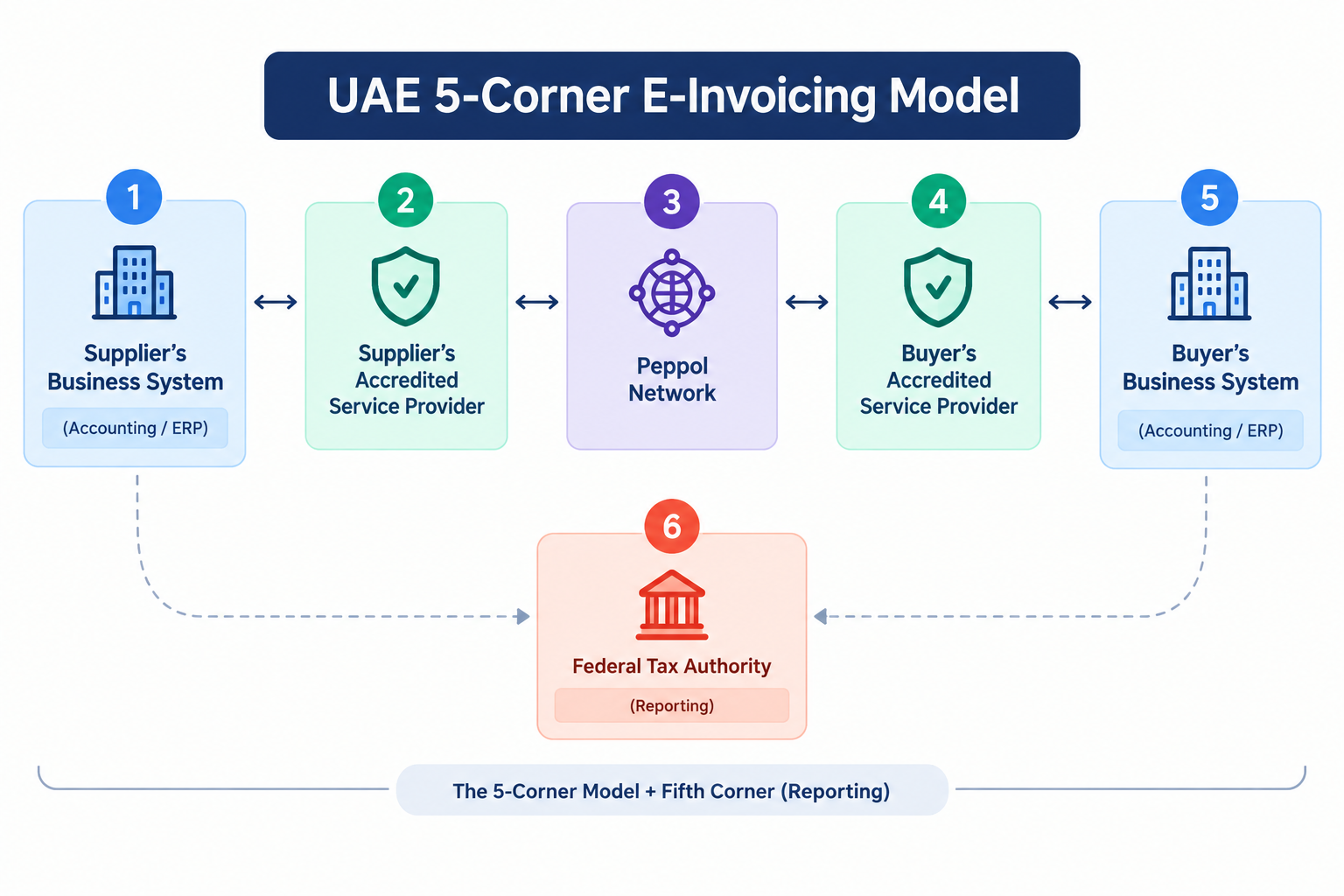
At the same time, the relevant tax data is reported through the UAE’s fifth-corner mechanism.
In practical terms, the supplier creates invoice data in its accounting or ERP system. The supplier’s ASP validates and processes the information, exchanges it through the Peppol network, and supports the required reporting process. The buyer’s ASP receives and validates the transaction before making it available to the buyer’s business system.
This architecture means that SMEs need to think about three separate components:
Business software → ASP → Peppol
The accounting system creates or supplies the business data. The ASP provides the accredited connection and e-invoicing services. Peppol provides the interoperability framework for exchanging the structured invoice.
Step 1 — Determine Whether Your SME Falls Within the E-Invoicing Scope
Before purchasing an e-invoicing platform, determine whether the business is subject to the UAE e-invoicing system and identify the applicable implementation phase.
Businesses should consider:
- Annual revenue.
- Legal entity and business structure.
- Nature of transactions.
- B2B activities.
- B2G activities.
- Applicable exclusions.
- VAT status and tax requirements.
- Whether the business conducts transactions through multiple entities.
The current implementation decision specifies that businesses with revenue below AED 50 million that are subject to the system must appoint an ASP by 31 March 2027 and implement the system by 1 July 2027. It also states that B2C transactions are not subject to the system until otherwise determined by the Minister.
Does every UAE SME need to implement e-invoicing?
Not necessarily. Applicability depends on the business and transaction circumstances defined under the UAE framework. SMEs should verify their position against the latest Ministry of Finance requirements rather than relying on assumptions based only on company size or location.
The UAE Ministry of Finance identifies its e-invoicing portal as the official source for information about the programme and advises businesses to monitor it as the programme evolves.
Step 2 — Map Your Current Invoicing Process
Once scope is confirmed, document how invoicing works today.
A simple process map can reveal gaps that may otherwise become implementation problems.
Map these stages:
Order received → Customer data captured → Product/service selected → Tax calculated → Invoice generated → Invoice approved → Invoice delivered → Payment received → Invoice reconciled → Record retained
For each stage, identify:
- Which application is used.
- Who performs the activity.
- Whether data is entered manually.
- Whether information is transferred between systems.
- Where errors commonly occur.
- Whether the process depends on spreadsheets or email.
- How corrections are handled.
For example, an SME may generate an invoice in an ERP but maintain customer tax information in another application. Another business may create invoices in accounting software while its sales team works from a CRM.
These situations matter because an e invoice system must work with the wider business process rather than operating as an isolated application.
Step 3 — Perform a UAE E-Invoicing Readiness Gap Analysis
After mapping the existing process, compare the current environment with the requirements needed for e-invoicing.
| Area | What to Check |
| Customer data | Legal name, tax information and required details |
| Supplier data | Accuracy and completeness |
| Product/service data | Correct descriptions, codes and tax treatment |
| Tax configuration | VAT and applicable tax information |
| Invoice fields | Required information and structured data |
| Accounting system | Compatibility and configuration |
| Integration | APIs, connectors and data exchange |
| Credit notes | Creation and correction process |
| Security | Access, authentication and data protection |
| Reporting | Transaction and reconciliation visibility |
| Users | Finance and operational readiness |
The result should be a gap list showing what is ready, what needs configuration and what requires technical or process changes.
This is also where businesses can determine whether their existing accounting system can be extended or whether they need additional E-Invoice Management Software in the UAE.
Step 4 — Prepare Your Financial and Master Data
Data accuracy and consistency play a key role in a successful implementation.
An e-invoicing system depends on structured information. If customer, supplier, product or tax data is incomplete, the business may encounter validation problems or manual corrections.
Review customer data
Check:
- Legal business name.
- Tax registration information where applicable.
- Address.
- Customer identification details.
- Required electronic invoicing information.
Review supplier data
Apply similar checks to supplier records, especially where supplier information is used in purchasing, accounting or invoice-related workflows.
Review product and service data
Check:
- Product/service descriptions.
- Applicable tax treatment.
- Unit information.
- Pricing.
- Product or service codes where required.
Review tax configuration
Make sure VAT and other relevant tax information is consistently configured across systems.
Review invoice numbering
Invoice numbering should be logical, controlled and aligned with the business’s accounting processes.
The goal is simple: clean the data before connecting it to the e-invoicing workflow.
Step 5 — Choose the Right E-Invoicing Technology
Selecting Einvoicing Software should involve more than comparing subscription prices.
An SME should evaluate whether the technology can support the complete invoicing lifecycle.
Important capabilities to evaluate
PINT-AE support: The solution should accommodate the applicable UAE structured invoice requirements.
Peppol connectivity: The UAE framework uses the Open Peppol standard for electronic document exchange.
Structured invoice generation: The system should create invoice data in the required structured format rather than simply generating a PDF.
Integration: The solution should connect with accounting software, ERP systems and other relevant applications.
Validation: The system should identify missing or invalid information before transmission where applicable.
Error management: Businesses need visibility into rejected or failed transactions and a defined correction process.
Credit notes: The system should support applicable credit-note workflows.
Security: Access controls, encryption and appropriate data-security practices should be considered.
Scalability: The solution should support future business growth without requiring another major technology change.
The right e-invoicing platform should therefore fit the SME’s existing technology environment rather than forcing the entire business to rebuild its financial operations.
Step 6 — Choose a Registered Service Provider
An Accredited Service Provider plays a central role in the UAE e-invoicing ecosystem.
The Ministry of Finance maintains an official list of accredited e-invoicing service providers and periodically updates it as providers receive accreditation.
What should SMEs ask an ASP?
Before signing an agreement, consider:
- Is the provider officially accredited?
- Does the solution support UAE requirements?
- Does it support Peppol connectivity?
- Can it handle PINT-AE requirements?
- Can it connect with your existing accounting or ERP software?
- How are rejected invoices handled?
- How are credit notes processed?
- What security controls are available?
- What support is provided during implementation?
- How does pricing work?
- Can the solution scale with transaction volume?
- What happens if an integration fails?
The Ministry’s accreditation requirements include Peppol-related capabilities, information security requirements and technical testing. Choosing an ASP should therefore be treated as a business-technology decision, not simply a vendor purchase. As recently, Zoho registered as an Accredited Service Provider in the UAE, businesses considering Zoho for their e-invoicing setup can evaluate its capabilities alongside their existing accounting workflows and implementation requirements.
Step 7 — Design the Integration Architecture
For many SMEs, e-invoicing implementation will involve connecting existing business applications.
A simplified architecture could look like:
CRM / Sales System → Accounting or ERP → E-Invoicing Layer → ASP → Peppol Network → Buyer
The exact architecture depends on the business.
Possible integration approaches include:
- Native software integration.
- API-based integration.
- Middleware.
- Custom connectors.
- ERP integration.
- Accounting-software integration.
The implementation team should define how invoice information moves from the original transaction to the e-invoicing environment and how responses move back into the accounting system.
For example:
Invoice created → Data validated → Invoice transmitted → Response received → Status updated → Accounting record reconciled
This prevents the e-invoicing system from becoming another disconnected application.
Step 8 — Configure Your Accounting System
The next step is to configure the accounting or ERP environment according to the approved implementation design.
Typical configuration areas include:
- UAE tax settings.
- Customer and supplier records.
- Product/service mapping.
- Invoice numbering.
- Tax codes.
- Required invoice information.
- Credit-note workflows.
- User permissions.
- Approval workflows.
- Integration settings.
- Reporting.
Where Zoho Books Can Fit
For SMEs already using Zoho Books, the implementation should begin by assessing the existing configuration and determining what needs to be connected or customised for the business’s e-invoicing workflow.
Zoho Peppol integration can be considered as part of the broader architecture where appropriate. However, the right approach depends on the company’s transaction flow, existing systems, integration requirements and selected ASP.
The objective should be to integrate e-invoicing into the existing financial workflow rather than create a parallel invoicing process.
Step 9 — Build and Test the E-Invoicing Workflow
Testing should happen before production go-live.
A successful test plan should cover normal transactions as well as exceptions.
Test a standard invoice
Check whether:
- Required data is available.
- The invoice is generated correctly.
- Structured information is transmitted.
- The receiving side gets the invoice.
- Status information is returned correctly.
Test credit notes
Confirm that the business can create, transmit and record credit notes correctly.
Test incorrect information
For example:
- Missing customer information.
- Invalid tax information.
- Incorrect product/service data.
- Invalid invoice fields.
Test rejected invoices
Define:
Who receives the error? → Who corrects it? → How is it resubmitted? → How is the accounting record updated?
Test system failures
Consider:
- API failure.
- Network interruption.
- ASP unavailability.
- Duplicate transactions.
- Delayed responses.
Testing these scenarios before go-live helps employees understand what to do when something goes wrong.
Step 10 — Prepare Your Finance Team for Go-Live
Technology alone does not complete an implementation.
Employees who create, approve, monitor or reconcile invoices need to understand the new workflow.
Training should cover:
- Creating invoices.
- Checking invoice information.
- Monitoring invoice status.
- Handling rejected invoices.
- Correcting customer or tax information.
- Creating credit notes.
- Escalating technical problems.
- Reconciliation.
- Record management.
Assign internal ownership
A practical SME structure could assign:
Finance: Invoice and tax processes
IT: Integration and technical support
Management: Approval and governance
Operations/Sales: Customer and transaction data
Implementation partner/ASP: Technical e-invoicing support
Clearly defined ownership reduces confusion after go-live.
Step 11 — UAE E-Invoicing Go-Live Checklist for SMEs
Before moving into production, review the following.
Business readiness
- Scope confirmed.
- Applicable deadline confirmed.
- Internal project owner assigned.
- Implementation responsibilities documented.
Data readiness
- Customer records reviewed.
- Supplier records reviewed.
- Product/service information mapped.
- Tax information validated.
- Invoice numbering reviewed.
Technology readiness
- Accounting/ERP system configured.
- ASP selected and onboarded.
- Required integration completed.
- Structured invoice requirements mapped.
- Peppol connectivity tested.
Operational readiness
- Finance team trained.
- Credit-note workflow tested.
- Error-handling process documented.
- Reconciliation process established.
- Support contacts identified.
Final testing
- Standard invoice tested.
- Credit note tested.
- Rejection scenarios tested.
- Duplicate/error scenarios tested.
- End-to-end transaction tested.
Only after these areas have been validated should the business move toward production go-live.
What Happens After UAE E-Invoicing Goes Live?
Implementation does not end when the first electronic invoice is successfully transmitted.
SMEs should establish a post-go-live monitoring process.
Monitor invoice status
Track:
- Accepted invoices.
- Rejected invoices.
- Failed transmissions.
- Delayed responses.
- Correction requirements.
Reconcile records
Compare e-invoicing transactions with:
- Accounting records.
- Customer records.
- Payment information.
- Tax reporting data.
Monitor data quality
Repeated invoice errors can indicate problems in customer, product or tax master data.
Maintain integrations
APIs, connectors and accounting platforms may require updates over time.
Monitor regulatory changes
UAE e-invoicing requirements can evolve. The Ministry of Finance currently identifies its e-invoicing portal as the official source of programme information and publishes updated guidance and legislative documents there.
A good implementation therefore includes an ongoing compliance and technology-maintenance process.
Common UAE E-Invoicing Implementation Mistakes SMEs Should Avoid
- Waiting until the deadline
Implementation can involve data cleanup, software configuration, integration and testing. Leaving everything until the deadline can reduce the time available to resolve technical issues.
- Treating a PDF as an eInvoice
A PDF is an unstructured document and is not considered an eInvoice under the UAE framework.
- Choosing software before understanding the process
Businesses should first understand how invoice data currently flows and then determine what technology is required.
- Ignoring master data
Poor customer, supplier or tax information can create avoidable invoice errors.
- Selecting an ASP based only on price
Integration capability, security, support, scalability and compliance should also be evaluated.
- Testing only successful invoices
Rejected invoices, corrections, credit notes and technical failures should also be tested.
- Forgetting employee training
Employees need clear procedures for handling errors and exceptions.
- Treating go-live as the end
Monitoring, reconciliation, system maintenance and regulatory updates remain important after implementation.
How Zoho Books Can Support UAE E-Invoicing
For businesses already using Zoho Books or considering it as their accounting platform, UAE e-invoicing can be incorporated into the accounting workflow rather than treated as an entirely separate invoicing environment.
Zoho Books currently states that Zoho Software Trading LLC is an Accredited Service Provider recognized by the UAE Ministry of Finance and that Zoho Books supports PINT-AE structured eInvoices and exchange through Peppol.
Preparing Zoho Books for UAE E-Invoicing
Implementation starts with accurate organizational and tax information.
Businesses should review:
- Registered business information
- Tax Identification Number
- TRN
- Organization address
- Customer information
- Product and service information
- Tax configuration
- Invoice details
Zoho Books’ current UAE e-invoicing workflow includes connecting the organization with the FTA’s EmaraTax environment, selecting Zoho Software Trading LLC as the ASP where applicable, and completing the e-invoicing setup in the organization.
What Happens When an Invoice Is Sent?
A typical Zoho Books workflow can be summarized as:
Create invoice → Validate required information → Submit through Peppol → Network validation → Buyer ASP → Buyer
Zoho Books also provides e-invoice status information. If an invoice fails validation, the business can review the error, correct the transaction and attempt transmission again.
Successful transactions receive a UUID that provides a reference for the e-invoice.
UAE E-Invoicing Implementation Cost: What SMEs Should Consider
The cost of implementing an e-invoicing solution varies significantly between businesses.
An SME with a modern accounting platform and straightforward invoice workflow may have different requirements from a company operating multiple ERP systems, custom applications and large volumes of historical data.
Important cost factors can include:
- Existing accounting software
- Transaction volume
- Number of legal entities
- ASP charges
- Integration requirements
- Data migration
- Customization
- API development
- Testing
- Employee training
- Ongoing support
Therefore, SMEs should evaluate the total implementation requirement rather than selecting a solution based only on the initial software price.
UAE E-Invoicing vs Traditional PDF Invoicing
A PDF invoice may look electronic, but it does not automatically qualify as a UAE eInvoice.
| Traditional PDF Invoice | Structured UAE eInvoice |
| Designed primarily for human reading | Designed for machine processing |
| Usually shared as a document | Exchanged as structured data |
| Can require manual data entry | Designed for system-to-system processing |
| Limited interoperability | Standardized electronic exchange |
| May be emailed manually | Exchanged through the applicable e-invoicing network |
The UAE Ministry of Finance specifically states that unstructured formats such as PDFs, Word documents, images, scanned copies and emails are not eInvoices.
This distinction is important when evaluating E-Invoice Management Software in the UAE. A solution should support the structured e-invoicing process rather than simply generate attractive electronic documents.
Recently Published UAE E-Invoicing Guidance: What SMEs Should Take From It
The UAE Ministry of Finance published its official UAE Electronic Invoicing Guidelines on 23 February 2026 to help businesses prepare for the national rollout.
The guideline specifically addresses system readiness, process alignment, governance, transaction scenarios, tax codes, implementation phases, penalties, readiness frameworks and stakeholder responsibilities.
For SMEs, the key takeaway is that preparation should begin with an assessment of the existing business process and technology environment, rather than waiting until the mandatory implementation date.
The Ministry has also described e-invoicing as part of the UAE’s wider digital transformation, with objectives including reducing manual intervention, improving efficiency, increasing transparency and supporting more secure electronic exchange.
Conclusion
UAE e-invoicing implementation for SMEs is a combination of compliance, technology, data and process readiness. It requires more than simply choosing e-invoicing software; businesses need to ensure that their financial systems, invoice data, workflows and integrations are ready for structured electronic invoicing.
For businesses with annual revenue below AED 50 million that fall within the applicable implementation phase, the current key dates are 31 March 2027 for appointing an Accredited Service Provider (ASP) and 1 July 2027 for full implementation.
A practical implementation journey should include assessing the existing accounting or ERP environment, preparing and validating business data, understanding PINT-AE requirements, selecting an appropriate ASP, establishing Peppol connectivity, configuring workflows, integrating systems, testing transactions and training employees before going live.
The overall approach can be summarized as:
Assess → Prepare → Select → Configure → Integrate → Test → Train → Go Live → Monitor
Starting early allows SMEs to identify data, integration and process gaps before the mandatory implementation date and helps make e-invoicing part of their regular financial operations rather than a last-minute compliance project.
For businesses using Zoho Books, the appropriate implementation approach will depend on their existing configuration, transaction requirements, integrations and selected e-invoicing architecture.
For SMEs that need support with their transition, E-invoicing implementation and Zoho integration in UAE can include system assessment, Zoho Books configuration, data migration, Peppol integration, custom e-invoicing requirements and implementation support. The right approach should ultimately be based on the business’s existing systems, transaction workflows and applicable UAE e-invoicing requirements.
How OfficeHub Tech Can Help SMEs Implement UAE E-Invoicing
UAE e-invoicing implementation often involves more than selecting an invoice application. SMEs may need help assessing existing systems, preparing data, connecting applications and creating workflows that fit their business.
OfficeHub Tech can support businesses with areas such as:
- E-invoicing readiness assessment.
- Existing finance-system and process analysis.
- Zoho Books configuration.
- Zoho Peppol integration.
- Accredited Service Provider integration.
- Accounting and ERP integrations.
- Financial data migration.
- Custom e-invoicing workflows.
- Testing and validation.
- Custom e-invoicing portals.
- Post-go-live support and optimisation.
For businesses looking for E-Invoicing Software For UAE Business, the right implementation approach should start with the company’s existing processes and systems. Technology can then be selected and configured around those requirements.
Preparing Your Business for UAE E-Invoicing
Preparing for UAE e-invoicing begins with assessing your existing Zoho Books setup, financial data, integrations, and invoicing processes to determine how they align with the upcoming compliance requirements. OfficeHub Tech can help you assess these areas and identify the changes needed for a smoother implementation. Reach out to experts today at sam@officehubtech.com or +971 55 280 8571 to discuss your current setup and explore the next steps based on your business requirements.