##Quick Answer
Autonomous development is changing how business applications are designed, built, tested, and improved. AI agents can now participate in multi-step development by understanding requirements, planning changes, generating components, creating logic, validating results, and supporting maintenance.
For Zoho Creator projects, this shift is relevant because the platform combines low-code development, Deluge, integrations, workflows, and AI-assisted capabilities such as Plan Agent, Build Agent, and AI Agents.
Rather than replacing developers, autonomous development enables a human-directed, AI-assisted model, allowing developers to focus more on architecture, business logic, security, governance, and quality.
##Key Takeaways
- Autonomous development goes beyond AI-generated code by enabling AI agents to support multi-step development workflows.
- Zoho Creator is moving toward AI-assisted, intent-driven application development.
- Build Agent can interpret natural-language requirements and modify supported Creator components.
- Development agents build and maintain applications, while AI Agents handle business tasks within them.
- Human developers remain essential for architecture, security, integrations, testing, governance, and business decisions.
- Successful adoption requires controlled permissions, validation, development environments, and human approval.
- The opportunity is to redesign the development lifecycle around AI agents, not just accelerate coding.
Why Zoho Creator Development Is Moving Toward Autonomous Execution
Business application development has traditionally depended on a sequence of human-led activities. A business team explains its requirements, an analyst translates those requirements into specifications, developers design the application, configure forms and workflows, write Deluge scripts, connect external systems, test the application, resolve defects, and eventually deploy the solution.
That model remains valuable, but many parts of it are repetitive.
As enterprises look for faster ways to build and modernize business applications, Zoho Creator development services are increasingly relevant to an AI-assisted development model in which natural-language requirements can be translated into application components, workflows, scripts, and other development tasks.
The important change is not simply that AI can generate a piece of Deluge code.
The bigger change is that AI can increasingly participate in the development workflow itself.
Consider a typical requirement:
“Build a service request management application that allows customers to raise service tickets, managers to allocate technicians, technicians to update job progress, and management to track and resolve pending requests.”
Traditionally, a developer would interpret that requirement and manually determine:
- What forms are required
- Which fields should exist
- How the relationships should work
- Which workflows should trigger
- What permissions each user should have
- What Deluge logic is required
- Which reports and dashboards should be created
- How notifications should work
- Which integrations are necessary
An AI-assisted development environment can take portions of that workload and translate natural-language requirements into suggested application structures and implementation steps.
Zoho’s current Creator direction reflects this shift. Its AI capabilities include application creation from prompts, application modification, Deluge assistance, AI agents, and conversational agents.
This creates the foundation for a different development model:
Business requirement → AI interpretation → development actions → validation → human approval → deployment
That is the beginning of autonomous development.
From AI Assistance to Autonomous Development: What Actually Changed?
The easiest way to understand autonomous development is to compare it with the AI coding assistants that businesses are already familiar with.
Traditional Development
A developer performs almost every technical step:
Requirement → Design → Configuration → Coding → Testing → Deployment
AI, if used at all, is mainly an external helper.
AI-Assisted Development
The developer remains the primary builder, but AI helps with individual activities:
Requirement → Human Development → AI Assistance → Human Review → Deployment
AI may generate code, explain errors, suggest workflows, create documentation, or provide recommendations.
Agent-Driven Development
The relationship changes further.
Instead of asking AI to perform one isolated action, a developer can provide a broader objective. The agent can then break that objective into smaller tasks, use available tools, inspect results, and continue through multiple steps.
Objective → Planning → Tool Selection → Execution → Validation → Review
This is what makes an agent different from a simple prompt-based assistant.
Zoho’s Build Agent, for example, can interpret natural-language instructions and generate proposed changes to supported Creator components. It provides a Change Summary for review before approved changes are applied. Supported operations include creating and modifying forms, fields and workflows and generating HTML and Deluge code.
The distinction is therefore important:
AI assistance helps developers do a task.
Autonomous development allows AI agents to participate in a sequence of development tasks.
That does not mean the entire process should become unsupervised. In enterprise environments, autonomy must exist within clearly defined permissions, architecture, testing, security, and approval boundaries.
What Are AI Agents in a Zoho Creator Project?
The phrase AI agent can mean different things depending on where the agent operates. An autonomous AI agent goes beyond a chatbot or fixed automation rule. Instead of simply responding to a prompt or executing a predefined action, it can interpret a broader objective, break it into steps, use available tools, and work toward the required outcome within defined permissions.
In a Zoho Creator environment, this can involve combining an AI reasoning model with Creator capabilities, APIs, Deluge functions, and other approved tools. The key concept is intent-driven execution: the user defines what needs to be achieved, while the agent determines the supported steps required to accomplish it.
-
AI Agents That Help Build Applications
These are development-oriented capabilities that help create or modify application components. They can assist with:
- Understanding requirements
- Creating application components
- Modifying forms
- Configuring workflows
- Generating Deluge
- Refining existing applications
- Providing implementation guidance
Zoho’s Build Agent is an example of this development-oriented capability. It works from natural-language instructions and can propose and apply supported changes to Creator applications.
-
AI Agents That Operate Inside Applications
These agents perform business tasks after an application exists. Zoho Creator’s AI Agent capability allows an agent to be defined with instructions and connected to Deluge functions that act as its tools.
An agent can analyze a situation, plan tasks, make decisions based on its defined behavior, and execute approved actions. For example, an AI agent could analyze a customer incident, retrieve relevant information, determine the required action, update records, and initiate the next step.
The distinction is straightforward:
Development agent: helps build and modify the application.
Business AI agent: performs intelligent work inside the application.
Autonomous development primarily concerns the first category, while business AI agents represent a further layer of intelligence within deployed applications.
What Can AI Agents Actually Do Across a Zoho Creator Development Project?
Autonomous development becomes more meaningful when AI agents participate across the entire application lifecycle, rather than being used only for code generation. Their role can extend from understanding requirements and building application components to testing, integration, documentation, and continuous improvement.
Requirements and Planning
AI can convert business descriptions into structured requirements, identifying user roles, data requirements, business rules, reports, workflows, and audit needs. Zoho’s Plan Agent is positioned around shaping an application idea into a business requirements document before development begins.
Application Design and Development
AI can assist with forms, fields, relationships, reports, dashboards, workflows, Deluge scripts, HTML components, and other supported configurations. Developers can review and refine the generated structure according to the application’s business and technical architecture.
Integration and Business-Process Orchestration
Autonomous development can extend beyond the Creator application. Where appropriate integrations, APIs, tools, and permissions are available, AI agents can help coordinate actions across Zoho Creator, CRM, Desk, Books, Analytics, and external business systems.
This moves autonomous development from building individual applications toward connecting and orchestrating broader business processes.
Testing and Validation
AI can help generate test scenarios covering valid and invalid inputs, permissions, integration failures, business rules, and edge cases. This provides developers with a broader first-pass testing approach while human validation remains important for business-critical functionality.
Documentation
AI can help document application components, Deluge functions, data relationships, integrations, workflows, and exception handling. This can make applications easier to understand, maintain, and update as they evolve.
Maintenance and Enhancement
Applications continue to change as business requirements evolve. AI-assisted development can support approved modifications to components, logic, workflows, reports, integrations, and other application elements, helping developers iterate without treating every change as a completely new development task.
The broader opportunity is therefore not simply “AI writes code.”
It is:
AI can participate across the application lifecycle—from requirements and application generation to integration, testing, documentation, maintenance, and continuous improvement.
The Autonomous Zoho Creator Development Architecture: Agents, Tools and Human Control
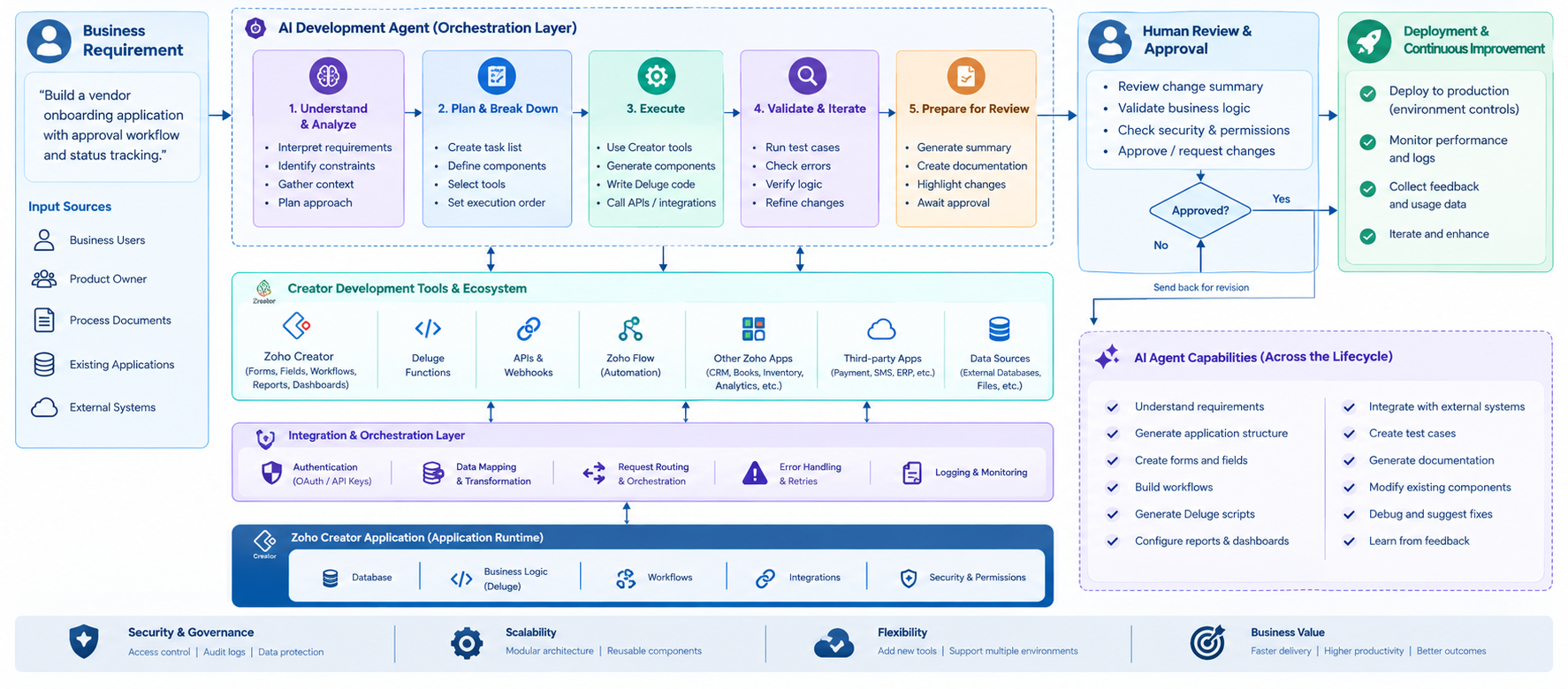
Autonomous development requires more than an LLM connected to a Creator application. A practical enterprise architecture needs an agent, development tools, application context, validation mechanisms, permissions, and human oversight.
A suitable conceptual architecture is:
The Autonomous Zoho Creator Development Architecture: Agents, Tools and Human Control
The AI agent acts as the orchestration layer. It interprets the objective, determines which actions are necessary, and uses permitted tools to perform those actions.
The agent can be understood as a combination of three core layers: an LLM and reasoning engine that interprets the requirement, MCP and APIs that provide structured access to approved Creator and external capabilities, and Deluge and other tools that execute defined application actions. Together, these layers move the process from natural-language intent to tool selection and controlled execution, while validation and human review remain part of the development process.
Those tools may include:
- Creator application components
- Forms
- Reports
- Workflows
- Deluge
- APIs
- Integration services
- External business applications
- Testing utilities
- Documentation systems
The architecture should also include a validation layer.
This is important because an AI agent can produce a technically valid change that is still business-invalid.
For example, an agent could correctly create a workflow that automatically approves a purchase request, but the workflow may violate the organization’s procurement policy.
Technical accuracy does not always mean business accuracy.
A controlled development architecture should therefore include:
Agent → Execute → Validate → Review → Approve → Deploy
rather than:
Agent → Execute → Production
Zoho’s Build Agent follows this controlled principle by generating a Change Summary for proposed changes so users can review what will be modified before approving the changes.
The same principle should guide broader enterprise implementations of autonomous development.
How an AI Agent Could Build a Zoho Creator Feature From a Natural-Language Requirement
Imagine an enterprise wants to add a vendor onboarding module to an existing Creator application.
Instead of manually configuring every component, the development process could be structured around a requirement such as:
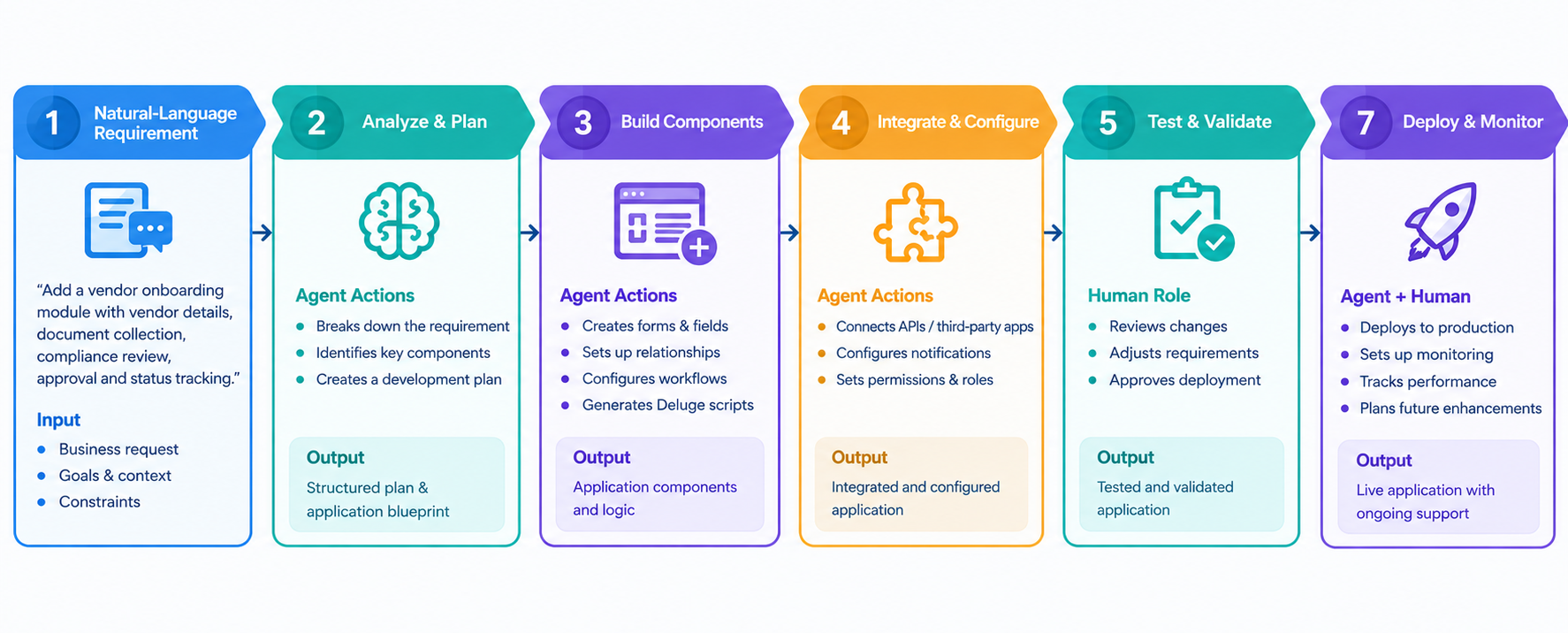
Natural-Language Application Development Flow
“Implement a vendor onboarding module that manages vendor information, collects required documents, supports compliance verification and approval, and provides ongoing status tracking.”
The agent could potentially help break this requirement into:
- Vendor master structure
- Required forms and fields
- Document requirements
- Review workflow
- Approval stages
- Status logic
- Notifications
- Reports
- Validation rules
- Supporting Deluge logic
The developer then reviews the proposed structure, modifies requirements where necessary, and validates the resulting application.
This creates a development loop:
Requirement → Understand → Plan → Build → Test → Review → Refine → Deploy
The important point is that the agent is not simply producing one answer. It is participating in an iterative development process.
Where Human Developers Still Matter in Autonomous Zoho Creator Development
The rise of autonomous development should not be interpreted as the disappearance of developers.
In enterprise environments, the developer’s role is likely to become more architectural and supervisory, not irrelevant.
An AI agent can generate a workflow, but it does not automatically understand every organizational consequence of that workflow.
A developer or solution architect must still determine:
Business Architecture: Does the application actually solve the right business problem?
Data Architecture: Should the information be stored in Creator, an existing ERP, CRM, or another system?
Integration Architecture: Should the application communicate through APIs, webhooks, middleware, custom connectors, or another integration pattern?
Security: Who should access the data? Which operations should require elevated permissions?
Performance: Will the design remain effective as records, users, integrations, and transaction volumes increase?
Exception Handling: What happens when an API fails, data is missing, an approval is rejected, or an external system becomes unavailable?
Governance: Which AI-generated changes can be approved automatically, and which require human review?
This changes the developer’s role from simply writing everything manually to:
Design → Direct → Review → Govern → Optimize
That is arguably a more valuable role for experienced enterprise developers.
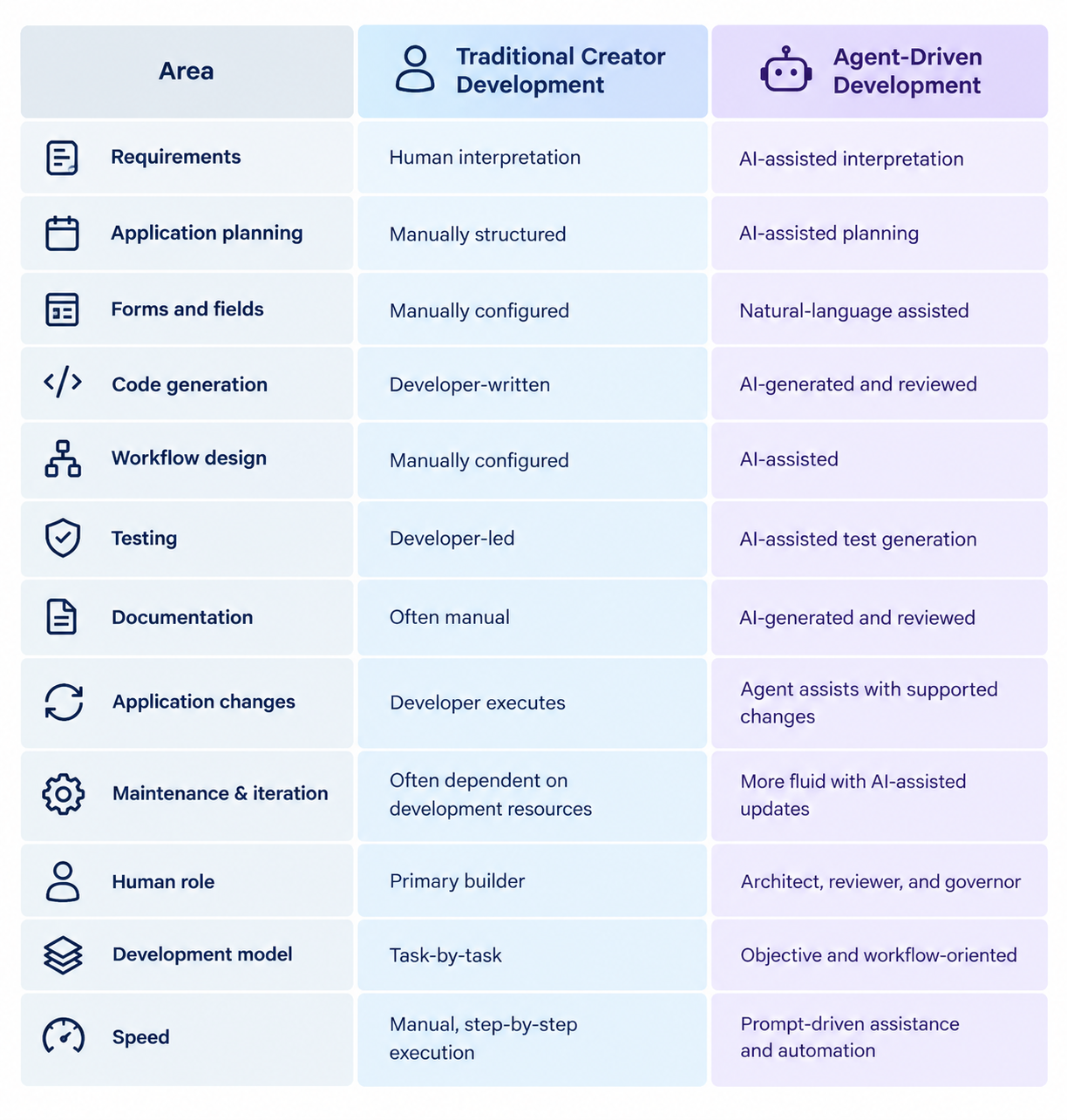
Traditional Development vs. Autonomous Low-Code: A Direct Comparison
AI-driven development changes how Zoho Creator applications can be planned, built, tested, and maintained.
What Business Benefits Can Autonomous Development Deliver?
For enterprises using Zoho Creator, the value of autonomous development should be measured in terms of the development lifecycle, not simply the number of lines of code generated.
Faster Application Iteration
When AI can assist with application configuration, scripting, documentation, and modification, developers can potentially move through iterations faster.
A business team may identify a new requirement on Monday, review an AI-generated implementation on Tuesday, test it on Wednesday, and refine it later in the week rather than waiting for every configuration task to be completed manually.
The actual timeline will depend on application complexity and governance requirements, but the development bottleneck can shift away from repetitive configuration.
More Developer Capacity
Developers can spend more time on:
- Architecture
- Complex integrations
- Security
- Performance
- Business logic
- Data strategy
- Quality assurance
rather than spending most of their time on repetitive application configuration.
Faster Prototyping
AI can help turn business ideas into early application structures more quickly.
This is particularly valuable when the organization needs to validate an idea before committing significant development resources.
Easier Application Evolution
Business applications rarely remain static.
Processes change. Approval rules change. New departments are added. New systems need to be integrated.
An AI-assisted development model can make smaller changes easier to initiate and iterate.
Better Knowledge Transfer
AI-generated explanations and documentation can also reduce dependence on individual developers who originally built an application.
That becomes increasingly important as Creator applications grow into enterprise business systems.
Real-World Business Use Cases
- Modernizing Legacy Systems: Enterprises can use Zoho Creator as a flexible application layer around older systems, while AI agents help users retrieve information, initiate workflows, and interact with business data conversationally without immediately replacing the core system.
- Custom Field Service Management: AI-assisted Creator applications can support FSM processes such as service requests, technician assignment, work orders, inventory updates, scheduling, and automated invoicing. AI agents can help users interact with these workflows through natural-language prompts.
- Zoho Developer AI Agent: An agentic development layer combining AI, MCP, Zoho Creator, and the wider Zoho ecosystem can help developers interact with applications, data, and development capabilities through conversational instructions.
- Faster Enterprise Delivery: Business teams can use AI-assisted development to turn requirements into functional Creator applications faster, reducing repetitive development work and shortening traditional IT queues.
What Are the Risks and Limitations of Autonomous Development?
Autonomous development introduces a new category of risk: the system can execute faster than humans can manually inspect every action.
That makes governance essential.
Incorrect Requirements
An AI agent can misunderstand ambiguous requirements.
A developer should therefore provide sufficient context, constraints, expected outcomes, and acceptance criteria.
Incorrect Code or Logic
Generated Deluge can appear correct while failing under an unusual condition.
Code review and testing remain necessary.
Security Problems
An agent with excessive permissions could potentially make changes outside its intended scope.
Agent permissions should follow least-privilege principles.
Integration Errors
AI-generated API logic may use incorrect fields, authentication methods, endpoints, or assumptions about external systems.
Integration changes require validation against actual API documentation and environments.
Technical Debt
If AI-generated components are repeatedly added without architectural review, an application can become difficult to maintain.
The speed of AI development can therefore create a new problem:
faster technical debt.
Data and Privacy Considerations
LLM configuration also matters.
Zoho documents that its native Zoho GenAI processes prompts within Zoho, while external LLM providers process data within their own systems. It specifically cautions users to avoid sharing sensitive or regulated information in prompts when external providers are used.
This means AI architecture must consider not only what an agent can do, but what information it can see and where that information goes.
Security, Governance and Human Approval for AI-Driven Creator Development
Enterprise autonomous development should be treated as a governed engineering capability.
Several controls become particularly important.
Role-Based Access
AI agents should receive only the permissions required for their assigned tasks.
Development and Production Separation
Development changes should be tested before they reach production.
Zoho’s Build Agent documentation recommends using development environments when modifying published applications.
Human Approval
High-impact changes should require explicit human approval.
For example:
- Database structure changes
- Security changes
- Financial workflows
- Production integrations
- Permission changes
- Customer-facing workflows
should not automatically receive unrestricted AI authority.
Auditability
Organizations should know:
- Which agent acted
- What instruction it received
- Which tools it used
- What changes it proposed
- What was approved
- When the change occurred
Validation
Automated validation should be combined with human review for important application changes.
The principle should be:
The more business-critical the action, the stronger the verification requirement.
This allows organizations to gain the productivity benefits of autonomy without treating AI output as inherently trustworthy.
When Autonomous Development Makes Sense for a Zoho Creator Project
Not every development task should be automated to the same degree.
Autonomous development is particularly suitable for repetitive and lower-risk activities such as:
- Initial application scaffolding
- Standard forms
- Basic workflows
- Repetitive configuration
- Documentation
- Test-case generation
- Deluge first drafts
- Existing application enhancements
- Standard internal business applications
- Prototyping
Human involvement should increase when dealing with:
- Complex enterprise integrations
- Sensitive information
- Financial systems
- Critical business processes
- Complex security models
- Highly customized business rules
- Production infrastructure
- Large-scale data migrations
The objective is therefore not maximum autonomy.
The objective is appropriate autonomy.
An enterprise should automate the parts of development where AI can operate reliably while maintaining human control over decisions that require business and technical judgment.
A Practical Adoption Roadmap for Enterprises
Organizations do not need to transform every Creator development project overnight.
A phased approach is more practical.
Phase 1: Identify Suitable Development Tasks
Start by identifying repetitive, low-risk activities where AI assistance can provide measurable value.
Phase 2: Introduce AI-Assisted Development
Use AI for:
- Requirement refinement
- Deluge generation
- Documentation
- Test generation
- Application configuration
At this stage, humans remain responsible for execution and approval.
Phase 3: Introduce Agent-Driven Execution
Once teams understand AI behavior, controlled agents can be given access to specific development tools and tasks.
Phase 4: Add Governance
Define:
- Permission boundaries
- Approval requirements
- Development environments
- Testing standards
- Audit requirements
- Data-handling policies
Phase 5: Scale Across Projects
Organizations can then establish reusable:
- Agent instructions
- Development patterns
- Tool configurations
- Testing procedures
- Governance standards
Phase 6: Measure Outcomes
Track actual business and engineering outcomes such as:
- Development cycle time
- Rework
- Defect rates
- Development effort
- Deployment frequency
- Requirement-to-release time
- AI usage
- Development AI costs
This turns autonomous development from an AI experiment into an engineering capability that can be measured and improved.
Why Agentic Development Requires More Than an AI Coding Tool
The shift toward autonomous development goes beyond low-code platforms.
A recent McKinsey study published on August 21, 2026, examined how organizations are scaling agentic product development. The research found that teams achieving stronger AI impact were redesigning their broader product-development systems rather than simply adding another AI tool. Key themes included redesigning processes, redefining roles, establishing verification mechanisms and managing organizational change. McKinsey’s research on scaling agentic product development
This is particularly relevant to Zoho Creator projects. AI agents deliver greater value when the development process itself evolves, not just when developers gain access to an AI assistant.
For an enterprise Creator team, this can mean moving from:
Developer writes → Developer tests → Developer deploys
to:
Human defines objective → Agent plans → Agent executes → Automated validation → Human reviews → Controlled deployment
That shift is central to autonomous development.
How OfficeHub Tech Helps Enterprises Adopt AI-Powered Zoho Creator Development
Adopting autonomous development requires more than enabling an AI feature. Enterprises need the right application architecture, business-process understanding, integration strategy, security controls, and development governance.
OfficeHub Tech helps enterprises design and implement AI-powered Zoho Creator applications around their operational requirements. Our capabilities include:
- Business-process analysis
- Zoho Creator application architecture and development
- AI-assisted application and Deluge development
- Workflow automation
- API and third-party integration
- Data migration and application modernization
- AI agent implementation
- Mobile and portal development
- Testing, deployment, and ongoing optimization
The goal is not to make every development task autonomous, but to identify where AI can safely reduce repetitive work while experienced developers retain control over architecture, security, integrations, and business-critical decisions.
For enterprises exploring Zoho Creator AI development and automation services providers in the USA, India, KSA, and UAE, OfficeHub Tech can help turn AI-assisted development into practical, secure, and scalable business applications.
Have an AI-powered Zoho Creator project in mind? Talk to OfficeHub Tech experts to evaluate your requirements, identify practical automation opportunities, and plan a secure implementation tailored to your business.
Explore Zoho Creator for AI-Powered Development
Start building smarter business applications with Zoho Creator. Automate workflows, connect your business systems, and use AI-powered capabilities to accelerate application development and streamline repetitive processes.
Whether you are evaluating AI agents for Zoho Creator development, modernizing an existing application, or building a new business solution, Zoho Creator provides a flexible foundation for turning business requirements into custom applications.
👉 Get Started with Zoho Creator:
For organizations planning a larger implementation, OfficeHub Tech can help with Zoho Creator application development, AI automation, integrations, modernization, and ongoing optimization.
Conclusion: From AI-Assisted Development to Autonomous Development
The rise of autonomous development is changing how business applications can be created. AI is moving beyond code generation toward systems that can understand objectives, plan tasks, use development tools, modify components, generate logic, validate results, and support iterative development workflows.
For AI automation in Zoho Creator development, this evolution is visible through AI-powered application creation, Build Agent, Deluge assistance, and AI Agents.
However, autonomous development does not make developers unnecessary. Instead, their role shifts toward architecture, orchestration, validation, security, governance, and business problem-solving.
The real question is not “How much of the development process can be delegated to AI?”
but
“What activities can AI agents perform consistently while people maintain oversight of architecture, risk, and business outcomes?”
For organizations using Zoho Creator, the future is likely to be increasingly human-directed, agent-assisted, and progressively autonomous.