
##Quick Answer
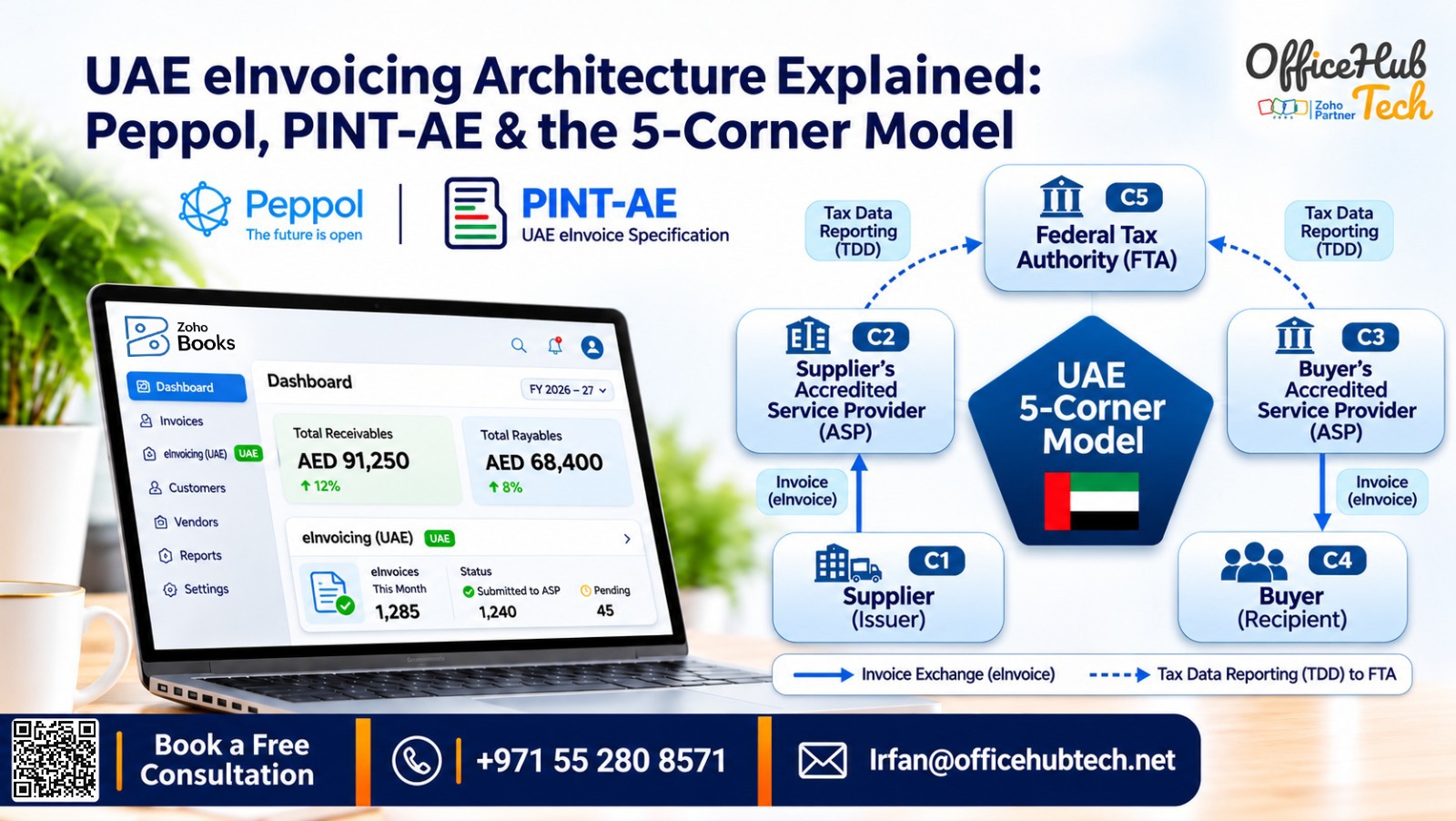
The UAE e-invoicing system follows a decentralised five-corner architecture built around the Peppol network and the PINT-AE invoice specification. A supplier creates structured invoice data in its business software and submits it to an Accredited Service Provider (ASP). The ASP validates and transmits the invoice to the buyer’s ASP through Peppol, while the required tax data is reported to the Federal Tax Authority (FTA) through Corner 5. PINT-AE defines the UAE invoice structure, Peppol enables interoperable exchange, and ASPs connect business systems to the national framework.
##Key Takeaways
- The UAE follows a five-corner DCTCE model for e-invoicing.
- Peppol enables secure invoice exchange between ASPs, while PINT-AE defines UAE-specific invoice standards.
- Corners 1 and 4 represent suppliers and buyers, Corners 2 and 3 their ASPs, and Corner 5 the FTA reporting layer.
- Supplier-side ASPs report TDDs alongside invoice transmission; buyer-side ASPs validate, deliver, and report invoice data.
- Message Level Status (MLS) communicates validation and reporting outcomes.
- ERP and accounting systems require accurate data mapping, integration, status synchronisation, and exception handling.
Exploring the UAE’s Decentralised e-Invoicing Architecture
The UAE’s electronic invoicing framework moves invoice processing beyond exchanging digital documents. Instead of sending PDF invoices through email, it uses structured data that can be validated, exchanged between businesses, and reported electronically to the Federal Tax Authority (FTA).
This requires business applications, service providers, network components, invoice standards, and government reporting functions to work together.
The Ministry of Finance describes this model as Decentralised Continuous Transaction Control and Exchange (DCTCE). Its five-corner architecture separates supplier-to-buyer invoice exchange from tax-data reporting to the government.
What Is the UAE Electronic Invoicing System?
An electronic invoice under the UAE framework is structured data exchanged electronically between a supplier and buyer and reported to the FTA.
Not every digital invoice qualifies as an e-invoice. PDFs, scanned documents, images, Word files, and email attachments do not automatically meet the structured e-invoicing requirements.
A structured e-invoice contains data arranged according to an agreed technical specification, allowing systems to read, validate, and exchange information without manual extraction.
Typical invoice data includes:
- Supplier and buyer identification details.
- Invoice number and issue date.
- Product or service descriptions.
- Quantities, unit prices, and line amounts.
- VAT categories and tax amounts.
- Invoice totals and payable amounts.
- Purchase order and related document references, where applicable.
Why Does the UAE Use a Decentralised Five-Corner Architecture?
Unlike centralised models that route invoices through one platform, the UAE distributes exchange responsibilities across Accredited Service Providers (ASPs).
The supplier connects through its ASP, while the buyer receives invoices through its own ASP. Both providers communicate through the Peppol network, with government reporting handled separately.
This supports interoperability between different ERP, accounting, billing, and invoicing systems. Businesses can retain their existing applications while ASPs manage the required exchange processes.
The architecture separates two activities:
- Invoice exchange: Transferring structured invoice data from supplier to buyer.
- Tax-data reporting: Reporting required tax information to the FTA through Corner 5.
Both processes are connected but have separate statuses that businesses must track.
The Three Main Architectural Layers
The framework operates through three practical layers:
Business application layer
Includes supplier and buyer systems such as ERP, accounting, billing, and e-invoicing software that create and process invoices.
Network and service-provider layer
Includes ASPs and the Peppol network, which handle invoice validation, transformation where required, routing, and exchange.
Government reporting layer
Includes Corner 5 and the FTA’s Central Data Platform, which receives relevant tax data through ASPs and returns reporting statuses.
Together, these layers enable structured invoice exchange between businesses and electronic tax reporting to the government.
What Is Peppol and How Does It Work in the UAE?
Peppol provides the network framework for exchanging structured business documents between organisations and software platforms. In the UAE, it enables supplier-side and buyer-side ASPs to exchange e-invoices without requiring businesses to use the same ERP or accounting software.
Peppol is not an invoicing application. It is the interoperable network through which participating service providers exchange electronic documents.
Understanding the Peppol Network
Peppol was developed to support interoperable electronic procurement and business-document exchange. It allows organisations to exchange documents through compatible service providers using shared technical standards.
In the UAE, businesses use an Accredited Service Provider (ASP) to connect to the Peppol environment. This eliminates the need for businesses to build individual connections with every trading partner.
How Peppol Enables Interoperable Invoice Exchange
Several technical components support Peppol communication:
Peppol Access Points
Access Points connect participants to the network. The sending Access Point transmits invoices to the receiving Access Point, which processes and delivers them to the buyer’s system.
Participant Identifiers
These identify organisations within the network. The buyer’s electronic address helps direct invoices to the correct receiving provider.
Service Metadata Publisher (SMP)
An SMP provides participant service details and technical capabilities, helping identify how documents should be delivered.
Service Metadata Locator (SML)
The SML helps locate the relevant SMP, supporting participant and service discovery.
AS4 Messaging
AS4 enables asynchronous message exchange between Access Points, supporting secure invoice transmission.
Peppol Public Key Infrastructure (PKI)
PKI supports authentication, message signing, and encryption to protect message integrity and confidentiality.
Together, these components enable secure document exchange. Businesses generally interact with their ASP and business software rather than managing these components directly.
How Supplier and Buyer Discovery Works
The invoice delivery process broadly involves:
- The supplier’s system submits the invoice to its ASP.
- The ASP identifies the buyer using its electronic address.
- Network discovery identifies the receiving provider and its capabilities.
- The supplier’s ASP transmits the invoice through Peppol.
- The buyer’s ASP processes and delivers the invoice to the buyer.
Incorrect or incomplete participant information can prevent successful delivery, making accurate customer records and electronic addresses essential.
What Peppol Does—and What It Does Not Do
Peppol establishes the infrastructure and standards for exchanging electronic documents. It does not replace business applications responsible for invoice creation, customer records, transaction approvals, or accounts payable management.
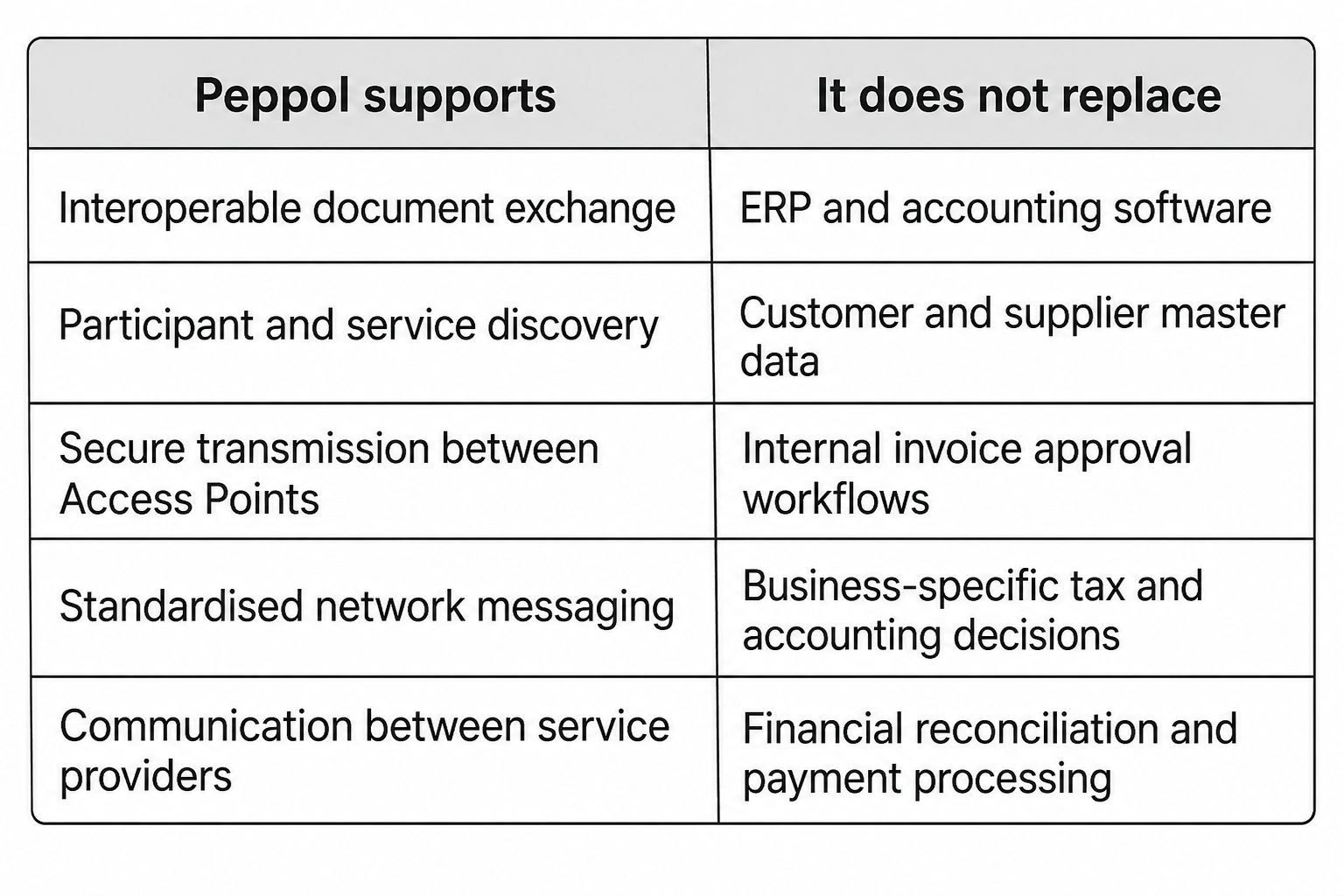
Understanding this boundary helps businesses identify which responsibilities belong to their software, which belong to their ASP, and which remain part of their internal finance operations.
What Is PINT-AE and Why Is It Required?
Peppol provides the exchange network, but consistent invoice processing also requires a standard structure for invoice data. This is where PINT-AE comes in.
PINT-AE, or Peppol International Invoice – UAE, is the UAE-specific electronic invoicing standard built on the Peppol framework. It specifies the format and structure of e-invoice data, along with the country-specific information and business rules that UAE businesses must follow.
Understanding PINT-AE
PINT-AE builds on the Peppol International Invoice framework and incorporates UAE requirements. It ensures that different ERP and accounting systems can interpret and process the same invoice information consistently.
For example, a supplier and buyer may use different software platforms, but both need to understand the same essential invoice data.
The three components serve different purposes:
- Peppol: Provides the network and interoperability framework for electronic document exchange.
- PINT-AE: Specifies the UAE’s e-invoice format, mandatory data fields, and applicable validation rules.
- ASP: Facilitates business connectivity with the designated e-invoicing exchange and reporting network.
An accounting application may generate invoice data, but it still needs a compliant process to prepare and exchange structured e-invoices.
How PINT-AE Structures Electronic Invoice Data
PINT-AE organises invoice information into data groups that help receiving systems identify parties, validate transactions, and process invoices.
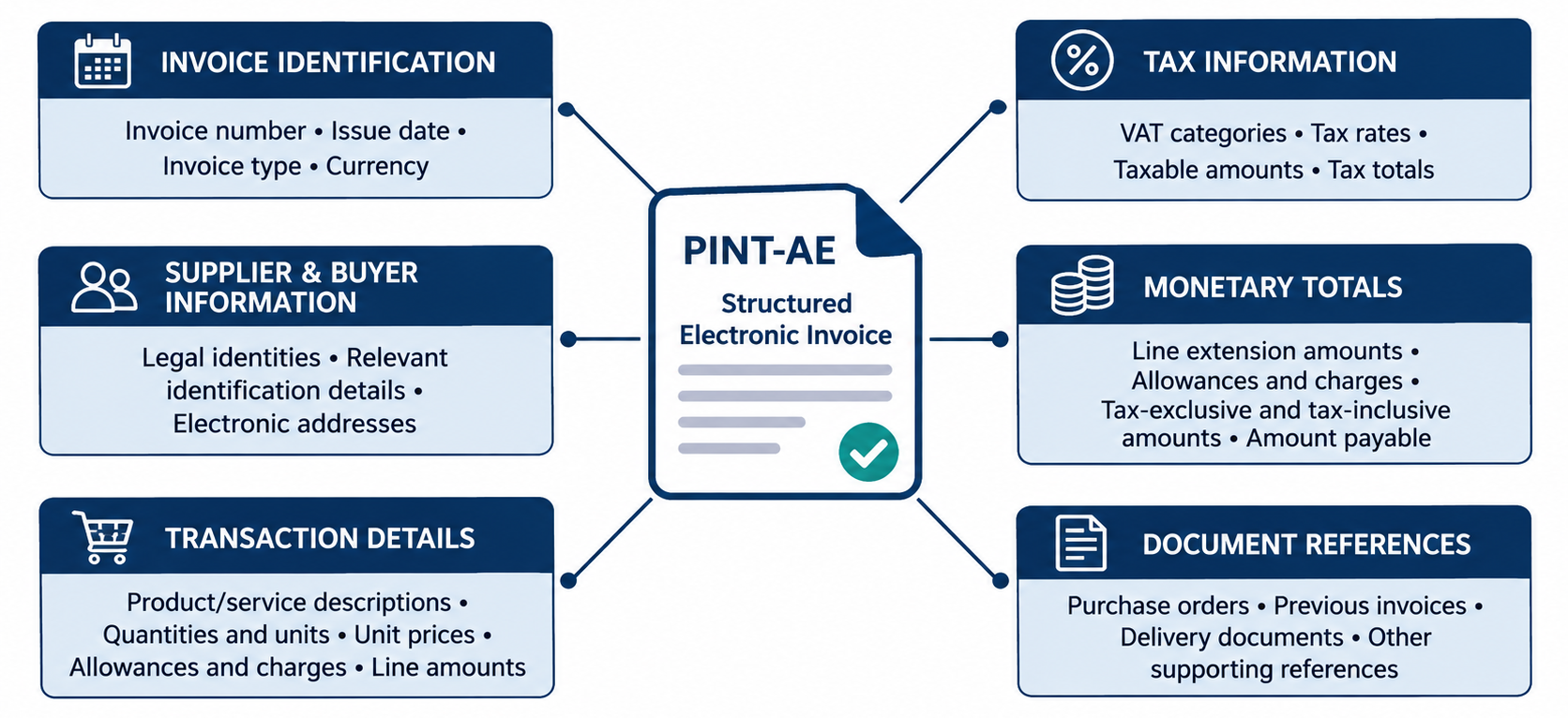
Key data groups include:
- Invoice identification: Invoice number, issue date, invoice type, currency, and document references.
- Supplier and buyer information: Legal identities, identification details, and electronic addressing information for invoice routing.
- Transaction details: Product or service descriptions, quantities, units, prices, allowances, charges, and line amounts.
- Tax information: Applicable VAT categories, rates, taxable amounts, and tax totals based on the transaction’s tax treatment.
- Monetary totals:Line amounts, allowances, charges, tax-exclusive and tax-inclusive amounts, and the final payable amount.
- Document references: Purchase orders, previous invoices, delivery documents, and other supporting references, where applicable.
The required and conditional fields depend on the UAE’s published data dictionary, invoice type, and business rules. Businesses should follow the latest official specifications rather than relying on generic invoice templates.
Mandatory Fields, Business Rules, and Validation
Displaying all invoice information does not automatically make a structured invoice valid. It must also meet the applicable format and business rules.
Validation checks may identify:
- Missing supplier or buyer identification details.
- Incorrect invoice date formats.
- Invalid tax categories.
- VAT calculations that do not match taxable amounts and applicable rates.
- Invoice totals that do not reconcile with line amounts.
- Missing references required for specific document types.
These checks identify errors before invoices proceed through the network.
However, technical validation is different from commercial approval. A valid invoice may still require purchase-order matching, internal review, or finance approval.
How Invoice Data Is Converted into the UAE Standard
Businesses often generate invoices through existing ERP or accounting applications whose data structures may differ from PINT-AE. Therefore, data mapping and transformation may be necessary.
For example, product details, quantities, prices, VAT codes, and customer information stored in an ERP must be mapped to the corresponding PINT-AE data elements.
The process typically involves:
- Retrieving invoice and master data from the source application.
- Mapping internal fields to UAE invoice data requirements.
- Standardising dates, currencies, identifiers, and tax categories.
- Generating or converting the structured XML invoice.
- Validating it against the applicable schema and business rules.
- Returning errors for correction where necessary.
Responsibilities may vary by integration arrangement. The business application, ASP, or both may handle data mapping, conversion, and validation.
The key requirement is that every invoice entering the exchange process complies with the applicable UAE specification.
The UAE Five-Corner Model: Roles and Responsibilities Explained
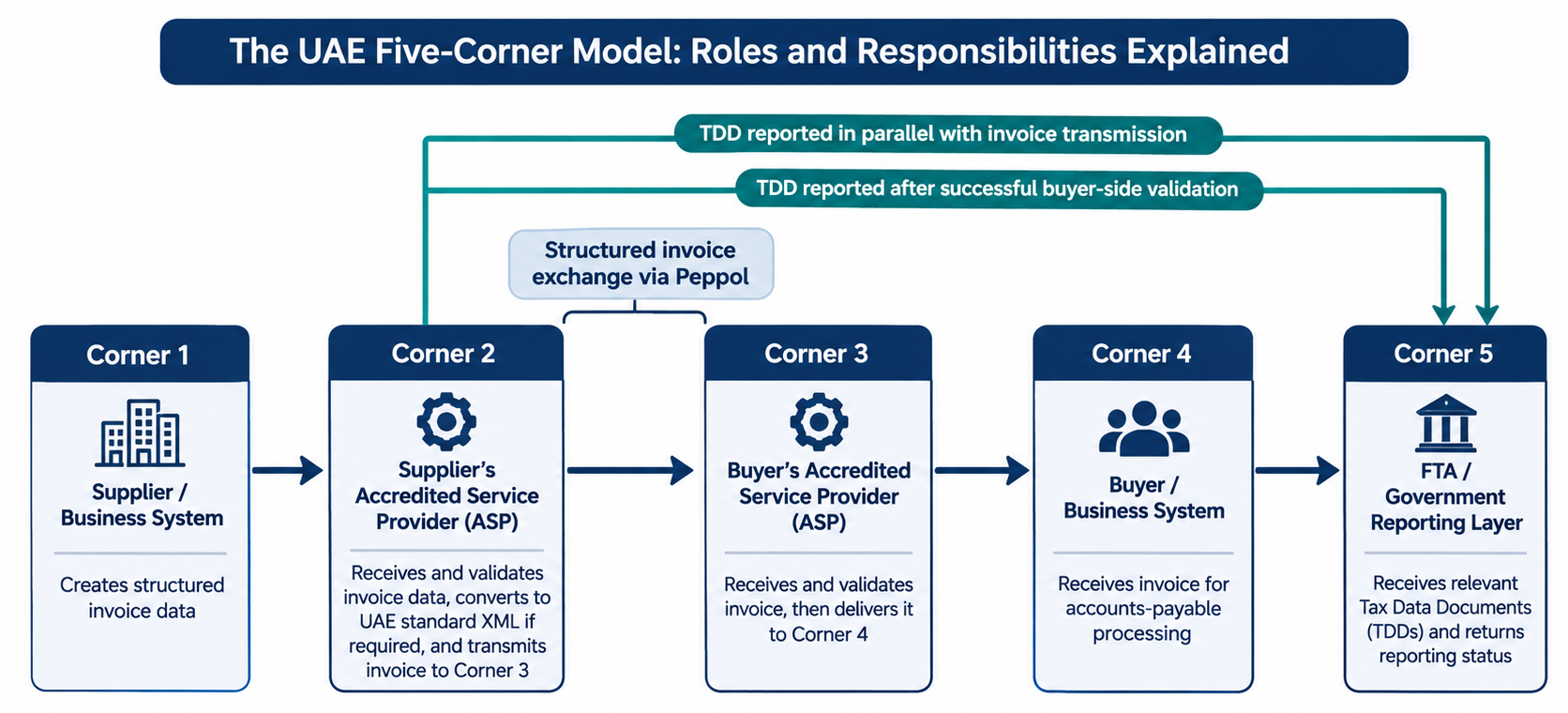
The five-corner model is the central part of the UAE e-invoicing architecture. It defines the participants involved in invoice creation, transmission, reception, and government reporting.
The five corners are:
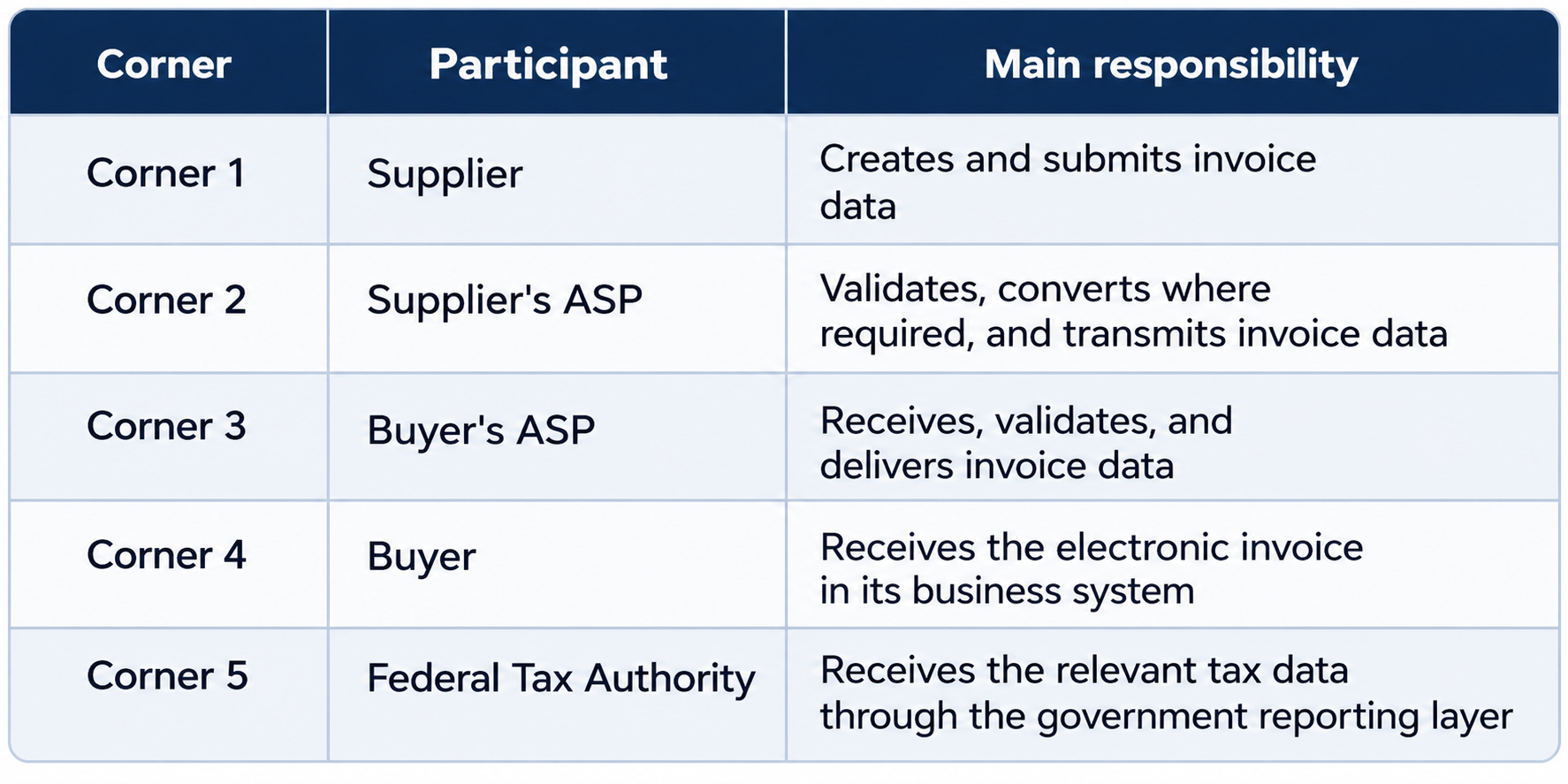
The model is decentralised because the supplier and buyer exchange invoices through their respective service providers rather than relying on one central platform to deliver every commercial invoice.
Corner 1: Supplier’s Business System
Corner 1 represents the supplier, where invoices are created in an ERP, accounting application, billing platform, or other business software.
The source system contains customer details, transaction lines, prices, tax information, and document references.
Before submission, the business should:
- Verify customer and supplier details.
- Check invoice numbers and dates.
- Review line items and quantities.
- Validate tax categories and calculations.
- Complete internal approvals.
Once ready, the invoice data is submitted to the supplier’s ASP at Corner 2.
Technical consideration: The connection should preserve invoice identifiers and transaction references to support document tracking and prevent duplicate submissions.
Corner 2: Supplier’s Accredited Service Provider
Corner 2 represents the supplier’s ASP. It receives invoice data and processes it before transmission to the buyer’s ASP.
Its responsibilities include:
- Receiving invoice data from Corner 1 in an agreed format.
- Validating the submitted data.
- Converting it into UAE standard XML if received in another format.
- Transmitting the invoice to the buyer’s ASP at Corner 3.
- Reporting the Tax Data Document (TDD) to Corner 5 alongside invoice transmission.
The supplier’s ASP supports both invoice exchange and government reporting. Missing information or validation failures must be identified and addressed before successful processing.
Businesses should understand their ASP’s error notifications, integration interfaces, status updates, and support for correcting rejected data.
Corner 3: Buyer’s Accredited Service Provider
Corner 3 represents the buyer’s ASP. It receives invoices from the supplier’s ASP through the Peppol network, validates them, and communicates the relevant status to Corner 2.
If validation succeeds, Corner 3 delivers the invoice to the buyer’s business software in the agreed format and reports the relevant TDD to Corner 5.
If validation fails, it sends a negative Message Level Status to Corner 2 and Corner 5 without submitting the TDD.
Therefore, the receiving ASP does not simply forward incoming invoices. Its validation outcome determines the subsequent delivery and reporting process.
Technical consideration: The buyer’s ASP must support reliable invoice processing, status communication, and delivery to the buyer’s ERP or accounting system. Businesses should also understand how rejected invoices and corrected documents are handled.
Corner 4: Buyer’s Business System
Corner 4 represents the buyer, who receives the invoice through its ASP and business software in an agreed format.
The invoice then enters the accounts-payable process, which may involve:
- Matching suppliers against vendor records.
- Checking invoices against purchase orders.
- Verifying quantities against goods received.
- Routing invoices for departmental approval.
- Recording invoices in accounting software.
- Preparing payments and reconciliation.
The buyer’s system should retain invoice references and status information for tracking from receipt to payment.
A technically valid e-invoice does not automatically mean the purchase is approved. Commercial checks and payment authorisation remain part of internal controls.
Corner 5: Government Reporting Layer
Corner 5 represents the FTA reporting function. It receives relevant tax data through ASPs, separately from the commercial invoice exchange between suppliers and buyers.
The supplier’s ASP reports the TDD alongside invoice transmission to the buyer’s ASP. The buyer’s ASP reports its TDD after successful invoice validation. If validation fails, it sends a negative status instead of submitting the TDD through this step.
Corner 5 processes the reported tax data and returns a Message Level Status confirming the reporting outcome.
This distinction is important for invoice monitoring. Invoice exchange and tax reporting have separate statuses. Treating both as a single “sent” or “accepted” status can create reconciliation difficulties.
End-to-End UAE eInvoice Data Flow: From Creation to FTA Reporting
The five-corner model becomes clearer when viewed as a sequence of connected interactions.
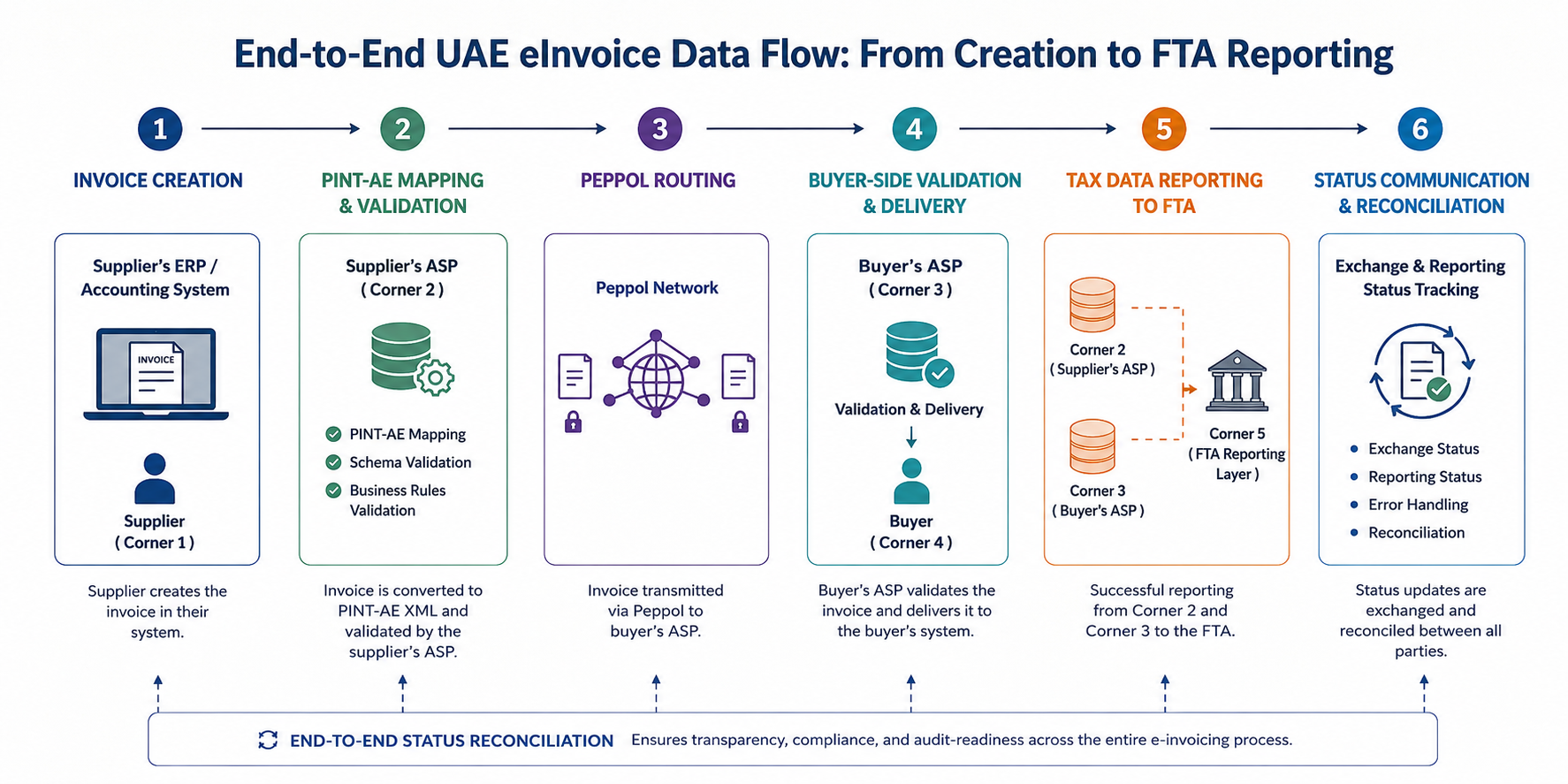
Step 1: Invoice Creation and Submission
The supplier creates an invoice in its business application, capturing customer, transaction, tax, and monetary details. After internal checks, the invoice data is submitted to the supplier’s ASP at Corner 2 in an agreed format. Accurate source data helps prevent errors later.
Step 2: PINT-AE Mapping and Validation
Corner 2 validates the submitted invoice data and converts it into the UAE standard XML format if required. The data is checked against applicable UAE requirements. Identified errors must be corrected before successful exchange.
Step 3: Buyer Identification and Peppol Routing
The supplier’s ASP identifies the buyer through its electronic address or endpoint. Peppol discovery identifies the receiving ASP, allowing secure invoice transmission between providers, even when businesses use different ERP or accounting systems.
Step 4: Buyer-Side Validation and Delivery
The buyer’s ASP (Corner 3) receives and validates the invoice. After successful validation, it sends an electronic status response to Corner 2 and delivers the invoice to the buyer’s business software. If validation fails, a negative status is communicated to Corner 2 and Corner 5, and the TDD is not submitted through the successful-validation reporting step.
Step 5: Tax Data Reporting to Corner 5
Tax reporting involves two stages:
- Corner 2 reports the TDD to Corner 5 alongside invoice transmission.
- After successful validation, Corner 3 reports the relevant TDD to Corner 5.
Corner 5 processes the tax data and returns a reporting status.
Step 6: Status Communication and Reconciliation
Service providers relay exchange and reporting statuses to the respective businesses. Corner 2 forwards buyer-side exchange and FTA reporting statuses to the supplier, while Corner 3 shares relevant reporting statuses with the buyer.
Both parties should reconcile these updates with their business records. Suppliers must track invoice exchange and reporting outcomes, while buyers should distinguish invoice receipt, validation, and internal accounts-payable approval.
Technical Protocols, Data Formats, and Security Behind the Architecture
The architecture uses technical standards to enable secure, structured data exchange between service providers and business systems.
XML as the Structured Invoice Format
XML represents invoice information through defined elements that software can interpret, including invoice IDs, supplier and buyer details, tax information, and monetary totals.
This structure supports automated validation and processing and allows ASPs to transform data for compatible systems. However, XML generation alone does not ensure compliance; invoices must also meet PINT-AE requirements and UAE business rules.
AS4 Messaging and Secure Transmission
AS4 enables asynchronous message exchange between Peppol Access Points.
The supplier’s ASP uses this messaging protocol to transmit invoices to the buyer’s ASP, which processes the message and returns the appropriate response.
Businesses generally do not need to implement AS4 within their accounting applications but should ensure their selected ASP supports the required Peppol messaging arrangements.
PKI, Authentication, and Message Integrity
Peppol’s Public Key Infrastructure (PKI) supports secure communication and trusted identities between participating service providers.
Digital certificates establish provider identities, while message-level signing and encryption help maintain data integrity and confidentiality during transmission.
Businesses must also secure application access, invoice approvals, financial records, and integration credentials through appropriate permissions and authentication.
Participant Discovery Through SMP and SML
Before transmitting an invoice, the sending ASP must identify the correct receiving service provider.
SMP and SML support this discovery process. SML locates the participant’s metadata service, while SMP provides information about registered electronic services and supported document capabilities.
This eliminates the need for individual technical connections between every supplier and buyer. Accurate buyer identifiers and endpoint details remain essential to avoid transmission failures.
API, Middleware, and ERP Integration
Business applications connect with ASP services through APIs, connectors, middleware, or other supported interfaces.
A typical integration involves:
- Retrieving invoice data from the ERP or accounting system.
- Mapping source fields to the required invoice structure.
- Submitting invoice data to the ASP.
- Receiving validation and processing responses.
- Updating invoice statuses in the source system.
- Processing incoming invoices in the buyer’s accounting workflow.
- Maintaining references for reconciliation and audits.
Middleware helps transform data and coordinate workflows across ERP, CRM, inventory, procurement, and finance systems.
Integration requirements vary by provider. Businesses should verify supported APIs, authentication methods, payload formats, response structures, rate limits, and error-handling procedures with their selected ASP.
Validation Responses, Rejections, and Exception Handling
A reliable e-invoicing architecture must handle both successful and failed transactions. Errors can occur in source data, invoice structure, participant details, transmission, or reporting. Clear status handling helps finance teams identify issues and take corrective action.
Different Types of Validation
Validation occurs at multiple stages:
Source-system validation: Checks performed by the supplier’s ERP or accounting application before submission.
PINT-AE and data-dictionary validation: Ensures invoice data meets UAE requirements.
Receiving-side validation: Checks performed by the buyer’s ASP after receiving the invoice.
Tax-data reporting validation: Checks the TDD submitted to Corner 5.
Passing one validation does not guarantee success at subsequent stages.
Understanding Message Level Status
Message Level Status (MLS) communicates invoice processing and reporting outcomes.
The buyer’s ASP sends an exchange status to the supplier’s ASP after validation, while Corner 5 returns a reporting status after successful TDD submission.
Businesses should retain and display these statuses to track validation, delivery, and reporting. A simple “submitted” flag does not confirm successful processing.
What Happens When an Invoice Fails Validation?
An invoice with an incorrect tax category or incomplete buyer identifier may receive a negative status. The supplier must identify and correct the issue before resubmission.
Common errors include:
- Missing mandatory invoice information.
- Incorrect XML structure or code values.
- Inconsistent VAT calculations.
- Incorrect participant or endpoint details.
- Temporary transmission failures.
Error records should include the invoice reference, timestamp, affected field, and processing stage.
Invoice Corrections and Credit Notes
Businesses must distinguish between correcting data before issuance and correcting an already-issued invoice.
Issued invoices should not be edited without considering UAE requirements. Where corrections require a credit note or related document, businesses must follow applicable tax rules and link it to the original invoice.
Finance teams should retain the original invoice, correction reason, related credit note, and processing status for audit purposes.
Retry, Queue Management, and Reconciliation
Network interruptions, unavailable endpoints, and API timeouts can also cause failures. Integrations must distinguish data errors from temporary technical issues.
For example:
- Invalid data must be corrected before resubmission.
- Temporary connection failures may require controlled retries.
- Duplicate submissions should be prevented using unique references and idempotent processing.
- Unresolved transactions should enter an exception queue.
- Finance or IT teams should receive alerts when manual intervention is required.
The goal is to maintain a traceable record of every invoice from creation through exchange, reporting, and internal processing.
What Must Business Software Support to Connect to the UAE e-Invoicing Network?
The e-invoicing architecture depends on more than the capabilities of an ASP. The supplier’s and buyer’s business applications must also provide reliable information and support the necessary integration workflows.
ERP and Accounting System Data Readiness
The source system must maintain accurate business and transaction records, including:
- Supplier and buyer details.
- Tax registration information.
- Invoice numbers and dates.
- Product and service descriptions.
- Quantities, prices, and discounts.
- Tax categories, rates, and amounts.
- Document references and invoice totals.
Poor master data can cause repeated validation failures. Businesses should review data quality before connecting to an ASP.
Integration Capabilities
The business application must exchange invoice data with the selected ASP through supported interfaces, such as APIs, connectors, or middleware.
Integration should support outgoing and incoming invoices, processing responses, and invoice status updates. A connection that only sends data may leave important workflow steps incomplete.
Security and Access Control
Invoice data contains sensitive financial and commercial information. Businesses should ensure:
- Secure API authentication.
- Controlled integration credentials.
- Role-based invoice creation and approval.
- Protection of certificates and configurations.
- Audit logs for important actions.
- Secure handling of invoice data.
Both ASP security arrangements and internal application controls should be assessed.
Monitoring and Operational Controls
Businesses need visibility into invoice processing after integration. Important monitoring capabilities include:
- Tracking submitted and processed invoices.
- Identifying validation failures.
- Monitoring exchange and reporting statuses.
- Detecting API and transmission errors.
- Reconciling ERP and ASP records.
- Managing unresolved transactions.
- Maintaining invoice and credit-note data.
These controls help finance and IT teams identify and resolve issues before they affect operations.
How to Evaluate an E-Invoicing Platform or Accredited Service Provider in UAE
Selecting an e-invoicing platform requires evaluating more than just its ability to create invoices. Businesses must ensure it connects with the UAE framework and supports invoice exchange and reporting requirements.
What Makes an ASP Suitable for the UAE Framework?
Businesses should verify the provider’s current accreditation through the Ministry of Finance’s official ASP list and assess its support for PINT-AE validation, Peppol exchange, TDD reporting, and status communication.
Other key considerations include:
- Integration with existing business applications.
- Security and access controls.
- Error handling and technical support.
- Service availability and reliability.
- Invoice status tracking and reconciliation.
- Data access, export, and retention.
Accreditation is the starting point; the ASP must also meet business and technical requirements.
What to Check in E-Invoicing Software
Businesses should check whether the software can:
- Prepare structured invoice data.
- Support PINT-AE mapping and validation.
- Connect with an accredited ASP.
- Send and receive electronic invoices.
- Process incoming invoices.
- Track validation and reporting responses.
- Integrate with ERP and accounting systems.
- Handle errors and reconciliation.
An e-invoicing platform may support invoice management, ASP services, or integrations. Businesses should clarify which functions are included.
Zoho Peppol Integration: What Businesses Should Understand
Businesses using Zoho Books or other Zoho applications should distinguish accounting software from accredited service-provider functions.
Zoho Books manages accounting records and invoice data, but UAE e-invoicing participation depends on the supported integration and ASP arrangement.
A Zoho Peppol integration should cover invoice mapping, submission, validation, exchange, status tracking, and incoming invoice processing.
Before selecting a solution, businesses should verify the Zoho integration, associated ASP, and its current accreditation. Using accounting software alone does not guarantee Peppol connectivity.
Questions to Ask Before Selecting a Solution
Businesses should consider these questions during technical evaluation:
- Is the ASP currently listed by the UAE Ministry of Finance?
- Does the solution support PINT-AE mapping and validation?
- Which APIs, connectors, or integration methods are available?
- Does it support incoming and outgoing invoices?
- How are exchange and TDD reporting statuses communicated?
- How are validation errors and failed transmissions handled?
- Can invoice records be reconciled with the ERP?
- What data access, export, and retention options are available?
These questions help determine whether a solution supports the complete e-invoicing process or only selected functions.
Recent Industry Development: The UAE’s Five-Corner Model Moves into Pilot Testing
On 26 June 2026, the UAE Ministry of Finance announced the launch of the pilot phase of the electronic invoicing system’s five-corner model. The pilot, organised with the Federal Tax Authority, involved stakeholders and Accredited Service Providers to test the framework, technical integration, and readiness before wider implementation.
It highlights the need to test the complete five-corner workflow, including ASP connectivity, PINT-AE data handling, Peppol exchange, buyer-side validation, TDD reporting, and status communication.
For businesses, readiness must be assessed end to end, as generating invoice data alone does not ensure successful exchange and tax reporting.
Conclusion:
The UAE e-invoicing framework brings together structured invoice data, PINT-AE, the Peppol network, Accredited Service Providers, and the FTA reporting layer. Each component has a distinct role: PINT-AE defines the invoice structure, Peppol supports exchange between service providers, and the five-corner model coordinates invoice delivery and tax data reporting.
For businesses, readiness depends on more than generating an electronic invoice. ERP and accounting systems must support accurate data mapping, validation, submission, incoming invoice processing, status synchronisation, and exception handling. Businesses should also understand how their selected ASP manages transmission, TDD reporting, and message-level responses so that invoice records remain traceable across the process.
A clear understanding of the UAE e-invoicing architecture helps organisations assess these dependencies, identify integration gaps, and prepare their finance workflows for the transition. The next step is to evaluate the solution and integration approach against current business systems and operational requirements.
Why Partner with OfficeHub Tech for UAE E-invoicing?
A successful UAE e-invoicing setup requires more than connecting accounting software to an ASP. It involves understanding existing finance workflows, preparing invoice data, configuring integrations, and ensuring reliable information exchange. OfficeHub Tech helps businesses with Zoho Books implementation and integration requirements, aligning accounting workflows with their operational needs.
As an ISO 27001-certified company and an Authorized Zoho Consultation and Implementation Partner in UAE, OfficeHub Tech can help assess your current setup and plan a suitable implementation approach.
Connect with our team to discuss your UAE e-invoicing requirements and prepare your business systems for the transition.
Get Started with Zoho Books for UAE E-invoicing Readiness
Zoho Books helps businesses prepare for UAE e-invoicing by centralizing invoice management, customer records, and financial transactions. It can support accounting improvements and finance workflow preparation as part of an e-invoicing integration plan.
Explore Zoho Books and Get Your Accounting Setup Started:
Take the first step toward streamlining your accounting workflows and preparing your business for the UAE e-invoicing transition.
FAQs:
Q1. What is the five-corner model in UAE e-invoicing?
Ans: The five-corner model governs UAE e-invoice issuance, exchange, and reporting. Corner 1 is the supplier, Corner 2 the supplier’s ASP, Corner 3 the buyer’s ASP, Corner 4 the buyer, and Corner 5 the FTA reporting layer.
Q2. How does Peppol work in UAE e-invoicing?
Ans: Peppol enables electronic document exchange between service providers. The supplier’s ASP uses the buyer’s electronic address to identify the receiving ASP, transmit the invoice, and deliver it to the buyer’s system.
Q3. What is PINT-AE in UAE e-invoicing?
Ans: PINT-AE (Peppol International Invoice – UAE) is the UAE-specific invoice specification defining structured data requirements and business rules for consistent invoice processing.
Q4. What is the difference between Corner 2 and Corner 3?
Ans: Corner 2 is the supplier’s ASP, responsible for receiving, validating, and transmitting invoices. Corner 3 is the buyer’s ASP, which validates invoices, communicates status, and delivers them to the buyer’s system.
Q5. What is a Tax Data Document (TDD) in UAE e-invoicing?
Ans: A TDD contains tax data reported to the government, separate from the full commercial invoice. The supplier’s ASP reports it alongside invoice transmission, while the buyer’s ASP reports its tax data after successful validation.
Q6. What happens if an e-invoice fails PINT-AE validation?
Ans: A validation failure may generate a negative status due to missing data, incorrect values, invalid formats, or unmet business rules. The issue must be corrected before submitting a valid document.
Q7. How do ERP and accounting systems connect to Peppol in the UAE?
Ans: ERP and accounting systems connect through an ASP using APIs, connectors, or middleware to support invoice submission, incoming invoice processing, and status updates.
Q8. Can Zoho Books connect to the UAE Peppol e-invoicing network?
Ans: Connectivity depends on the available integration and ASP arrangement. Zoho Books users should verify data mapping, invoice exchange, and provider support, as using Zoho Books alone does not guarantee Peppol connectivity.
Q9. Does the FTA receive the complete invoice through Corner 5?
Ans: No. The commercial invoice is exchanged between the supplier and buyer, while relevant tax data is reported to Corner 5 through ASPs.
Q10. How are invoice delivery and tax reporting statuses tracked?
Ans: Message Level Status (MLS) responses communicate validation and reporting outcomes. The buyer’s ASP shares exchange status with the supplier’s ASP, while Corner 5 returns TDD reporting status. ASPs relay these updates to both parties.