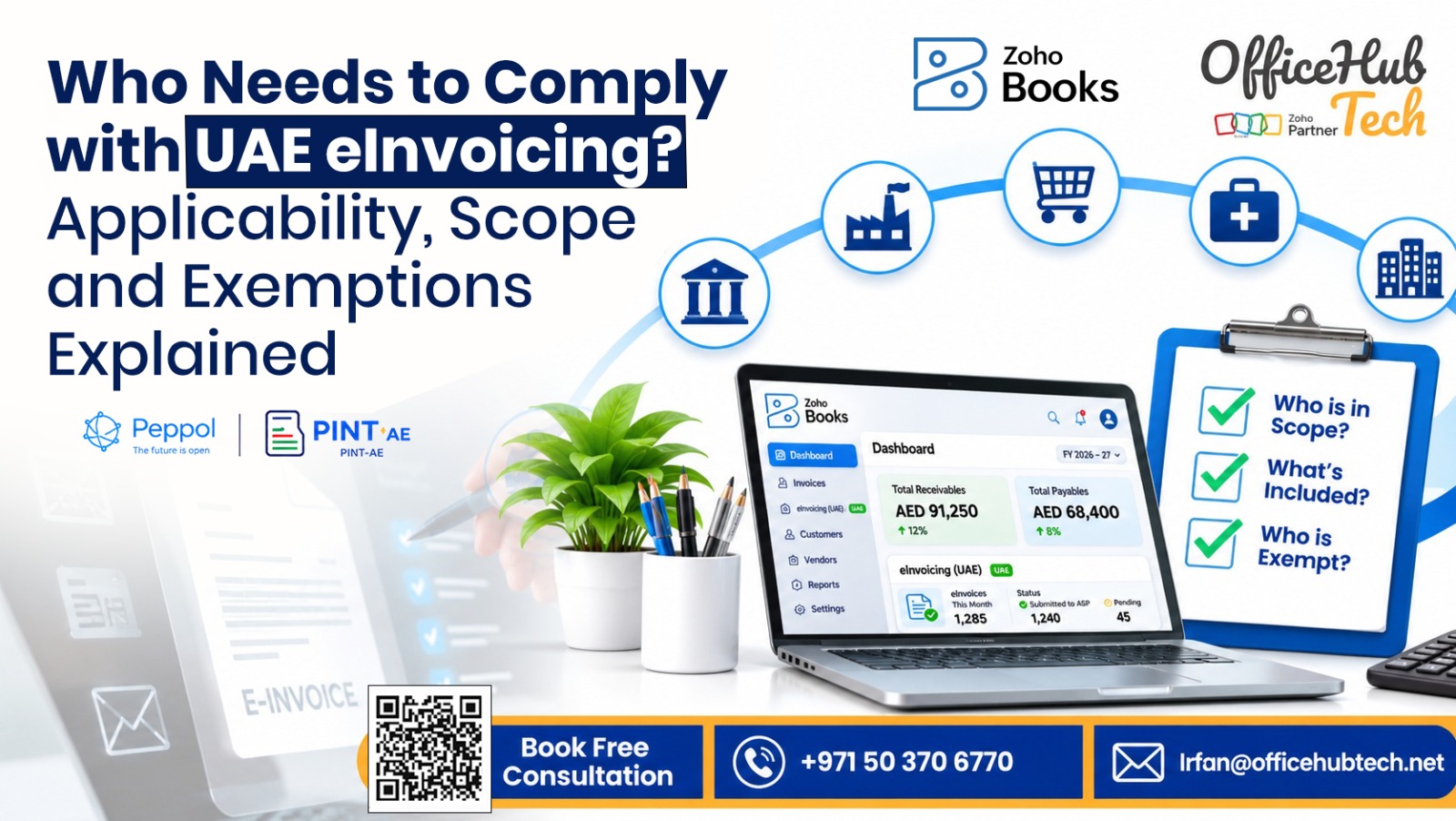
##Quick Answer
Every business conducting business in the UAE must comply with eInvoicing for its B2B and B2G transactions, whether or not it is VAT-registered. That includes free zone companies. The mandatory rollout dates are 1 January 2027 for businesses earning AED 50 million or above, 1 July 2027 for businesses below this revenue threshold, and 1 October 2027 for government entities. B2C sales, sovereign government activities, certain airline services and qualifying financial services are excluded.
##Key Takeaways
- UAE eInvoicing applies to businesses, not only VAT registrants. Non-registered B2B suppliers need an FTA-issued TIN.
- B2B and B2G transactions are covered; B2C is currently excluded.
- The AED 50 million threshold determines implementation phase, not applicability.
- The large-business ASP deadline (30 October 2026) has passed; mandatory go-live remains 1 January 2027.
- Intra-Tax Group transactions are excluded for 24 months from 1 January 2027, but each member must onboard separately using its own TIN.
- PDF invoices are not valid structured eInvoices.
- Non-compliance can attract AED 5,000 monthly, capped at AED 50,000 per 12 consecutive months.
The UAE eInvoicing Mandate, and Why Applicability Comes First
Most finance teams we speak to don’t start with XML schemas or Peppol. They start with a simpler question: does this even apply to us? The honest answer is that it applies to more businesses than most people expect.
The UAE is replacing paper, email and PDF invoices with structured electronic invoices. These are exchanged between businesses through Accredited Service Providers (ASPs) and reported to the Federal Tax Authority (FTA) in near real time. The regulatory framework is established under Ministerial Decision No. 243 of 2025, which defines the UAE eInvoicing system, and Ministerial Decision No. 244 of 2025, which outlines its implementation requirements. Both were amended during 2026.
Applicability shapes every later decision:
- Your phase decides when you must appoint an ASP.
- Your transaction mix decides which invoices go through the network.
- Your group structure can affect how many entities need onboarding, and whether intercompany invoices get temporary relief.
Get these wrong and you either rush an integration months early, or miss a deadline you didn’t know applied to you.
This guide covers who is in scope, which transactions are covered, the revenue threshold and timeline, the exclusions, and what businesses on the edge of scope should do. If you already know you’re in scope, our guide to UAE eInvoicing implementation covers the ERP, ASP and Peppol side.
Who Needs to Comply with UAE eInvoicing?
The framework covers any person conducting business in the UAE, unless a specific exclusion applies. Your business activities and the type of customers you serve are the key factors. Your VAT certificate and licence type don’t decide it.
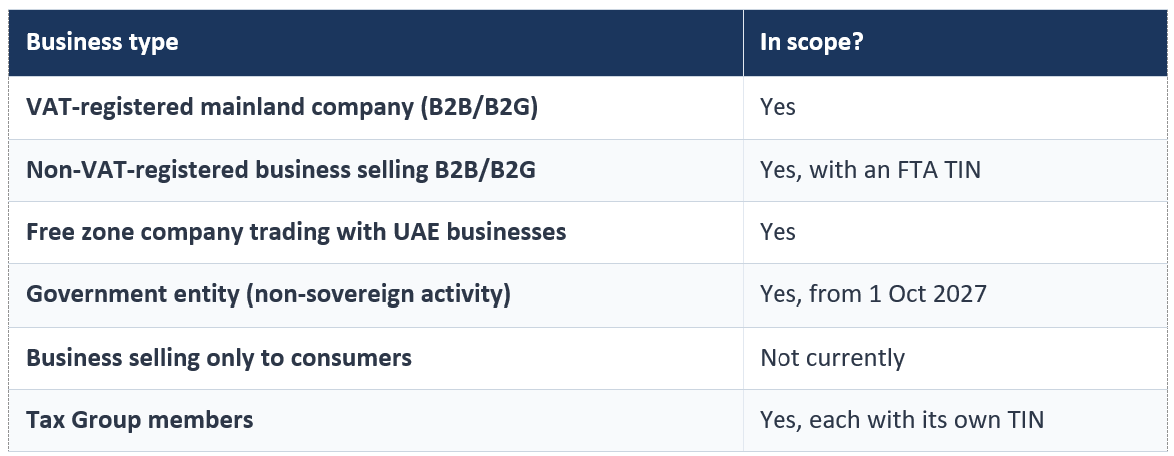
VAT-Registered Businesses
If your company is registered for UAE VAT and issues tax invoices or tax credit notes to corporate or government buyers, you are squarely within the mandate. Once your implementation phase begins, every in-scope tax invoice and credit note must be issued and exchanged in the prescribed electronic format.
Businesses That Aren’t VAT-Registered
This is where many SMEs get caught out. Earning below the AED 375,000 VAT registration threshold doesn’t take you out of eInvoicing. If you invoice other businesses or government, your commercial invoices and commercial credit notes fall inside the framework. According to MoF guidance, an in-scope person who isn’t registered for a tax type must register with the FTA to get a Tax Identification Number (TIN) for eInvoicing.
Mainland and Free Zone Companies
Operating under a free zone licence—whether in JAFZA, DMCC, DIFC, ADGM, RAKEZ, or a designated zone—does not grant an automatic exemption. If a Dubai free zone trading company sells equipment or services to another UAE business, those B2B transactions are subject to the exact same eInvoicing rules as a mainland LLC.
Government Entities
Government bodies are covered on their own timeline, with go-live on 1 October 2027. Activities carried out in a sovereign capacity that don’t compete with the private sector are excluded.
Tax Groups and Branches
A Tax Group files one VAT return, but the FTA requires each member to onboard separately with its own TIN and Peppol participant identifier. A branch that is part of the same legal entity uses its head office’s TIN.
What’s in Scope: B2B and B2G eInvoicing in the UAE
The system covers two document types:
- Electronic invoices, covering tax invoices and commercial invoices
- Electronic credit notes, covering tax credit notes and commercial credit notes
Each one must be issued in the structured UAE format and sent through an ASP, with tax data reported to the FTA at the same time. The Ministry of Finance says plainly that PDFs, Word files, images, scanned copies and emails are not eInvoices.
B2B and B2G Transactions
Business-to-business (B2B) transactions form the primary focus of the mandate. A distributor supplying a retail chain, a consultancy billing a corporate client, a facilities company invoicing a building owner, or anyone issuing a credit note to a business customer is in scope. B2G supplies are in scope too, including supplies made through government procurement portals. MoF guidance also lists G2B and G2G transactions as in scope.
Your obligation as a supplier doesn’t wait for your customer. Once your go-live date arrives, you can’t hold back eInvoicing because a buyer hasn’t onboarded with an ASP yet. Work with your ASP on the buyer-identification and transitional rules in the guidelines instead.
B2C Transactions
B2C sales to individuals acting in a personal capacity are outside the framework for now. A business that sells only to consumers isn’t covered until the Minister sets a future date. Few businesses are purely B2C, though. A restaurant’s dine-in receipts are excluded, but an invoice to a company for event catering is in scope.
Receiving eInvoices
Compliance also covers receiving. In-scope businesses get supplier invoices through their own ASP, so you need a working receiving channel as well as a sending one.
The Phased Rollout: Revenue Threshold and Deadlines
Your revenue decides your phase:
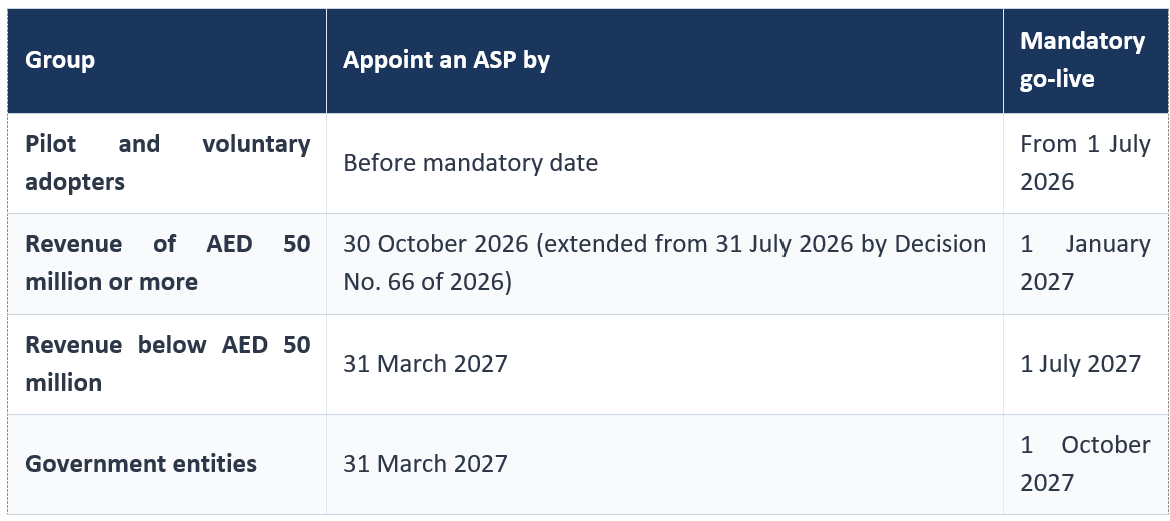
If you’re in the first group and still haven’t appointed an ASP, you’ve missed the deadline. Under Cabinet Decision No. 173 of 2026, not appointing an ASP counts as failing to implement the system, so it should be your first priority this week.
For everyone else, voluntary adoption is worth considering. Businesses that start early aren’t penalised before their mandatory date, so a phase 2 company can test its setup with a few customers months ahead of July 2027.
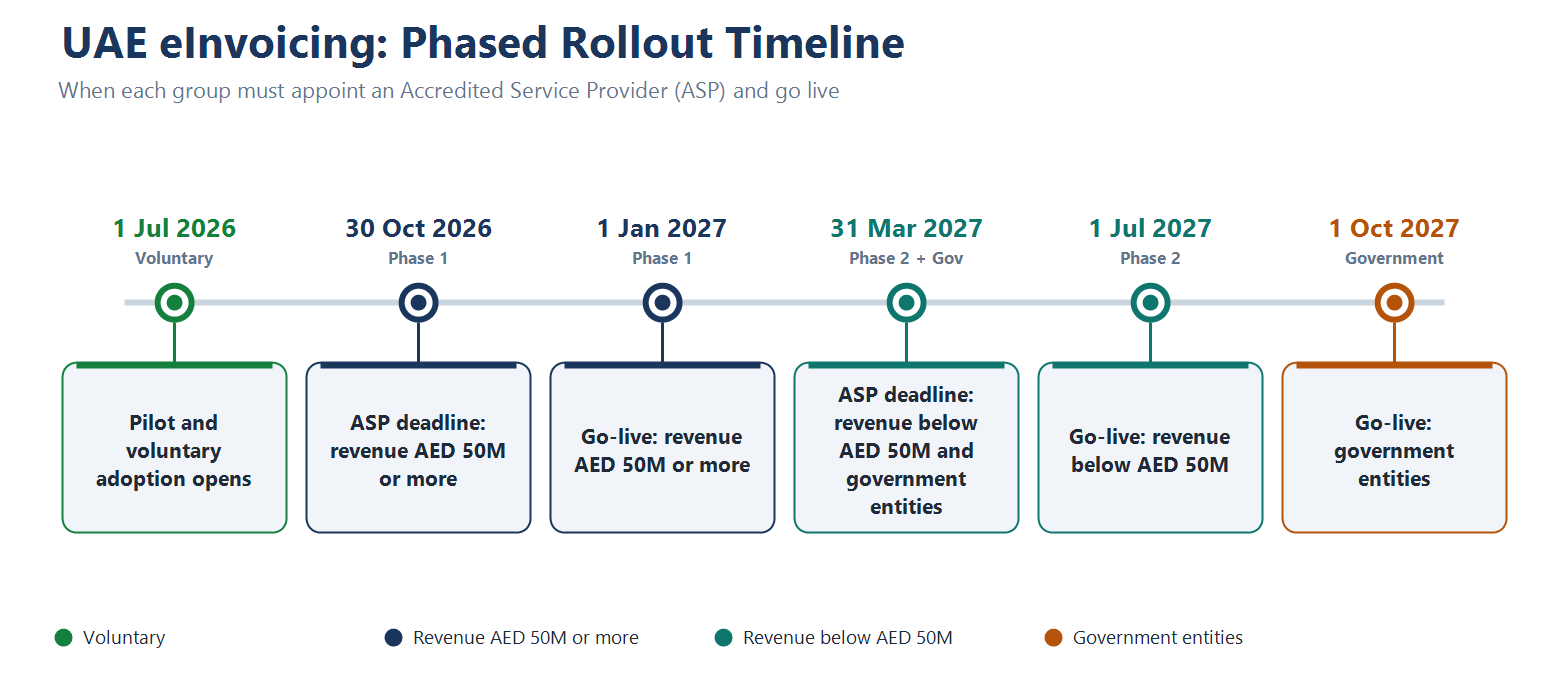
[Fig: UAE eInvoicing Phased Timeline UAE eInvoicing phased timeline showing ASP appointment deadlines and go-live dates for businesses above and below AED 50 million and for government entities]
How to Work Out Revenue for the AED 50 Million Threshold
Ministerial Decision No. 244 of 2025 defines Revenue as the gross income a person earned during its most recent Accounting Period, based on financial statements prepared under UAE law. If those statements aren’t available, other documentation acceptable to the FTA is used instead. It’s gross income, not VAT-taxable supplies, so don’t use your VAT return figure as a shortcut.
Some situations need extra care.
Close to the Line
If revenue sits between roughly AED 40 and 50 million and is growing, plan on the phase 1 timeline. Being ready early costs far less than integrating under penalty pressure.
Pay close attention to four edge cases when measuring your threshold:
- Borderline revenue (AED 40M–50M): If your latest audited accounts sit just under AED 50 million or your current year is tracking above it, prepare on the Phase 1 schedule. Finishing your setup a few months early costs far less than rushing an integration under penalty pressure.
- Multi-entity groups and subsidiaries: The AED 50 million test applies per legal Person, not on a consolidated group basis. A subsidiary with AED 18 million in revenue does not automatically get pulled into Phase 1 just because its parent company earns AED 120 million—nor can a large subsidiary hide behind a smaller sister company. Evaluate every legal entity individually.
- Newly incorporated businesses: If a newly formed entity has not yet completed its first financial accounting period, consult a UAE tax adviser to confirm its applicable timeline rather than guessing.
- Large B2C businesses with minor B2B sales: If a retail chain earns AED 200 million exclusively from individual shoppers, its B2C sales remain excluded. However, if that same chain generates even a small volume of corporate B2B invoicing, its entity-wide revenue puts those B2B transactions into Phase 1.
Document your threshold calculation—noting which financial statements, accounting period, and revenue line you used—so you have a clear audit trail if the FTA ever requests verification.
Groups and Subsidiaries
The threshold applies to each legal person. A AED 18 million subsidiary isn’t pulled into phase 1 because its parent earns AED 120 million, and a large subsidiary can’t follow a smaller sister company’s timeline. Assess each entity on its own.
New Businesses
If an entity doesn’t have financial statements yet, the decision allows revenue to be shown through other documentation acceptable to the FTA. Agree with your tax adviser which documents you’ll rely on, and keep them on file.
Large, Mostly B2C Businesses
A retail chain earning AED 200 million from shoppers doesn’t eInvoice those B2C sales. If it also bills corporate customers, those B2B invoices follow the phase 1 dates.
Keep a short record of the assessment: which financial statements, which figure, which period. If the FTA asks why you followed a particular timeline, that’s your answer.
UAE eInvoicing Exemptions: What’s Excluded
Article 4 of Decision No. 243 of 2025, as superseded by Decision No. 197 of 2026, lists the excluded transactions. Exclusions apply transaction by transaction. A business with one excluded activity can still have plenty of in-scope invoices.
Standing Exclusions:
Sovereign Government Activities
These are excluded only when all three conditions are met: the supply is made by a government entity, it acts in a sovereign capacity, and the activity doesn’t compete with the private sector. A government-owned company trading commercially stays in scope.
International Passenger Airline Services
International passenger transport by aircraft is excluded where an Electronic Ticket is issued. Related ancillary services to passengers are excluded where an Electronic Miscellaneous Document is issued. Corporate charters and other B2B contracts that fall outside those conditions remain in scope.
Certain Financial Services
The decision excludes financial services that are exempt from VAT under Article 42 of the VAT Executive Regulation, as well as qualifying exempt financial services supplied to non-residents that are zero-rated under Article 31. Financial services charged at the standard 5% rate, such as many fee-based services, aren’t covered by this exclusion and stay in scope. Banks, exchange houses and fintechs need to tell the two apart in their billing systems.
B2C Sales
Sales to consumers, and businesses that make only B2C supplies, are outside the system until a future date.
Temporary Exclusions:
International Air Cargo
International goods transport by an airline where an Airway Bill is issued is excluded only for 24 months from the date the Electronic Invoicing System becomes effective. Freight forwarders and logistics firms should check that the supplier, service and documents actually meet the conditions before treating invoices as excluded.
Transactions Within a Tax Group
Decision No. 197 of 2026, announced by the Ministry of Finance on 19 October 2026, excludes transactions between members of the same Tax Group for 24 months from 1 January 2027, until 31 December 2028. It applies only to registered Tax Groups, not to informal sister companies or related parties.
VAT Invoice Concessions Are Not eInvoicing Exclusions
VAT invoicing concessions, such as simplified tax invoices, are a separate framework. The MoF treats them separately, so they don’t make an invoice exempt from eInvoicing.
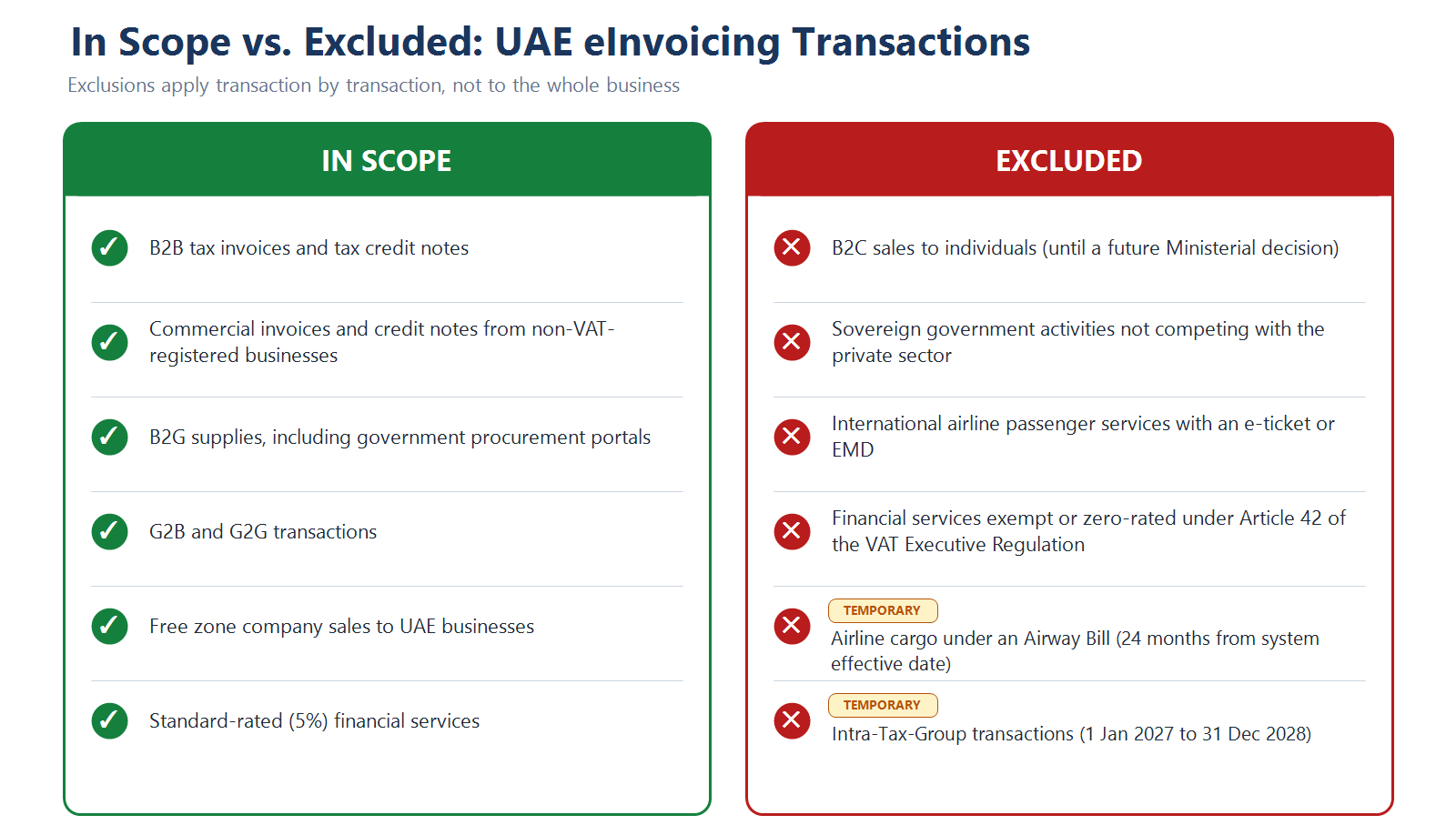
[Table: In-Scope vs. Excluded Transactions: Comparison of UAE eInvoicing in-scope transactions and excluded transactions, including B2C, sovereign, airline, financial services and intra-Tax-Group supplies.]
What Excluded and Partly Excluded Businesses Still Need to Do
An exclusion seldom means there’s nothing to do.
If your outgoing sales are mostly excluded, you still buy software, legal services and supplies from in-scope vendors, and their invoices will reach you through the network. Mixed businesses need their ERP or accounting system to tag each customer and transaction type, so in-scope invoices go to the ASP and excluded ones don’t.
Tax Groups should treat the 24-month window as preparation time. Every member still has to onboard individually before its own go-live date, and intercompany invoices come into scope from 1 January 2029. Use the time to tidy intercompany master data.
Excluded businesses can also opt in voluntarily. Some do so they run one invoicing process instead of two. Retail, hospitality and e-commerce businesses should also expect the B2C exclusion to end eventually, and build structured data into their plans now.
“Do I Need to Comply?” Decision Checklist
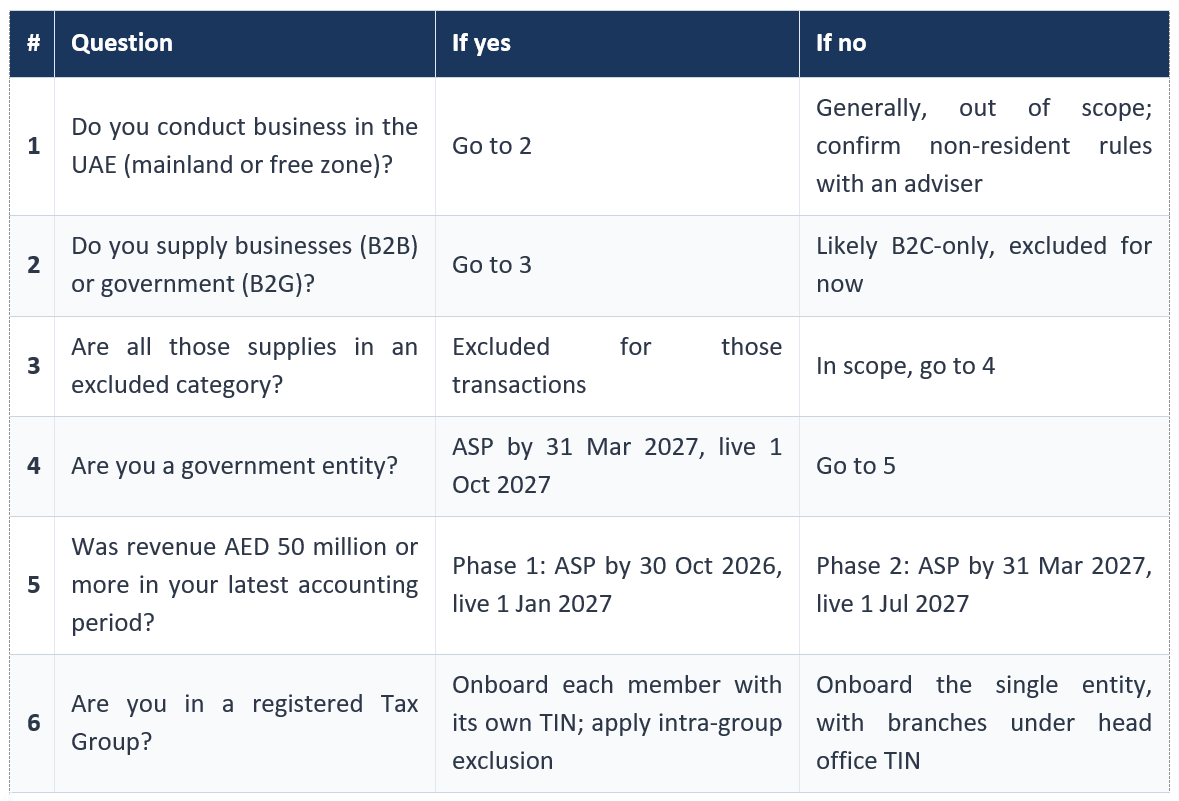
Note: If a step is unclear, plan as if you’re in scope until you’ve confirmed otherwise.
The Technical Side: Peppol, ASPs, PINT AE and FTA Reporting
Once you know you’re in scope, the next question is what your systems need to do.
How the 5-Corner Model Works
The UAE uses a decentralised continuous transaction control and exchange (DCTCE) model, known as the 5-corner model:
- Corner 1, the supplier, sends invoice data from its ERP or accounting system to its ASP.
- Corner 2, the supplier’s ASP, validates it, converts it into PINT AE, sends it to the buyer’s ASP, and reports a Tax Data Document to the FTA.
- Corner 3, the buyer’s ASP, validates the invoice, delivers it to
- Corner 4, the buyer, and reports to the FTA.
- Corner 5, the FTA, receives tax data from both sides. Status messages flow back so each party knows the invoice was delivered and reported.
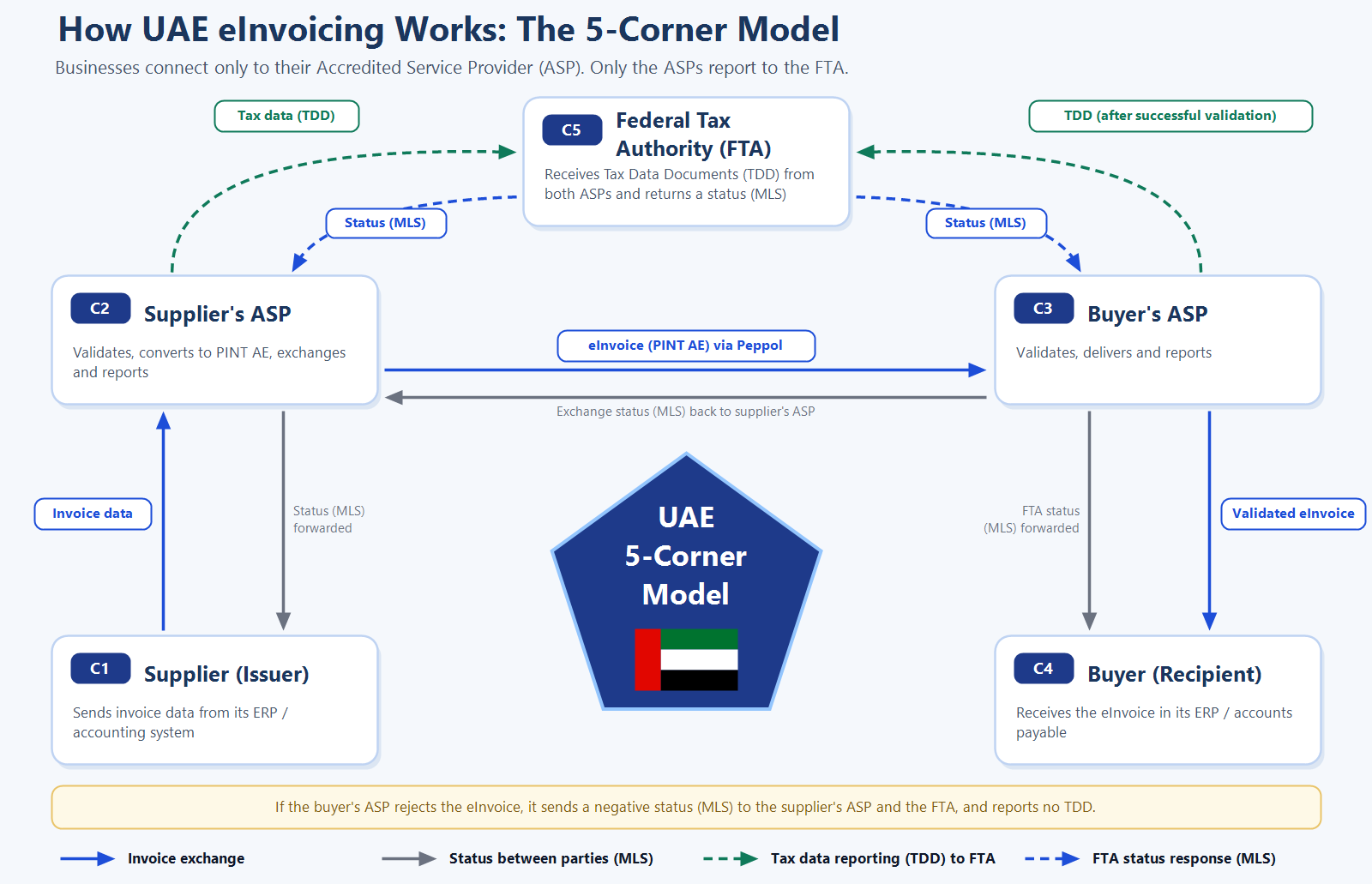
[UAE 5-corner DCTCE eInvoicing model showing supplier, accredited service providers, buyer and FTA reporting.]
What PINT AE Means for Your ERP
PINT AE is the UAE’s localized version of the Peppol International invoice specification. It defines how electronic invoices must be structured and exchanged. Compliant invoices need to contain structured XML data with key details such as supplier and buyer TINs or TRNs, tax category codes, currency, line items and payment information.
A PDF created in Word, Excel or an older accounting system does not qualify as a compliant eInvoice. The same applies to scanned copies and emailed images. The invoice data must follow the PINT AE format and be exchanged through an Accredited Service Provider (ASP), which validates the information, handles its conversion where needed, sends it through the Peppol network and reports the relevant tax data to the FTA.
Appointing an ASP does not make the provider responsible for your business’s invoice data. If your ERP contains missing TINs or TRNs, incorrect tax mappings or incomplete addresses, the ASP may reject the invoice before it reaches your customer, delaying billing and payment. Your ERP or accounting system must be ready to capture and maintain accurate information. For a closer look at how invoices move through this process, read our guide to the UAE eInvoicing 5-corner model.
The Role of Accredited Service Providers (ASPs) in UAE eInvoicing
An Accredited Service Provider (ASP) is a technology provider officially vetted and certified by the UAE Ministry of Finance to validate, convert, transmit, and report electronic invoices across the Peppol network. Every in-scope business must contract an accredited ASP to send and receive compliant eInvoices.
Before signing with a provider, finance and IT leaders should check seven practical criteria:
- Official MoF Accreditation: Confirm the provider’s legal entity is actively listed on the Ministry of Finance’s official ASP register.
- Native ERP & Accounting Compatibility: Check whether the ASP offers pre-built connectors or documented APIs for your current finance system (such as Zoho Books, SAP, Oracle, Microsoft Dynamics, or NetSuite).
- Validation & Error-Handling Visibility: Ensure your billing team gets clear, plain-English alerts—not cryptic XML error logs—when an invoice fails validation.
- Inbound & Outbound Coverage: Verify seamless handling of tax invoices, commercial invoices, credit notes, and incoming supplier bills.
- Security & Data Governance: Review encryption standards, role-based access controls, and long-term audit archiving.
- Local UAE Implementation Support: Confirm the provider or its implementation partner understands UAE FTA tax rules, not just generic European Peppol setups.
- Transparent Volume Pricing: Compare per-document fees, setup charges, and scalability as your invoice volume grows.
Zoho as an Accredited Service Provider
Zoho Software Trading LLC is an MoF-accredited eInvoicing ASP (accreditation number 121988). Pairing Zoho Books as your accounting system with Zoho’s accredited ASP capabilities covers PINT AE validation, Peppol exchange, and FTA reporting in one unified ecosystem—so you don’t need extra middleware
Common Misconceptions About UAE eInvoicing Applicability
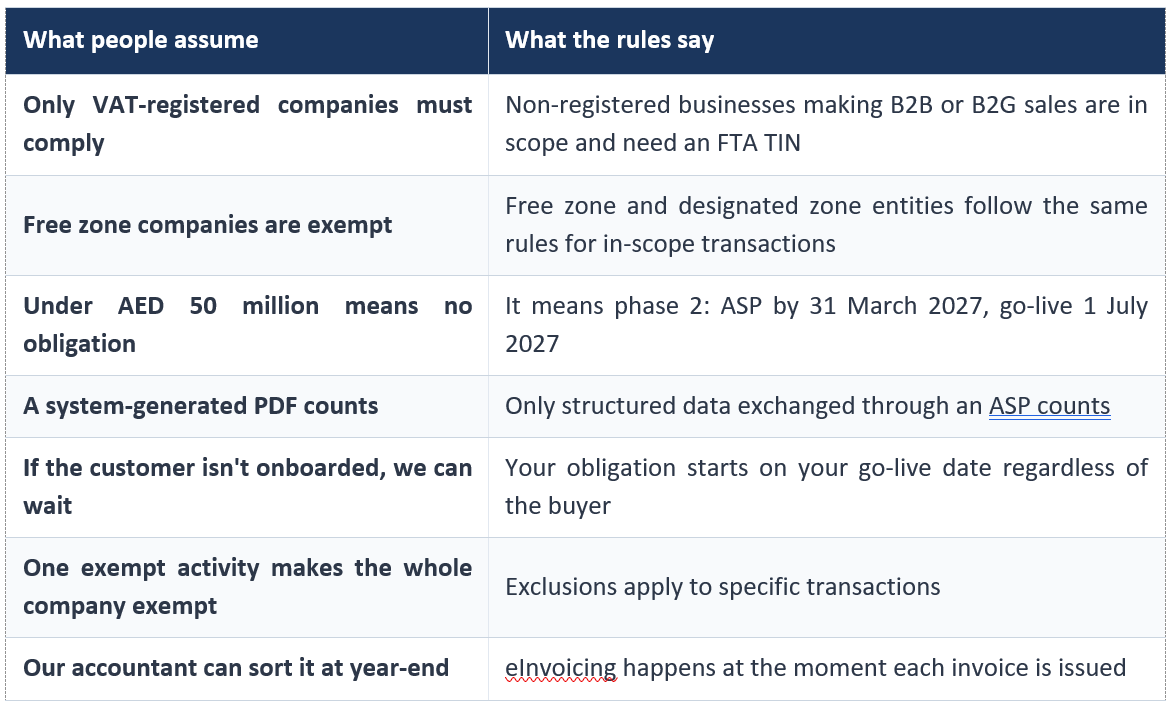
Penalties and Compliance Risks
Cabinet Decision No. 173 of 2026 replaced the earlier penalty rules under Cabinet Decision No. 106 of 2025.
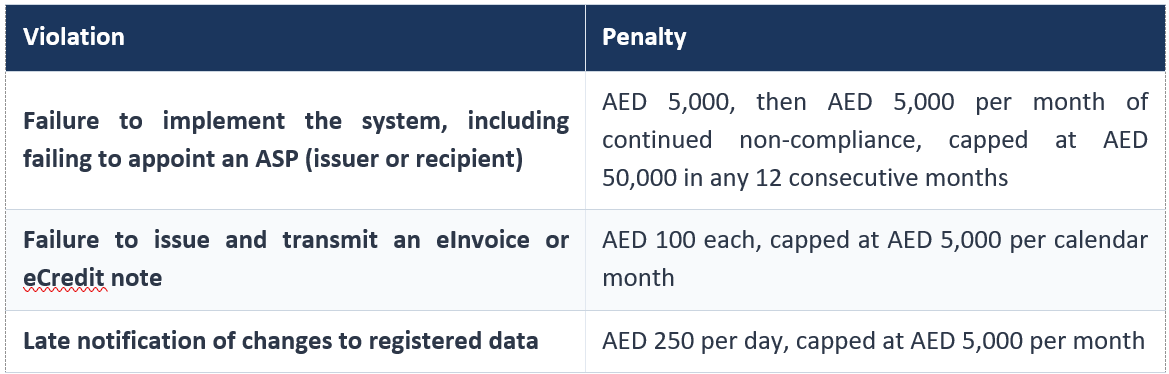
Decision No. 197 of 2026 also removed two earlier requirements: notifying the FTA of a system failure within two business days, and storing eInvoice data inside the UAE. Where the same party would be fined as both issuer and recipient for one violation, only one penalty applies.
Fines are only part of the risk. As corporate and government buyers move to automated payables, invoices sent outside the network may be rejected, and payment waits until a valid eInvoice arrives. For many businesses, that hit to cash flow will hurt more than the fines.
What Changed in 2026: A Quick Recap
The rules moved several times during 2026. If you’re planning from a 2025 summary, check it against these changes:
- May 2026, Ministerial Decision No. 66 of 2026: extended the ASP appointment deadline for businesses earning AED 50 million or more from 31 July to 30 October 2026. Their go-live date remained 1 January 2027.
- 19 October 2026, Ministerial Decision No. 197 of 2026: excluded intra-Tax-Group transactions for 24 months from 1 January 2027, and removed the system-failure notification and UAE data storage requirements.
- 26 October 2026, UAE Electronic Invoicing Guidelines Version 2.0: updated the MoF guidance to reflect the new deadlines and onboarding rules.
- November 2026, Cabinet Decision No. 173 of 2026: replaced the earlier penalty rules with the capped amounts shown above, and stopped the same party being fined twice for one violation.
The group-wise go-live dates remain the same: 1 January 2027 for businesses earning AED 50 million or above, 1 July 2027 for smaller companies, and 1 October 2027 for government entities.
Next Steps for In-Scope Businesses
- Record your applicability decision for each legal entity.
- Appoint an ASP. This deadline has passed for phase 1, while phase 2 must be completed by 31 March 2027.
- Clean master data, especially customer TINs and TRNs, addresses and tax codes.
- Map invoice fields against the MoF’s mandatory field requirements.
- Test with real invoices, credit notes and rejections.
- Train your billing team on corrections and rejected invoices.
- Go live early if you can, while there’s no penalty exposure.
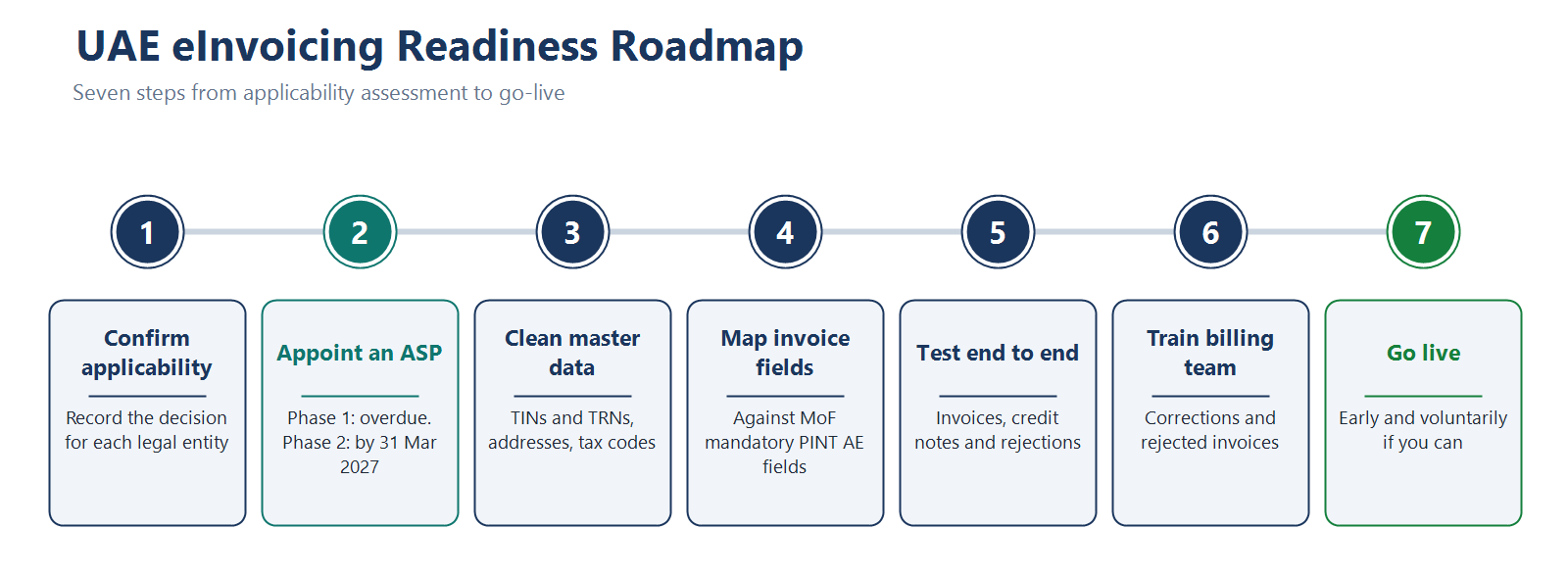
[Image 5: UAE eInvoicing Readiness Roadmap- Seven-step UAE eInvoicing readiness roadmap from applicability assessment to go-live.]
Conclusion
Most UAE businesses selling to other companies or government entities must comply with eInvoicing, including SMEs, free zone firms, and non-VAT-registered businesses. Rather than turnover, licence type, or VAT status, your transaction mix and narrow statutory exclusions determine what falls in scope, while the AED 50 million threshold sets your implementation phase. Tax Groups receive two years of relief on intercompany invoices from 1 January 2027 to 31 December 2028, though every member still needs its own TIN and individual onboarding.
A clear assessment of your legal entities, B2B and B2G transactions, consumer sales, exclusions, and invoice workflows gives you a much stronger foundation before touching accounting or ERP settings. Confirming your exact obligations first—and aligning your ASP, accounting platform, and finance team early—helps prevent last-minute rework and payment delays. Partnering with a team offering end-to-end UAE eInvoicing implementation support lets you settle your applicability and configure your systems in one connected step.
How Office Hub Tech Can Help
As an Authorized Zoho implementation and consultation partner and e-invoicing solution provider in UAE, Office Hub Tech helps businesses get from “does this apply to us?” to a working eInvoicing setup, without replacing the systems they already use.
We begin with an applicability assessment. We look at your legal entities, revenue, Tax Group structure and transaction mix, and give you a written answer on your phase, deadlines and which invoices are in scope. From there, we coordinate ASP onboarding, including Zoho, which is on the MoF’s accredited list, so your Peppol participant ID and routing are set up correctly.
For Zoho Books users, we configure the platform, clean customer and supplier data, separate excluded transactions, and map every PINT AE field. If you run another ERP or accounting system, we build the integration between that system and your chosen ASP. Beyond compliance, we help UAE businesses with custom integrations and AI-powered finance automation, such as validation alerts, credit-note approvals, exception tracking and reconciliation, so the compliance work also cuts manual effort for your finance team.
Unsure of your phase, or your deadline is close? Book a call with our expert team and we’ll go through your setup with you.
Simplify Your Accounting and Prepare for UAE eInvoicing with Zoho Books
Bring your invoicing, customer details, tax configurations, and financial records under one roof. Backed by Zoho’s status as an MoF-accredited ASP, Zoho Books lets you modernize your day-to-day bookkeeping while laying the groundwork for seamless eInvoicing integration.
Start building your accounting setup today:
Streamline your finance workflows now so your business is ready well ahead of your UAE eInvoicing deadline.