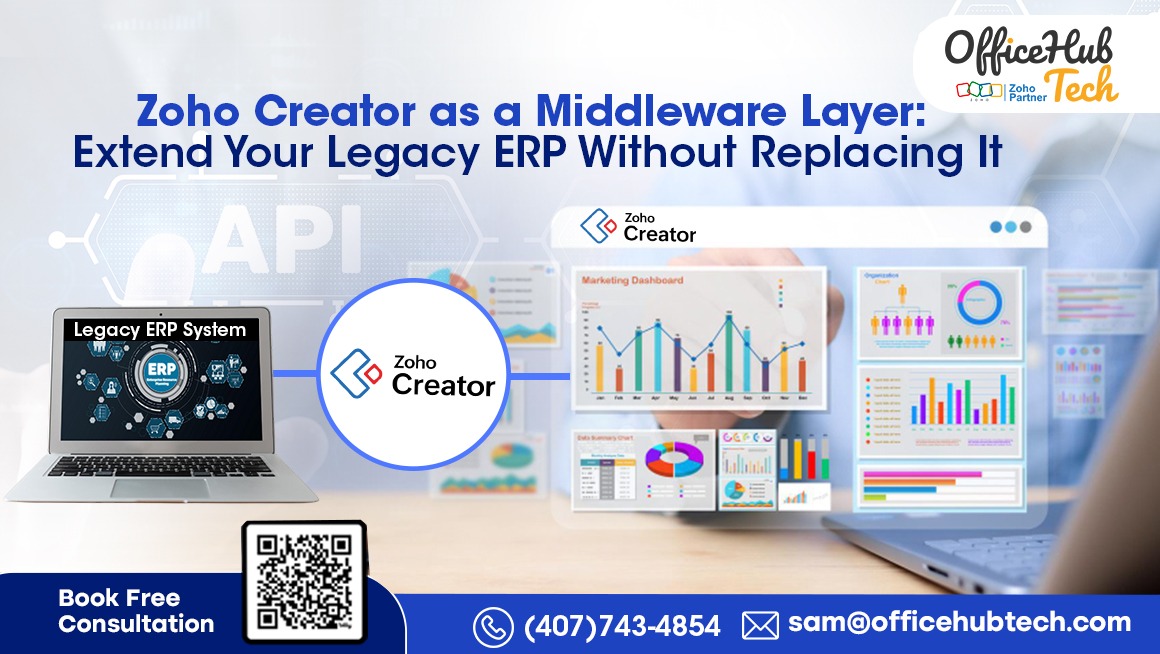
Zoho Creator as a Middleware Layer: Extend Your Legacy ERP Without Replacing It
Why ERP Modernization No Longer Means Replacement
For years, ERP modernization has been treated as a replacement problem. When systems like SAP, Infor, or Acumatica start showing limitations, the default approach has often been to consider migrating to a new ERP platform.
However, this approach is no longer practical for many organizations.
Legacy ERP systems still serve as the backbone of business operations. They manage finance, supply chain, inventory, and critical transactional data built over years. Replacing them entirely involves significant cost, long implementation cycles, and operational disruption—making it a high-risk strategy.
At the same time, modern business demands have evolved. Organizations now need real-time integrations, cloud-ready applications, automation, and AI-driven insights—capabilities that traditional ERP systems were not originally designed to support.
This creates a gap.
Instead of replacing ERP systems, forward-thinking organizations are now shifting toward a more strategic approach—extending and modernizing existing ERP environments.
This is where the concept of a middleware layer becomes essential.
Zoho Creator for ERP extension enables businesses to modernise legacy ERP systems without replacing them
And increasingly, Zoho Creator is emerging as that middleware layer, helping organisations extend legacy ERP with Zoho Creator while enabling modernisation and scalability.
Understanding the Role of Middleware in Modern ERP Systems
As organizations move toward digital-first operations, their technology landscape becomes more complex. ERP systems are no longer the only source of truth—they now coexist with CRM platforms, analytics tools, automation systems, and cloud applications.
The challenge is not just managing these systems, but making them work together seamlessly.
This is where middleware comes into the picture.
In simple terms, middleware acts as a bridge. It connects different systems, allows them to exchange data, and ensures that workflows can run across platforms without friction. Instead of forcing every system to integrate directly with the ERP, middleware creates a central layer that manages these interactions.
For legacy ERP systems, this becomes especially important.
Platforms like SAP, Infor, and Acumatica were designed to operate as centralized systems. While they are powerful, they are not inherently built for today’s API-driven, cloud-connected environments. Integrating them with modern tools often requires complex development or manual workarounds.
A middleware layer simplifies this.
It enables businesses to:
- connect ERP systems with modern applications through APIs
- access ERP data in real time without complex queries
- automate workflows across departments and tools
- reduce dependency on heavy ERP customization
This makes it easier for organisations focused on modernising legacy ERP systems using Zoho Creator to build flexible and connected architectures.
More importantly, it allows organizations to extend the capabilities of their ERP systems without changing the core system itself.
This shift—from tightly coupled systems to a more flexible, middleware-driven architecture—is becoming a key foundation for modern ERP strategies.
And this is exactly where platforms like Zoho Creator begin to play a much bigger role.
What Happens When ERP Systems Operate Without a Middleware Layer
For many organizations, the limitations of legacy ERP systems don’t appear all at once—they show up gradually, in everyday operations.
It often starts with small inefficiencies.
A sales team needs real-time inventory data but has to request it from operations. Finance teams wait for reports because data needs to be exported and consolidated manually. Operations teams rely on spreadsheets to bridge gaps between systems that don’t communicate with each other.
Over time, these small gaps turn into larger challenges.
Without a middleware layer, ERP systems tend to operate in isolation. While they manage core processes effectively, they struggle to connect with modern tools such as CRM platforms, analytics systems, or automation workflows. As a result, businesses end up creating parallel systems—each solving a specific problem, but none truly integrated.
This leads to fragmented data.
Different teams begin working with different versions of information. Reports don’t always match. Decision-making slows down because leaders cannot rely on a single, consistent view of the business.
To compensate, organizations often introduce manual processes.
Data is exported, modified, and re-uploaded. Teams spend hours maintaining consistency across systems. Not only does this reduce productivity, but it also increases the risk of errors.
Then comes the integration challenge.
Connecting legacy ERP systems to modern applications without a middleware layer often requires custom development. These integrations are expensive, difficult to maintain, and rarely scalable. Every new requirement adds another layer of complexity.
Eventually, innovation slows.
When every new initiative—whether it’s automation, analytics, or customer experience—depends on complex ERP changes, organizations begin to delay or avoid transformation altogether.
This is the tipping point.
What started as a stable ERP environment becomes a bottleneck for growth.
And this is why more organizations are now recognizing the need for a smarter approach—one that allows them to extend and modernize ERP systems without being constrained by their limitations.
That approach begins with introducing a middleware layer.
Zoho Creator as a Middleware Layer for Legacy ERP Systems
With Zoho Creator ERP modernisation and extension, businesses can extend legacy ERP systems while building modern applications on top of existing data.
Once organizations recognize the need for a middleware layer, the next question becomes: what should that layer look like?
It needs to be flexible enough to integrate with legacy ERP systems, simple enough to build applications quickly, and powerful enough to handle automation, data flow, and scalability.
This is where Zoho Creator stands out.
Instead of treating ERP as something to replace or heavily modify, Zoho Creator sits on top of existing ERP systems as a middleware layer—connecting, extending, and modernizing them without disrupting core operations.
At its core, Zoho Creator allows businesses to interact with ERP data in a completely new way.
Rather than being limited to traditional ERP interfaces, organizations can build custom applications that connect directly to their ERP systems. These applications can be designed for specific use cases—whether it’s dashboards for leadership teams, mobile apps for field operations, or automated workflows for internal processes.
This changes how ERP systems are used.
They no longer remain isolated back-end systems. Instead, they become part of a broader, connected ecosystem where data flows seamlessly across applications.
Through Zoho Creator legacy ERP integration, businesses can connect ERP platforms like SAP, Infor, or Acumatica with modern tools such as CRM systems, analytics platforms, and automation engines.
This creates a unified environment where:
-
data moves in real time across systems
-
workflows are automated across departments
-
applications are built around business needs—not system limitations
Another key advantage is that all of this happens without modifying the core ERP system.
Zoho Creator acts as an extension layer, meaning organizations can continue using their ERP for what it does best—managing core operations—while using Zoho Creator to handle flexibility, innovation, and user experience.
This approach allows businesses to modernize incrementally.
Instead of large, risky transformation projects, they can build and deploy applications step by step—improving processes, integrating systems, and unlocking new capabilities over time.
In this model, ERP remains the foundation.
Zoho Creator becomes the layer that brings it to life in a modern, connected, and scalable way.
What Zoho Creator Enables as a Middleware Layer
Once Zoho Creator is positioned as a middleware layer, its real value becomes visible in how it reshapes everyday business operations.
It’s not just about connecting systems—it’s about making those systems work together intelligently.
One of the first changes organizations notice is how easily data begins to move across platforms. Instead of being locked inside ERP databases, information becomes accessible in real time across applications. Teams no longer have to wait for reports or rely on manual data transfers. The right data is available where it’s needed, when it’s needed.
This naturally leads to better visibility.
Leadership teams can access live dashboards built on ERP data. Operations teams can track processes without switching between systems. Decision-making becomes faster because it is based on up-to-date, consistent information.
Another major shift happens in how workflows are managed.
With Zoho Creator, processes that once required manual coordination—approvals, updates, notifications—can now be automated across systems. For example, an action in the ERP system can trigger workflows in other applications, ensuring that tasks move forward without delays.
This reduces operational friction.
Teams spend less time managing processes and more time focusing on outcomes.
At the same time, Zoho Creator introduces a new level of flexibility.
Organizations can build custom applications tailored to their specific needs—without being constrained by ERP limitations. Whether it’s a vendor portal, a field service app, or an internal operations dashboard, these applications can be developed quickly using low-code tools and connected directly to ERP data.
This is where a low-code platform for ERP extension like Zoho Creator becomes practical.
Instead of waiting months for changes within the ERP system, businesses can build and deploy solutions in weeks—sometimes even days.
Integration also becomes significantly simpler.
This also enables businesses to transform a legacy ERP system to cloud business apps without complex migration
Zoho Creator allows ERP systems to connect with other platforms through APIs, creating a network of applications that work together as a single ecosystem. Whether it’s CRM, analytics, or automation tools, everything becomes part of a connected environment.
And as organizations grow, this model scales with them.
Because Zoho Creator is cloud-based, it supports expanding operations, new applications, and increasing data volumes without requiring major infrastructure changes.
In essence, Zoho Creator transforms ERP from a system of record into a system of engagement—one that actively supports business processes, collaboration, and innovation.
How Businesses Use Zoho Creator as a Middleware Layer
Once Zoho Creator is implemented as a middleware layer, its impact becomes visible across multiple business functions. What was once a disconnected system landscape starts to feel unified, responsive, and easier to manage.
Here’s how different teams begin to experience that shift.
Operations and Supply Chain
Operations teams often deal with delays caused by limited visibility into ERP data. Tracking inventory, orders, or production status typically requires navigating complex ERP interfaces or waiting for updates.
With Zoho Creator, organizations can build real-time dashboards and operational apps connected directly to ERP data. Teams can monitor inventory levels, track order movements, and receive alerts—all from a simplified interface.
This improves coordination across warehouses, suppliers, and internal teams, making operations more responsive and efficient.
Finance and Approvals
Finance departments rely heavily on ERP systems, but processes like approvals, reporting, and reconciliation can still be time-consuming.
Using Zoho Creator as a middleware layer, businesses can automate approval workflows, generate real-time financial dashboards, and streamline reporting processes. Instead of chasing updates or compiling data manually, finance teams can access accurate information instantly.
This not only speeds up operations but also improves accuracy and compliance.
Sales and Customer Management
In many organizations, sales teams work in CRM systems while ERP systems handle orders, billing, and inventory. Without proper integration, this creates gaps in visibility.
Zoho Creator bridges this gap by connecting CRM and ERP data. Sales teams can access real-time inventory, track order status, and view customer transaction history—all within connected applications.
This leads to better customer experiences and more informed sales decisions.
Procurement and Vendor Management
Procurement processes in legacy ERP systems often involve multiple steps and manual coordination. Tracking vendor interactions, approvals, and purchase requests can become cumbersome.
With Zoho Creator, organizations can build vendor portals, automate purchase workflows, and track procurement activities in real time. Vendors can interact directly with the system, reducing delays and improving transparency.
Field Teams and Remote Operations
Field teams often face challenges accessing ERP data outside the office. Traditional ERP systems are not always designed for mobile usage or real-time updates.
Zoho Creator solves this by enabling mobile applications connected to ERP systems. Field teams can update job statuses, access inventory data, and submit reports from anywhere.
This keeps remote operations aligned with core business systems and improves overall productivity.
Across these use cases, organisations can build cloud apps from legacy ERP systems while maintaining stability and continuity.
The Real Business Impact of Using Zoho Creator as a Middleware Layer
When organizations adopt Zoho Creator as a middleware layer, the impact goes beyond just integration—it fundamentally changes how ERP systems support the business.
Instead of being a limitation, ERP becomes a foundation that can be extended, adapted, and evolved over time.
Faster Innovation Without ERP Dependency
One of the biggest shifts is speed.
Businesses no longer have to depend on complex ERP customization for every new requirement. With Zoho Creator, applications and workflows can be built quickly using low-code tools—allowing teams to experiment, adapt, and innovate without delays.
Extending ERP Without Risk
Zoho Creator enables organizations to extend ERP capabilities without touching the core system. This eliminates the risks associated with system changes, upgrades, or full replacements.
ERP continues to run stable operations, while Zoho Creator handles flexibility and innovation.
Connected Systems, Not Isolated Tools
By acting as a middleware layer, Zoho Creator brings systems together.
ERP, CRM, analytics, and other applications become part of a connected ecosystem where data flows seamlessly. This reduces silos and improves collaboration across teams.
Reduced Manual Work and Operational Friction
Automation becomes a natural outcome.
Workflows that once required manual coordination—data entry, approvals, updates—can now run automatically across systems. This reduces errors, saves time, and improves efficiency across the organization.
Real-Time Visibility for Better Decisions
With ERP data accessible through modern applications and dashboards, decision-makers gain real-time insights into operations.
Instead of relying on delayed reports, businesses can respond quickly to changes and make more informed decisions.
A Future-Ready ERP Strategy
Perhaps the most important benefit is long-term flexibility.
By introducing a middleware layer, organizations create an architecture that can evolve over time—supporting new applications, integrations, and technologies without reworking the ERP system.
This approach supports complete legacy system modernisation and extension with Zoho Creator without disrupting core ERP environments
A Smarter Way to Modernize ERP Systems
By adopting Zoho Creator for ERP extension, businesses can extend legacy ERP with Zoho Creator while building scalable, future-ready applications
ERP systems were never designed to do everything—and they don’t need to.
What they do best is manage core business operations and store critical data. The challenge has always been how to extend that value into modern use cases like automation, integrations, and cloud applications.
That’s where the middleware approach changes the game.
By using Zoho Creator as a middleware layer, organizations can build a flexible layer around their existing ERP systems—one that connects applications, automates workflows, and enables real-time data access without disrupting the foundation.
This shift allows businesses to modernize at their own pace.
Instead of large, high-risk transformation projects, they can take an incremental approach—building applications, improving processes, and integrating systems step by step. Over time, this creates a connected, scalable ecosystem that evolves with the business.
And more importantly, it ensures that ERP systems remain relevant in a rapidly changing digital landscape.
Enabling ERP Transformation with the Right Partner
For organizations looking to adopt this approach, having the right implementation partner is critical.
OfficeHub Tech specializes in ERP legacy modernization, Zoho Creator development, and enterprise integrations—helping businesses design middleware-driven architectures that extend and enhance existing ERP systems.
Recognized as the Best ERP Legacy Modernization and Extension Services Provider in USA, India, UAE, and KSA, and a Top Certified Zoho Creator Developer and Zoho Consultation Company, OfficeHub Tech supports organizations in building scalable, future-ready solutions.
As a trusted Zoho Partner and n8n Partner, OfficeHub Tech enables businesses to unlock the full potential of their ERP systems—without replacing what already works.
Frequently Asked Questions (FAQs)
Q1: What is middleware in ERP systems?
Ans: Middleware in ERP systems is a layer that connects the ERP with other applications, enabling seamless data exchange, integration, and workflow automation without modifying the core ERP system.
Q2: How does Zoho Creator act as a middleware layer?
Ans: Zoho Creator acts as a middleware layer by connecting legacy ERP systems with modern applications through APIs. It allows businesses to build custom apps, automate workflows, and access ERP data in real time without replacing the ERP system.
Q3: Can Zoho Creator integrate with SAP, Infor, and Acumatica?
Ans: Yes, Zoho Creator supports integration with major ERP systems such as SAP, Infor, Acumatica, Oracle ERP, and Microsoft Dynamics using APIs, connectors, and custom integration frameworks.
Q4: Why use a middleware layer instead of replacing ERP?
Ans: Replacing ERP systems is costly, time-consuming, and risky. A middleware layer allows businesses to extend and modernize ERP systems without disruption, preserving existing data and processes while adding new capabilities.
Q5: What are the benefits of using Zoho Creator for ERP integration?
Zoho Creator enables:
-
seamless ERP integration with other systems
-
faster application development using low-code
-
workflow automation across departments
-
real-time data access and visibility
-
scalable and cloud-ready applications