##QuickAnswer
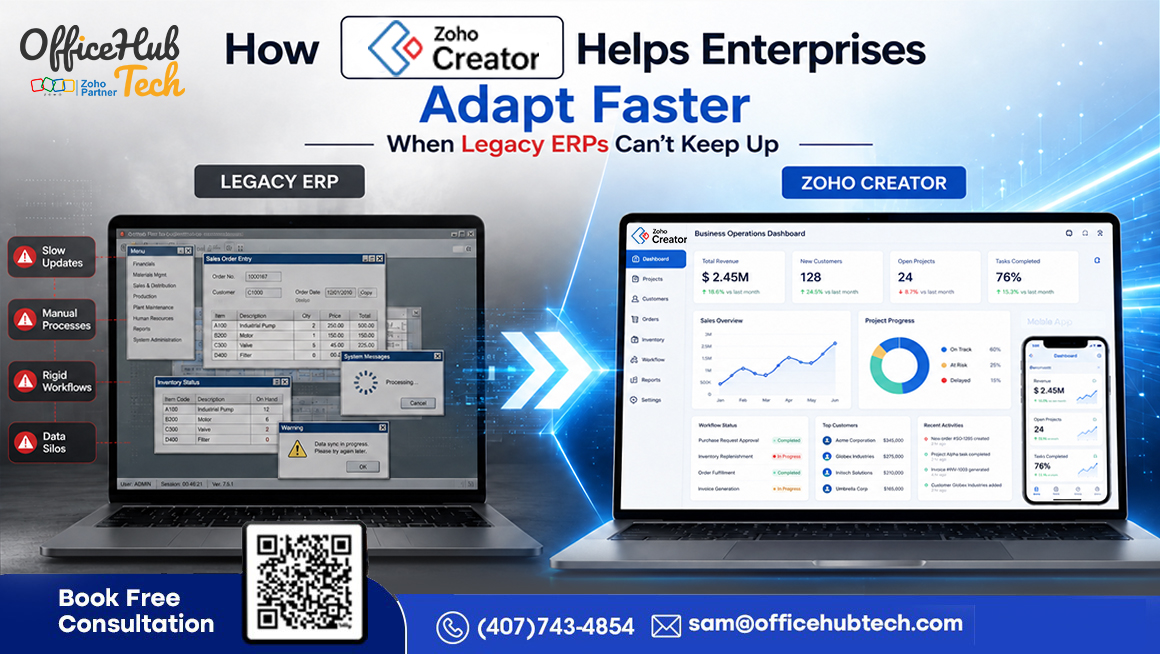
Modern enterprises need technology that keeps pace with business change. While legacy ERP systems remain reliable for core operations, they often struggle to support evolving workflows, customer expectations, regulatory requirements, and digital initiatives. Zoho Creator bridges this gap by extending legacy ERP systems instead of replacing them. Its low-code platform enables businesses to rapidly build custom applications, automate workflows, integrate third-party software, create self-service portals, develop mobile solutions, and deliver real-time dashboards while keeping the ERP as the system of record. This approach helps organizations adapt faster, reduce development time, and maximize their existing ERP investment without the cost and disruption of a full replacement.
##KeyTakeaways
- Low-code business platform manage core operations well but often struggle to meet evolving business needs.
- Business agility depends on quickly deploying new processes, applications, and integrations.
- Zoho Creator extends ERP capabilities with custom apps, automation, APIs, dashboards, mobile apps, and AI-driven workflows.
- ERP extension enables gradual modernization without replacing existing systems or disrupting operations.
- Low-code platforms help organizations adapt faster while reducing complex ERP customizations.
- An experienced Zoho Creator implementation partner delivers scalable, secure, and future-ready ERP extension solutions.
Enterprise Success Today Depends on Adaptability—Not Just a Reliable ERP
For years, enterprise success depended on stable ERP systems that efficiently managed finance, procurement, inventory, manufacturing, and supply chain operations. While reliability remains essential, today’s businesses also need the ability to adapt quickly. Organizations constantly introduce new products, expand into new markets, adopt cloud applications, strengthen compliance, and improve customer experiences—creating demands that many legacy ERP systems weren’t designed to support. Although these systems continue to handle core operations effectively, business innovation now moves faster than traditional ERP development cycles.
As a result, organizations often rely on spreadsheets, disconnected applications, manual approvals, and repetitive data entry to fill functional gaps. Over time, these workarounds become operational bottlenecks that reduce productivity, limit visibility, and slow decision-making.
This is why enterprise leaders are shifting their focus from simply maintaining a reliable ERP to Legacy ERP Extension and Modernization, creating an adaptable business environment around their existing systems.
Instead of asking, “Should we replace our ERP?”, forward-thinking organizations are asking a more strategic question:
“How can we make our existing ERP adapt to changing business needs without disrupting what already works?”
That question has led many enterprises toward Legacy ERP Extension and Modernization—an approach that adds modern capabilities while preserving the stability of core ERP systems.
When Your Business Changes Faster Than Your ERP Can Respond
A common misconception is that legacy ERP systems become obsolete simply because they are old. In reality, many enterprises continue using them because they are stable, secure, and essential to core business operations. The challenge is that business needs now evolve faster than traditional ERP systems can adapt. Modern organizations require digital workflows, mobile applications, SaaS integrations, vendor portals, and other capabilities that often demand costly customizations and lengthy development. As a result, IT backlogs grow, employees rely on spreadsheets and manual processes, and disconnected systems reduce productivity and visibility.
These challenges don’t mean the ERP has failed—they highlight the gap between modern business demands and legacy technology.
Zoho Creator bridges this gap by extending legacy ERP systems instead of replacing them. Its low-code platform enables businesses to rapidly build custom applications, automate workflows, integrate third-party software, create dashboards, and deliver modern user experiences while keeping the ERP as the system of record. This allows organizations to respond to changing business needs in weeks rather than months. Instead of making the ERP handle everything, enterprises can let it manage core operations while Zoho Creator provides the flexibility to innovate, adapt, and scale.
Research Insight: Why Low-Code Is Becoming a Strategic Enterprise Priority
The gap between business requirements and traditional development cycles has made low-code platforms an important part of enterprise modernization. Instead of waiting for lengthy ERP customizations, organizations can rapidly build and update applications around existing systems.
This trend is reflected in the Nucleus Research 2025 Low-Code Technology Value Matrix , which evaluated low-code vendors on usability and functionality. Zoho was recognized as a Leader for its strong application development capabilities.
For enterprises with legacy ERP systems, low-code enables new workflows, applications, automation, and reporting without modifying the ERP core. Platforms like Zoho Creator integrate seamlessly with existing ERP systems, helping organizations adapt faster while keeping core operations stable. The Nucleus Research 2025 Low-Code Technology Value Matrix also provides valuable independent insight into leading low-code platforms.
Why Waiting for the Next ERP Upgrade Is No Longer a Competitive Strategy
ERP upgrades are essential for security, support, performance, and new features, but they don’t solve business adaptability. While upgrades improve the core system, organizations often need new workflows, customer portals, integrations, field applications, or reporting much sooner. Waiting for vendor roadmaps or major ERP customizations can delay innovation and force teams to rely on spreadsheets, emails, and manual processes.
For example, implementing a new supplier approval workflow within a legacy ERP may require complex customization, specialized developers, and extensive testing. The impact goes beyond IT costs—slow adaptation increases administrative work, delays decisions, fragments information, and leaves valuable process improvements stuck in the IT backlog.
That is why enterprises should separate two questions:
Does our core ERP still perform its primary job reliably?
and
Can our business introduce new capabilities as quickly as it needs them?
If the answer to the first question is yes and the second is no, replacing the ERP may be solving the wrong problem.
A Low-code business platform offers another path. Rather than continually modifying the ERP core, organizations can introduce an adaptable digital layer around it. The existing ERP remains responsible for critical transactions and master data, while modern applications handle rapidly changing business requirements.
This is where Zoho Creator ERP Extension becomes particularly relevant. Enterprises can develop custom applications, automate workflows, connect cloud services, and introduce new user experiences without waiting for every requirement to become part of the core ERP.
The result is not simply ERP modernization—it is the ability to change business processes at the speed the business demands.
From ERP Dependency to an Adaptable Enterprise Model
The biggest shift is both architectural and organizational. Instead of expecting one ERP to support every new business requirement, enterprises separate stable core systems from processes that require flexibility.
The legacy ERP continues as the trusted system of record for finance, inventory, orders, customers, suppliers, and other critical data, while Zoho Creator provides a flexible application layer for rapidly evolving business processes.
Instead of asking:
“How much will it cost to customize our ERP?”
organizations can ask:
“Can we build this capability outside the ERP and securely connect it to our existing data?”
This approach accelerates digital transformation. Departments can replace manual processes with custom applications, automate spreadsheet-based tasks, create supplier self-service portals, enable mobile apps for field teams, and build unified dashboards by combining ERP and business data. Organizations can modernize incrementally by improving high-impact processes first while keeping core ERP operations stable. By extending legacy ERP systems with Zoho Creator, businesses gain the flexibility to innovate faster without disrupting existing operations. The next step is understanding how Zoho Creator creates this adaptable extension layer around legacy ERP systems.
How Zoho Creator Becomes the Enterprise Adaptation Layer
Once enterprises recognize that the challenge is not the legacy ERP but its pace of change, the focus shifts to extending rather than replacing it.
Zoho Creator acts as a low-code adaptation layer, enabling organizations to build custom applications, automate workflows, and integrate modern technologies while the ERP continues managing core operations such as finance, procurement, inventory, manufacturing, and supply chain.
Through APIs, web services, databases, and middleware, Zoho Creator delivers customer portals, mobile apps, approvals, and other digital solutions that connect securely with the ERP, reducing costly customizations and enabling faster business innovation.
Rapidly Build Business Applications Without Touching Core ERP Logic
Treating every new business requirement as an ERP customization slows innovation. Using Zoho Creator for Legacy ERP Extension, organizations can develop custom applications like onboarding systems, vendor portals, and inspection apps while securely connecting them to the ERP. The ERP remains the system of record, while Zoho Creator delivers flexible applications that can be updated without modifying the ERP core.
Automate Business Workflows That Previously Relied on Manual Processes
Many organizations still depend on emails, spreadsheets, and manual approvals. Zoho Creator digitizes these processes with workflow automation, approval hierarchies, notifications, task assignments, document management, and business rules. Procurement, HR, vendor approvals, and customer workflows become centralized, reducing delays, improving visibility, minimizing errors, and synchronizing approved data with the ERP.
Connect Legacy ERP Systems With Modern Business Applications
Zoho Creator securely connects legacy ERP systems with CRM, finance, operations, and other business applications using APIs, webhooks, databases, middleware, and pre-built connectors. This eliminates duplicate data entry, improves accuracy, and creates connected workflows while keeping the ERP as the trusted system of record.
Deliver Mobile Experiences for a Modern Workforce
Zoho Creator enables secure mobile applications connected to ERP data, allowing employees to submit approvals, complete inspections, capture photos, collect signatures, and update records from anywhere. Managers receive real-time notifications, while customers and suppliers benefit from self-service portals.
Prepare Legacy ERP Systems for AI and Future Innovation
By extending legacy ERP systems with Zoho Creator, organizations build a foundation for AI-powered automation, predictive analytics, intelligent document processing, conversational applications, and decision support. This approach enables continuous innovation while protecting existing ERP investments.
In other words, Zoho Creator doesn’t simply help enterprises adapt faster today—it creates the flexibility needed to adapt continuously as technology and business requirements evolve tomorrow.
The Bigger Picture
When viewed together, these capabilities reveal why more enterprises are adopting an Connected enterprise architecture instead of immediately pursuing large-scale ERP replacement projects.
Zoho Creator enables businesses to modernize incrementally by building applications, workflows, integrations, and digital experiences around their ERP. While the ERP continues managing core operations, Zoho Creator helps organizations adapt faster to changing business needs. This approach delivers continuous innovation without disrupting existing systems.
What Enterprise Adaptation Looks Like in Practice
Understanding Legacy ERP Extension is easier when you see it in action. While every enterprise has unique challenges, business needs often evolve faster than legacy ERP systems can support. Instead of treating every requirement as an ERP customization, organizations use Zoho Creator to extend specific business processes while keeping the ERP focused on core data.
This approach enables continuous improvements without major ERP projects. Below are common business scenarios where Zoho Creator helps enterprises adapt faster without replacing their existing ERP.
Modernizing Department-Specific Processes Without Disrupting the ERP
Different departments often have different operational needs. While the ERP provides a common foundation, not every workflow fits neatly into its standard functionality. Zoho Creator allows organizations to address these gaps through tailored business applications that remain connected to the ERP.
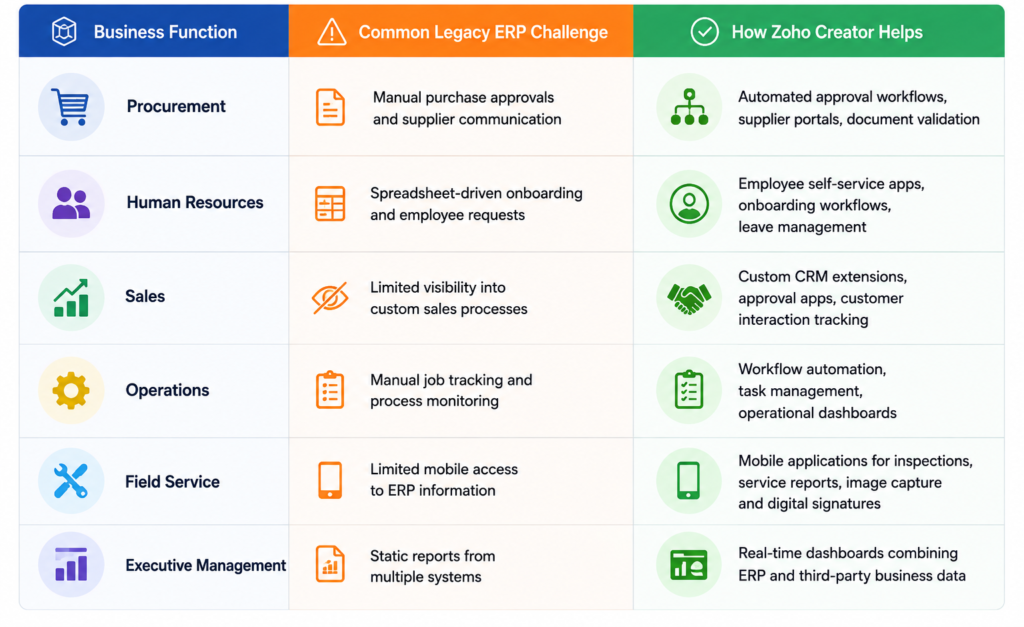
The advantage isn’t simply digitization—it’s the ability to introduce these improvements rapidly while maintaining a single source of truth within the ERP.
From Business Request to Working Solution—In Weeks, Not Months
One of the biggest barriers to enterprise innovation is the time needed to turn business ideas into solutions. Traditional ERP customizations often take months to deliver.
With Zoho Creator, organizations can rapidly build applications connected to their ERP, such as maintenance management systems with mobile inspections, automated alerts, dashboards, and synchronized ERP records. While the ERP continues managing core data, Zoho Creator delivers modern user experiences and operational flexibility.
The same approach applies to procurement, finance, HR, warehouse management, quality control, customer service, and project management, enabling businesses to evolve faster without waiting for ERP upgrades.
Why Enterprises See Greater Long-Term Value with an ERP Extension Strategy
Many organizations initially explore ERP extension to solve a single operational problem. Over time, however, they discover that the benefits extend far beyond one department or one workflow.
As more applications are introduced, businesses begin creating a connected digital ecosystem where processes, people, and data work together more efficiently.
Some of the long-term advantages include:
Faster Process Innovation
Business teams can introduce new workflows as operational needs change instead of waiting for ERP development cycles.
Better Employee Experience
Employees interact with applications designed specifically for their roles, reducing unnecessary complexity and improving productivity.
Improved Data Accuracy
Automated integrations reduce duplicate data entry and minimize manual errors across multiple business systems.
Higher Return on Existing ERP Investments
Rather than replacing a functioning ERP, organizations maximize the value of the systems they have already invested in.
Greater Organizational Agility
Departments become more responsive to changing customer expectations, regulatory requirements, and internal process improvements.
Most importantly, enterprises gain confidence that future business changes can be addressed without initiating another large-scale ERP transformation project.
Considering How to Make Your ERP More Adaptable?
If your existing ERP supports core business operations but struggles to keep pace with new workflows, integrations, or digital initiatives, extending it may be a smarter choice than replacing it. Zoho Creator enables you to build custom applications, automate workflows, integrate legacy systems with modern business tools, and add new capabilities without disrupting your ERP.
Create your Zoho Creator account using the link below to begin your ERP extension journey. As a premium Zoho implementation and consultation company, OfficeHub Tech helps enterprises design, implement, and scale Zoho Creator ERP Extension solutions through custom applications, workflow automation, API integrations, and enterprise modernization strategies.
The Technology Behind Faster Enterprise Adaptation
Business agility requires the right technology architecture. A common misconception about Legacy ERP Extension is that it involves modifying or replacing the ERP. Instead, it preserves ERP stability while adding a flexible extension layer that evolves with changing business needs.
Zoho Creator acts as this secure extension layer, connecting with existing ERP systems through APIs, web services, databases, middleware, and automation. While the ERP continues managing finance, inventory, procurement, manufacturing, and order management, Zoho Creator handles evolving workflows, integrations, and user experiences. This enables organizations to modernize gradually, reduce implementation risks, and innovate without disrupting daily operations.
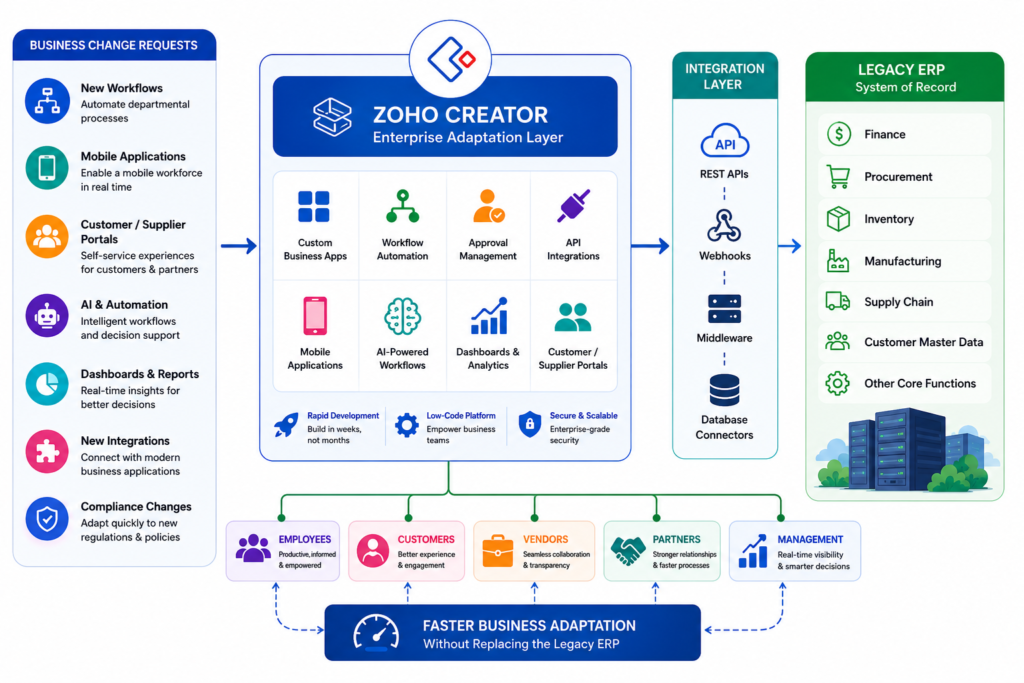
How Zoho Creator Fits into an Enterprise ERP Environment
A successful ERP extension follows one principle:
Keep the ERP stable. Make everything around it adaptable.
Legacy ERP (System of Record)
↓
APIs • Database Connectors • Web Services
↓
Zoho Creator (Application & Workflow Layer)
↓
Automation • AI • Integrations
↓
Web Portals • Mobile Apps • Dashboards • Business Applications
In this architecture:
- The ERP remains the trusted source of enterprise data.
- Zoho Creator extends business functionality without replacing the ERP.
- APIs securely exchange data between systems.
- Workflows operate independently while staying connected to ERP data.
- Departments receive applications tailored to their business needs.
This layered approach simplifies future enhancements without affecting the ERP foundation.
Building a Connected Enterprise Through Integrations
Modern enterprises rely on multiple business applications beyond ERP. Without integration, employees face duplicate data entry, inconsistent records, and inefficient workflows.
Zoho Creator eliminates these silos by connecting business applications into a unified ecosystem.
It integrates with:
- Legacy ERP systems
- SAP, Oracle ERP, Microsoft Dynamics 365
- Salesforce, HubSpot
- QuickBooks, Xero
- Zoho CRM, Zoho Books, Zoho Inventory, Zoho Projects
- Third-party REST APIs
- Enterprise databases
- Cloud storage platforms
- Email and communication services
Instead of replacing existing systems, Zoho Creator connects them, enabling automated workflows and a unified operational view.
Automation That Keeps Business Moving
Many business delays result from manual approvals, spreadsheets, repetitive updates, and routine follow-ups.
Zoho Creator automates these activities through configurable workflows, business rules, notifications, approval hierarchies, and scheduled actions.
Examples include:
- Routing purchase requests automatically.
- Sending approval reminders.
- Creating customer records from forms.
- Updating ERP records after approvals.
- Assigning workflow-based tasks.
- Triggering inventory alerts.
- Synchronizing data across enterprise systems.
Automation reduces manual effort, improves efficiency, and helps organizations respond faster to business changes.
Preparing Your Legacy ERP for AI-Driven Operations
AI performs best with connected, reliable business data. By extending ERP systems with Zoho Creator, organizations create a strong foundation for AI-driven operations.
Examples include:
- AI-assisted document processing
- Intelligent approvals
- Automated customer communications
- Predictive maintenance
- AI-powered analytics
- Smart data validation
- Conversational business applications
- Intelligent workflow routing
Because innovation happens around the ERP rather than inside it, businesses can adopt AI incrementally while protecting existing investments.
Security, Governance, and Scalability Remain Enterprise Priorities
Enterprise modernization should never compromise security.
Zoho Creator supports:
- Role-based access
- Secure authentication
- Audit trails
- Data validation
- Workflow permissions
- API authentication
- Data encryption
- Controlled deployments
These capabilities strengthen governance while supporting business growth. Organizations can start with a single workflow and gradually extend HR, procurement, customer portals, field operations, dashboards, and AI automation without replacing their ERP.
Why the Right Implementation Partner Matters
Technology alone doesn’t guarantee ERP extension success. Planning, integration, and implementation are equally important.
OfficeHub Tech helps organizations assess existing ERP systems, identify extension opportunities, build scalable Zoho Creator solutions, integrate enterprise applications, and automate workflows aligned with business objectives.
Whether modernizing manual processes, improving visibility, developing custom applications, or preparing ERP systems for AI, OfficeHub Tech helps reduce project risk and accelerate business value while protecting existing ERP investments.
Business Outcomes Enterprises Can Expect by Extending Legacy ERP with Zoho Creator
Technology investments are measured by the value they create. While automation, integrations, custom applications, and dashboards are important, enterprise leaders focus on business outcomes. The objective is not simply to modernize technology but to improve efficiency, respond faster to change, and maximize existing ERP investments.
By adopting a Legacy ERP Extension Strategy with Zoho Creator, organizations can innovate without disrupting critical operations. Instead of replacing stable ERP systems, they create a more agile environment where departments evolve independently while remaining connected through a centralized ERP.
Below are the key business outcomes enterprises achieve by extending rather than replacing their ERP.
Respond Faster to Changing Business Requirements
Business needs constantly evolve, from customer onboarding and compliance to supplier collaboration and new services. Traditional ERP customizations often involve lengthy development and testing. With Zoho Creator, organizations can rapidly build applications that integrate with existing ERP systems, enabling departments to adopt new processes in weeks instead of months. This agility helps businesses respond faster to market changes and improve customer experiences.
Maximize the Value of Existing ERP Investments
Replacing a reliable ERP simply because it lacks modern capabilities is often unnecessary. An ERP extension strategy preserves existing investments while adding value through custom applications, workflow automation, mobile access, dashboards, and self-service portals. This extends ERP lifespan and delivers greater return on investment.
Improve Employee Productivity Across Departments
Many productivity challenges stem from manual processes such as data entry, approvals, and reporting. Zoho Creator automates these tasks with intuitive, role-based applications, mobile access, and automated approvals, allowing employees to focus on higher-value work.
Increase Operational Visibility for Better Decision-Making
Business data is often scattered across ERP systems, spreadsheets, and standalone applications. Zoho Creator consolidates information into real-time dashboards and reports, giving leaders better visibility into KPIs, workflows, and operations for faster, data-driven decisions.
Build a Foundation for Continuous Innovation
Extending a legacy ERP transforms modernization into an ongoing capability rather than a one-time project. Organizations can continuously improve workflows, introduce new applications, and adopt AI, analytics, automation, and integrations without disrupting core ERP operations. This approach helps businesses remain competitive while maximizing the value of their existing ERP investment.
Conclusion: Your ERP Doesn’t Need to Change Overnight—Your Business Does
Legacy ERP systems continue to support thousands of successful enterprises with their stability, reliability, and ability to manage mission-critical operations.
However, today’s businesses need greater agility to respond to changing customer expectations, regulations, business models, and emerging technologies. Instead of relying on complex ERP customizations or replacements, many organizations are adopting Legacy ERP Extension.
With Zoho Creator as an enterprise adaptation layer, businesses can build custom applications, automate workflows, integrate modern software, deliver mobile experiences, and prepare for AI-driven operations while keeping their existing ERP at the core of their technology ecosystem.
Instead of asking whether it’s time to replace your ERP, a better question may be:
“ How can we make our ERP better support the business we’re becoming?”
For many enterprises, the answer isn’t replacement—it’s extension.
With the right strategy, the right technology platform, and the right implementation partner, organizations can modernize legacy ERP systems with minimal disruption while preserving the stability of their core operations. Backed by a team of certified Zoho Creator developers, OfficeHub Tech helps enterprises extend their existing ERP systems through custom applications, workflow automation, seamless integrations, and AI-ready solutions. Our approach enables businesses to improve operational agility, accelerate digital transformation, and build a scalable foundation for continuous innovation and long-term growth.
Why Enterprises Choose OfficeHub Tech for Zoho Creator ERP Extension
Selecting the right technology platform is only part of a successful ERP extension initiative. The expertise of the implementation partner often determines how quickly the solution delivers measurable business value.
As a Top Zoho implementation and consultation Partner company in USA, UAE, KSA and India, OfficeHub Tech understands that every enterprise has unique operational challenges, business processes, compliance requirements, and technology environments. That’s why we don’t believe in one-size-fits-all ERP modernization strategies.
Our approach begins with understanding how your business operates today, identifying where your legacy ERP creates operational constraints, and designing a Zoho Creator ERP Extension roadmap that aligns with your business objectives—not just technical requirements.
Our expertise includes:
- Legacy ERP assessment and extension strategy
- Custom enterprise application development using Zoho Creator
- Workflow automation and process digitization
- API development and third-party software integrations
- Executive dashboards and operational reporting
- Customer, employee, and supplier portal development
- AI-ready business process automation
- Ongoing optimization, support, and scalability planning
Whether you’re extending SAP, Oracle, Microsoft Dynamics, Infor, Epicor, Sage, or another enterprise ERP, our goal is the same: help your business adapt faster without disrupting the systems you already trust.
Looking for a Trusted Zoho Creator Implementation Partner?
If you’re looking to modernize your legacy ERP without a full replacement, OfficeHub Tech can help. Our experts assess your existing ERP, identify high-impact extension opportunities, and implement scalable Zoho Creator solutions that improve business agility while protecting your ERP investment.
Schedule a consultation with OfficeHub Tech to know how a Zoho Creator-powered ERP extension strategy can help your enterprise respond faster to changing business demands.