
##Quick Answer
A legacy ERP can remain valuable long after it begins limiting business agility. The hidden costs often appear through manual workarounds, disconnected applications, slow approvals, duplicate data entry, expensive customizations, and difficult integrations rather than as a single line item on the IT budget.
Instead of replacing a stable ERP immediately, businesses can use Zoho Creator to build an extension layer around it. This approach supports API integration with ERP systems, workflow automation, custom applications, portals, mobile experiences, and real-time data exchange while keeping the ERP core focused on its critical transactional responsibilities.
The result is a more incremental modernization strategy: extend what already works, address the highest-cost bottlenecks first, measure the business impact, and expand from there.
##Key Takeaways
- Legacy ERP costs include operational inefficiency, manual work, customization debt, integration complexity, and opportunity costs.
- An ERP can remain valuable as a system of record even when its surrounding workflows have become outdated.
- Full ERP replacement can involve significant implementation, migration, integration, testing, and change-management costs.
- Zoho Creator can serve as an extension layer for custom applications, workflow automation, integrations, portals, and mobile experiences.
- Moving new business logic outside the ERP core can reduce customization complexity and make future changes easier to manage.
- Faster ROI comes from targeting measurable operational bottlenecks instead of attempting a large transformation all at once.
- Businesses should measure time savings, error reduction, automation, process-cycle improvements, avoided development costs, and other measurable benefits.
- ERP extension is not a universal replacement for ERP modernization or replacement; the right approach depends on the condition and capabilities of the existing ERP.
The True Cost of Legacy ERP Goes Far Beyond Maintenance
A legacy ERP may appear affordable when viewed only through its annual maintenance, support, or licensing expenses. The larger financial impact often comes from everything employees and IT teams have to do around the ERP because the system cannot easily adapt to newer business requirements.
Consider a sales team that exports ERP information into spreadsheets before preparing a customer report. Or a procurement team that still depends on email approvals because the ERP system cannot support a newly introduced approval rule. A field team may use a separate application because the ERP does not provide an effective mobile experience.
Each workaround may appear small. Across hundreds or thousands of transactions, however, these inefficiencies can become a recurring operating cost.
This is where a low-code platform for ERP extension and modernization can become relevant. Instead of rebuilding the entire ERP, businesses can create a flexible application layer around the existing system and focus modernization efforts on the processes generating the greatest operational friction.
The hidden cost of legacy ERP typically appears in six areas:
- Manual effort: Employees repeatedly enter, validate, reconcile, and transfer information.
- Process delays: Approvals and handoffs depend on emails, spreadsheets, or manual intervention.
- Customization debt: Business-specific modifications make the ERP harder to maintain and upgrade.
- Integration complexity: Older systems may require additional middleware or custom development to communicate with newer applications.
- IT dependency: Even relatively small business changes can require specialized ERP development.
- Opportunity cost: Teams spend time maintaining workarounds instead of improving customer experience, automation, analytics, or new business processes.
Zoho’s current ERP-extension guidance similarly identifies technical debt, custom applications, manual workflows, and fragmented tools as challenges surrounding ERP environments.
The important question is therefore not simply “How much does our ERP cost?”
It is:
“How much does the business spend because the ERP cannot change as quickly as the business does?”
Where Legacy ERP Creates Hidden Costs Across the Business
The hidden cost becomes easier to understand when it is connected to everyday business operations.
Operational Cost
Manual data entry is one of the most common sources of hidden ERP expense. Employees may need to transfer information between the ERP, spreadsheets, email, CRM systems, project tools, or departmental applications.
The business pays for this through employee hours, rework, reconciliation, and slower processing.
Integration Cost
Modern organizations rarely operate on one application.
ERP systems increasingly need to exchange information with CRM, accounting, analytics, HR, customer portals, field-service applications, communication tools, and other cloud services.
When these systems are poorly connected, teams compensate with manual exports, imports, spreadsheets, or point-to-point integrations.
A structured API integration with ERP systems can instead create controlled pathways for applications to exchange information while keeping the ERP responsible for core transactional data.
Customization Cost
Legacy ERP customization usually begins with a legitimate business requirement. Over time, however, custom code, modified workflows, reports, and integrations can accumulate.
The problem is not necessarily one customization. It is the dependency chain created by many customizations.
A small ERP change can require extensive testing because another workflow, report, integration, or business rule may depend on it.
Agility Cost
Business requirements change faster than traditional ERP release cycles.
A company may need a new approval workflow, mobile application, customer portal, or integration. If every change must be developed inside the ERP, even relatively contained requirements can become lengthy IT projects.
That delay has a business cost.
Upgrade Cost
ERP upgrades can involve:
- Customization review
- Regression testing
- Data validation
- Integration testing
- User training
- Documentation
- Deployment planning
- Business continuity planning
The more customized the ERP core becomes, the greater the potential upgrade complexity.
Opportunity Cost
Some ERP costs never appear as an invoice.
If a business cannot launch a new workflow quickly, automate a repetitive task, or give employees mobile access to information, the organization may lose opportunities to improve productivity and customer experience.
This is the opportunity cost of slow modernization.
The Real Problem: ERP Core vs. Business Agility
The existence of a legacy ERP does not automatically mean that its core functionality has become useless.
In many organizations, the ERP still performs critical functions such as:
- Financial transactions
- Inventory management
- Procurement
- Order processing
- Manufacturing
- Accounting
- Compliance
- Transactional record keeping
The challenge often exists outside these core functions.
Modern businesses also need:
- Mobile applications
- Customer and vendor portals
- Custom approval workflows
- Cross-system automation
- Real-time integrations
- Department-specific applications
- AI-assisted processes
- Modern user interfaces
Trying to make the ERP perform every one of these functions by continuously modifying its core can increase complexity.
An extension approach separates the two responsibilities.
ERP core: stability, transactions, governance, and system-of-record responsibilities.
Extension layer: new applications, workflows, interfaces, integrations, and business-specific experiences.
This architectural separation allows the ERP to continue performing the functions it already handles well while giving the business a more flexible environment for change.
Why Full ERP Replacement Can Delay ROI
Replacing an ERP can be the correct decision when the existing platform can no longer support essential business, technical, security, compliance, or scalability requirements.
However, replacement is a major transformation rather than a simple software change.
A replacement project may involve:
- Business-process redesign
- Data migration
- Application configuration
- Integration redevelopment
- Testing
- User training
- Change management
- Reporting migration
- Operational transition
These activities can require substantial investment before the business realizes measurable benefits.
That creates an important modernization question:
Does the business need a new ERP core, or does it need a more flexible way to extend the ERP it already has?
If the existing ERP remains reliable for core transactions but struggles with newer operational requirements, extension can provide a more incremental path.
The goal is not to claim that replacement is always unnecessary. Instead, organizations can evaluate whether the highest-value problems actually require replacing the core system.
An extension-first strategy can allow businesses to modernize the surrounding experience first, measure the results, and determine later whether deeper modernization is necessary.
How Zoho Creator Extension Changes the ROI Equation
Zoho Creator can be positioned as an application and workflow extension layer around an existing ERP.
Instead of placing every new requirement directly into the ERP core, organizations can use Creator to build applications and workflows that communicate with the ERP through APIs, integrations, and other supported connectivity mechanisms.
This can include:
- Custom business applications
- Web and mobile applications
- Approval workflows
- Customer portals
- Vendor portals
- Department-specific applications
- Data-entry and validation interfaces
- Cross-system automation
- Operational dashboards
- AI-assisted workflows
Zoho describes this approach as moving high-frequency changes and unique business requirements into a dedicated agility layer rather than continually modifying the ERP core. Its current ERP-extension material also identifies three practical patterns: Build, Enhance, and Replace.
Build
Create a new application for a requirement the ERP does not efficiently cover.
Enhance
Modernize an existing process with a better interface, mobile access, workflow, automation, or integration.
Replace
Retire surrounding legacy applications such as outdated custom tools, spreadsheets, or older application stacks while retaining the ERP core.
This is the foundation of practical Zoho Creator ERP solutions: keeping the ERP where it provides value while using Creator to address the surrounding operational gaps.
How Legacy ERP Extension Turns Hidden Costs Into Faster ROI
The value of extending a legacy ERP becomes clearer when each extension is connected to a specific business cost. Instead of treating modernization as a broad technology project, businesses can target the processes where the existing ERP creates the most manual effort, delays, errors, or IT dependency.
For example, if employees repeatedly transfer data between the ERP and spreadsheets, a Zoho Creator application can provide a structured interface and automate the movement of information. If approvals depend on email, an extension can introduce a digital workflow connected to the ERP. If employees need mobile access, a dedicated mobile application can provide the required experience without changing the ERP core.
This creates a direct path from business problem → targeted extension → measurable improvement → ROI.
The improvement can be measured through outcomes such as:
- Fewer manual data-entry hours
- Shorter approval and processing cycles
- Reduced errors and rework
- Lower dependency on specialized ERP development
- Faster deployment of new business applications
- Reduced maintenance of spreadsheets and disconnected tools
- Lower integration and operational effort
- Improved user adoption and process visibility
The key is to prioritize high-impact bottlenecks rather than extending the ERP simply because a new capability is technically possible. A process with thousands of repetitive transactions may provide a clearer ROI opportunity than a low-volume process with limited operational impact.
For example, consider an approval process that requires employees to manually collect information, send emails, update the ERP, and follow up with different teams. An extension can bring these steps into a structured workflow while keeping the ERP responsible for the underlying transaction. The business can then compare the original approval cycle, manual effort, and error rate against the new process.
This approach makes ROI easier to evaluate because modernization is tied to a specific operational outcome rather than a broad promise of digital transformation.
The aim is to achieve more than just reducing technology-related expenses. It is to remove recurring business friction while preserving the value of the existing ERP. By solving one measurable bottleneck at a time, organizations can build a business case for further modernization based on actual results.
Technical Architecture: How Legacy ERP Extension Works With Zoho Creator
The extension architecture should keep the ERP responsible for its core transactional role while Zoho Creator provides a flexible layer for applications and process orchestration.
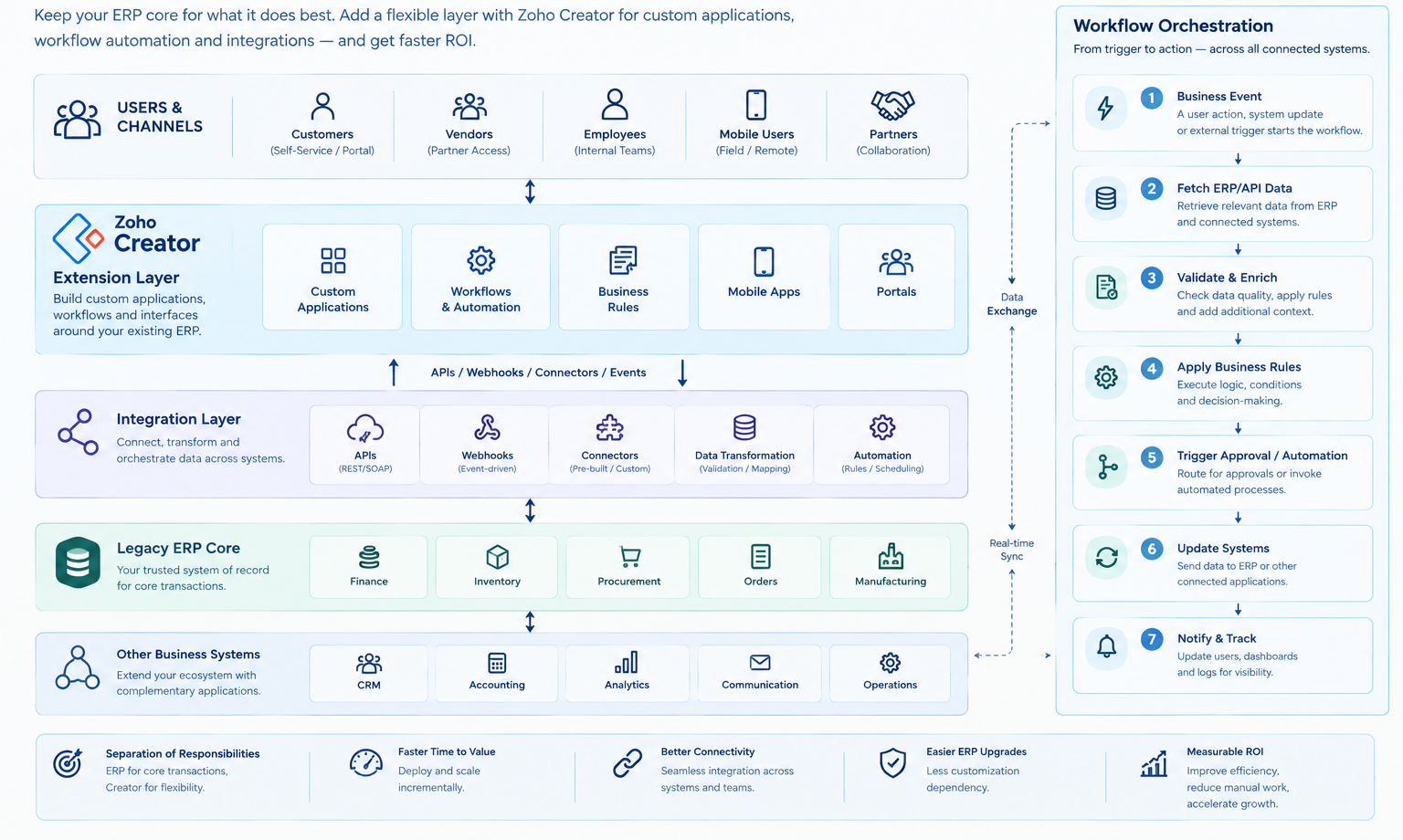
The key architectural principle is separation of responsibilities.
The ERP remains the authoritative system for its core transactional data, while Creator manages applications and workflows that require greater flexibility.
Zoho’s current documentation describes Creator as an API-first, event-driven layer that can connect ERP environments with external applications, workflows, and automation.
This approach can also help keep future ERP upgrades more manageable because new application logic does not necessarily need to be embedded directly into the ERP core.
From Hidden Cost to Measurable ROI: What Businesses Should Actually Measure
The phrase “faster ROI” should not simply mean “the software is cheaper.”
It should mean that the business can move more quickly from identifying a costly problem to implementing a solution and measuring its financial or operational impact.
Start by establishing a baseline.
Before Extension
Measure:
- Processing time
- Manual hours per transaction
- Number of manual data-entry steps
- Approval cycle time
- Error and rework rates
- Reporting time
- IT development effort
- Integration maintenance effort
- Number of disconnected applications
- Cost of existing workarounds
After Extension
Measure:
- Hours eliminated
- Process-cycle reduction
- Automation percentage
- Error reduction
- Faster approval times
- Reduced manual intervention
- Faster application deployment
- Lower integration effort
- User adoption
- Reduced operational cost
A simple ROI calculation can be expressed as:
ROI = (Financial Benefits − Extension Investment) ÷ Extension Investment × 100
Financial benefits can include measurable labor savings, reduced rework, reduced processing costs, and avoided technology expenditure where those values can be reliably quantified.
There may also be avoided modernization costs. For example, if a targeted extension removes the need for a large ERP customization project or replaces an isolated legacy application, that avoided expenditure can form part of the business case.
The important point is to measure actual outcomes rather than promise a universal ROI percentage.
Where Zoho Creator Extension Can Deliver the Fastest Business Impact
The fastest measurable impact usually comes from focused processes with high transaction volumes, repetitive manual work, or visible bottlenecks.
Customer and Vendor Portals
A portal can provide external stakeholders with controlled access to relevant information and workflows without exposing the full ERP interface.
Approval Workflows
Procurement, finance, sales, operations, and compliance processes can be digitized around the ERP rather than forcing every approval requirement into its core.
Mobile Operations
Employees working outside traditional office environments can interact with relevant business applications through mobile experiences connected to ERP data.
Data Collection and Validation
Instead of allowing incomplete or inconsistent information to enter the ERP, a Creator application can collect and validate information before it reaches the core system.
Legacy Application Replacement
Older departmental applications, spreadsheet workflows, or outdated custom tools surrounding the ERP can be candidates for modernization.
Cross-System Automation
Creator can coordinate processes that involve multiple applications rather than forcing employees to manually move information between systems.
Zoho identifies customer/vendor portals, field service and inspection apps, custom approval workflows, inventory extensions, compliance applications, and department-specific tools among common applications that can be built around ERP environments.
A Practical Roadmap: Extend First, Modernize Incrementally
A successful extension strategy should not begin by trying to modernize everything simultaneously.
Step 1 — Identify the Costliest Bottleneck
Find the process creating the greatest combination of manual effort, delay, errors, or IT dependency.
Step 2 — Protect the ERP Core
Identify which functions should remain inside the ERP because they represent critical transactional, financial, or governance responsibilities.
Step 3 — Build the Extension
Create the application, interface, workflow, portal, or automation required to solve the selected business problem.
Step 4 — Integrate and Automate
Connect the extension to the ERP and relevant business systems through APIs, webhooks, connectors, or supported integration mechanisms.
Step 5 — Measure and Expand
Compare the new process against the original baseline.
If the extension produces measurable improvements, the organization can identify the next high-value process for modernization.
This creates a cycle of:
Identify → Extend → Integrate → Measure → Optimize → Expand
Instead of treating modernization as one enormous project, businesses can make it a sequence of measurable improvements.
When ERP Extension Makes Sense—and When It Doesn’t
ERP extension is not automatically the right solution for every legacy environment.
Extension can make sense when:
- Core ERP transactions remain reliable.
- Financial and governance processes remain adequate.
- Existing ERP data remains valuable.
- APIs or other integration mechanisms are available.
- The main requirement is greater business agility.
- The organization needs new applications or workflows around the ERP.
- The business wants to modernize incrementally.
Deeper modernization or replacement may be necessary when:
- The ERP cannot support fundamental business requirements.
- Required security or compliance standards cannot be achieved.
- Integration capabilities are fundamentally inadequate.
- Vendor support has ended or is insufficient.
- The architecture prevents required scalability.
- The total cost of retaining the system outweighs its business value.
Even in a replacement scenario, an extension layer can potentially play a transitional role by supporting new applications and workflows while the core ERP migration progresses.
The decision should therefore be based on business requirements, technical constraints, cost, risk, and expected outcomes, rather than the age of the ERP alone.
What Faster ROI Really Means in Legacy ERP Modernization
Faster ROI is fundamentally about reducing the distance between a business problem and a measurable improvement.
A traditional ERP customization may follow a path such as:
Requirement → ERP Development → Testing → Deployment → User Adoption → Benefit
An extension model can create a more focused path:
Business Bottleneck → Creator Application → Integration → Deployment → Measurement
This does not mean every Creator project will automatically be faster or cheaper. The actual outcome depends on application complexity, integration requirements, data architecture, governance, and implementation quality.
However, the extension model can allow organizations to scope modernization around a specific business problem rather than committing immediately to a full ERP transformation.
That makes it easier to establish a business case for each individual initiative.
The result is a modernization strategy where ROI can be evaluated continuously instead of being deferred until the completion of a large ERP replacement program.
Industry Evidence: The Rising Cost of Legacy Technology
Legacy systems can create substantial costs beyond maintenance, particularly when modernization is slow or difficult. A 2025 Pegasystems study conducted with Savanta, surveying more than 500 IT decision-makers worldwide, estimated that the average global enterprise wastes more than $370 million annually because of technical debt and difficulties modernizing legacy systems. The study also found that 63% of respondents rely on 1–10 legacy applications, while 29% rely on 11–20 across their front and back offices.
The research identified an estimated $56 million per year in average costs associated with maintaining, updating, and integrating legacy systems. Additionally, 78% of respondents said the time, money, and effort spent maintaining legacy applications could be better used on initiatives that improve business effectiveness.
These findings highlight why legacy ERP modernization is not simply an IT upgrade. For businesses that cannot immediately replace their ERP, ERP extension can provide a more incremental path—using API integration with ERP systems, ERP workflow automation, real-time ERP data integration, and a Legacy ERP orchestration layer to modernize surrounding processes while retaining the existing ERP core.
The $370 million figure is an estimated enterprise-wide technical-debt cost, not an ERP-specific benchmark. Its relevance is the broader evidence that delaying legacy modernization can create significant financial and operational overhead.
Source: Pega — Average Global Enterprise Wastes More Than $370 Million Every Year Through Technical Debt
Conclusion: Modernize the Capability, Not Necessarily the Core
Living with a legacy ERP can cost more than the organization realizes. The expense can appear through manual data entry, disconnected systems, spreadsheet workarounds, customization debt, slow approvals, difficult upgrades, and the opportunity cost of delayed innovation.
But a legacy ERP does not automatically need to be discarded.
If the ERP continues to provide reliable transactional, financial, and governance capabilities, an extension strategy can provide another route toward modernization. Zoho Creator can provide a flexible layer for custom applications, workflow automation, integrations, portals, mobile experiences, and cross-system orchestration while the ERP continues serving its core role.
The strongest business case comes from starting with measurable problems.
Identify where the legacy ERP creates the most operational friction. Build a focused extension. Integrate it with the existing environment. Measure the improvement. Then expand the modernization strategy to the next process.
That is how legacy ERP extension and modernization can move from a large transformation concept to a sequence of measurable business improvements—and how organizations can pursue faster ROI while protecting the value already invested in their ERP.
How OfficeHub Tech Helps Businesses Modernize Legacy ERP with Zoho Creator
Legacy ERP modernization requires more than selecting a low-code platform. The real challenge is deciding what should remain in the ERP, what should move outside it, how systems should communicate, and how the business will measure the result.
OfficeHub Tech approaches ERP extension around these practical considerations.
The focus can include:
- Legacy ERP extension strategy
- Business-process assessment
- Zoho Creator application development
- ERP and API integration
- Workflow automation
- Cross-system orchestration
- Mobile and portal development
- Role-based access and governance
- Incremental modernization
- Application modernization
- Post-implementation optimization
As Premium Zoho Creator developers, OfficeHub Tech can help businesses evaluate where an extension layer can provide practical value without unnecessarily disrupting the existing ERP environment.
For organizations looking for Top Legacy ERP Extension and Modernization Services providers In USA, India, UAE and KSA, the focus should be on connecting technology decisions with measurable business outcomes—not simply adding another application to an already fragmented technology stack.
The objective is to create an architecture where the ERP remains dependable while the surrounding business capabilities become easier to adapt.
Modernize Your Legacy ERP with Zoho Creator
Your legacy ERP may still handle core transactions and business records effectively, even if surrounding workflows have become inefficient. Zoho Creator can extend its capabilities with custom applications, automated workflows, portals, mobile solutions, and real-time ERP data integration.
By moving selected processes outside the ERP core, businesses can reduce manual work, connect systems, simplify approvals, and introduce new capabilities without disrupting existing operations.
The goal is to modernize in manageable stages, with each extension addressing a specific business need and delivering a measurable outcome.
Ready to explore what your legacy ERP can do with the right extension strategy?
and discover how a low-code approach can help extend your existing ERP, modernize surrounding processes, and move toward a more agile, connected business environment. {sign up button}