Quick Answer
Zoho ERP for the AV equipment industry provides a centralized platform for AV manufacturers, distributors, dealers, and wholesalers to manage products, SKUs, inventory, warehouses, procurement, sales, manufacturing, quality, fulfillment, accounting, and reporting.
It is particularly useful for AV businesses managing complex product catalogs, serialized equipment, multiple warehouses, suppliers, assemblies, and connected sales and fulfillment operations.
Zoho ERP supports item management, multi-location inventory, serial and batch tracking, assemblies, BOMs, manufacturing orders, job cards, warehouse operations, accounting, analytics, automation, and AI-powered capabilities.
Key Takeaways
- Zoho ERP can centralize critical AV equipment business processes across sales, inventory, procurement, manufacturing, quality, and finance.
- Complex AV product catalogs can be organized using items, SKUs, units of measure, pricing structures, serial numbers, batches, assemblies, and bills of materials.
- Multi-location inventory capabilities can help businesses maintain visibility across warehouses and stock movements.
- AV manufacturers can use manufacturing orders, BOMs, job cards, work centers, and quality processes to connect production with inventory and financial operations.
- Distributors and dealers can connect purchasing, sales orders, inventory, shipments, returns, and payments within connected workflows.
- Zoho ERP includes analytics and AI capabilities designed to provide contextual insights and automate selected operational activities.
- Successful implementation depends on mapping the AV company’s products, warehouses, workflows, approvals, integrations, and reporting requirements before configuration begins.
Zoho ERP for AV Equipment Businesses at a Glance
| AV Business Requirement | Relevant Zoho ERP Capability |
|---|---|
| Large product catalogs | Items, SKUs and Composite Items |
| Serialized AV equipment | Serial and batch tracking |
| Multiple warehouses | Multi-location inventory |
| Warehouse operations | Picklists, putaways and move orders |
| Stock availability | Stock counts and replenishments |
| Purchasing | Purchase Requests, RFQs and Purchase Orders |
| Product assembly | Assemblies and BOMs |
| Manufacturing | Manufacturing Orders and Job Cards |
| Production operations | Work Centers and production tracking |
| Quality control | Quality Templates and Inspections |
| Order fulfillment | Packages and Shipments |
| Financial operations | Accounting and reporting |
| Business intelligence | Analytics and Zia |
| Automation | Workflows and AI-powered capabilities |
Why AV Equipment Businesses Need an ERP
The AV equipment industry operates across a wide range of products, suppliers, sales channels, and operational processes. A single business may sell displays, speakers, amplifiers, cameras, control systems, racks, networking components, accessories, cables, and installation-related products.
The operational challenge increases when the business handles thousands of SKUs, multiple vendors, different pricing structures, serial-numbered equipment, multiple warehouses, dealer networks, project-based orders, returns, and product assemblies.
Without a connected ERP, information can become fragmented between spreadsheets, accounting software, CRM platforms, inventory applications, procurement tools, and manufacturing systems.
An ERP creates a common operational layer across these processes.
For businesses evaluating their options, Zoho ERP implementation for AV equipment businesses can be structured around the company’s actual product, inventory, sales, procurement, manufacturing, and financial workflows rather than simply enabling standard modules.
Common operational challenges in AV equipment businesses
| Business challenge | ERP requirement |
| Thousands of products and SKUs | Centralized item and product management |
| Multiple warehouses | Multi-location inventory visibility |
| Serial-numbered equipment | Serial-number tracking |
| Complex product assemblies | BOM and assembly management |
| Vendor-dependent purchasing | Procurement and vendor management |
| Dealer/distributor sales | Structured sales and order workflows |
| Frequent product returns | Returns and credit management |
| Manufacturing or assembly | Manufacturing orders and job tracking |
| Manual financial reconciliation | Connected accounting workflows |
| Fragmented reporting | Centralized operational and financial reporting |
The goal is therefore broader than inventory management. An ERP should connect the commercial, operational, production, and financial sides of the AV business.
What Is Zoho ERP?
Zoho ERP is an integrated enterprise resource planning platform designed to connect business operations within a unified environment.
Its capabilities span core financials, supply chain management, billing, people and payroll operations, spend management, sales, inventory, manufacturing, quality, reporting, analytics, automation, and AI. Zoho ERP also provides extensibility through workflows, custom modules, widgets, extensions, APIs, and low-code/no-code capabilities.
For an AV equipment company, this can create a connected operational flow:
Products → Suppliers → Procurement → Inventory → Sales → Manufacturing/Assembly → Fulfillment → Billing → Finance → Analytics
Instead of maintaining disconnected records across multiple applications, the objective is to maintain consistent operational and financial data throughout the transaction lifecycle.
Why this matters for AV equipment companies
Consider an AV distributor selling a professional display.
A sales order should not exist independently from inventory. The business needs to know:
- Which SKU was ordered?
- How many units are available?
- Where are those units located?
- Are they reserved for another order?
- Does the company need to purchase additional stock?
- Which supplier provides the product?
- What is the expected delivery date?
- Has the product shipped?
- Has the customer been invoiced?
- Has payment been received?
An ERP connects these relationships so that operational decisions can be based on shared business data rather than manually reconciled records.
Zoho ERP Capabilities That Matter for AV Equipment Businesses
Product and Item Management
AV businesses frequently manage large catalogs containing equipment, components, accessories, bundles, replacement items, and different product configurations.
Zoho ERP allows businesses to structure items and services while managing pricing, units of measure, composite items, assemblies, bills of materials, and related transaction information.
For an AV company, product structures can include:
- Product category
- Manufacturer
- Model
- SKU
- Unit of measure
- Product variants
- Pricing
- Serial or batch tracking
- Components
- Composite items or assemblies
- Warranty-related information
This creates a structured product foundation for purchasing, inventory, sales, manufacturing, and fulfillment instead of maintaining separate product lists across spreadsheets and applications.
Inventory and Warehouse Management
Inventory accuracy is one of the most important ERP requirements for AV equipment companies.
Zoho ERP supports multi-location inventory, stock transfers, move orders, picklists, putaways, stock counts, replenishments, packages, shipments, assemblies, inventory adjustments, and serial and batch number tracking.
This can support workflows such as:
Warehouse A → Warehouse B → Sales Order → Pick → Pack → Shipment → Delivery
For AV distributors operating regional warehouses, these capabilities provide a structured way to monitor stock availability and movement instead of depending on manual inventory updates.
Procurement and Vendor Management
AV businesses often depend on multiple manufacturers, distributors, suppliers, and component vendors.
An ERP can connect:
Purchase Request → RFQ → Purchase Order → Receipt → Vendor Bill → Payment
This allows procurement teams to understand what has been ordered, what has been received, and what remains outstanding.
Zoho ERP supports purchasing workflows and features such as purchase orders, RFQs, automated purchase order creation, and guided buying capabilities, depending on the configured plan and environment.
Sales and Order Management
AV equipment sales can involve quotations, negotiated pricing, sales orders, delivery requirements, returns, and payment collection.
Zoho ERP supports quotes, sales orders, invoices, payment tracking, returns, credit notes, packages, shipments, and related sales processes.
This helps connect the customer-facing transaction with the operational activities required to fulfill it.
Manufacturing and Assembly
For AV manufacturers and businesses assembling products, ERP requirements extend beyond purchasing and selling equipment.
Zoho ERP supports bills of materials, manufacturing orders, job cards, work centers, shop-floor operations, material consumption, work-in-progress, and production tracking.
This is relevant when an AV company manufactures, configures, or assembles:
- Speaker systems
- Control panels
- Rack assemblies
- Custom equipment packages
- Integrated hardware units
- Electronic components
- Preconfigured AV systems
Financial Management
An AV ERP implementation should not stop when the product is shipped.
Financial operations need to remain connected with sales, procurement, inventory, expenses, payments, taxes, and reporting.
Zoho ERP’s financial capabilities include accounting, banking, reconciliation, budgeting, general ledger management, tax processes, and financial reporting.
This provides management with a financial view of operational activity rather than requiring finance teams to reconstruct business activity from multiple systems.
How Zoho ERP Works Across the AV Equipment Business: Technical Architecture and Workflow
This is the technical foundation of a Zoho ERP implementation for an AV equipment business.
Architecture:
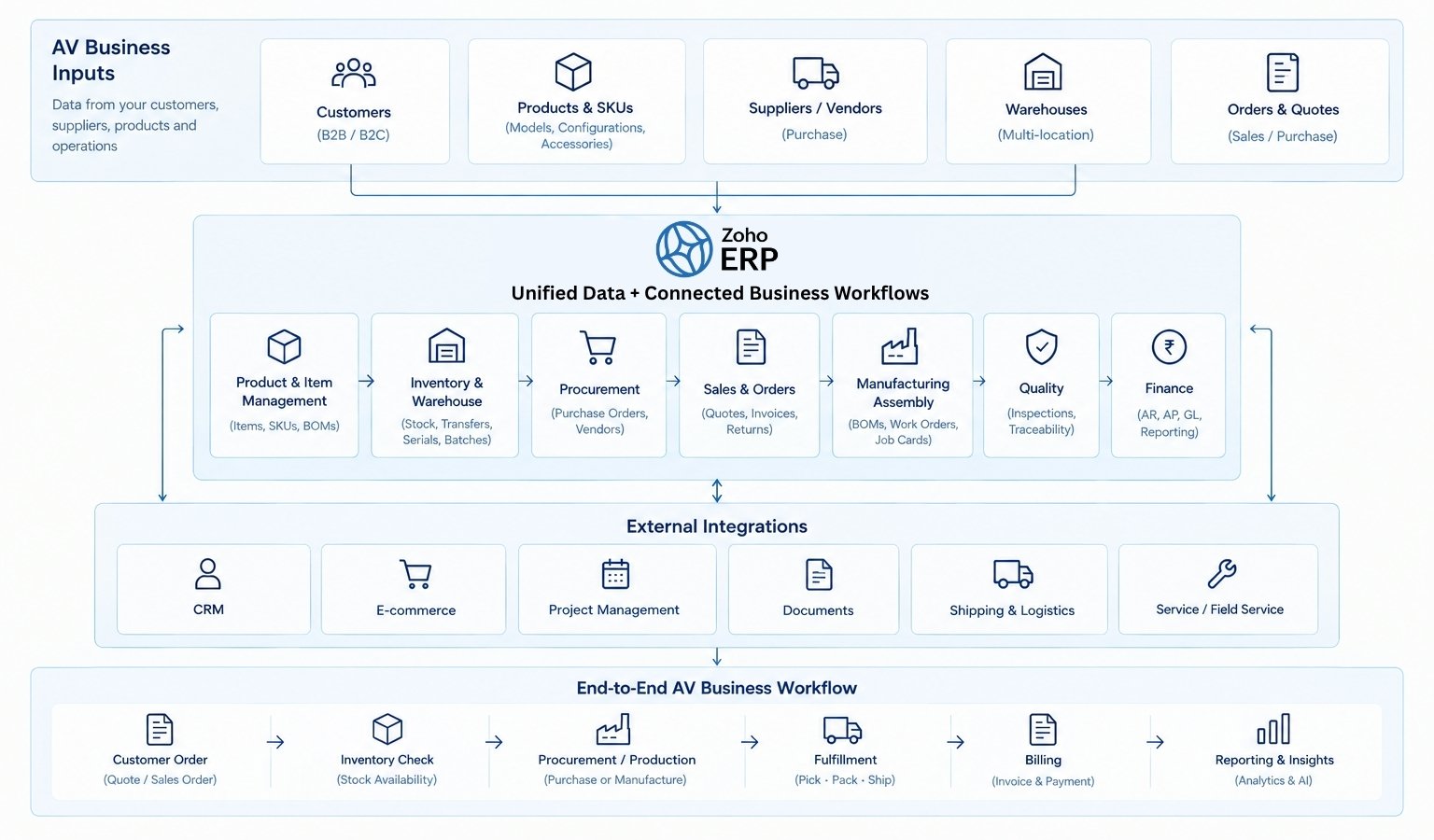
How Zoho ERP connects AV business operations—from products, inventory, and procurement to manufacturing, fulfillment, finance, and reporting.
Step 1: Customer Order
A customer quotation or sales order enters the operational workflow.
Step 2: SKU/Product Validation
The system identifies the relevant item, pricing, quantity, availability, and product configuration.
Step 3: Inventory Check
Available stock is evaluated across the relevant warehouse or locations.
Step 4: Procurement or Production
If inventory is insufficient, the business can initiate procurement or production/assembly based on its operating model.
Step 5: Fulfillment
Warehouse teams pick, package, ship, and track the order.
Step 6: Invoice and Payment
The fulfilled transaction moves into billing and payment processes.
Step 7: Financial Reporting
The resulting transaction contributes to accounting, reporting, margin analysis, and management visibility.
Zoho ERP supports connected business functions through workflows, custom modules, widgets, extensions, and low-code/no-code capabilities.
For AV businesses using CRM, proposal, e-commerce, document, or specialized platforms, Zoho ERP can operate as part of a broader integrated technology ecosystem rather than replacing every existing application.
Zoho ERP for Different AV Equipment Business Models
Zoho ERP can be configured differently depending on how an AV company operates.
AV Equipment Manufacturers
Manufacturers require visibility from product definition through production and fulfillment.
Important capabilities include:
- Bills of materials
- Manufacturing orders
- Job cards
- Work centers
- Material consumption
- Production tracking
- Quality inspections
- Finished-goods inventory
- Cost tracking
Zoho’s manufacturing capabilities are designed to connect production planning, execution, inventory, quality, and fulfillment.
AV Distributors
Distributors generally need stronger control over purchasing, inventory, warehouse operations, order fulfillment, and dealer/customer sales.
The ERP can connect:
Supplier → Purchase Order → Warehouse → Customer Order → Shipment → Invoice
AV Dealers and Resellers
Dealers may need a stronger combination of customer management, product cataloging, pricing, sales orders, inventory, and payment management.
An ERP can provide a central operational layer while connecting the customer acquisition and sales processes with fulfillment and financial records.
AV Wholesalers
Wholesalers can use ERP capabilities to coordinate large-volume purchasing, warehouse stock, pricing, customer orders, transfers, and fulfillment.
The exact configuration should be determined by transaction volume, warehouse structure, sales model, product complexity, and integration requirements.
Managing AV Equipment Products, SKUs, Serial Numbers and Inventory
Product complexity is one of the main reasons AV equipment businesses require structured ERP systems.
A single product category may contain multiple manufacturers, models, configurations, accessories, replacement parts, and compatible components.
A properly structured item master can establish relationships between:
Category → Manufacturer → Product → SKU → Variant → Serial/Batch → Warehouse → Transaction
Serial tracking is particularly important for high-value equipment where the business needs to know which specific unit was sold, received, transferred, returned, or serviced.
Zoho ERP’s current inventory capabilities include serial-number tracking, batch-number tracking, stock counting, replenishment-related functions, warehouse operations, and stock transfers.
For example, an AV distributor could track a serialized camera from warehouse receipt through customer shipment and subsequent return.
This creates a more reliable operational record than simply recording that “10 cameras” were sold.
Managing Procurement, Sales and Fulfillment in One ERP
Connecting Sales Demand With Operational Capacity
AV equipment businesses need to align customer commitments with product availability, supplier lead times, warehouse stock, and production requirements.
Zoho ERP connects customer demand with inventory, procurement, production, fulfillment, and financial processes within a shared operational environment.
From Customer Requirement to Payment
A customer requirement can move from quotation to sales order, followed by an inventory availability check. If equipment is unavailable, the requirement can trigger procurement or production based on the company’s operating model.
Once products are available, warehouse teams can manage fulfillment and shipment, followed by invoicing and payment processing.
Customer Requirement → Quote → Sales Order → Inventory → Purchase/Production → Fulfillment → Shipment → Invoice → Payment
Maintaining Connected Business Data
The value of ERP comes from maintaining relationships between transactions. A sales order for unavailable equipment can remain connected to the corresponding procurement or production requirement rather than relying on separate emails or spreadsheets.
This shared data helps sales, procurement, warehouse, fulfillment, and finance teams operate from consistent transaction information.
Zoho ERP for AV Equipment Manufacturing and Assembly
Not every AV company manufactures equipment from raw materials. Some businesses bundle products, assemble components, configure equipment, or manufacture finished products.
This distinction matters when designing the ERP.
Composite items can represent bundled products, while assemblies can combine components into finished items. More structured production processes can use BOMs, manufacturing orders, job cards, work centers, and production operations.
For example, an AV business may combine components into a rack assembly or preconfigured equipment package.
A BOM can define:
- Finished product
- Components
- Required quantities
- Production steps
- Work centers
- Manufacturing requirements
Zoho ERP can connect these product structures with manufacturing orders, job cards, inventory, and production tracking.
Quality management can also support the manufacturing lifecycle through quality templates, rules, inspections, and inspection worklists.
For AV manufacturers, this creates traceability between components, production activity, quality checks, and finished goods.
AI, Zia, Analytics and Automation in Zoho ERP for AV Businesses
AV businesses generate operational data across sales, purchasing, inventory, production, fulfillment, and finance. Zoho ERP uses Zia and AI-powered capabilities to help users interact with and analyze this business data.
Capabilities include natural-language interaction through Ask Zia, contextual insights, forecasting, anomaly detection, automation, and AI-assisted record creation. Zoho’s CoCreate Agent can also guide users through creating business records and transactions.
Potential AV business use cases include:
- Identifying unusual inventory patterns
- Reviewing financial trends
- Monitoring receivables
- Supporting demand analysis
- Retrieving operational insights
- Automating repetitive activities
- Assisting with record creation
- Supporting workflow automation
For example, a manager can use natural-language interaction to retrieve relevant business information instead of manually navigating multiple reports.
AI effectiveness still depends on well-structured ERP data, accurate product records, consistent inventory information, and clearly defined business processes.
Integrating Zoho ERP With the AV Technology Ecosystem
An AV equipment company may already use specialized platforms for CRM, proposals, project management, documents, e-commerce, service, or collaboration.
Therefore, ERP implementation should not automatically mean replacing every existing application.
A more practical approach can be to determine which system should own each type of data.
For example:
| Business function | Potential system responsibility |
| Customer and opportunity | CRM |
| AV proposal/design | Proposal platform |
| Product and inventory | Zoho ERP |
| Procurement | Zoho ERP |
| Finance | Zoho ERP |
| Project execution | Project management platform |
| Documents | Document management platform |
| Analytics | ERP + connected analytics |
Integration can then synchronize the data required between these systems.
Depending on the business architecture, this may involve APIs, middleware, connectors, workflow automation, or custom applications.
The objective is system interoperability, not simply adding another application.
What Business Problems Can Zoho ERP Solve for AV Equipment Companies?
AV equipment businesses can face operational challenges across inventory, warehouses, product management, procurement, manufacturing, fulfillment, finance, and reporting. Zoho ERP can address these challenges by connecting the relevant processes and data within a unified ERP environment.
Business Problem: Inventory Discrepancies
Zoho ERP approach: Centralized inventory transactions and stock controls.
When inventory information is maintained across disconnected records, differences can occur between physical stock and system records. Centralizing inventory transactions and applying structured stock controls can provide a more consistent view of inventory movement and availability.
Business Problem: Poor Warehouse Visibility
Zoho ERP approach: Multi-location inventory and stock transfers.
AV equipment businesses operating across multiple warehouses need visibility into where products are stored and how inventory moves between locations. Multi-location inventory capabilities and stock-transfer processes can help businesses track these movements more systematically.
Business Problem: Complex Product Catalogs
Zoho ERP approach: Structured item and SKU management.
AV businesses may manage large catalogs containing different models, configurations, accessories, and product variations. Structured item and SKU management helps organize product information and provides a consistent foundation for purchasing, sales, inventory, and fulfillment.
Business Problem: Manual Purchasing
Zoho ERP approach: Connected procurement workflows.
When purchasing decisions depend heavily on emails, spreadsheets, or manually communicated requirements, procurement can become disconnected from actual business demand. Connected procurement workflows allow purchasing activities to be aligned more closely with inventory requirements and operational transactions.
Business Problem: Production Visibility Gaps
Zoho ERP approach: Manufacturing orders and job cards.
AV manufacturers and businesses involved in assembly need visibility into what is being produced, what stage production has reached, and which activities are pending. Manufacturing orders and job cards provide structured records for managing production activities.
Business Problem: Component Traceability Issues
Zoho ERP approach: BOM, batch, and serial tracking.
AV equipment can contain multiple components and may require traceability at the product or component level. Bills of Materials can define component relationships, while batch and serial tracking can provide greater visibility into relevant inventory records and movements.
Business Problem: Delayed Fulfillment
Zoho ERP approach: Connected sales, inventory, warehouse, and shipment workflows.
Fulfillment delays can occur when sales orders, inventory availability, warehouse activities, and shipment information are managed separately. Connecting these processes helps teams work from related transaction information throughout the fulfillment lifecycle.
Business Problem: Fragmented Finance Data
Zoho ERP approach: Integrated accounting and transaction records.
When financial information is separated from operational transactions, finance teams may need to reconcile information from multiple sources. Integrating accounting with relevant business transactions creates a more connected financial record across sales, purchases, inventory, billing, and payments.
Business Problem: Manual Reporting
Zoho ERP approach: Centralized reports and analytics.
Manually combining information from different systems can make reporting time-consuming and inconsistent. Centralized reports and analytics provide a structured way to examine operational and financial information from the ERP environment.
Business Problem: Repetitive Operational Tasks
Zoho ERP approach: Workflows and automation.
Repetitive activities such as notifications, approvals, record updates, and routine process steps can consume employee time. Workflow automation can help standardize these activities and reduce unnecessary manual intervention.
Business Problem: Limited Business Intelligence
Zoho ERP approach: Analytics and AI-supported insights.
Operational data becomes more valuable when businesses can analyze it to identify patterns and support decision-making. Analytics and AI-supported capabilities can help AV equipment companies examine business information and derive insights from their ERP data.
Creating a More Connected AV Business Operation
The result is a business environment where operational teams can work from a more consistent source of information. Instead of treating inventory, procurement, sales, manufacturing, fulfillment, finance, and reporting as isolated activities, Zoho ERP can connect these processes around shared business data and workflows.
How to Implement Zoho ERP for an AV Equipment Business
A successful implementation starts with business architecture rather than software configuration.
Step 1: Map the current AV business processes
Document how products move from suppliers to warehouses and customers.
Step 2: Define the product and SKU structure
Identify categories, manufacturers, models, variants, units, bundles, serial numbers, and other product attributes.
Step 3: Design warehouse architecture
Map warehouses, locations, bins, transfers, receiving, picking, packing, and shipping processes.
Step 4: Map procurement
Define vendor structures, purchasing approvals, RFQs, purchase orders, receipts, and vendor billing.
Step 5: Map sales and order fulfillment
Document quotation, sales order, availability, reservation, fulfillment, shipment, invoicing, and returns.
Step 6: Define manufacturing or assembly requirements
For manufacturers, configure BOMs, work centers, production operations, job cards, and quality checkpoints.
Step 7: Configure financial processes
Map accounts, taxes, payments, reconciliation, budgets, receivables, payables, and reporting.
Step 8: Define roles and approvals
Determine who can create, approve, modify, and access different transactions.
Step 9: Identify integrations
Document existing CRM, proposal, project-management, document, e-commerce, payment, or other systems that must exchange data with ERP.
Step 10: Migrate and validate data
Clean product, vendor, customer, inventory, and financial data before migration.
Step 11: Test real AV business scenarios
Do not test only individual modules. Test complete scenarios such as:
Customer Order → Inventory Check → Purchase/Production → Fulfillment → Invoice → Payment
This validates whether the configured ERP actually supports the company’s operational reality.
AV Industry Research: Why Operational Scalability Matters
The professional AV market itself is expanding, making scalable operational infrastructure increasingly important.
According to AVIXA’s Industry Outlook and Trends Analysis (IOTA) published in August 2025, the professional AV industry was forecast to grow from $332 billion in revenue in 2025 to $402 billion by 2030, representing a projected increase of $70 billion over five years.
For AV equipment businesses, market expansion can increase operational complexity alongside revenue: more products, customers, suppliers, inventory locations, transactions, and reporting requirements.
That makes connected business systems increasingly relevant.
The implication for an AV equipment company is not simply “buy an ERP.” Instead, businesses should evaluate whether their current systems can maintain accurate product, inventory, procurement, fulfillment, manufacturing, and financial information as transaction volume grows.
Building an AV-Focused Zoho ERP Environment with OfficeHub Tech
A successful Zoho ERP implementation for an AV equipment business should reflect its operational model, product structure, warehouses, data requirements, and existing technology ecosystem.
OfficeHub Tech takes a business-process and integration-led approach to Zoho ERP solutions for AV businesses, including:
- Zoho ERP configuration
- AV product and SKU architecture
- Inventory and warehouse workflows
- Procurement automation
- Sales and fulfillment workflows
- Manufacturing and assembly processes
- CRM and ERP integration
- Custom business applications
- Workflow automation
- Third-party integrations
- Reporting and analytics
- AI-powered workflows
For AV equipment manufacturers, distributors, dealers, wholesalers, and system integrators, the process begins by mapping actual business workflows before configuring the ERP environment.
This approach helps create a connected architecture where products, transactions, data, and workflows remain aligned across sales, inventory, procurement, manufacturing, fulfillment, finance, and reporting.
Conclusion
Zoho ERP can provide AV equipment businesses with a centralized operational foundation connecting products, SKUs, inventory, procurement, sales, manufacturing, quality, fulfillment, accounting, and business intelligence.
Manufacturers can use the platform to manage BOMs, production, job cards, work centers, quality processes, and product traceability. Distributors and wholesalers can streamline inventory, procurement, warehouse operations, sales, shipments, and financial processes. Dealers and resellers can connect product management, pricing, sales, fulfillment, and customer transactions through structured workflows.
The most important consideration is not whether an AV business needs “ERP software” in isolation. It is whether its existing operational architecture can provide reliable visibility from customer demand to product availability, procurement or production, fulfillment, billing, and financial reporting.
When implemented around the company’s actual AV workflows, Zoho ERP for the AV equipment industry can become more than an accounting or inventory system—it can serve as a connected operational platform for scaling the business.