
Introduction
The way businesses exchange financial information in the UAE is entering a new phase. As the country moves toward mandatory e-invoicing, invoicing is becoming more than a routine accounting activity. It is part of a broader shift toward structured digital business transactions, where the accuracy, consistency, and exchange of financial data play an increasingly important role.
For businesses, this transition represents a change in how invoice information moves between organisations and their business systems. Choosing the right E-Invoicing Software for UAE Business will therefore be an important part of preparing for this shift, helping businesses assess how their invoicing processes and existing systems can support structured digital transactions.
Understanding this shift is important for businesses of every size, particularly those looking to maintain continuity in their financial operations while adapting to the UAE’s evolving digital framework. Knowing what the transition means today can help business leaders approach the change with a clearer perspective and make informed decisions about what comes next.
##Quick Answer
UAE e-invoicing is the move from conventional invoices, such as PDFs and paper documents, to structured electronic invoice data that can be processed and exchanged between business systems. Under the UAE framework, applicable businesses must prepare to issue, receive, and exchange e-invoices through the prescribed system, using an Accredited Service Provider (ASP) and the relevant technical standards.
Preparation involves more than purchasing e-invoicing software. Businesses need to understand their applicable deadlines, review invoice and tax data, assess existing accounting or ERP systems, choose an appropriate ASP, and test invoice exchange and exception-handling processes before implementation.
The UAE is introducing the framework in phases. Businesses should confirm their applicable dates and obligations using the latest Ministry of Finance requirements rather than assuming that every entity follows the same timeline.
##Key Takeaways
- Understand your applicable deadlines: The UAE is introducing eInvoicing in phases, so confirm the requirements and implementation dates relevant to your business.
- Know the core technical requirements: Peppol, PINT-AE, XML, and an Accredited Service Provider (ASP) each play a distinct role in structured invoice exchange.
- Assess your existing systems: Your accounting software or ERP may remain suitable if it supports the required functionality or can connect through an appropriate integration.
- Prepare your invoice data: Review customer and supplier details, tax information, invoice fields, and other records to reduce avoidable validation errors.
- Evaluate software and ASP options carefully: Consider compatibility, integration capabilities, transaction tracking, security, error handling, and total implementation costs.
- Plan for testing and operational readiness: Prepare workflows for invoice exchange, rejected transactions, staff responsibilities, and ongoing monitoring before implementation.
What Is UAE E-Invoicing and How Is It Different From Digital Invoicing?
E-invoicing is the electronic creation, exchange, and processing of structured invoice data between a supplier and a buyer, with reporting through the UAE’s prescribed framework. The invoice information is represented in a format that connected systems can interpret and process.
Many businesses already create invoices in accounting software, export them as PDFs, email them to customers, and store them electronically. Those practices digitise the document, but they do not necessarily meet structured e-invoicing requirements. A PDF, scanned image, Word document, or email attachment alone is not equivalent to the structured invoice data required by the framework.
How does structured invoicing change the process?
Consider a business that issues an invoice for consulting services. Its accounting application may display the customer name, tax registration details, service description, quantity, taxable amount, VAT, and total payable. In a conventional process, the buyer may receive a PDF and manually enter these details into its own accounting system.
In a structured e-invoicing process, the relevant information is represented in a prescribed electronic format. The systems involved can validate required fields and exchange the data through the applicable network and service-provider arrangements. This can reduce repeated data entry and make invoice processing more consistent, provided the underlying data is accurate and the connected systems are configured correctly.
The change affects both accounts receivable and accounts payable. Suppliers need to generate and transmit suitable invoice data, while buyers need processes for receiving, checking, recording, and reconciling incoming invoices.
E-invoicing is therefore a business-process and systems-readiness exercise, not simply a change in invoice appearance.
Who Needs to Prepare for UAE E-Invoicing?
The first step is to establish whether the business falls within the applicable requirements and identify the dates relevant to its category. The UAE is introducing e-invoicing in phases, so businesses should not rely on a single deadline without checking the relevant implementation decision.
The published schedule currently identifies the following key dates.
| Business category | ASP appointment deadline | Mandatory implementation |
| Businesses with annual revenue of AED 50 million or more | 30 October 2026 | 1 January 2027 |
| Businesses with annual revenue below AED 50 million | 31 March 2027 | 1 July 2027 |
| Government entities covered by the framework | 31 March 2027 | 1 October 2027 |
These are the published dates available as of October 13, 2026. Confirm the applicability of the current rules, including any amendments, exclusions, and special cases, before making implementation decisions.
What should businesses verify?
Business scope and transaction types: Determine which legal entities, activities, and transactions are covered. Do not assume that every transaction follows identical rules or that a business is excluded simply because it is not VAT-registered.
Revenue category: Establish the appropriate revenue basis under the applicable rules. For groups, related entities, and businesses with complex structures, obtain clarification where the treatment is uncertain rather than making assumptions.
Supplier and customer relationships: Identify the parties with whom invoices are exchanged and consider their readiness to receive structured invoices. This is particularly important when transactions involve multiple entities or existing procurement arrangements.
Applicable deadlines: Separate the deadline for appointing an ASP from the date on which mandatory implementation begins. Appointment is an important milestone, but it does not mean that configuration, testing, staff training, and operational readiness are complete.
Businesses should assign an internal owner to confirm the relevant requirements and maintain a record of the decisions made. Regulatory applicability is the starting point for the implementation plan, not something to leave until software configuration begins.
How Does the UAE E-Invoicing System Work?
The UAE framework uses a decentralised exchange model based on Peppol, with accredited service providers facilitating invoice exchange and tax-data reporting. Understanding the roles of the different components helps businesses evaluate software and integration requirements more accurately.
Understanding Peppol, PINT-AE, XML, and the ASP
These terms are related, but they do not describe the same thing.
- Peppol: Provides the interoperability framework used to exchange electronic business documents between connected participants.
- PINT-AE: Defines the UAE-specific invoice specification, including the structured data requirements relevant to the framework.
- XML: Provides a machine-readable representation of invoice information that can be processed by connected systems.
- Accredited Service Provider (ASP): Performs the prescribed service-provider functions within the UAE framework, including relevant validation, exchange, and reporting activities.
An e-invoicing platform may generate invoice information from an accounting application, but the overall process also depends on correct data, compliant formatting, connectivity, and the required service-provider arrangements.
How the UAE E-Invoicing Five-Corner Model Works
The UAE eInvoicing framework follows a decentralised exchange model in which businesses exchange structured invoice data through Accredited Service Providers (ASPs), with relevant tax data reported to the Federal Tax Authority (FTA). Understanding the five-corner model helps businesses see how invoices move between systems and why coordination between software, service providers, and finance teams matters.
The model involves five key participants:
- Supplier
The supplier creates an invoice in its accounting software, ERP, or billing system. The invoice must contain the required information and follow the applicable UAE eInvoicing specifications.
- Supplier’s Accredited Service Provider (ASP)
The supplier’s ASP receives the invoice data and performs the applicable validation and processing activities. It then transmits the structured invoice through the prescribed exchange framework.
- Buyer’s Accredited Service Provider (ASP)
The buyer’s ASP receives the invoice through the network and processes it according to the applicable requirements before making it available to the buyer.
- Buyer
The buyer receives the structured invoice through its ASP and processes it within its accounting or purchasing workflow. Depending on the business’s systems, this may involve recording the invoice, matching it with purchase orders, and preparing it for payment.
- Federal Tax Authority (FTA) reporting corner
The FTA receives the relevant tax data through the prescribed reporting process. The framework also uses Tax Data Documents (TDDs) and Message Level Status (MLS) responses as part of its reporting and status communication processes.
Why the Five-Corner Model Matters for Businesses
The five-corner model means that invoice processing does not end when an invoice is created or sent from an accounting application. Businesses need visibility into transmission status, validation results, and any errors that require corrective action.
For example, if an invoice is rejected because a required field is missing or incorrect, the responsible team needs to identify the source of the problem, correct the data, and follow the applicable resubmission process. Resolving the issue may involve the accounting system, an integration between applications, or the ASP.
Before implementation, businesses should therefore assess whether their existing systems can supply the required invoice data, connect with the selected ASP, track transaction statuses, and support exception handling. Preparing these workflows early can help reduce avoidable disruptions when mandatory eInvoicing begins.
What Should Businesses Evaluate Before Choosing E-Invoicing Software?
Choosing e-invoicing software is not just a comparison of subscription prices or invoice templates. The right solution must fit the business’s existing financial processes and support the required technical and operational workflows.
1. PINT-AE support and structured invoice validation
Evaluate whether the proposed solution can support the applicable UAE invoice specification and required data fields. Relevant considerations include supplier and buyer identifiers, tax details, invoice dates, line items, taxable amounts, tax treatment, totals, and references connecting credit notes to original invoices where applicable.
Validation should identify missing or inconsistent information before it causes downstream problems. However, technical validation does not automatically prove that every underlying tax treatment or business decision is correct. Finance teams remain responsible for reviewing their accounting policies and the accuracy of the data they supply.
Ask vendors how they handle validation errors, changes to required fields, credit notes, and updates to the applicable specification.
2. Integration with existing accounting and ERP systems
An e-invoicing platform must work with the systems where the business maintains its financial information.
A small business might generate invoices directly in its accounting software. A larger company may use an ERP system, a billing application, a CRM, and separate purchasing tools. In the latter case, the implementation may need to map data between several applications before the invoice can be generated and exchanged.
Assess the available connection methods:
- Native functionality: Features provided directly within the existing application.
- API integration: A method for applications to exchange data and invoke supported operations.
- Webhooks: Event notifications that can trigger downstream processing when supported events occur.
- Middleware or connectors: Components that transfer, transform, and coordinate information between systems.
Verify the actual capabilities of each product. Do not assume that an advertised connector supports every invoice type, that data synchronization is bidirectional, or that all updates occur immediately.
3. Invoice exchange, status tracking, and exception handling
A useful e-invoicing system should provide enough visibility for teams to identify what happened to each transaction.
Evaluate whether users can distinguish between invoices that are awaiting submission, successfully transmitted, rejected, or awaiting further action. Check how errors are displayed and whether the responsible team can identify the fields or processes that need attention.
Also review how the system handles credit notes, corrections, duplicate transactions, and reconciliation. The appropriate method depends on the applicable rules and the software’s functionality.
A clear exception workflow is particularly important. If an invoice fails, someone must own the investigation, correct the underlying issue, and confirm that the required process has been completed.
4. Security, access controls, and auditability
Invoice data can contain commercially sensitive and identifying information. The implementation should therefore consider how access is granted, how users are authenticated, and how transactions are recorded.
Review role-based permissions, administrative access, integration credentials, audit trails, backup arrangements, and applicable data-retention requirements. Where information passes between multiple applications and service providers, clarify the responsibilities of each party.
Security should be assessed across the complete workflow rather than treated as a feature of the accounting application alone.
5. Scalability, support, and total cost
Compare the complete cost of implementation rather than looking only at the software license.
Potential cost components include subscriptions, ASP services, integration development, data cleanup, configuration, testing, employee training, support, and ongoing maintenance. Costs will vary according to transaction volumes, the number of entities, system complexity, and the provider’s commercial model.
A solution that works for one company may not be appropriate for a group operating several entities or processing invoices through multiple business applications. Evaluate the anticipated workload and growth requirements before committing.
The best e-invoicing solutions are those that meet the business’s applicable requirements while fitting its existing processes, technical environment, budget, and support needs.
How to Select an Accredited Service Provider in the UAE
An Accredited Service Provider is a central part of the UAE e-invoicing framework. Businesses should evaluate the ASP separately from the accounting software they use, even where a vendor offers both capabilities within one platform.
What should you check before appointing an ASP?
Accreditation verification: Ensure the provider is listed in the latest Ministry of Finance register and holds valid accreditation for the required service. The accreditation framework was updated in October 2026, so older provider lists and references to previous approval stages should not be relied upon without verification.
For businesses using Zoho Books, Zoho registered as an e-invoicing accredited service provider in the UAE may be worth considering when assessing suitable solutions for their existing accounting workflows.
Compatibility: Establish whether the provider can connect to the business’s accounting or ERP environment and support its required invoice workflows.
Technical readiness: Ask about validation, data exchange, reporting, status notifications, and the process for resolving rejected invoices.
Onboarding and testing: Understand the provider’s requirements for registration, configuration, connectivity, testing, and transition to operational use.
Support and continuity: Review service availability arrangements, incident escalation, maintenance communications, support hours, and responsibilities when a transaction cannot be processed.
Commercial terms: Compare setup charges, recurring fees, transaction-based charges where applicable, integration costs, and contract conditions.
Questions to ask a potential provider
Before signing an agreement, businesses should be able to answer the following:
- Is the provider currently accredited under the applicable UAE framework?
- Does the proposed solution support our accounting software and required invoice scenarios?
- How will invoice data be validated and exchanged?
- How will failed transactions and status notifications reach our team?
- What testing and onboarding activities are included?
- Which responsibilities remain with our business after onboarding?
- How are support, continuity, and ongoing service costs handled?
The purpose is not simply to find an Accredited Service Provider in UAE, but to select one that fits the business’s technical environment and operational needs.
Is Your Current Accounting Software Ready for UAE E-Invoicing?
Businesses do not necessarily need to replace their accounting software to prepare for e-invoicing. The decision depends on whether the existing system can support the necessary functions directly or connect reliably to an appropriate solution.
Start by mapping how invoices are currently created, approved, issued, corrected, and reconciled. Identify whether invoice information originates in one system or is assembled from CRM, inventory, project management, billing, and accounting applications.
Next, review the quality and consistency of the data used in those processes. Customer names, tax registration details, addresses, product and service descriptions, tax classifications, pricing, and invoice references should be reviewed before implementation.
The technical assessment should then establish whether the current platform can generate or supply the required data, whether a supported integration exists, and where additional configuration or development may be necessary.
What should Zoho Books users evaluate?
For businesses using Zoho Books, readiness includes verifying the organisation’s details, tax configuration, relevant transaction data, and the available e-invoicing setup. Zoho’s UAE documentation describes functionality for creating and exchanging supported e-invoices through Peppol, including invoice validation, transaction statuses, and the handling of failed submissions. Product functionality and setup requirements should be confirmed against the current documentation for the specific organisation.
Businesses should also check whether their current workflows rely on other applications. If invoice details originate elsewhere, the implementation may require supported integrations, field mapping, and checks to prevent missing or inconsistent data.
Zoho Peppol integration should be evaluated in terms of the actual supported workflow, the organisation’s configuration, and the service-provider arrangements. It should not be assumed that every Zoho application or third-party connector automatically supports every e-invoicing requirement.
OfficeHub Tech’s existing UAE e-invoicing and Zoho Books guide can provide additional context for readers who need a more detailed accounting-platform discussion.
What Can Go Wrong If Businesses Delay E-Invoicing Preparation?
Delaying preparation can leave businesses with insufficient time to resolve problems that only become apparent during configuration and testing. The main risks are often related to data quality, system compatibility, unclear responsibilities, and inadequate operational planning.
Incomplete financial data: Missing tax registration details, inconsistent customer records, or inaccurate item information can prevent invoices from passing validation.
Integration gaps: An existing system may not provide all the fields or functions required by the proposed e-invoicing workflow. Discovering this late can require additional configuration or development.
Unclear ownership: If nobody is responsible for rejected invoices, supplier onboarding, or system errors, issues may remain unresolved longer than necessary.
Insufficient testing: Testing only a standard invoice may overlook credit notes, unusual tax scenarios, multi-entity workflows, or error recovery.
Staff readiness: Finance and operational teams need to understand the new statuses, approval procedures, and steps for correcting failed transactions.
These risks can be reduced by identifying dependencies early, allocating responsibility, and testing realistic scenarios before the applicable implementation date. Purchasing software alone does not eliminate them.
A Practical Pre-Implementation Checklist for UAE Businesses
Before selecting an e-invoicing platform or beginning technical configuration, businesses should complete a readiness assessment. This helps identify regulatory, data, integration, and operational dependencies while there is still time to address them.
Use the checklist below as a starting point to guide your initial planning and ensure that the key steps are covered:
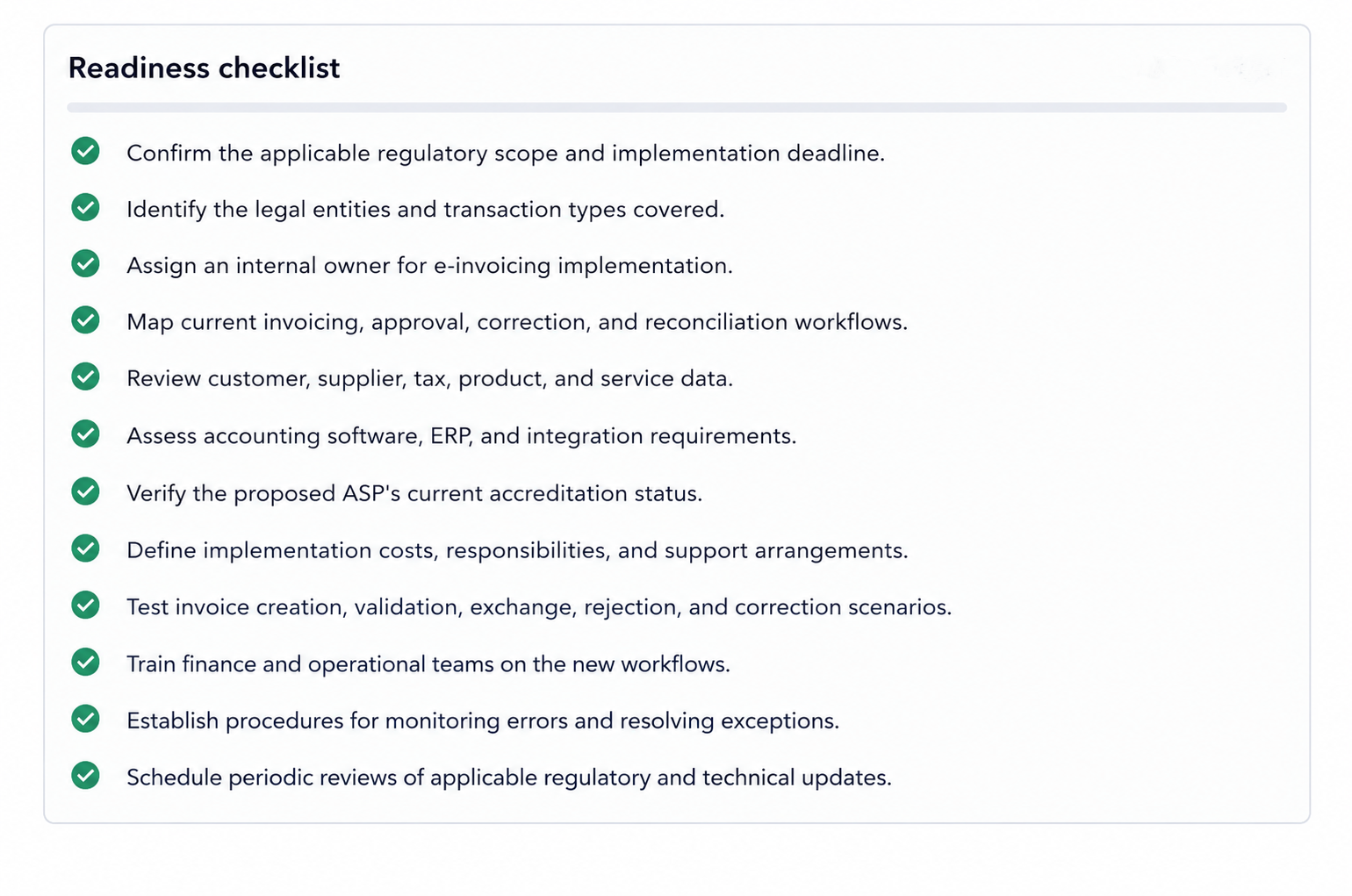
The checklist is a planning aid, not a substitute for verifying the legal requirements that apply to a particular business. Companies with multiple entities, complex tax arrangements, or extensive system dependencies may need a more detailed assessment.
Conclusion
UAE e-invoicing represents a change in how businesses create, exchange, validate, and manage invoice data. Moving from PDFs and manual processing to structured electronic invoicing requires attention to more than software selection. Businesses need to understand their applicable obligations, prepare accurate financial data, assess existing systems, choose a suitable ASP, and establish processes for monitoring transactions and resolving errors.
Early preparation gives finance, IT, and operational teams time to identify integration gaps, test realistic invoice scenarios, and clarify responsibilities before mandatory implementation begins. It also helps businesses evaluate whether their existing accounting platform can support the transition or requires additional configuration and connectivity.
The most effective starting point is a structured readiness assessment: establish the applicable requirements, map current invoicing workflows, evaluate software and ASP options, and create a practical implementation plan based on the business’s actual needs. Working with experienced e-invoicing implementation solution providers in UAE can also help businesses assess their technical requirements, plan integrations, and coordinate implementation activities around their existing systems.
How OfficeHub Tech Can Support UAE E-Invoicing Readiness
Preparing for UAE e-invoicing requires businesses to assess how their existing accounting systems, financial data, and business workflows align with the applicable technical requirements. OfficeHub Tech helps businesses evaluate and configure relevant Zoho-based applications and plan integrations that support their operational needs.
Depending on the project scope and platform capabilities, implementation support may include:
- Accounting Workflow Assessment: Reviewing invoice processing, customer records, tax details, and existing financial workflows.
- Zoho Books Configuration: Assessing organisation settings and supported features against business requirements.
- Integration Planning: Identifying data exchange requirements between accounting software, ERP systems, and other connected applications.
- Data Preparation and Validation: Reviewing field mappings, data consistency, and validation requirements to help reduce avoidable processing errors.
- Workflow Testing: Testing relevant configurations and integrations to identify issues before deployment.
The implementation approach depends on the business’s current technology, integration requirements, and selected Accredited Service Provider (ASP). Required e-invoicing functionality, connectivity, and compliance-related capabilities must be verified with the relevant software provider and ASP. Responsibilities should also be clearly defined across the implementation team, internal IT, and finance department.
The goal is to prepare a practical e-invoicing workflow that fits the existing business environment while avoiding unnecessary system changes. OfficeHub Tech can help assess relevant Zoho Books workflows, identify integration requirements, and plan technical implementation steps within the agreed project scope.
Planning your UAE e-invoicing implementation?
Connect with The Certified Zoho implementation and consultation partner in UAE, OfficeHub Tech for support with services to assess your accounting workflows and identify the technical requirements for your business.