

Introduction
Implementing UAE eInvoicing involves more than installing software or converting invoices into digital documents. It changes how businesses prepare invoice data, integrate financial systems, exchange transactions, process status messages, and manage exceptions. Established ERP and accounting systems may require additional configuration to support the process.
The UAE framework relies on structured invoice data, the Peppol network, UAE-specific PINT-AE requirements, and Accredited Service Providers (ASPs). According to the Ministry of Finance, eInvoices must be exchanged electronically as structured data and reported to the Federal Tax Authority (FTA). PDFs, scanned documents, images, and email attachments alone do not qualify as eInvoices.
The main challenge is integrating these requirements reliably. Incorrect data mapping can prevent validation, incomplete integrations can interrupt transactions, and unhandled status messages can create uncertainty for finance teams.
Effective UAE eInvoicing Implementation relies on accounting systems that can manage structured invoice data, enable electronic document exchange, and monitor transaction status.
Understanding the most common implementation challenges early helps businesses make informed technology decisions, reduce avoidable rework, and build a process that remains manageable after go-live.
##Quick Answer
The main challenges in UAE eInvoicing implementation include adapting legacy ERP and accounting systems, generating correctly structured PINT-AE invoice data, integrating applications with an Accredited Service Provider, establishing reliable Peppol connectivity, managing complex invoice scenarios, and processing validation responses and failures. Businesses must also coordinate finance and IT teams, control implementation costs, and maintain reliable monitoring after go-live. Addressing these issues requires an end-to-end implementation approach rather than a software installation alone.
Key Takeaways
- Existing ERP or accounting software may need configuration, integration, or an additional application to support the required eInvoicing workflow.
- Generating structured invoice data involves more than exporting a document; data mapping, business rules, and technical validation must work together.
- Peppol connectivity does not eliminate the need to manage invoice statuses, reporting, rejections, retries, and reconciliation.
- Complex transactions and multiple business systems increase integration and testing requirements.
- Clear ownership across finance, tax, IT, and operations helps prevent unresolved technical issues from becoming business disruptions.
- Implementation does not end at go-live. Monitoring, exception management, system updates, and operational support remain important.
Why UAE eInvoicing Implementation Is More Complex Than a Software Upgrade
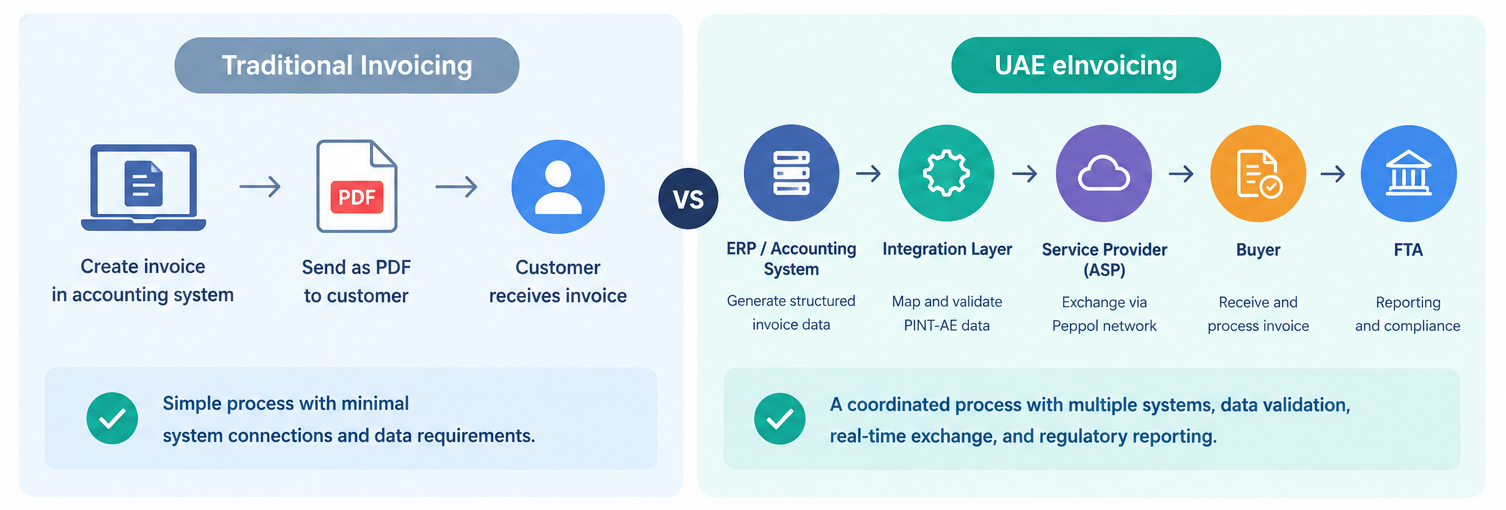
Traditional invoicing typically involves generating an invoice in an accounting system and sending it to the customer as a PDF. UAE eInvoicing introduces a structured exchange process in which invoice data must meet specific requirements and pass through the appropriate service-provider and reporting arrangements.
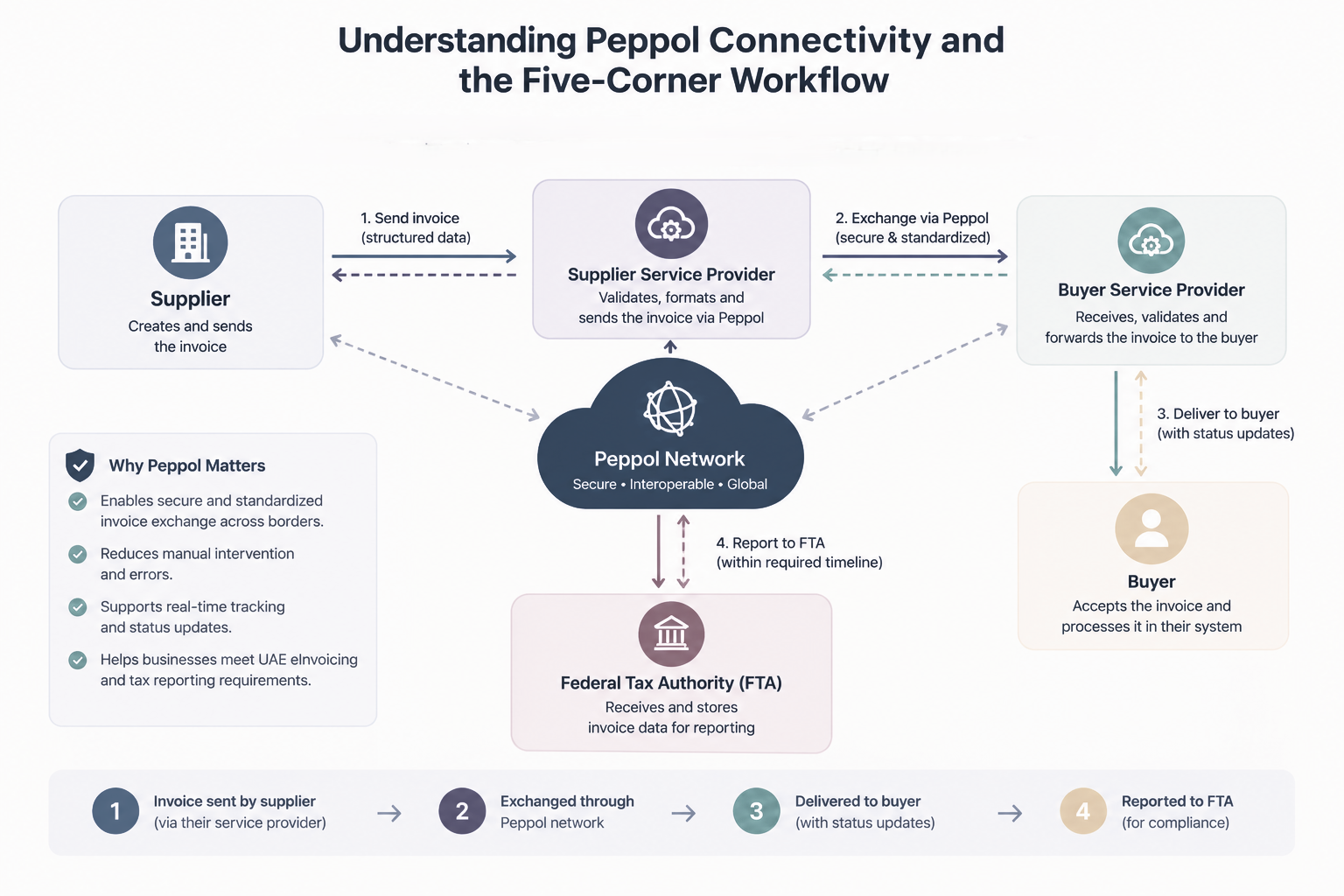
The UAE framework follows the Decentralized Continuous Transaction Control and Exchange (DCTCE) approach, using a five-corner model. The supplier and buyer interact through their respective service providers, while the fifth corner represents the tax authority’s reporting function. The Ministry of Finance explains this architecture in its official eInvoicing guidance.
Implementing this model requires coordination across multiple technical components. Source systems must supply accurate invoice data, integration services must map and transfer it correctly, and the service-provider connection must support the required exchange. Businesses must also process responses and maintain reliable transaction records.
Consider an invoice containing an incorrect tax classification. Even if the integration connection works correctly, the invoice may fail validation. Similarly, an invoice may be transmitted successfully, but the accounting system may not reflect its latest status if provider responses are not processed correctly.
These dependencies make end-to-end testing essential. Businesses need to verify not only that individual systems connect, but also that invoice data, validation, transmission, responses, and reporting work together throughout the transaction lifecycle.
Common UAE eInvoicing Implementation Challenges
1. Adapting Legacy ERP and Accounting Systems
Many businesses rely on established ERP or accounting platforms to manage sales, procurement, inventory, billing, and financial reporting. Although these systems may generate conventional invoices accurately, they may not meet every UAE eInvoicing requirement.
Legacy applications may store tax information in fields that do not map directly to the required invoice structure. They may also lack suitable interfaces for sending invoice data to an Accredited Service Provider (ASP) or processing external status messages.
Custom-built systems can present further challenges when documentation is incomplete, original developers are unavailable, or integration methods are outdated.
However, replacing the entire ERP is not always necessary. The right approach depends on the system’s capabilities and identified gaps. Some businesses may need configuration changes, while others may require an integration layer, an additional application, or targeted development.
For example, an ERP can continue managing sales orders, customer records, and financial transactions while a separate integration component transforms invoice data and coordinates submission to the chosen provider.
The priority is to preserve the ERP as the authoritative source for its records. Any additional application must avoid duplicate invoice numbers, conflicting business rules, and inconsistent financial records.
How to address the challenge: Develop the solution based on the existing system’s functional capabilities and limitations. Define the responsibilities of the ERP, accounting application, integration layer, and provider before development begins. This reduces unnecessary replacement costs while making technical gaps explicit.
2. Converting Business Data into PINT-AE-Compliant Invoice Information
One of the key technical challenges in UAE eInvoicing is converting business records into compliant structured invoice data.
PINT-AE is the UAE-specific implementation of Peppol International invoicing requirements. It defines the structured data and validation rules businesses must follow during eInvoicing.
An invoice may appear correct on screen but still fail processing due to missing customer identifiers, incorrect tax category mapping, or mismatched line-item and invoice totals. Additionally, ERP fields may differ in meaning or format from their corresponding structured invoice fields. Businesses must therefore validate data mapping and ensure compliance with applicable PINT-AE specifications and business requirements.
These issues generally fall into three categories:
- Data mapping problems: Source-system fields are mapped to the wrong destination fields, omitted, or transformed incorrectly.
- Structural validation problems: The generated invoice does not satisfy the required format, data types, mandatory fields, or other applicable schema and specification rules.
- Business-rule problems: The structure may be technically valid, but the information or relationships between fields do not satisfy the applicable invoice requirements.
The distinction matters because each problem requires a different response. Correcting an XML structure will not resolve an incorrect tax classification in the source data. Similarly, cleaning customer records will not fix an integration that places a value in the wrong field.
Tax calculations and rounding rules can create further complications. Invoice-level totals must remain consistent with line items, discounts, charges, tax amounts, and applicable rounding behaviour. Credit notes and adjustments may also require different data relationships from standard invoices.
How to address the challenge: Define a documented mapping between the source application and the required invoice structure. For businesses using Zoho Books, Zoho Peppol integration can form part of the process of connecting accounting data with Peppol-based eInvoicing. Validate representative transactions against the applicable specifications, and test both technical format and business-level consistency. Treat transformation logic as a controlled component that needs testing whenever source fields, tax configurations, or applicable requirements change.
3. Integrating ERP, Accounting Software, and an Accredited Service Provider
An eInvoicing workflow often spans multiple applications. Invoice data may originate in an ERP, customer information may reside in a CRM, and finance teams may use accounting software for posting and reconciliation. The Accredited Service Provider (ASP) connection adds another essential component. In the UAE, Zoho is registered as an Accredited Service Provider, making its role in the eInvoicing ecosystem relevant when businesses evaluate their implementation approach.
The challenge is ensuring consistent data exchange without delays, duplicate records, or gaps in transaction status. Depending on the systems involved, integration may use APIs, supported connectors, webhooks, middleware, or controlled file-based exchange. APIs enable applications to exchange invoice data and retrieve responses, webhooks notify systems about events, and middleware coordinates data transformation and communication.
However, connectivity alone does not guarantee reliability. If an invoice submission times out, the source system may not know whether the receiving service processed it. Resubmitting without checking the transaction status could create duplicates, while failing to retry could leave the invoice unprocessed.
Authentication failures, expired credentials, API rate limits, temporary outages, and provider interface changes can also interrupt processing.
A reliable integration must handle communication failures and distinguish between failed requests, accepted submissions, and transactions with unknown outcomes. This helps maintain accurate records, prevent duplicate submissions, and support consistent eInvoicing operations.
How to address the challenge: Establish clear ownership of invoice data, use stable transaction identifiers, and implement appropriate duplicate-prevention and retry controls where supported. Record integration events and errors, reconcile source transactions with provider responses, and ensure unresolved records remain visible to the responsible team.
The goal is not simply to connect systems. It is to maintain consistency across them.
4. Understanding Peppol Connectivity and the Five-Corner Workflow
Peppol provides the interoperability framework for electronic invoice exchange under the UAE model. Businesses must understand how their chosen Accredited Service Provider (ASP) supports participant identification, routing, validation, and invoice exchange.
A common implementation mistake is treating successful transmission as proof that the transaction is complete. The UAE’s five-corner model involves multiple interactions and status updates. The supplier submits invoice data to its provider, which validates and transmits the structured invoice through the relevant provider connection. Tax data is reported through the prescribed process, while the buyer-side provider validates and delivers the invoice to the buyer.
Peppol Five-Corner E-Invoicing Workflow
Integration responsibilities extend beyond connectivity. Systems must process the correct messages, associate responses with the relevant invoice, and accurately represent transaction status within the business application.
Two important concepts are the Tax Data Document (TDD) and Message Level Status (MLS). Broadly, TDD relates to tax-data reporting, while MLS communicates a message’s status or related processing step. Their handling must follow applicable technical specifications and provider implementations.
Without proper response handling, finance users may see a generic “sent” status without knowing whether validation succeeded, the invoice reached the buyer-side provider, or the required reporting step was completed. Businesses must ensure provider responses are recorded, tracked, and accessible to the relevant teams.
How to address the challenge: Map the complete exchange and reporting workflow before configuring the integration. Identify which system receives each response, what each status means, and how that status changes the transaction record. Confirm the actual behaviour with the selected ASP rather than assuming all providers expose identical interfaces or status terminology.
5. Managing Complex Transactions and Multiple Business Systems
Not every invoice follows the same path. Businesses may manage multiple legal entities, locations, currencies, tax treatments, and billing applications. Invoices can originate from sales, service management, subscriptions, procurement, or project-based workflows, making implementation more complex.
For example, product sales and service contracts may use different systems with distinct customer identifiers, tax configurations, and numbering conventions. Integrating these sources into a common eInvoicing workflow requires careful data mapping while preserving each transaction’s identity.
Credit notes, corrections, discounts, and partial billing introduce additional complexity. Systems must maintain links to relevant original transactions and apply the appropriate business and technical rules.
Cross-border transactions and special customer arrangements may also require separate analysis. Using the same accounting application does not mean every transaction follows identical requirements.
Risks increase when testing covers only standard domestic invoices. A workflow that handles a straightforward transaction may fail when processing credit notes, different tax treatments, or invoices generated by another business unit.
How to address the challenge: Build a representative set of transaction scenarios based on actual business operations. Include relevant invoice types, adjustments, entities, tax treatments, currencies, and source systems. Test how each transaction moves through the integration and how its status and references are preserved. Prioritise scenarios according to business impact and applicable requirements.
6. Preventing Invoice Rejections and Unresolved Transactions
Invoice rejection is more than a technical inconvenience. It adds to the finance team’s workload, slows subsequent operations, and makes it harder to track transaction statuses accurately.
Rejections may result from missing information, invalid identifiers, incorrect tax data, structural errors, or failed business rules. Connectivity issues, incomplete responses, and system interruptions can also complicate processing.
One major challenge is identifying whether an invoice has been rejected or its transaction status remains unconfirmed. Without a provider response, businesses should not assume the invoice succeeded or failed. Blind retries may cause duplicate processing, while manually investigating every exception becomes costly as volumes grow.
A robust implementation requires an exception-handling process that connects technical errors with business actions. It should capture error details, link them to the invoice, assign responsibility, and support controlled resolution.
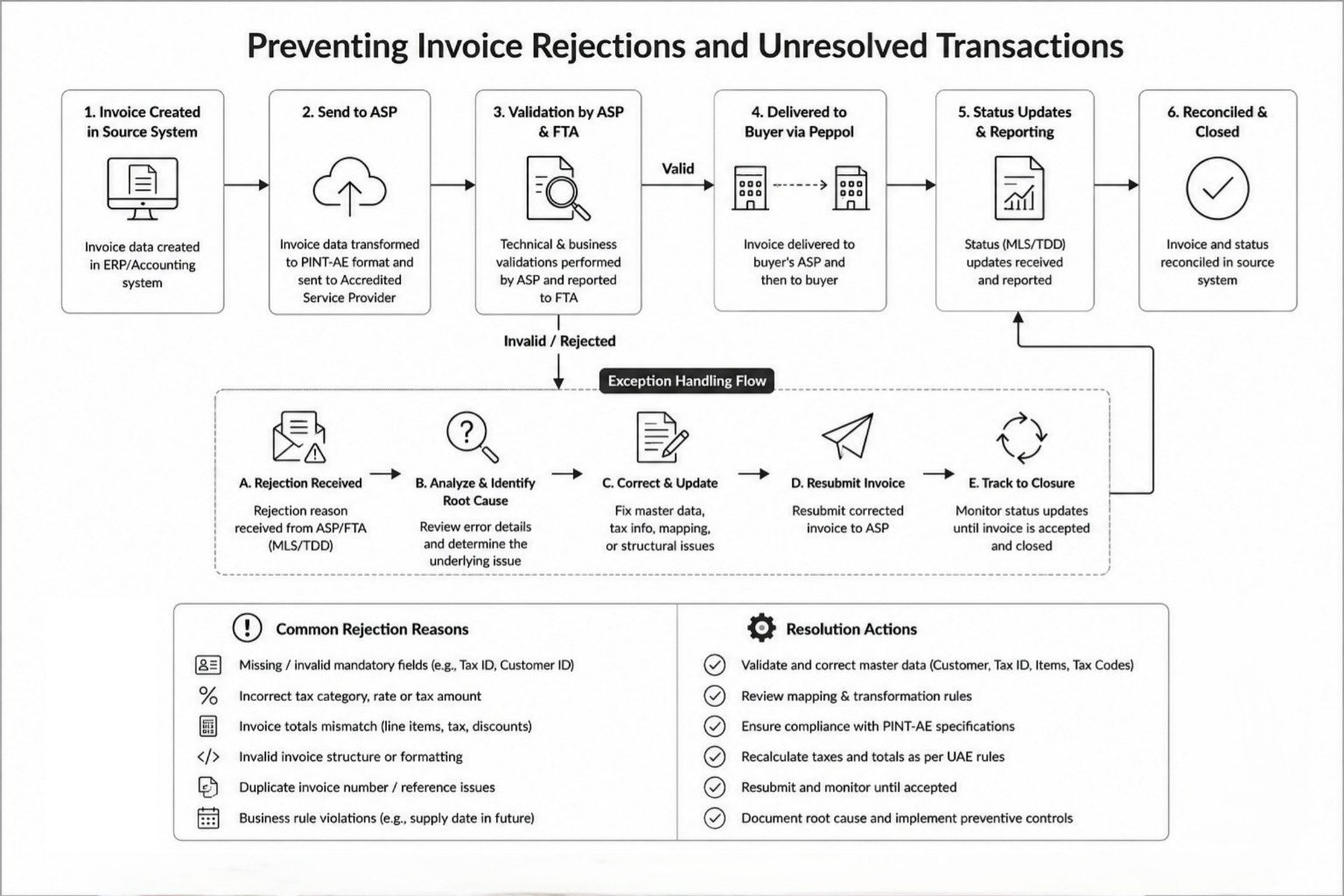
For example, an incorrect customer identifier requires master-data correction, whereas a temporary connection failure may need a controlled retry. Each case requires an appropriate resolution procedure.
When correction or resubmission is necessary, businesses should preserve the original invoice record and transaction history rather than silently overwriting evidence.
How to address the challenge: Use actionable error categories, visible exception queues, controlled retries, and documented resolution procedures. Establish escalation rules for unresolved transactions and reconcile invoice records with the relevant provider statuses. Track recurring errors so the business can fix underlying causes instead of repeatedly correcting individual invoices.
7. Coordinating Finance, Tax, IT, and External Vendors
UAE eInvoicing implementation involves multiple departments and external vendors. Finance manages billing and reconciliation, tax specialists interpret regulatory requirements, IT handles architecture and connectivity, and operations understand how transactions originate. External vendors may manage ERP configuration, integration development, and ASP services.
When these teams work independently, requirements can become inconsistent. For example, technical teams may build interfaces without accounting for rejected invoices, while finance teams may expect automatic status updates that connected applications cannot support. Vendors may also overlook critical business scenarios missing from documented requirements.
Unclear accountability further complicates incident resolution. When an invoice encounters an error, teams need to determine whether it stems from inaccurate source data, integration issues, service provider connectivity, or internal business workflows.
How to address the challenge: Define responsibilities for requirements, technical design, testing, approval, exception resolution, and ongoing support. Maintain a shared view of transaction flows and dependencies. Agree on who investigates each category of failure and how issues move between internal teams and external providers.
The objective is to make implementation a coordinated business and technology initiative rather than an isolated IT project.
8. Controlling Implementation Timelines, Costs, and Scope Creep
Implementation costs extend beyond software licensing to include configuration, integration development, data transformation, testing, vendor support, staff training, and maintenance.
Costs may rise when technical gaps emerge late, custom transformation logic becomes necessary, documentation is incomplete, or poor-quality data requires remediation. Scope creep can also increase expenses when additional transaction types, applications, reporting requirements, or workflows fall outside the original plan.
Reducing testing to meet deadlines can create costly issues later, especially when integrations fail under higher transaction volumes or less common invoice scenarios.
Businesses should distinguish one-time implementation expenses from recurring operating costs. Ongoing support, provider charges, integration maintenance, monitoring, software updates, and regulatory changes all influence the total cost of ownership.
How to address the challenge: Divide the project into clear phases, define the scope of each phase, and document dependencies. Prioritise essential workflows and high-impact risks. Estimate the effort for data transformation, integration, testing, and support separately instead of treating implementation as a single software expense.
A realistic plan should also include time to resolve defects and validate end-to-end behaviour before production use.
9. Maintaining Reliability After Go-Live
Go-live marks the start of live operations, not the end of implementation. Businesses must continuously manage exceptions, system changes, provider communications, and operational performance.
Workflows that succeed during testing may behave differently under real transaction volumes. Temporary outages can create backlogs, API changes may disrupt integrations, and new business entities or billing processes may introduce unmapped data.
If these problems are not tracked, they may remain undetected until finance teams notice missing status updates or discrepancies in transaction records.
Operational reliability also depends on access controls, record retrieval, audit trails, and incident response. Businesses must be able to verify what was submitted, which response was received, what action followed, and whether the transaction was resolved.
Retention and access policies should align with applicable requirements. Monitoring must also distinguish technical failures from business exceptions requiring human intervention, ensuring issues are identified, investigated, and resolved efficiently.
How to address the challenge: Establish an operational support model with named owners, monitoring, escalation procedures, and change management. Track measures such as rejection rates, unresolved transaction counts, recurring integration failures, and exception-resolution time as internal performance indicators. Review them regularly to identify problems before they become widespread.
A sustainable implementation combines reliable technology with clear operating procedures and ongoing ownership.
Industry Research on UAE E-Invoicing Readiness
As businesses prepare for the UAE’s structured eInvoicing framework, system readiness and automated invoice processing are becoming important implementation priorities.
ClearTax’s State of E-Invoicing Readiness 2026 surveyed more than 500 UAE finance leaders across 11 sectors between April and May 2026, assessing readiness across 13 benchmarks. Read the ClearTax UAE CFO survey report.
According to the survey, 60.5% of respondents reported that their ERP could not generate a compliant eInvoice. Additionally, 70.4% could not automatically process tax-authority clearance or rejection responses, while 73.3% lacked a post-go-live operational plan. The overall readiness score was 57.5%.
These findings highlight three implementation challenges: ERP capability gaps, limited response automation, and insufficient operational planning.
As a vendor-conducted survey, these results should not be interpreted as official UAE government statistics or as representative of every business. Preparedness depends on the current software infrastructure, the number of transactions processed, and the specific needs of the implementation.Top of FormBottom of Form
The key takeaway is that software selection alone is insufficient. Businesses must validate their integration architecture, test response handling, and establish ongoing operational support.
How Businesses Can Reduce UAE eInvoicing Implementation Risks
The most effective way to reduce implementation risk is to connect technical decisions with the business outcomes they are intended to protect.
Prioritise high-impact workflows
Identify where invoicing failures would cause the greatest disruption, such as ERP integration for distributors or invoice generation from service records.
Design around existing capabilities
Define system responsibilities, maintain authoritative financial records, and introduce middleware only when it adds clear value.
Validate data early
Test source fields, mappings, tax classifications, calculations, and references before building extensive automation to reduce validation failures and rework.
Test complete transaction lifecycles
Verify invoice creation and delivery, handle rejected transactions and connectivity issues, test retry mechanisms and corrections, and ensure accurate reconciliation. Ensure every transaction has a traceable status and clear next steps.
Establish operational ownership
Assign responsibility for monitoring, exceptions, tax-related interpretation, provider coordination, and system changes. Document escalation procedures for unresolved issues.
Measure and improve continuously
Track rejection rates and unresolved transactions to identify recurring data, integration, or support problems. Address root causes instead of relying on manual intervention.
Together, these practices help businesses build a reliable eInvoicing implementation that supports daily operations and ongoing compliance.
Conclusion: Successful UAE eInvoicing Implementation Requires More Than Software
UAE eInvoicing implementation can become challenging when existing systems, structured invoice requirements, provider connections, and business processes are treated as separate problems. Legacy ERP limitations, incorrect PINT-AE data mapping, incomplete integrations, unclear transaction statuses, complex invoice scenarios, and weak post-go-live support can all undermine the reliability of the overall workflow.
Businesses can reduce these risks by designing around their existing systems, validating invoice data, testing end-to-end transaction flows, and establishing clear ownership for exceptions and ongoing maintenance. The right approach depends on the organisation’s architecture and business requirements; not every company needs to replace its ERP or adopt the same software configuration.
Choosing suitable eInvoice management software in the UAE helps businesses align technical requirements with practical system decisions and establish a dependable process for structured invoice exchange, accurate records, and manageable operations beyond go-live.
How OfficeHub Tech Can Help in EInvoicing Implementation
OfficeHub Tech helps businesses address the system and workflow challenges that can arise when implementing electronic invoicing. The appropriate scope depends on the applications already in place, the complexity of business processes, and the integration gaps that need to be resolved.
Support may include:
- ERP and accounting integration: Connecting existing business applications with the relevant eInvoicing workflow while preserving the appropriate source of financial records.
- Zoho Books and Zoho Peppol integration: Assessing how a Zoho-based environment can support the required invoice data and exchange process, subject to the capabilities of the selected services and configuration.
- Data mapping and transformation: Aligning source-system information with the required structured invoice format and resolving mapping gaps.
- Workflow and exception automation: Improving the visibility of transaction statuses, integration errors, and unresolved items for responsible teams.
- Testing and operational support: Supporting end-to-end validation, reconciliation processes, and ongoing monitoring.
As a Premium Zoho implementation and consultation partner in UAE, OfficeHub Tech can help businesses assess their existing systems and determine an appropriate approach to Zoho-based implementation and integration. An implementation or integration partner and an Accredited Service Provider have different roles. Businesses should verify the selected provider’s current accreditation and confirm which exchange and reporting functions it is responsible for delivering. OfficeHub Tech’s implementation scope should reflect the services it is engaged to provide and should not be confused with the regulated role of an ASP.
If your existing ERP, accounting application, or billing workflow presents integration challenges, OfficeHub Tech can help evaluate the technical gaps and identify a practical implementation approach suited to your business environment.