
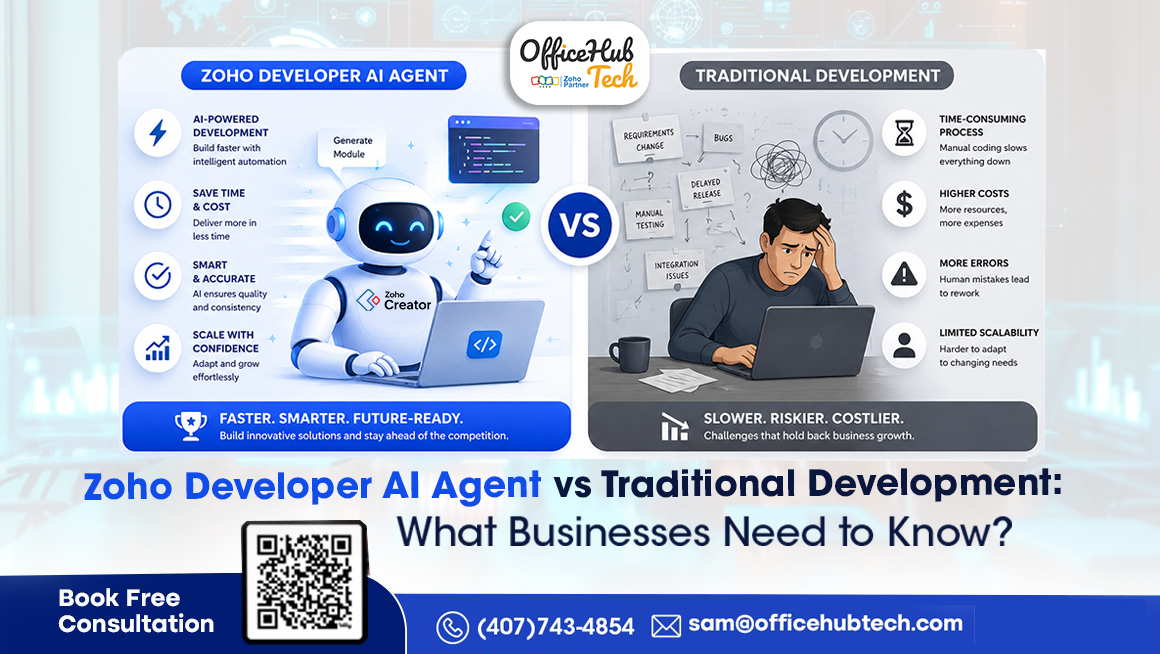
Why Businesses Are Rethinking Application Development
For decades, traditional software development has been the primary method for building business applications. It relies on structured stages such as requirement gathering, coding, testing, and deployment. While effective for earlier digital needs, this approach is becoming less suitable for today’s fast-changing business environment where speed and adaptability are critical.
Modern organizations are no longer focused only on building applications; they are focused on how quickly those applications can evolve when business requirements change. This shift has made the discussion around Zoho Developer AI Agent vs Traditional Development increasingly relevant for enterprises undergoing digital transformation.
Traditional development follows a linear, code-driven process where even small changes require multiple technical steps and development cycles. In contrast, businesses now require systems that can adapt continuously without long delays or heavy dependency on engineering teams.
The Zoho Developer AI Agent introduces an intent-driven approach where applications are shaped using natural language, AI-assisted workflows, and human validation. This allows faster creation, modification, and maintenance of business applications as operational needs evolve.
This is not about replacing developers but about enhancing how applications are built and maintained. AI helps streamline repetitive tasks while enabling faster adaptation to changing business logic.
This blog helps you clearly understand how both approaches differ and what that means for businesses choosing the right development strategy today.
Why Traditional Application Development Is Becoming a Business Bottleneck
Traditional application development has long supported enterprise software systems, but in today’s fast-changing business environment, it often slows down innovation instead of enabling it. The core issue is not capability but rigidity, where systems struggle to keep up with evolving business needs.
Long Development Lifecycle
Traditional development follows multiple stages like analysis, design, coding, testing, and deployment, making even small changes slow and time-consuming. This reduces business agility in fast-moving environments.
High Dependency on Technical Teams
Business users cannot directly modify workflows or features, which creates heavy reliance on developers. Even minor updates require technical intervention, increasing backlog and delaying decisions.
Difficulty in Handling Continuous Change
Modern businesses evolve frequently, but traditional systems are linear in nature. This makes iterative improvements difficult, often leading to repeated redevelopment cycles and higher complexity.
Rising Cost and Maintenance Burden
Long timelines, skilled resource dependency, and ongoing maintenance increase overall development costs. Over time, this contributes to technical debt and lowers ROI on digital systems.
Lack of Real-Time Adaptability
The biggest limitation is the inability to adapt in real time. Traditional development is reactive rather than adaptive, making it harder for organizations to respond quickly to market or operational changes.
What Is Traditional Development and How Does It Typically Work?
Traditional application development follows a structured Software Development Life Cycle (SDLC) focused on control, accuracy, and stability, but it is often time-intensive and highly dependent on technical teams.
The process begins with requirement gathering, where business needs are documented and translated into technical specifications. These are then passed to system architects who design the application structure, including databases, workflows, and integrations. After this, developers perform manual coding and configuration, which is usually the most time-consuming stage.
Once development is completed, the application moves into testing and quality assurance, where issues are identified and fixed through multiple iterations before final deployment. After release, ongoing maintenance and updates continue based on system requirements.
The typical flow is:
Business Requirement → Analysis → Design → Development → Testing → Deployment → Maintenance
While this approach ensures reliability and control, it follows a strictly sequential model where each phase depends on the completion of the previous one. This creates slower delivery cycles and reduces flexibility in responding to changing business needs.
Another limitation is the separation between business users and developers. Any change in requirements must go through formal requests and redevelopment cycles, which further delays updates and innovation.
Traditional development is best suited for complex, specialized systems where stability and precision are more important than speed. However, in fast-changing business environments, it often lacks the flexibility needed for continuous evolution.
This gap between business speed and technical execution is one of the key reasons organizations are now exploring AI-driven approaches like Zoho Developer AI Agent.
What Is Zoho Developer AI Agent and How Does It Transform Application Development?
The Zoho Developer AI Agent represents a shift from traditional code-centric development to an intent-driven approach where business requirements can be translated into working applications using artificial intelligence. Instead of relying entirely on lengthy development cycles involving technical analysis, coding, testing, and deployment, businesses can describe their requirements in natural language and use AI assistance to accelerate application creation within Zoho Creator.
At its core, the Zoho Developer AI Agent combines Large Language Models (LLMs), Model Context Protocol (MCP), and Zoho Creator APIs to convert business intent into executable application components. The AI interprets user requirements, identifies workflows, data structures, and automation needs, and then executes the required actions within Zoho Creator through structured tools and APIs.
Key capabilities include:
- AI-assisted application generation from business prompts
- Automated creation of forms, workflows, and data models
- Faster adaptation to changing business requirements
- Reduced manual configuration and development effort
- Continuous refinement and application enhancement
Unlike traditional development, where every change often requires developer intervention, the Zoho Developer AI Agent enables a collaborative Human + AI model. Business users can participate more actively in application development while technical teams focus on governance, integrations, and strategic decision-making. This approach helps organizations improve development speed, agility, and alignment between business needs and technology execution.
How Zoho Developer AI Agent Works: From Business Idea to Working Application
One of the biggest differences between Zoho Developer AI Agent and traditional development is how business requirements are transformed into working applications. Instead of following a lengthy code-first process, the AI Agent converts business intent into executable actions within Zoho Creator.
Step 1: Business Requirement Becomes a Natural Language Prompt
The process begins when a user describes a requirement in plain language, such as:
“Create a Vendor Management System with onboarding, approval workflows, compliance tracking, and reporting.”
Unlike traditional development, detailed technical specifications are not required upfront.
Step 2: Claude AI Interprets Business Intent
Claude AI acts as the reasoning engine behind the Zoho Developer AI Agent. It analyzes the prompt, identifies workflows, data relationships, and business objectives, then creates a structured execution plan.
Step 3: MCP Converts Intent into Executable Actions
Model Context Protocol (MCP) serves as the bridge between AI and Zoho Creator. It exposes Zoho Creator capabilities as structured tools, enabling the AI Agent to create applications, configure workflows, define data models, and update business logic.
Step 4: Zoho Creator APIs Execute the Build Process
Zoho Creator APIs execute the selected actions in real time, automatically generating application components, workflows, and business logic with significantly less manual effort.
Step 5: Human Validation and Refinement
Business users and technical teams review the generated application to validate workflows, business rules, and compliance requirements before deployment.
Step 6: Deployment and Continuous Optimization
Once approved, the application is deployed and can be continuously refined through new prompts as business requirements evolve.
Simplified Workflow:
Demo Preview: Learn how Zoho Developer AI Agent builds smarter applications in real time.
Why This Matters Compared to Traditional Development
Traditional development converts requirements into code. The Zoho Developer AI Agent converts business intent into executable actions. By combining Claude AI, MCP, and Zoho Creator APIs, businesses can accelerate development, reduce manual effort, and adapt applications more quickly as operational needs change.
Technical Architecture Differences: Zoho Developer AI Agent vs Traditional Development
Traditional development follows a code-centric, linear architecture, while the Zoho Developer AI Agent follows an intent-driven, AI-assisted architecture. The key difference lies in how business requirements are interpreted, transformed, and continuously evolved into working applications.
Traditional Development Architecture (Code-Centric Model)
In traditional systems, every application begins with structured technical planning before any implementation happens. Business requirements are converted into detailed specifications, which developers then translate into code using programming languages, frameworks, and database structures.
Architecture Flow:
Business Requirement → Technical Design → Manual Coding → Testing → Deployment → Maintenance
This model provides strong control, deep customization, and predictable system behavior. However, it is heavily dependent on skilled developers and follows a rigid, sequential process. Any change in requirement often requires revisiting multiple stages, making iteration slow, costly, and resource-intensive.
Zoho Developer AI Agent Architecture (Intent-Driven Model)
The Zoho Developer AI Agent shifts application development from a coding-first approach to an intent-driven model. Instead of starting with technical specifications, users describe business requirements in natural language. Claude AI interprets the intent, MCP (Model Context Protocol) translates it into executable actions, and Zoho Creator APIs generate application components such as forms, workflows, data models, and business logic.
AI-Driven Architecture Flow: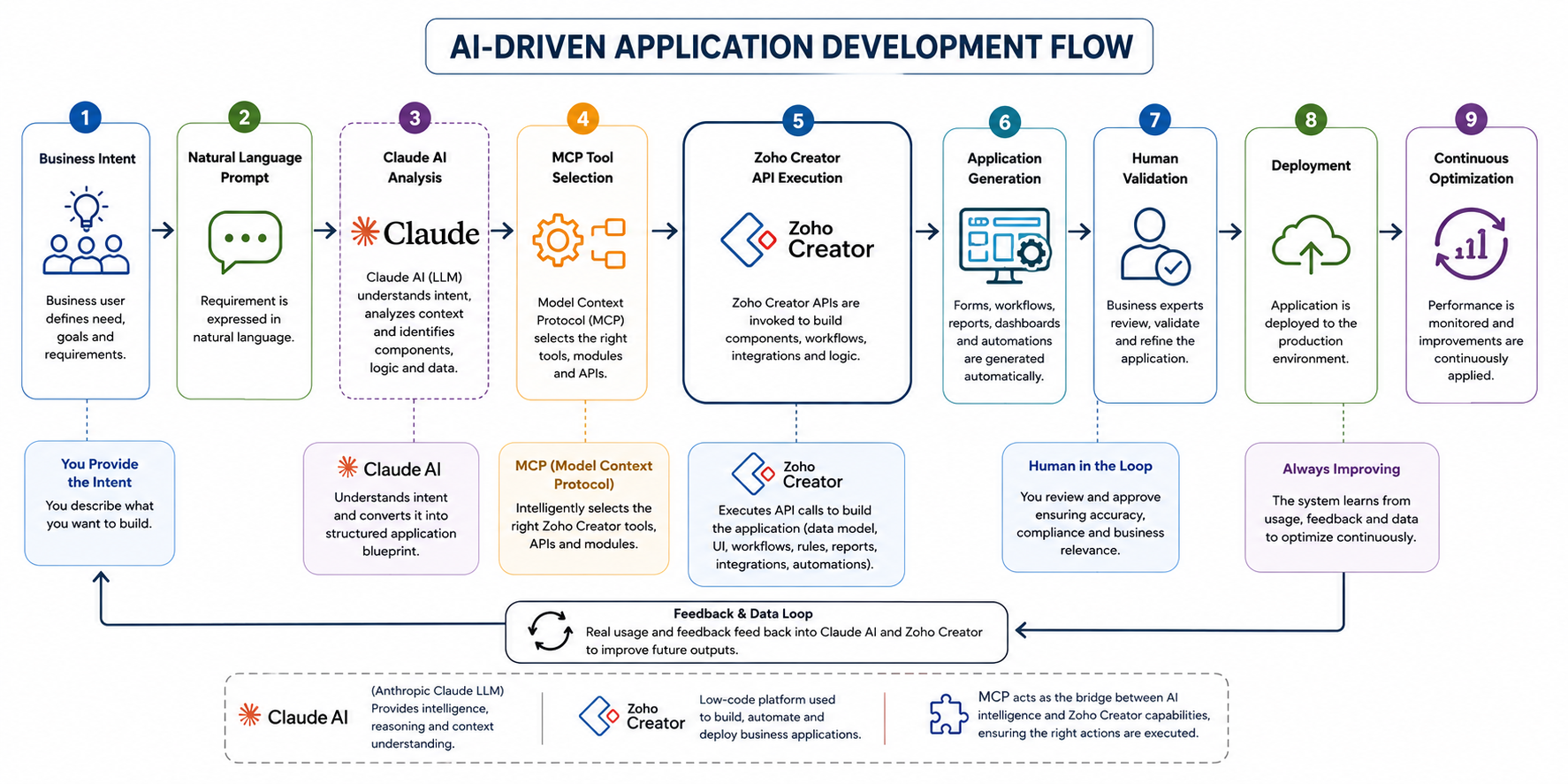
This architecture reduces manual development effort, accelerates application delivery, and supports continuous improvement through AI-assisted updates. Unlike traditional development, which primarily relies on technical teams, the Zoho Developer AI Agent enables business users and developers to collaborate more effectively in creating, refining, and evolving applications.
Key Architectural Shift
The transformation from static, code-heavy systems to dynamic, AI-assisted architecture enables businesses to achieve greater agility, faster innovation, and improved alignment between operational needs and application behavior.
Zoho Developer AI Agent vs Traditional Development: Side-by-Side Comparison
This comparison highlights how traditional software development and the Zoho Developer AI Agent differ in execution, speed, flexibility, and business alignment. While both aim to build functional applications, their approach to delivery and adaptability varies significantly, especially in modern fast-changing business environments.
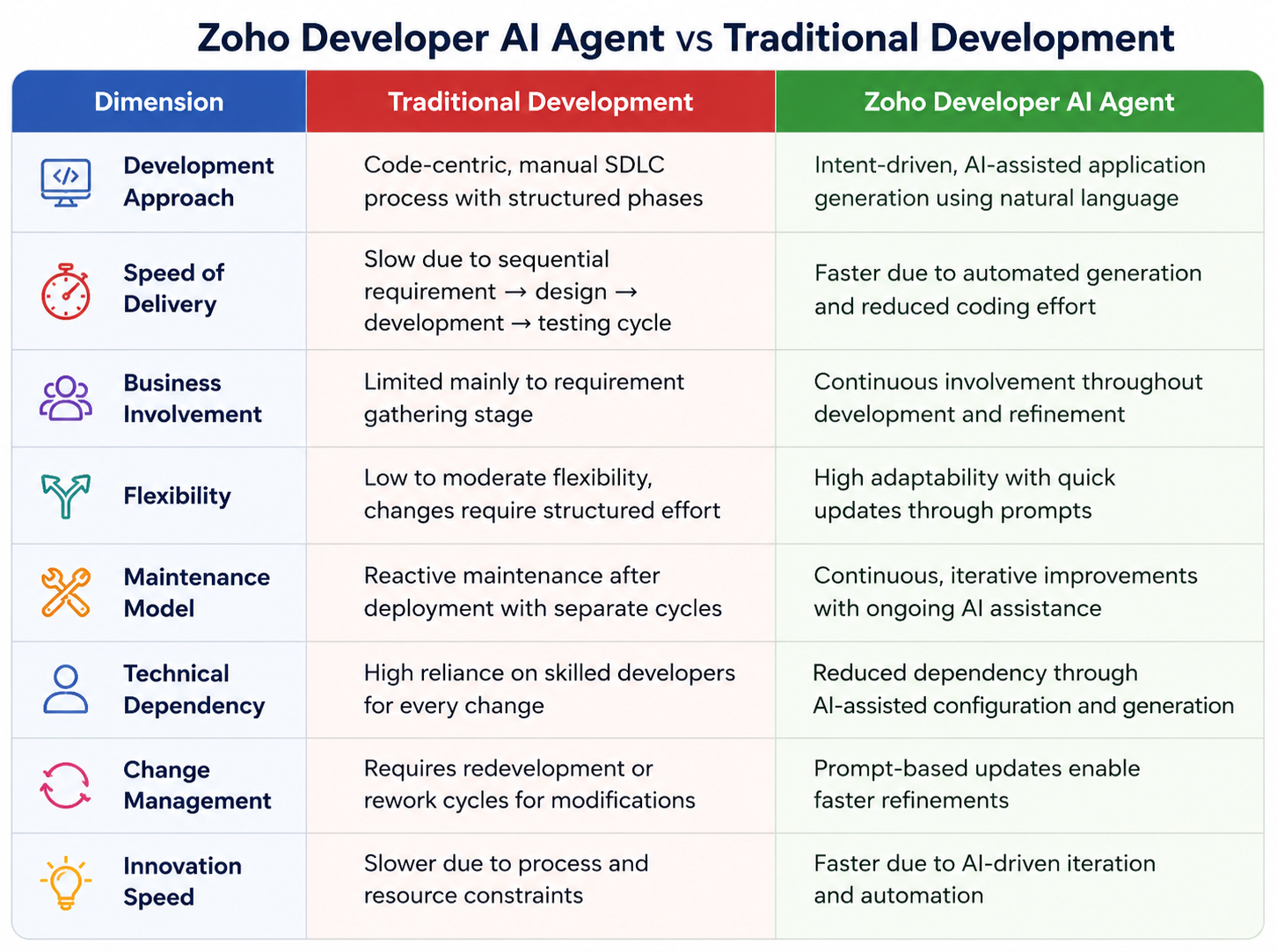
From a business perspective, traditional development prioritizes stability and control, while AI-assisted development focuses on agility and faster adaptation. Industries with frequent process changes benefit most from AI-driven approaches, whereas traditional development remains valuable for highly complex or legacy-integrated systems. The best choice depends on balancing agility, complexity, and long-term business goals.
Key Business Benefits of Choosing Zoho Developer AI Agent Over Traditional Development
The shift to the Zoho Developer AI Agent represents a strategic move from rigid development models to a more intelligent, adaptive, and business-driven application approach.
Faster Time-to-Market
- Automates application structure and workflow creation
- Eliminates long SDLC cycles
- Enables quicker response to business and market changes
Reduced Development Cost
- Lowers dependency on large development teams
- Minimizes repetitive coding and configuration work
- Allows developers to focus on complex logic and governance
Improved Business Agility
- Enables prompt-based updates instead of redevelopment cycles
- Supports rapid workflow changes without system disruption
- Helps organizations adapt quickly to evolving requirements
Higher Operational Efficiency
- Reduces waiting time for system modifications
- Improves execution speed of business processes
- Enhances overall team productivity and decision-making
Continuous Application Improvement
- Applications evolve with changing business needs
- Supports ongoing optimization and enhancements
- Creates a future-ready and adaptive digital system
Better Business–IT Collaboration
- Encourages shared participation in development
- Reduces communication gaps between teams
- Enables more iterative and aligned application building
Overall, the Zoho Developer AI Agent replaces traditional rigid development with a dynamic, continuously evolving model that supports faster innovation and stronger digital transformation outcomes.
Real Business Scenario: Traditional Development vs Zoho Developer AI Agent
This scenario compares how a Vendor Management System (VMS) is built in a manufacturing company using traditional development versus the Zoho Developer AI Agent, highlighting differences in speed, cost, and adaptability.
Traditional Development Approach
- Requirement gathering and stakeholder alignment: ~2 weeks
- System design and coding (vendor onboarding, approvals, tracking, reporting): 6–8 weeks
- Testing and bug fixing: ~2 weeks
- Deployment and stabilization: additional time required
- Total delivery time: 10–12+ weeks
- Any mid-cycle change often restarts development phases, increasing delays and cost
Zoho Developer AI Agent Approach
- Business requirement given in natural language (e.g., vendor onboarding, approvals, tracking, monitoring)
- AI interprets intent and auto-generates application structure in Zoho Creator
- Forms, workflows, and logic built in a significantly reduced cycle
- Business users validate and refine using prompts
- Functional system delivered in days to a few weeks depending on complexity
Key Business Outcome
- Traditional: slow delivery, high cost, rigid change cycles
- AI Agent: faster deployment, iterative updates, and adaptive workflows
Overall, the key difference is not only speed but continuous responsiveness to business changes, enabling faster time-to-value and improved operational agility.
Decision Matrix: Which Approach Is Right for Your Business?
Choosing between traditional development and the Zoho Developer AI Agent depends on business size, operational complexity, and how quickly an organization needs to adapt to change. The right choice is driven by speed, cost, and scalability requirements rather than a universal rule.
Startups and Fast-Growing Businesses
These organizations prioritize speed and agility. The Zoho Developer AI Agent enables rapid application building, fast iterations, and quick alignment with evolving business models, supporting faster growth cycles.
Small and Medium-Sized Businesses (SMBs)
SMBs focus on cost efficiency and simplicity. The AI Agent reduces dependency on large development teams and allows scalable system building with lower upfront investment.
Mid-Market Organizations
These businesses require both structure and flexibility. A hybrid model works best, using AI-driven development for workflows and traditional methods for complex integrations.
Large Enterprises
Enterprises prioritize stability, compliance, and legacy integration. Traditional development remains essential for core systems, while the AI Agent supports internal tools and automation.
Regulated Industries (Finance & Healthcare)
Strict compliance requirements make traditional development necessary for critical systems, but AI-assisted tools can still optimize non-core operational workflows.
Key Evaluation Factors
- Frequency of process changes
- Speed of delivery required
- Technical resource availability
- Customization and integration complexity
- Long-term scalability needs
Ultimately, the best approach is often a hybrid strategy, combining traditional development for control and Zoho Developer AI Agent for speed, agility, and continuous innovation.
When Traditional Development Still Makes More Sense
Traditional development continues to be relevant even with AI-assisted platforms like the Zoho Developer AI Agent, especially where control, complexity, and compliance are critical. The goal is to choose the right approach based on business and technical needs rather than replacing one with the other.
It is better suited for highly specialized systems requiring deep code-level customization, such as engineering platforms, performance-heavy applications, or algorithm-driven solutions. It is also essential for organizations relying on legacy systems, where stability, backward compatibility, and tightly integrated architectures are key requirements.
In regulated industries like banking, insurance, and government, strict compliance, auditability, and data governance make traditional development more reliable due to its transparency and full control over system behavior. Similarly, complex SaaS products often require architectural flexibility and performance optimization that goes beyond low-code capabilities.
For mission-critical systems where stability and predictability are more important than rapid iteration, traditional development remains the preferred choice. However, many organizations now adopt a hybrid approach, using traditional development for core systems while leveraging AI tools for internal applications and workflow automation.
Common Misconceptions About Zoho Developer AI Agent
As AI-assisted development becomes more widely adopted, certain misconceptions can create confusion about its role and capabilities.
AI Replaces Developers
The Zoho Developer AI Agent is designed to enhance developer productivity, not replace technical teams. Developers remain essential for architecture, integration, security, and complex logic design.
No Need for Human Validation
AI-generated applications still require business and technical review to ensure accuracy, compliance, and alignment with operational goals.
Fully Unlimited Application Creation
While highly flexible, AI-assisted development still operates within platform capabilities and architectural constraints. Complex systems may require hybrid approaches.
Traditional Development Will Disappear
Both models will coexist. Traditional development remains critical for core systems, while AI tools accelerate internal applications and workflows.
Only Large Enterprises Benefit
In reality, small and mid-sized businesses often gain the most value due to reduced dependency on large development teams and faster application delivery.
Signs Your Business Should Move Beyond Traditional Development
Many organizations continue with traditional development because it has worked historically, but increasing operational complexity often reveals its limitations over time.
A key sign is a growing backlog of application requests, where even minor changes take weeks or months, slowing productivity and decision-making. Another indicator is high dependency on technical teams, where business users cannot independently update workflows or processes, creating operational bottlenecks.
Frequent changes in business processes also expose limitations when systems remain static, forcing teams to rely on spreadsheets or manual workarounds. Similarly, rising development and maintenance costs signal inefficiency when a large share of IT effort is spent on continuous fixes and updates.
If technology is increasingly seen as slowing down innovation rather than enabling it, it becomes a strategic concern for growth-focused organizations. A lack of business-user involvement in application updates further widens the gap between operational needs and system execution.
When these challenges become consistent, it indicates that traditional development alone may no longer meet business demands. At this stage, organizations should evaluate more adaptive approaches like the Zoho Developer AI Agent, which supports faster iteration, better collaboration, and continuous application evolution aligned with changing business needs.
The Future of Application Development: AI-Assisted and Intent-Driven
Enterprise application development is evolving from code-centric processes to AI-assisted, intent-driven models. Instead of relying heavily on technical specifications and manual coding, AI can interpret business requirements expressed in natural language and convert them into application logic, workflows, and data structures.
A key trend is Human + AI collaboration, where AI handles repetitive development tasks while humans focus on validation, governance, and strategic decision-making. This improves both development speed and accuracy.
Organizations are also moving toward continuous application evolution, replacing lengthy redevelopment cycles with incremental, prompt-based updates. This enables faster innovation, smoother change management, and greater adaptability to evolving business needs.
As speed and agility become competitive advantages, AI-assisted platforms such as the Zoho Developer AI Agent are expected to play an increasingly important role in enterprise application development. Businesses that adopt these technologies can accelerate delivery, improve responsiveness to change, and strengthen digital transformation efforts while maintaining human oversight and control.
How OfficeHub Tech Helps Businesses Implement Zoho Developer AI Agent
Adopting the Zoho Developer AI Agent requires a structured transition from traditional development to AI-driven application delivery. OfficeHub Tech enables this shift by evaluating existing workflows, identifying inefficiencies, and aligning them with AI-assisted execution models to improve speed, accuracy, and operational efficiency.
The focus is on developing scalable, intelligent applications within Zoho Creator, where business intent is converted into workflows, data structures, and automation logic. Integration across CRM, finance, and operations ensures a unified and connected business ecosystem.
As a Trusted Zoho Developer AI Implementation Partner in USA, India, KSA and UAE, and an Authorized Zoho and n8n partner, OfficeHub Tech supports organizations in adopting practical and scalable AI-driven development strategies for long-term digital transformation.
For businesses planning to implement or build solutions using Zoho Developer AI Agent, OfficeHub Tech can help design tailored systems aligned with specific workflow requirements.
Conclusion
The comparison between Zoho Developer AI Agent and Traditional Development highlights a major shift in how business applications are built. Traditional development offers stability and control but often lacks the speed and flexibility needed in today’s fast-changing environment.
In contrast, the Zoho Developer AI Agent enables intent-driven development, where applications are created based on business needs instead of complex coding cycles. This results in faster delivery, greater adaptability, and continuous alignment between business and technology.
Organizations adopting this AI-assisted approach are better positioned for scalability, innovation, and rapid response to market changes. However, the most effective strategy is not full replacement but intelligent adoption, combining traditional development and AI-driven systems based on complexity, compliance, and operational requirements.