##Quick Answer
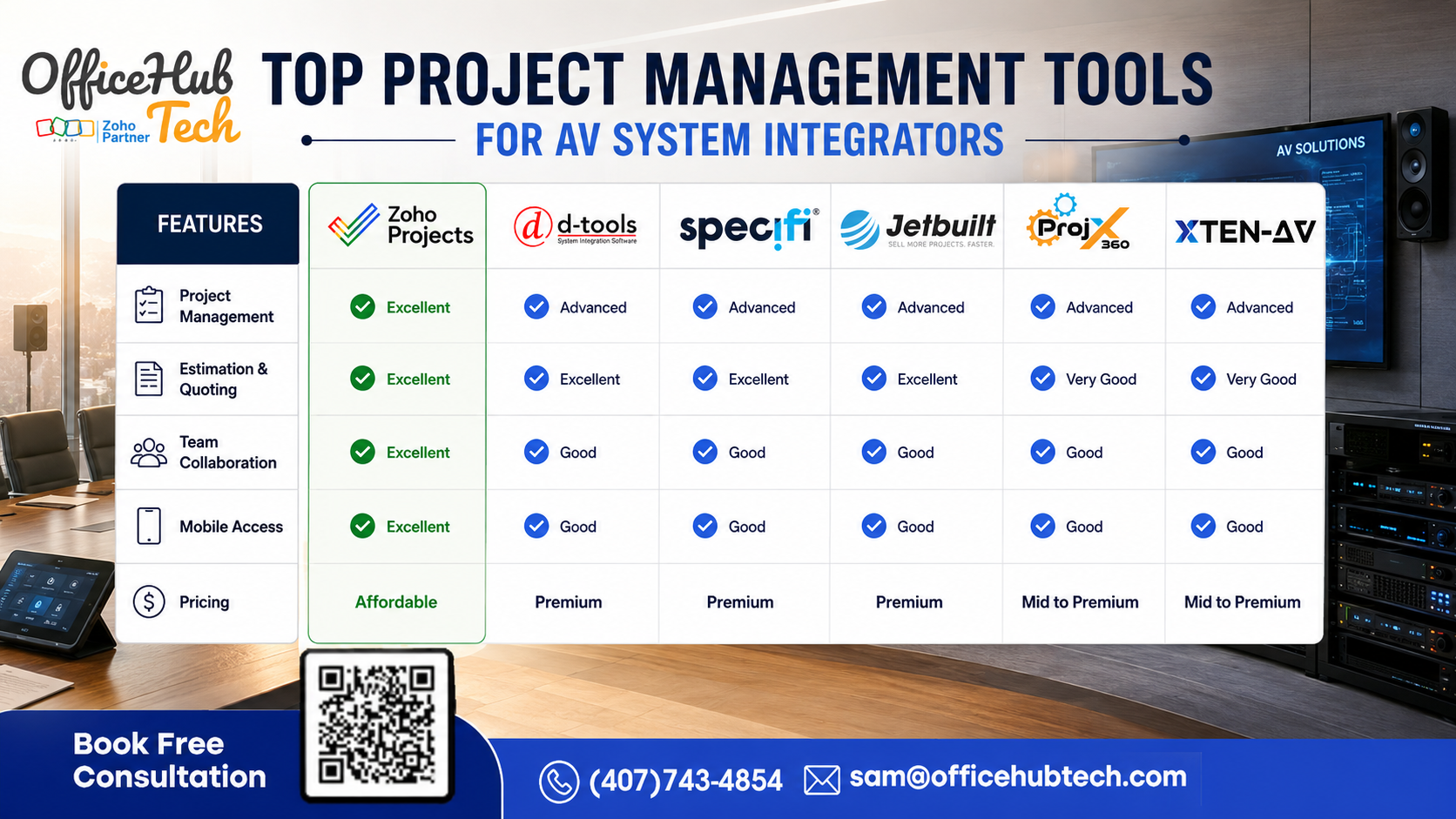
The best project management software for AV System Integrators depends on the type of workflow, level of customization, and integrations a business requires. D-Tools, Specifi.io, Jetbuilt, ProjX360, and X-PRO offer AV-focused project workflows, while Zoho Projects stands out for customization, automation, integrations, and scalability.
For integrators that need ready-made AV workflows, an AV-specific platform may be the better fit. For businesses looking to connect project management with CRM, finance, inventory, customer portals, analytics, and other systems, Zoho Projects is a strong overall choice for project management tools for AV system integrators.
##Key Takeaways
- AV System Integrators need project management software that supports complex installation workflows, not just basic task tracking.
- Project scheduling, resource management, time tracking, documentation, budgeting, automation, and integrations are key evaluation criteria.
- D-Tools, Specifi.io, Jetbuilt, ProjX360, and X-PRO provide AV-focused project management capabilities.
- Zoho Projects offers extensive customization, automation, integrations, reporting, and scalability.
- AV-specific platforms can be a better fit for businesses seeking ready-made industry workflows.
- Zoho Projects is a strong overall choice for integrators that prioritize flexibility, connected workflows, and broader business integration.
- The right platform ultimately depends on the integrator’s workflow, existing software ecosystem, and growth requirements.
Why Project Management Has Become a Critical Business Function for AV System Integrators
AV installation projects involve multiple teams and activities, including sales, design, engineering, procurement, warehouse coordination, technicians, programming, commissioning, documentation, and customer support.
As project volume grows, managing these activities through spreadsheets, emails, shared calendars, and disconnected applications becomes increasingly difficult. Delays in equipment delivery can affect technician schedules, while design changes can impact procurement, labor, and project timelines.
This makes project management software an operational control layer for AV businesses. It should connect tasks, schedules, resources, documents, costs, and project information—not simply function as a digital to-do list.
For AV system integrators, the right platform should help create a repeatable process for delivering projects on schedule, within budget, and with better visibility across teams.
What Should AV System Integrators Look for in Project Management Software?
Choosing project management software requires more than comparing the number of features listed by each vendor. AV integrators should evaluate how well a platform supports their actual project lifecycle and connects with the rest of their technology stack.
- Project Planning and Task Management: The platform should support milestones, dependencies, subtasks, Gantt charts, recurring activities, project templates, and task ownership.
- Resource and Installation Management: AV businesses need visibility into technician availability, workloads, schedules, installation phases, and site activities.
- Time and Cost Management: Time tracking, labor costs, budgets, expenses, and actual-versus-planned performance are important for protecting project margins.
- Documentation and Collaboration: Project drawings, site photographs, notes, change orders, technical documents, and customer communications should remain accessible to the appropriate teams.
- Automation: Automated notifications, approvals, recurring tasks, status updates, and workflow rules can reduce administrative work.
- Integration and Customization: The platform should connect with CRM, proposal, ERP, accounting, inventory, field-service, and other systems through APIs or supported integrations.
- Reporting: Project managers and executives need dashboards that show project progress, resource utilization, budget health, delays, and profitability.
Why AV Integrators Should Not Choose Project Management Software Based on Features Alone
A platform can offer dozens of features and still be a poor fit for an AV business. The more important question is whether those capabilities match the organization’s operating model.
An AV integrator managing residential automation projects may have very different requirements from a commercial integrator delivering hundreds of conference rooms across multiple locations. One business may prioritize service management and customer communication, while another may need resource planning, procurement coordination, and project profitability.
For this comparison, AV integrators should evaluate each platform across four key dimensions:
- Industry fit: Does the software support AV installation workflows?
- Operational fit: Can project managers and technicians use it efficiently in daily operations?
- Technology fit: Can it integrate with the systems already used by the business?
- Growth fit: Can it adapt as the company adds employees, projects, locations, services, and processes?
AV-specific platforms can provide ready-made workflows with less configuration, while flexible platforms such as Zoho Projects can require more setup but offer greater freedom to adapt workflows around the organization’s specific processes.
What Recent Project Management Research Says About Execution
Project-management technology matters because successful project delivery depends on turning plans into coordinated execution. A December 2025 global study from the Project Management Institute (PMI) surveyed more than 5,800 project professionals, stakeholders, and knowledge workers and found that only half of projects met its modern definition of success.
Although the research is not specific to AV System Integrators, the implication is relevant to project-driven AV businesses. Successful execution requires coordinated schedules, assigned resources, completed installation tasks, accurate time records, controlled costs, and timely communication.
For this reason, AV integrators should evaluate project-management software based not only on planning capabilities, but also on how effectively it supports day-to-day project execution and operational visibility.
Top Project Management Software for AV System Integrators: At-a-Glance
The following platforms represent different approaches to AV project management. Each has a different strength depending on the integrator’s workflow, technology ecosystem, and need for customization.
| Platform | Best For | Primary Strength |
|---|---|---|
| Zoho Projects | Custom workflows and integrations | Customization, automation, and scalability |
| D-Tools | AV design-to-project continuity | AV design, documentation, and project workflows |
| Specifi.io | All-in-one AV operations | CRM, proposals, projects, inventory, and service |
| Jetbuilt | Installation execution | Installation tasks, scheduling, and technician workflows |
| ProjX360 | Project-to-service management | AV projects, service, inventory, and field operations |
| X-PRO by XTEN-AV | XTEN-AV users | Design, proposals, and project execution |
No single platform is universally best for every AV business. The right choice depends on factors such as AV workflow fit, customization, integrations, automation, resource management, and scalability.
In the sections below, we compare each platform based on its strengths, typical use cases, and fit for different AV System Integrators.
Zoho Projects
Zoho Projects is a cloud-based project management platform that provides the core capabilities required to plan, execute, monitor, and report on projects. Its key advantage for AV integrators is its ability to be configured around specific business workflows rather than requiring every business to follow the same predefined process.
Zoho Projects supports task dependencies, recurring tasks, critical paths, project baselines, dashboards, time tracking, and multiple project views. It also provides customization options for layouts, fields, modules, reports, and dashboards.
This flexibility can be valuable because AV integrators often have different project workflows. One company may require engineering, procurement, staging, installation, programming, commissioning, and handover, while another may need additional approval, subcontractor, service, or documentation stages.
Zoho Projects can also connect with a wider business ecosystem through integrations and APIs, allowing project workflows to work alongside CRM, finance, inventory, analytics, customer portals, and other applications.
Best fit: AV integrators that prioritize customization, automation, integration flexibility, and scalable project operations.
Consideration: Unlike AV-native platforms, Zoho Projects may require configuration to support specialized AV workflows.
D-Tools
D-Tools is built specifically for the system-integration industry, offering an environment that connects estimating, system design, documentation, procurement, project management, installation, and service. D-Tools states that its System Integrator platform is used by nearly 7,000 companies.
For project managers, D-Tools provides Gantt views, task dependencies, resource allocation, scheduling, change-order management, punch lists, item tracking, time tracking, and project reporting. Its field-service functionality also supports technician notes, photographs, time tracking, and customer signatures from mobile devices.
Its biggest advantage is the connection between AV system design and project execution. For integrators already using D-Tools, maintaining continuity between design information, equipment, documentation, procurement, and project execution can reduce handoff friction.
Best fit: Integrators already invested in the D-Tools ecosystem and prioritizing AV-specific design-to-installation continuity.
Consideration: Businesses seeking highly customized workflows beyond the D-Tools ecosystem should also evaluate more configurable project-management platforms.
Specifi.io
Specifi.io takes a broader AV-business approach by combining project management with CRM, proposals, inventory, suppliers, work orders, time management, invoicing, customer portals, and field operations.
Its platform connects signed proposals with projects, schedules, work orders, assigned technicians, material requirements, and progress tracking. It also supports customer portals, change-order approvals, accounting synchronization, and mobile field operations.
This approach can be attractive to integrators that want to reduce the number of separate applications used across their business. By connecting sales, project execution, inventory, field operations, and customer-facing processes, Specifi.io can provide greater operational continuity.
Best fit: AV integrators seeking an AV-focused, broader business platform that brings project management and related operations into one environment.
Consideration: Businesses with highly specialized processes should evaluate how well Specifi.io’s standard workflows can accommodate their specific requirements compared with more configurable platforms.
Jetbuilt
Jetbuilt is particularly relevant to AV integrators that want project information to flow into structured installation tasks.
Its Install platform allows integrators to create tasks associated with products, create tasks from line-item labor, assign tasks to field technicians, monitor progress, and track technician time.
The platform also provides an installation calendar that can display scheduled tasks by day, week, or month. Tasks can be moved within the calendar and filtered by job phase, room, system, tag, status, and assignment.
These capabilities are useful for AV projects where installation work needs to be translated into structured activities for field technicians. Connecting tasks with products and labor can also help link project planning with installation execution.
Best fit: AV businesses prioritizing installation task management, technician scheduling, and field execution.
Consideration: Integrators looking for broader business-process customization and enterprise-wide integrations should compare Jetbuilt with more flexible project-management platforms.
ProjX360
ProjX360 is designed specifically for residential and professional AV integrators and combines project management with sales, proposals, inventory, work orders, scheduling, time tracking, budgeting, invoicing, purchasing, service management, and mobile applications.
Its project-management environment provides visibility into project stages, tasks, documents, work orders, time tracking, and project performance. Customizable checklists and project forms can also support repeatable installation processes that require specific documentation.
A key advantage is the connection between project and service operations. After an installation is completed, the platform can continue supporting service activities while preserving project and customer information.
ProjX360 also supports integrations with D-Tools, Portal, and QuickBooks, providing options for businesses already using those platforms.
Best fit: AV integrators seeking project management with integrated service and operational workflows.
Consideration: Businesses primarily looking for a highly customizable project-management environment should compare its configuration capabilities with broader platforms such as Zoho Projects.
X-PRO by XTEN-AV
X-PRO is the project-management module within the XTEN-AV platform. It extends XTEN-AV beyond design and proposals into project execution and monitoring, connecting design, proposal, and project-management workflows within the same ecosystem.
Current X-PRO documentation highlights task and event management, mobile access for field technicians, clock-in/clock-out functionality, inventory and purchase-order management, invoicing, and project profitability analytics.
For integrators already using XTEN-AV for design and proposals, this continuity can reduce the need to transfer information between separate systems and provide a more connected project workflow.
Best fit: Integrators looking for design, proposals, and project execution within the XTEN-AV ecosystem.
Consideration: Businesses seeking extensive customization across a broader business technology stack should also evaluate more configurable project-management platforms.
Detailed Feature Comparison: Top Project Management Tools for AV Integrators
The following comparison should be viewed as a decision framework rather than a simple feature-count exercise.
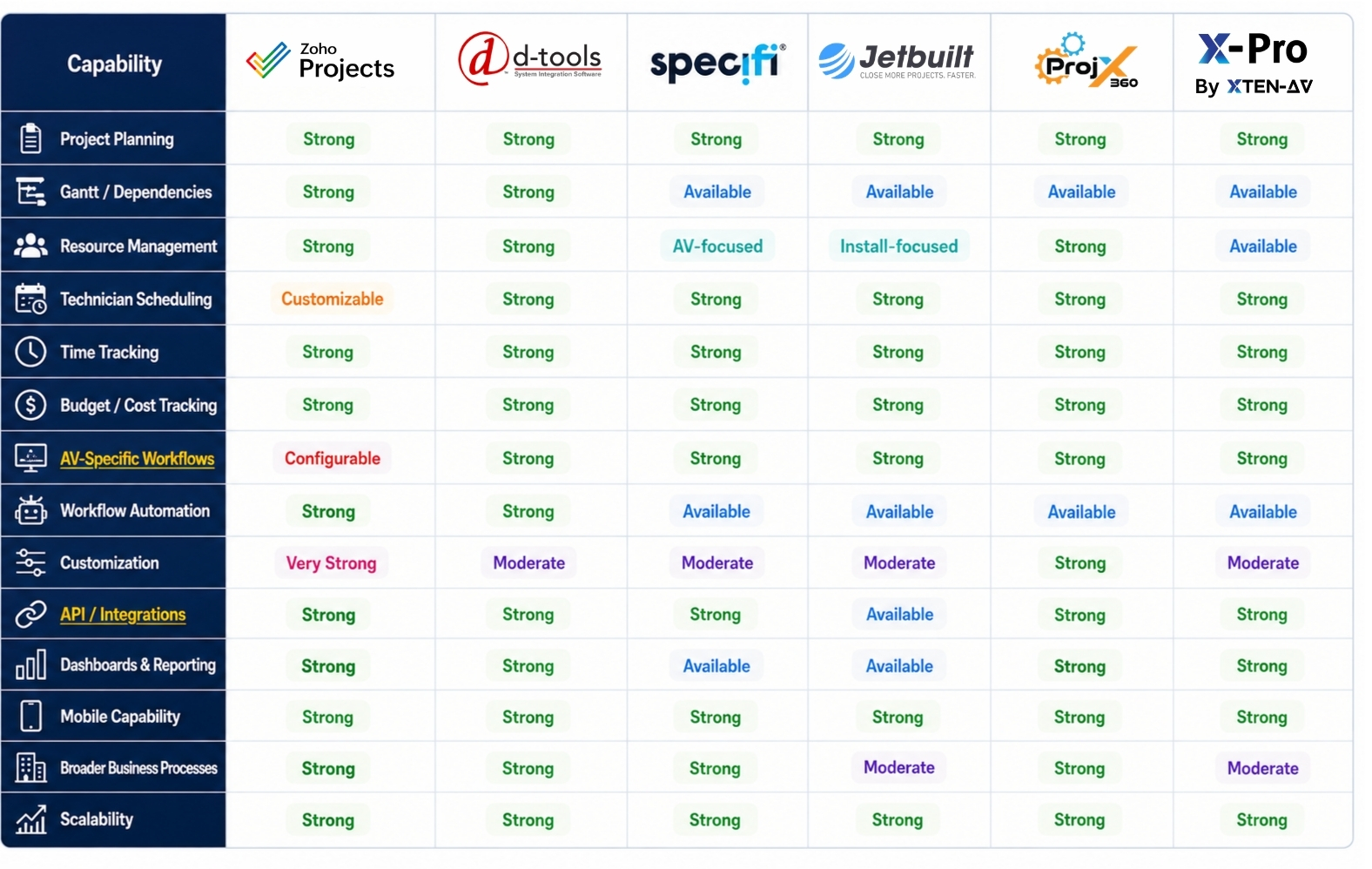
Zoho Projects stands out in this comparison for its combination of customization, workflow automation, integrations, reporting, and broader business-process capabilities. Its custom modules, layouts, fields, reports, dashboards, and automation options allow AV integrators to configure project management around their specific operating processes.
The other platforms take a more specialized approach, with several providing strong AV-focused capabilities out of the box. This can be an advantage for integrators whose existing workflows closely match those predefined processes and require less customization.
Which Project Management Tool Is Best for Different AV Integrators?
There is no single platform that will be the perfect choice for every AV System Integrator. The right decision depends on how the company operates today and where it wants to go.
1. Choose Zoho Projects If You Need:
- Extensive workflow customization
- Flexible project structures
- Advanced automation
- Multiple system integrations
- Custom dashboards and reporting
- Broader business-process connectivity
- A platform that can evolve beyond project management
2. Choose D-Tools If You Need:
- Strong AV design and documentation continuity
- Integrated equipment and project workflows
- Deep D-Tools ecosystem alignment
3. Choose Specifi.io If You Need:
- An AV-focused operating platform
- CRM, proposals, project management, field operations, and accounting in one environment
- Customer-facing capabilities
4. Choose Jetbuilt If You Need:
- Strong installation task management
- Technician scheduling
- Product-to-install-task workflows
- Installation time tracking
5. Choose ProjX360 If You Need:
- Project and service management together
- AV-specific forms and checklists
- Inventory and purchasing
- Mobile field operations
6. Choose X-PRO If You Need:
- XTEN-AV design-to-project continuity
- AV project execution
- Field technician access
- Project profitability and operational analytics
Why Zoho Projects Is Our Overall Winner for AV System Integrators
Based on the criteria used in this comparison—customization, workflow automation, integration flexibility, reporting, scalability, and broader business connectivity—Zoho Projects is our overall choice for AV System Integrators that need a configurable project-management environment.
Its key advantage is flexibility. Zoho Projects provides a project-management foundation that can be adapted through custom layouts, fields, modules, reports, dashboards, workflows, and automation.
For an AV integrator, this allows project workflows to be structured around engineering, procurement, staging, installation, programming, commissioning, punch lists, handover, and service rather than forcing every business into the same predefined process.
Zoho Projects can also connect project management with CRM, finance, inventory, analytics, customer portals, and other business applications, making it suitable for growing AV companies that need connected project management.
However, Zoho Projects is not automatically the best choice for every integrator. Businesses that prioritize ready-made, AV-native workflows with minimal configuration may find D-Tools, Specifi.io, Jetbuilt, ProjX360, or X-PRO a better fit.
How OfficeHub Tech Can Customize Zoho Projects for AV Integrators
Selecting a project-management platform is only the first step. The greater value comes from configuring the platform around the way an AV business actually operates.
OfficeHub Tech can help AV System Integrators configure Zoho Projects around their project lifecycle, existing software stack, and operational requirements.
- Custom AV Project Templates: Create reusable templates for conference rooms, digital signage, control systems, structured cabling, enterprise AV deployments, and service projects.
- Automated Project Creation: Connect CRM and sales processes so approved opportunities can create structured projects with predefined phases, tasks, milestones, and responsibilities.
- Proposal-to-Project Workflows: Transfer relevant customer, scope, equipment, labor, and project information from proposal systems into project workflows.
- Resource and Technician Management: Configure workflows for technician assignment, workload visibility, scheduling, time tracking, and installation activities.
- Procurement and Inventory Integration: Connect project requirements with purchasing and inventory systems to improve visibility into equipment availability and procurement status.
- Project Profitability Dashboards: Build dashboards around labor utilization, material costs, budget variance, project margins, delays, and completion status.
- Multi-Software Integration: Connect Zoho Projects with CRM, ERP, finance, inventory, D-Tools, XTEN-AV, and other business applications where appropriate integration methods are available.
The objective is to create a project-management environment that fits the AV business instead of forcing the AV business to fit the software.
Common Mistakes AV Integrators Make When Selecting Project Management Software
Selecting software based only on a feature checklist can create problems later. AV integrators should evaluate how the platform will operate across the entire project lifecycle.
Choosing Generic Features Over Business Fit
A platform may offer Gantt charts, tasks, and dashboards but still fail to support the specific handoffs involved in AV installation projects.
Better approach: Map the actual workflow before selecting the platform.
Ignoring Integration Requirements
Project management rarely operates independently. CRM, proposals, accounting, inventory, procurement, and field systems may all need to exchange information.
Better approach: Define integration requirements before implementation.
Underestimating Customization
Every integrator has different approval structures, project phases, documentation requirements, and resource models.
Better approach: Evaluate whether the software can adapt to those processes.
Focusing Only on Installation
Installation is only one stage of an AV project. Engineering, procurement, project administration, commissioning, documentation, billing, and service also influence project profitability.
Better approach: Evaluate the complete project lifecycle.
Ignoring Scalability
A platform that works for five active projects may not work equally well when the company manages dozens of simultaneous installations.
Better approach: Evaluate future users, projects, locations, integrations, reporting requirements, and automation needs.
AI for AV and Low Voltage System Integrators: From Automation to Agentic AI
AI is changing how AV and Low Voltage System Integrators can manage projects, operations, and business workflows. However, the real opportunity is not simply adding an AI assistant to project management software—it is connecting AI with the business data and systems teams already use.
For AI for AV and Low Voltage System Integrators to deliver meaningful value, AI should work with information across CRM, proposals, project management, inventory, finance, field operations, and other connected applications.
What Can an AI-Ready Project Management Environment Do?
An AI-ready project-management environment could help teams:
- Create or update project tasks using natural-language instructions
- Summarize project progress, risks, and outstanding work
- Retrieve project information without searching across multiple systems
- Identify delays, resource constraints, or workflow exceptions
- Generate project reports and status updates
- Trigger actions across connected applications and workflows
This leads to the next evolution: an Agentic AI Platform for AV Business. Instead of simply answering questions, agentic AI can use business context to understand what needs to happen, recommend or initiate actions, and work across connected systems through APIs, automation, and AI-enabled workflows.
For AV and Low Voltage businesses, this could mean moving from manually checking multiple applications to an intelligent operational layer that helps coordinate projects, people, data, and processes.
When evaluating project-management software, AV integrators should therefore consider not only customization, automation, integrations, and scalability, but also AI readiness and the ability to connect AI with real business workflows.
The Future of Project Management Software for AV System Integrators
Project-management platforms are moving from passive record-keeping toward intelligent operational assistance. AI is increasingly being incorporated into project planning, reporting, knowledge retrieval, automation, and decision support.
For AV System Integrators, the next generation of project management could include AI-assisted project planning, automated task creation, predictive risk identification, intelligent resource allocation, automated project summaries, and proactive customer communication.
The direction is already visible across the industry. ProjX360 announced an AI Assistant in April 2026 designed to provide contextual workflow guidance and answers directly within its AV project-management environment. XTEN-AV has also incorporated AI capabilities into its wider AV software ecosystem, while Zoho Projects supports a Zoho MCP Server connection that allows AI models to understand project data and perform actions using natural-language instructions.
This trend matters because project managers spend significant time collecting information, checking status, preparing reports, and coordinating repetitive activities.
The future opportunity is therefore not simply AI inside project management. It is project management becoming an intelligent coordination layer that can understand project information, identify exceptions, recommend actions, and automate routine execution.
For AV integrators, platforms that combine structured project data, integrations, automation, and AI readiness will become increasingly valuable.
Choosing the Right Project Management Platform for Your AV Business
The six platforms evaluated in this guide each address a legitimate need within the AV System Integration industry.
D-Tools is particularly strong for businesses seeking continuity between AV design, documentation, procurement, project execution, and service. Specifi.io takes an all-in-one AV business approach. Jetbuilt provides strong installation-oriented workflows. ProjX360 combines AV project and service management, while X-PRO connects XTEN-AV’s design and proposal environment with project execution.
Zoho Projects takes a different approach. Rather than relying primarily on a predefined AV workflow, it provides a flexible project-management foundation that can be customized and integrated around an integrator’s specific operating model.
That makes it our overall winner for AV System Integrators that need customization, automation, integration flexibility, scalability, and broader business connectivity.
The decision should ultimately come down to one question:
Do you need software that already matches your current AV workflow, or do you need a platform that can evolve with the way your AV business operates?
For organizations in the second category, Zoho Projects offers a compelling foundation.
Why Choose OfficeHub Tech for Zoho Projects Implementation?
Choosing the right platform is only the first step. The greater value comes from configuring the technology around the business.
OfficeHub Tech works with AV System Integrators through Zoho Projects implementation services in the USA, UAE, KSA, and India to understand their project lifecycle, identify operational gaps, design workflows, configure Zoho Projects, and connect it with the rest of their technology environment.
This can include:
- AV-specific project templates
- Custom fields and modules
- Workflow automation
- CRM and ERP integration
- Proposal-platform integration
- Inventory and accounting connectivity
- Technician and resource workflows
- Custom dashboards
- Data migration
- API and third-party integrations
- Ongoing optimization
Rather than asking your team to change its entire operating model to fit a software platform, the objective is to build a project environment that supports the way your business actually delivers AV projects.
If you are evaluating project-management platforms or considering a move from spreadsheets and disconnected systems, a conversation with an experienced implementation team can help clarify which approach makes the most sense for your organization.
Schedule a conversation with OfficeHub Tech to review your current AV project workflow and explore where project automation, customization, and integration could create the greatest operational impact.