
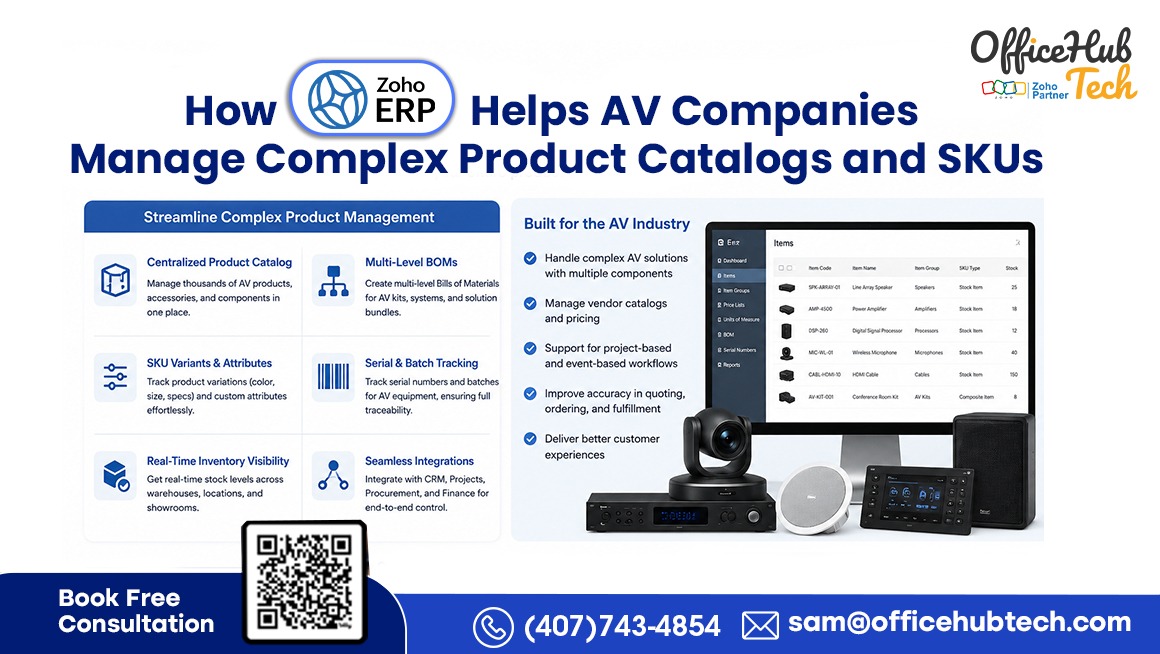
Growing Inventory Complexity in Modern AV and Low Voltage Businesses
Modern AV and low voltage businesses no longer operate with simple inventory systems. Today’s AV companies manage interconnected product ecosystems that include conferencing systems, LED displays, surveillance, networking devices, automation controllers, structured cabling, DSP processors, smart sensors, and software-integrated hardware.
As operations grow, managing product catalogs and SKU structures through traditional or disconnected systems becomes increasingly complex. AV manufacturers must oversee component-level dependencies, regional product variations, firmware-linked versions, and assembly-based structures. At the same time, distributors manage extensive SKU catalogs spanning multiple brands and warehouse locations, while retailers and system integrators oversee project-driven inventory, room-based installations, bundled equipment, and ongoing service activities within highly interconnected and fast-paced operational environments.
This growing operational complexity is creating major visibility gaps across procurement, warehousing, logistics, finance, and customer fulfillment operations. Businesses still depending on spreadsheets or fragmented systems frequently experience inventory mismatches, procurement delays, inaccurate quotations, warehouse inefficiencies, and operational bottlenecks that affect scalability and profitability. This is where Zoho ERP solutions for AV & Low Voltage Companies are becoming increasingly important for building centralized and scalable operational ecosystems.
This blog explores how Zoho ERP helps AV and LV companies centralize product catalog management, improve SKU visibility, automate procurement workflows, optimize warehouse coordination, and build scalable inventory ecosystems for modern AV operations.
Product Catalog Expansion Is Increasing Operational Complexity
AV and LV Product Ecosystems Are Becoming More Connected
The rapid expansion of AV and low voltage technologies has transformed how inventory ecosystems function across the industry. Earlier, most AV businesses managed relatively straightforward inventory environments involving standalone hardware products and predictable procurement cycles. Today, deployments involve highly interconnected product ecosystems where compatibility, configuration, and operational synchronization play critical roles.
Modern Deployments Require Complex SKU Coordination
For example, a single smart conference room deployment may include cameras, microphones, displays, control systems, automation sensors, structured cabling, network switches, wireless collaboration devices, and software-driven licensing environments. Every product introduces multiple operational dependencies related to compatibility mapping, firmware versions, power configurations, certifications, bundled accessories, and deployment-specific requirements.
Growing Product Expansion Is Increasing Inventory Challenges
As businesses continue expanding into enterprise collaboration, smart building automation, surveillance infrastructure, and hybrid workspace technologies, product catalogs become significantly larger and more dynamic. Manual inventory management methods are no longer capable of supporting these operational environments efficiently.
Fragmented Systems Reduce Inventory Visibility and Accuracy
Many AV companies struggle because inventory information exists across disconnected systems including spreadsheets, warehouse applications, procurement tools, and independent sales platforms. Over time, operational fragmentation creates duplicate SKU records, inconsistent warehouse visibility, procurement inaccuracies, delayed fulfillment, and reduced forecasting accuracy.
Zoho ERP Creates Centralized Operational Visibility
Zoho ERP addresses these operational challenges by creating a centralized operational ecosystem where product catalogs, inventory movement, procurement workflows, warehouse visibility, and financial operations remain continuously synchronized. This enables AV businesses to manage expanding inventory ecosystems without creating operational instability or reducing scalability.
Why SKU Complexity Creates Serious Risks for AV and LV Operations
Modern AV and low voltage environments operate through interconnected product ecosystems rather than isolated inventory systems. Unlike traditional industries where products function independently, AV deployments depend on synchronized hardware, software, networking, and configuration layers working together across procurement, installation, and long-term service operations.
This interconnected nature makes SKU management significantly more complex and introduces operational risks that many conventional ERP systems struggle to manage effectively.
How SKU Complexity Impacts AV and LV Operations
Inventory Complexity
↓
Product Compatibility Dependencies
↓
Firmware & Regional Variations
↓
Serialized Asset Tracking Challenges
↓
Disconnected Inventory Visibility
↓
Procurement Delays & Installation Risks
↓
Operational Inefficiencies and Service Disruptions
-
Compatibility-Driven Product Dependencies
One of the most critical inventory risks involves compatibility-driven product relationships. A conferencing or integrated AV deployment often depends on microphones, DSP processors, displays, networking infrastructure, automation controllers, mounting systems, power modules, and software licenses functioning together within a synchronized deployment environment.
Even a minor mismatch in configuration, availability, or compatibility can interrupt procurement coordination, delay installations, and disrupt project timelines.
Operational Impact:
- Project deployment delays
- Installation rework
- Increased procurement errors
- Reduced execution efficiency
-
Firmware, Configuration, and Product Variant Complexity
AV and low voltage products frequently exist in multiple firmware versions, regional compliance models, power configurations, and bundled accessory structures. Managing these evolving variations across manufacturers, warehouses, and distribution channels creates significant SKU mapping challenges.
When systems remain disconnected, maintaining accurate product relationships and real-time inventory visibility becomes increasingly difficult.
Operational Impact:
- Incorrect product selection
- Deployment inconsistencies
- Inventory synchronization issues
- Increased operational overhead
-
Serialized Inventory and Lifecycle Visibility Risks
Serialized inventory introduces another layer of operational complexity. AV equipment typically demands ongoing tracking of warranty coverage, deployment timelines, replacement history, service records, and AMC management throughout its extended operational lifespan.
Without centralized inventory intelligence, maintaining end-to-end traceability becomes difficult and can negatively affect service performance and customer support operations.
Operational Impact:
- Limited warranty visibility
- Slower service response
- Poor asset traceability
- Lifecycle management inefficiencies
How Zoho ERP Helps Reduce SKU Complexity
Zoho ERP helps AV and low voltage businesses centralize SKU architecture, compatibility relationships, inventory visibility, warehouse synchronization, and procurement workflows within a connected operational ecosystem.
By unifying inventory intelligence and operational coordination, businesses can reduce deployment risks, improve inventory accuracy, and support scalable AV operations across increasingly complex product environments.
Managing Product Dependencies and Compatibility Mapping
Modern AV and low voltage deployments operate through highly interconnected technology ecosystems where hardware, software, networking, and automation components must function together without compatibility conflicts. This makes dependency management a critical operational requirement for AV businesses handling enterprise conferencing systems, smart automation environments, surveillance infrastructure, and integrated commercial deployments.
Common Compatibility Challenges in AV Inventory Operations
- Many AV companies still manage product compatibility relationships through spreadsheets, disconnected databases, or manual documentation workflows.
- As product catalogs continue expanding, maintaining accurate compatibility visibility across inventory environments becomes increasingly difficult.
- Procurement teams may unknowingly source incompatible components due to limited synchronization between inventory and deployment requirements.
- Warehouse teams often allocate incorrect accessories, mounts, controllers, or supporting hardware during project fulfillment.
- Sales departments may generate inaccurate quotations when compatibility relationships are not properly mapped within the inventory ecosystem.
- These operational gaps eventually affect deployment timelines, project execution efficiency, customer experience, and overall operational reliability.
The Real Operational Challenge
A commercial AV deployment may require DSP processors compatible only with specific microphones, firmware versions, network switches, automation controllers, and power configurations. If these product relationships are not synchronized operationally inside the inventory ecosystem, businesses risk installation delays, procurement rework, inventory mismatches, and expensive deployment corrections.
Modern AV deployments are no longer standalone hardware installations — they are compatibility-driven operational ecosystems.
Without Zoho ERP:
Disconnected systems → Compatibility mismatch → Procurement errors → Deployment delays
With Zoho ERP:
Centralized compatibility mapping → Synchronized procurement → Correct warehouse allocation → Successful deployment
How Zoho ERP Solves the Problem
Zoho ERP helps AV companies centralize compatibility-driven inventory relationships through structured product catalog management and synchronized operational workflows. Product dependencies, bundled inventory structures, firmware-linked configurations, and deployment requirements remain connected across procurement, warehousing, sales, and project operations.
This centralized operational visibility reduces compatibility-related errors while improving quotation accuracy, procurement coordination, deployment planning, and inventory reliability. As AV environments continue becoming more integration-driven and technologically interconnected, centralized compatibility mapping will become increasingly important for maintaining operational consistency and scalable project execution.
Streamlining Component-Level Inventory Operations for AV Manufacturers
Managing Complex Manufacturing Dependencies
- AV and LV manufacturing involves interconnected workflows across procurement, BOM management, inventory visibility, warehousing, production scheduling, and quality control.
- Even minor inventory synchronization issues can disrupt production timelines and overall manufacturing operations.
Rising SKU and Component Complexity in AV Manufacturing
- AV manufacturers manage conferencing hardware, LED systems, amplifiers, surveillance equipment, automation controllers, structured cabling, and networking devices.
- They handle thousands of interconnected components simultaneously.
- Complexity increases with regional compliance requirements, firmware standards, voltage configurations, and dealer-specific product structures.
Operational Gaps Affecting Production Efficiency
- Disconnected procurement visibility from production scheduling and warehouse operations.
- Inaccurate demand forecasting for procurement teams.
- Lack of synchronized production visibility for inventory departments.
- Component shortages and excess inventory accumulation.
- Delayed production cycles and rising operational costs.
How Zoho ERP Improves AV Manufacturing Visibility
Zoho ERP helps AV manufacturers centralize component-level inventory intelligence through synchronized operational workflows connecting procurement, production, warehousing, and inventory forecasting. Multi-level BOM visibility, serialized inventory tracking, procurement forecasting, and production lifecycle synchronization remain continuously connected within one operational environment.
This enables manufacturers to improve operational efficiency, reduce inventory waste, optimize procurement planning, and maintain stronger production visibility across increasingly complex manufacturing ecosystems.
Managing Multi-Brand Product Catalog Complexity for AV Distributors
Inventory Complexity Across Multi-Brand Distribution Environments
- Managing thousands of SKUs across manufacturers and dealer ecosystems.
- Handling multiple warehouses, regional markets, and procurement environments.
- Product data spread across disconnected systems and spreadsheets.
- Procurement inefficiencies and inaccurate stock visibility.
- Dealer coordination issues and operational instability.
Operational Challenges in Inventory Synchronization and Dealer Coordination
- Complex multi-brand pricing and inventory management.
- Region-specific stock allocation challenges.
- Dealer-specific procurement workflow inefficiencies.
- Poor warehouse synchronization across locations.
- Overstocking, delayed replenishment, and inaccurate quotations.
ERP-Driven Inventory Forecasting and Operational Intelligence
The ERP environment improves operational forecasting by analyzing procurement activity, warehouse movement, sales trends, and inventory demand simultaneously. This enables distributors to optimize stock allocation while improving operational execution speed across dealer and warehouse networks.
How Zoho ERP Improves AV Distributors Visibility
Zoho ERP helps AV distributors create centralized operational control across highly scalable inventory ecosystems. Product catalogs become structured operational assets while warehouse movement, procurement visibility, dealer coordination, and inventory forecasting remain synchronized continuously. For enterprise-scale product ecosystems, Zoho ERP provides the operational intelligence necessary to support high-volume inventory operations without increasing backend operational complexity.
Synchronizing Project Execution and Inventory Workflows for AV Retailers and System Integrators
Project-Driven Inventory and Deployment Coordination
- Project-driven retail and integration operations in the AV and low voltage industry.
- Inventory movement linked with deployment scheduling and installation coordination.
- Procurement approvals connected with customer lifecycle management.
- AV businesses manage configurable solution packages instead of standalone product sales.
Complex AV Operations Require Workflow Synchronization
- AV integrators manage conference rooms and surveillance projects together.
- They also handle automation, networking, signage, and cabling systems.
- Each deployment needs inventory planning and compatibility mapping.
- Warehouse allocation, scheduling, and procurement must stay synchronized.
Challenges Caused by Disconnected Inventory Visibility
Without ERP-driven visibility, businesses frequently experience warehouse allocation conflicts, procurement delays, inaccurate project quotations, and deployment bottlenecks caused by disconnected inventory coordination. Operational teams spend excessive time manually synchronizing workflows between sales, procurement, warehousing, finance, and installation departments.
How Zoho ERP Improves AV Retailers and System Integrators Visibility
Zoho ERP helps AV retailers and integrators centralize project-based inventory workflows through synchronized operational visibility. Inventory allocation, procurement planning, warehouse coordination, billing visibility, and deployment scheduling remain continuously connected inside one operational ecosystem. This improves customer fulfillment accuracy while reducing operational delays across commercial deployment environments. Businesses also gain stronger visibility into project profitability, inventory liabilities, operational forecasting, and deployment timelines through centralized ERP intelligence designed specifically for scalable AV operations.
Real-World AV Industry Scenarios Where Zoho ERP Improves Inventory Operations
Example 1: Enterprise Conference Room Deployment Management
A commercial AV integrator deploying Microsoft Teams Rooms or Zoom Rooms may need to coordinate cameras, microphones, DSPs, touch panels, displays, network switches, and cabling across multiple meeting rooms. If even one compatible component is unavailable or misallocated, the installation timeline can be delayed.
With Zoho ERP, AV teams can manage inventory allocation, hardware dependencies, procurement approvals, and warehouse coordination from one centralized system. This helps reduce deployment errors, improve quotation accuracy, and streamline installation scheduling across enterprise projects.
Example 2: Multi-Brand Inventory Management for AV Distributors
AV distributors managing conferencing systems, LED displays, surveillance hardware, networking equipment, and automation controllers often handle thousands of SKUs across multiple warehouses and dealer networks. Without centralized inventory visibility, inaccurate or fragmented stock data can delay dealer orders.
Zoho ERP helps centralize multi-brand catalog management, automate warehouse stock synchronization, monitor fast-moving inventory, and improve procurement forecasting. This helps distributors improve dealer coordination while reducing stock shortages and overstocking risks.
Example 3: LED Video Wall Manufacturing and Component Tracking
An AV manufacturer producing LED video walls and display systems must track cabinets, receiving cards, power supplies, processors, mounting structures, firmware versions, and replacement modules across production and warehouse operations. Managing these interconnected components manually often leads to BOM errors and procurement inefficiencies.
Zoho ERP provides component-level inventory visibility, multi-level BOM management, procurement synchronization, and production planning within a single system. This helps manufacturers improve inventory control, streamline production scheduling, and reduce material wastage.
Example 4: Surveillance and Low Voltage Infrastructure Projects
A low voltage company handling commercial surveillance projects must coordinate IP cameras, NVRs, PoE switches, storage devices, racks, cabling, and access control hardware. When procurement, warehousing, and installation teams use disconnected systems, delays and inventory mismatches become common.
Zoho ERP centralizes procurement, inventory allocation, warehouse transfers, and installation scheduling in real time. This improves operational visibility and helps businesses manage large infrastructure deployments more efficiently.
Example 5: AMC and Service Lifecycle Management for AV Equipment
AV companies managing AMC contracts often maintain displays, conferencing hardware, DSP systems, and control processors across multiple client locations. Without serialized inventory visibility, tracking warranties, replacements, and service schedules becomes difficult.
Zoho ERP helps centralize serial tracking, warranty monitoring, service records, and replacement coordination across customer environments. This improves support quality and reduces operational confusion during maintenance workflows.
Serialized Inventory Tracking for AV and LV Equipment
Serialized inventory management has become increasingly important for AV and low voltage businesses because modern hardware ecosystems require long-term operational traceability across deployments, warranties, service operations, and replacement cycles. Many AV businesses still rely on fragmented systems that track inventory movement without maintaining detailed lifecycle visibility for serialized equipment.
This creates major operational challenges when businesses attempt to manage:
- Warranty tracking across deployed AV equipment
- AMC contract coordination and maintenance schedules
- RMA workflows and replacement management
- Firmware update visibility and lifecycle monitoring
- Installation history tracking across customer locations
- Service dependencies connected with enterprise deployments
Without centralized tracking visibility, service operations often become reactive instead of proactive, while operational accountability decreases significantly across support environments.
For example, conferencing systems, surveillance infrastructure, DSP processors, automation controllers, networking hardware, and enterprise displays often require ongoing maintenance visibility across multiple years. Businesses managing serialized equipment manually frequently struggle to identify deployment history, replacement records, warranty coverage, and service dependencies accurately.
Zoho ERP improves operational traceability by centralizing serialized inventory management inside one synchronized operational environment. Businesses gain visibility into equipment lifecycle movement from procurement and warehouse allocation through installation, warranty monitoring, service coordination, and replacement management.
With ERP-driven serialized inventory visibility, AV businesses can improve:
- Customer support accuracy and response efficiency
- Replacement coordination across enterprise environments
- Warranty validation and service transparency
- Long-term asset traceability and operational reporting
- Preventive maintenance planning and support workflows
This operational visibility helps reduce replacement delays, warranty confusion, and service inefficiencies. As AV operations continue expanding into recurring support ecosystems and enterprise infrastructure environments, serialized inventory visibility will become increasingly critical for maintaining long-term operational consistency and customer experience quality.
Real-Time Inventory Transparency Across Departments
One of the biggest operational challenges inside AV and low voltage businesses is the lack of synchronized inventory visibility across departments. Procurement teams often work independently from warehouse operations while sales teams generate quotations without accurate inventory synchronization. Finance departments may operate with delayed inventory reporting while installation teams struggle with inconsistent deployment visibility.
These disconnected workflows create operational inefficiencies that affect inventory accuracy, procurement planning, quotation reliability, warehouse coordination, and customer fulfillment timelines. As businesses scale operationally, communication gaps between departments become more difficult to manage manually.
Zoho ERP solves this problem through centralized inventory transparency across the organization. Inventory movement, procurement exposure, warehouse allocation, dispatch planning, customer fulfillment, and operational forecasting remain continuously updated in real time.
This allows procurement teams to forecast purchasing requirements more accurately while warehouse teams maintain synchronized inventory visibility across ongoing operations. Sales departments gain access to live inventory intelligence during quotation generation while finance teams receive real-time operational reporting connected directly with inventory workflows.
The result is stronger operational coordination, faster execution timelines, improved forecasting accuracy, and significantly better inventory control across enterprise AV environments. As operational ecosystems continue becoming more interconnected, centralized inventory transparency will remain essential for scalable AV business growth.
Intelligent Procurement Forecasting for Growing AV Businesses
Procurement planning in modern AV and low voltage operations has become increasingly complex. Inventory demand now depends on multiple operational variables, making manual forecasting methods increasingly unreliable and operationally risky.
Common procurement challenges include:
- Delayed hardware procurement affecting deployment schedules
- Overstocking and rising carrying costs
- Reduced warehouse efficiency
- Inventory turnover limitations
- Procurement delays impacting customer commitments
Zoho ERP addresses these challenges through synchronized operational intelligence that connects inventory movement, warehouse activity, sales trends, procurement exposure, and deployment forecasting within one centralized ecosystem.
The platform supports:
- Automated procurement alerts
- Inventory aging analysis
- Replenishment logic
- Vendor coordination
- Forecasting and procurement automation
As enterprise deployments and integration ecosystems continue expanding, predictive procurement intelligence will become increasingly important for maintaining procurement control, scalability, and operational efficiency.
AI-Driven Automation Is Shaping the Future of AV Operations
The future of AV and low voltage operations will depend heavily on intelligent ERP ecosystems capable of automating workflows, improving operational forecasting, and reducing manual coordination across highly interconnected business environments. Traditional inventory systems focused mainly on transactional processing, but modern AV operations require operational intelligence capable of adapting dynamically to evolving business conditions.
Zoho ERP supports this transformation through workflow automation, synchronized operational visibility, intelligent inventory coordination, and AI-driven process optimization. Businesses can automate procurement approvals, inventory alerts, warehouse allocation, operational notifications, billing coordination, and project workflows across departments.
Automation becomes especially valuable for AV companies managing multiple warehouses, dealer ecosystems, recurring support environments, project-based deployments, and enterprise infrastructure operations simultaneously. Manual coordination across these environments eventually limits scalability and reduces operational efficiency.
AI-driven forecasting also improves procurement accuracy by analyzing inventory movement, warehouse activity, sales patterns, and operational demand trends continuously. Leadership teams gain access to centralized business intelligence instead of fragmented reporting systems, allowing faster and more accurate operational decision-making.
As AV environments continue becoming more integration-driven and technologically complex, businesses adopting intelligent ERP infrastructure early will gain major operational advantages through stronger inventory visibility, faster workflow execution, improved forecasting accuracy, and scalable operational control.
Before and After Zoho ERP in AV and LV Operations
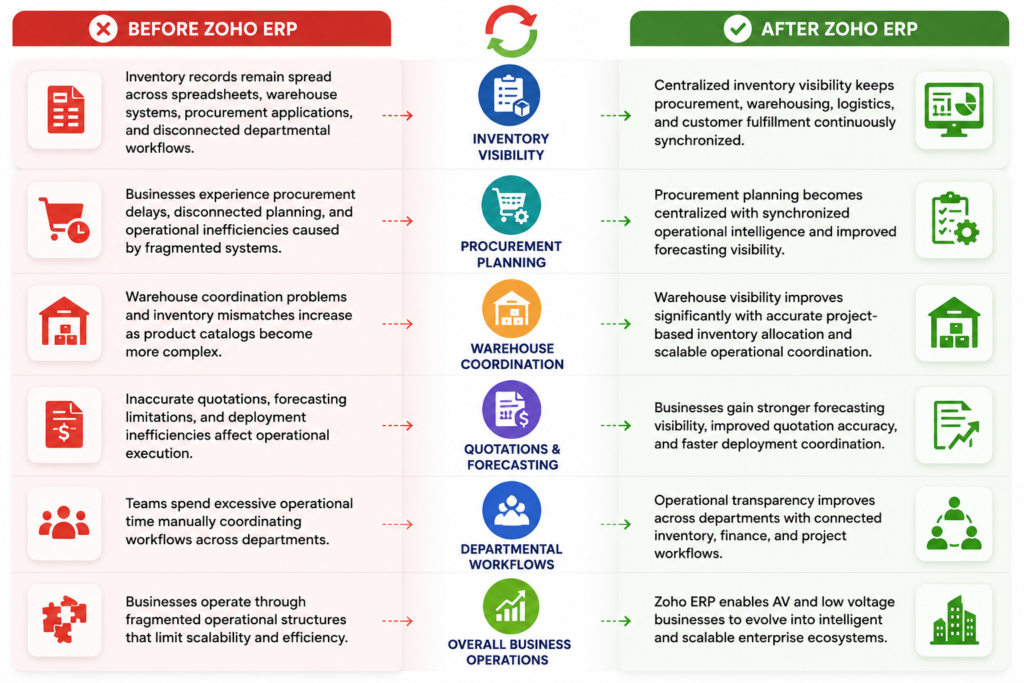
Before and After Zoho ERP in AV and LV Operations
AV-Centric Zoho ERP Implementation and Operational Strategy
Modern AV and low voltage businesses require ERP ecosystems that can support complex SKU structures, project-based inventory workflows, warehouse synchronization, procurement visibility, and installation-driven operations simultaneously. Generic ERP implementations often fail because they are not designed around the operational realities of AV environments.
OfficeHubTech specializes in implementing customized Zoho ERP ecosystems for AV manufacturers, AV distributors, AV retailers, and AV system integrators. The company builds ERP environments aligned with real AV operational requirements, including inventory intelligence, procurement automation, warehouse coordination, CRM-ERP synchronization, and project-driven workflow management.
As a top notch Zoho ERP consulting and implementation company in USA, India, UAE, and KSA, and an official Zoho and n8n partner, OfficeHubTech helps businesses centralize operations and automate workflows across project management, installation scheduling, field operations, and service coordination through customized Zoho ERP and n8n integrations for scalable long-term growth.
Conclusion
The AV and low voltage industry is moving toward highly connected operational environments where inventory accuracy, procurement coordination, deployment planning, warehouse synchronization, and customer fulfillment can no longer operate independently. As businesses continue expanding product portfolios across conferencing systems, surveillance technologies, networking hardware, automation platforms, and smart infrastructure solutions, operational complexity increases at every level of the business. Companies still relying on disconnected systems often struggle with inventory inconsistencies, delayed procurement cycles, inaccurate forecasting, and limited operational visibility that directly affect scalability and execution efficiency.
Zoho ERP helps solve these challenges by creating a centralized operational ecosystem where product catalogs, SKU structures, procurement workflows, warehouse operations, project coordination, and financial visibility remain continuously connected in real time. This level of operational synchronization allows AV manufacturers, AV distributors, AV retailers, and AV system integrators to manage complex inventory ecosystems more efficiently while improving forecasting accuracy, operational agility, and long-term business scalability.
For businesses managing larger deployments, multi-location inventory, and automation-driven workflows, ERP is becoming a core operational necessity rather than an optional system. When implemented with a clear strategy and aligned to business operations, Zoho ERP for AV and low-voltage manufacturers, distributors, and retailers supports the creation of scalable, future-ready systems that evolve with industry demands and enable long-term digital transformation.