Why AV Businesses Need an Agentic AI Platform Today
The AV industry has entered an era where business success depends on both technical expertise and operational intelligence. Modern AV System Integrators (AVSIs) manage complex projects spanning proposal creation, system design, procurement, installation, commissioning, and ongoing field service. Every stage generates valuable business data, but much of it remains scattered across disconnected systems.
Most AV businesses already use proposal tools to manage quotations, Bills of Materials (BOMs), customer records, project details, and product documentation. While these tools form the operational backbone of the business, locating critical information becomes increasingly difficult as project volumes grow. Teams often spend valuable time searching project records, reviewing service history, and coordinating across departments before making informed decisions.
Meanwhile, field service operations generate additional intelligence through technician notes, maintenance records, warranty updates, equipment replacements, and customer interactions. Unfortunately, this information is rarely connected to proposal data in a meaningful way.
This is where Agentic AI Platforms create a significant advantage. Powered by Large Language Models (LLMs) and orchestrated through Model Context Protocol (MCP), they securely connect with existing proposal tools to deliver contextual, conversational insights without replacing existing software.
In this blog, we’ll explore how an Agentic AI Platform connects field service data from AV proposal tools with LLM-based intelligence, its architecture, business use cases, implementation considerations, and the long-term value it brings to modern AV businesses.
Why AV Proposal Tools Hold More Than Just Quotes
AV proposal tools are often seen as software for creating quotations and estimating project costs. However, they serve as the operational foundation of every AV project. From the initial proposal stage, these platforms capture critical business information, including customer details, project scope, room layouts, equipment specifications, Bills of Materials (BOM), labor estimates, product selections, system designs, revisions, and supporting documentation.
As projects move from proposal to execution, this information becomes essential across multiple departments. Sales teams use previous proposals to build accurate quotes, project managers rely on equipment and labor details for planning, procurement teams reference approved product data, and installation engineers follow project documentation during deployment. Even after project completion, field service teams depend on proposal records to understand installed equipment, configurations, and customer requirements during maintenance or support visits.
This makes AV proposal tools much more than estimating software—they become a centralized repository of project knowledge throughout the customer lifecycle. However, as businesses handle more projects, retrieving the right information quickly becomes increasingly difficult. While proposal tools excel at storing operational data, they are not designed to deliver contextual business intelligence, creating the need for a smarter, AI-driven approach to accessing and utilizing this valuable information.
The Challenge: Valuable Data Exists Everywhere but Actionable Intelligence Exists Nowhere
-
Information Exists, But Accessing It Is Difficult
Most AV businesses don’t have a data shortage—they have an information accessibility problem. Every proposal, installation report, service ticket, maintenance record, and technician note adds valuable operational knowledge. However, retrieving the right information at the right time remains a challenge.
-
Finding Critical Information Takes Too Long
A simple customer inquiry can quickly become a lengthy search process. For example, answering questions about:
- Previously installed equipment
- Warranty status
- Installation technician details
- Latest service history
often requires employees to search multiple project files, review historical records, switch between applications, or consult experienced team members.
-
Business Growth Creates Information Silos
As AV businesses expand, operational complexity increases with:
- Hundreds of active projects
- Thousands of completed proposals
- Multiple customer locations
- Numerous field technicians
- Years of service and maintenance records
Traditional keyword searches and static reports struggle to connect this growing volume of information into meaningful business insights.
-
The Business Impact
Disconnected data leads to:
- Slower customer response times
- Delayed project decisions
- Reduced employee productivity
- Increased administrative effort
- Inconsistent customer experiences
To stay competitive, AV businesses need more than data storage. They need an Agentic AI Platform that understands business context, connects proposal and field service data, and delivers accurate, context-aware insights exactly when they’re needed.
Why Traditional Search, Reports, and Dashboards Are No Longer Enough
For years, AV businesses have depended on keyword searches, static reports, dashboards, and spreadsheets to retrieve project information. While these tools help organize data, they were never designed to understand business context or support real-time decision-making. As projects grow in complexity and customer expectations increase, these traditional methods are becoming less effective.
Consider a service manager trying to identify projects using a specific display model, verify warranty status, and check for recurring service issues. Although the information exists, retrieving it often requires searching multiple projects, filtering reports, and manually combining data from different systems. The process is time-consuming and delays decision-making.
This challenge affects every department. Sales teams struggle to retrieve proposal records, project managers spend time gathering updates, and executives depend on static dashboards showing only past performance. Traditional searches locate records but cannot understand relationships between customers, equipment, service history, and project status.
Modern AV businesses need a smarter approach that understands natural language, interprets user intent, and connects information across the entire project lifecycle. Instead of employees adapting to software limitations, an Agentic AI Platform enables software to understand business questions and deliver contextual, actionable insights instantly.
What Is an Agentic AI Platform for AV Businesses?
An Agentic AI Platform is an intelligent business layer that enables AV professionals to interact with their operational systems through natural conversations rather than manual navigation. Instead of simply searching databases or generating predefined reports, Agentic AI understands user intent, reasons through available business data, retrieves relevant information, and delivers contextual responses that help users make faster decisions.
Unlike conventional AI assistants that primarily answer general knowledge questions, an Agentic AI platform is connected directly to an organization’s business ecosystem. It can securely access proposal tools, project records, field service information, equipment databases, customer history, and other operational systems to provide answers based on real business data.
For example, instead of asking an employee to search multiple applications, an operations manager could simply ask:
“Which projects are awaiting commissioning, have open service requests, and involve Brand X displays?”
Rather than returning a list of unrelated records, the platform understands the business context, gathers information from connected systems, and presents a meaningful response that supports immediate action.
More importantly, Agentic AI does not replace existing AV proposal software. Proposal tools continue performing their core functions such as quotation management, project documentation, and equipment planning. The Agentic AI platform simply becomes the intelligent layer above these systems, making the information stored within them significantly easier to access, analyze, and utilize. This allows AV businesses to maximize the value of their existing software investments while preparing for the future of AI-driven operations.
How Agentic AI Connects Proposal Tools with LLM-Based Intelligence
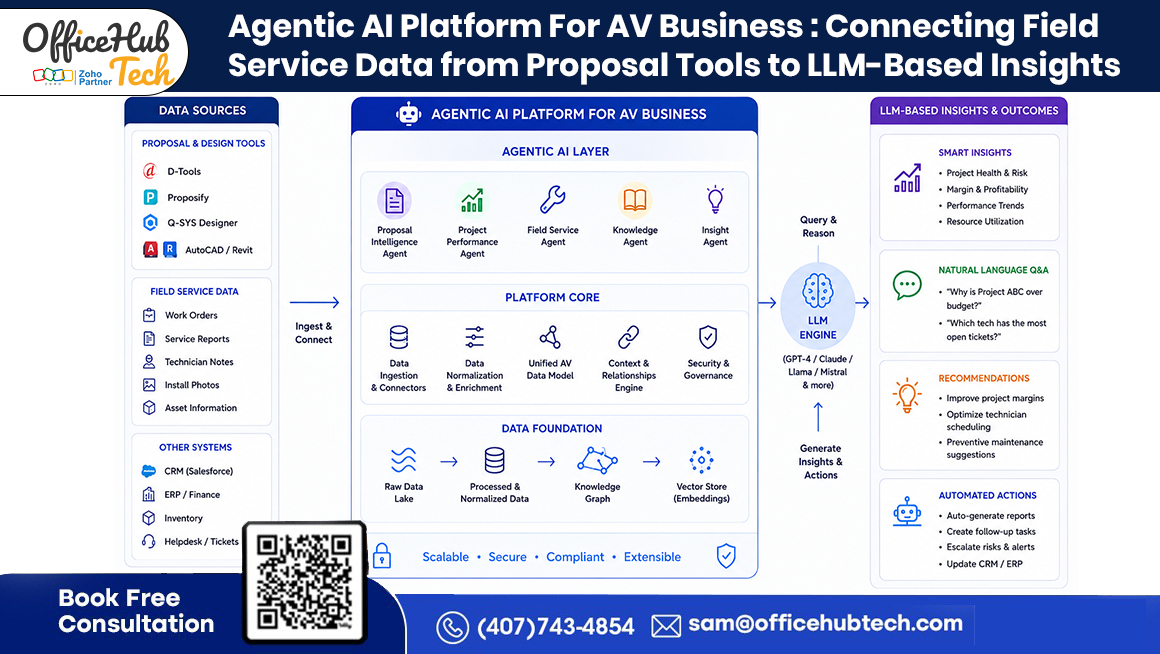
The true value of an Agentic AI Platform lies in its ability to connect existing AV proposal tools with modern AI models without replacing the software businesses already depend on. Instead, it adds an intelligent layer that enables users to retrieve information, understand project context, and gain actionable insights through natural language conversations.
The architecture follows a simple workflow:
User → Large Language Model (LLM) → Model Context Protocol (MCP) Server → Proposal Tool APIs → Business Data → Context-Aware Response
The process begins when a user asks a business question, such as, “Which conference room projects are awaiting final commissioning?” or “Show customers with active maintenance contracts requiring display upgrades.”
The LLM understands the user’s intent and sends the request to the Model Context Protocol (MCP) Server, which acts as the secure communication layer. The MCP Server retrieves relevant information from connected proposal tools through APIs and sends structured data back to the LLM. The AI then analyzes the business context and delivers meaningful, conversational responses instead of raw database records.
This architecture can integrate with AV proposal platforms such as D-Tools, Jetbuilt, XTEN-AV, iPoint, Portal.io, ProjX360, and other tools that support APIs or integrations. These platforms continue serving as the system of record, while the Agentic AI Platform becomes the intelligent interface for accessing business information.
The architecture is also highly scalable. As businesses add CRM, ERP, inventory, scheduling, or field service applications, the same MCP-based framework can connect them into a single conversational experience. Rather than switching between multiple software systems, employees interact with one AI-powered interface that understands the complete project lifecycle and business context.
This future-ready approach helps AV businesses scale efficiently while protecting existing software investments and operational workflows.
Get Started with an Open-Source D-Tools MCP Server
If you’re using D-Tools SI and want to explore how Model Context Protocol (MCP) works in a real-world AV environment, OfficeHub Tech has developed an open-source D-Tools MCP Server that you can use as a starting point for your own AI integrations. It enables AI assistants and Large Language Models (LLMs) to securely interact with D-Tools data through the MCP standard, making it easier to build conversational workflows and intelligent business assistants.
It is completely free and open source, and you can download it from our GitHub repository here:
Whether you’re experimenting with Agentic AI, building internal copilots, or creating enterprise AI workflows, this repository provides a practical foundation that you can customize for your business. If you’d like a production-ready implementation tailored to your AV business, OfficeHub Tech’s experts can help design, integrate, and deploy the solution for you.
From Proposal Data to Field Service Intelligence: Building the Knowledge Layer for Agentic AI
Every AV project generates valuable business data long after the proposal is approved. From engineering and procurement to installation, commissioning, warranty management, and field service, each stage contributes information that supports better operations and stronger customer relationships.
Throughout the project lifecycle, AV businesses create critical data such as:
- Proposal & Design: Customer requirements, system designs, Bills of Materials (BOM), pricing, and project specifications.
- Project Execution: Procurement updates, equipment deliveries, installation progress, and project milestones.
- Field Service: Technician notes, maintenance history, equipment replacements, and recurring issues.
- Customer Support: Warranty details, service contracts, and customer communication history.
While this information is highly valuable, it often remains scattered across proposal tools, field service software, project management systems, and shared documents. As a result, teams spend valuable time searching for information instead of making decisions.
Common business questions like these become difficult to answer:
- Which technician installed this equipment?
- Is this system still under warranty?
- Has this customer reported recurring issues?
- Which projects have generated the most service visits?
An Agentic AI Platform for AV Business eliminates these silos by connecting proposal data with field service intelligence into a unified knowledge layer. Instead of manually searching multiple systems, users simply ask questions in natural language and receive complete, context-aware answers.
For example, a field technician can request the complete history of a customer site and instantly receive the original proposal, approved BOM, installed equipment, service history, warranty status, engineering revisions, and previous maintenance records. Similarly, managers can identify recurring equipment failures, delayed projects, or upcoming preventive maintenance through conversational queries.
By transforming disconnected project records into intelligent business insights, Agentic AI improves collaboration, accelerates decision-making, increases first-time fix rates, and delivers a better customer experience.
More importantly, this connected knowledge layer becomes the foundation for Model Context Protocol (MCP) and Large Language Models (LLMs), enabling secure, conversational access to business information and unlocking the next generation of AI-powered AV operations.
The End-to-End AV Project Lifecycle AI Understands
An Agentic AI Platform connects every stage of the AV project lifecycle, enabling AI to understand the complete business context instead of isolated records.
- Proposal & Design: Records customer requirements, system designs, Bills of Materials (BOM), pricing, and labor estimates.
- Project Execution: Tracks procurement, equipment delivery, installation, commissioning, testing, and project progress.
- Field Service: Records technician notes, maintenance visits, equipment replacements, warranty claims, and service history.
- Customer Support: Maintains support interactions, service contracts, preventive maintenance, and upgrade recommendations.
- Unified Business Intelligence: Connects proposal tools, field service platforms, and business applications into a single knowledge layer.
- Conversational Insights: Users can instantly ask questions like who installed specific equipment, warranty status, service history, recurring issues, or maintenance schedules without searching multiple systems.
- Business Benefits: Improves decision-making, increases first-time fix rates, enhances customer service, identifies preventive maintenance opportunities, and supports long-term customer relationships through AI-powered insights.
What Can You Ask an Agentic AI Platform?
One of the most practical advantages of an Agentic AI platform is that employees no longer need to remember where information is stored. Instead of navigating multiple software applications or generating complex reports, they can simply ask questions in natural language and receive contextual answers based on real business data.
For sales teams, common prompts might include:
- Show all proposals created for a specific customer in the last two years.
- Which opportunities are awaiting customer approval?
- What products are most frequently quoted for conference room projects?
Project managers can ask:
- Which projects are currently delayed?
- Show projects awaiting equipment delivery.
- Which installations are scheduled for next week?
Field service teams benefit from prompts such as:
- Display the complete service history for this customer.
- Which technician last worked at this location?
- Show all projects using a specific display or audio processor.
- Which installed products are still under warranty?
Business leaders can quickly request:
- Which customers generate the highest service revenue?
- What are the most common equipment failures?
- Which projects exceeded estimated labor hours?
- Identify customers that may benefit from technology upgrades.
Instead of returning isolated database records, the platform understands relationships between proposals, projects, equipment, customers, and field service activities. This enables users to receive business-ready insights that support faster decision-making, improve customer communication, and reduce the time spent searching for operational information.
Real Business Use Cases Across Every Department
The true value of an Agentic AI Platform lies in the business outcomes it delivers. By connecting proposal tools, field service systems, and business applications, it enables every department to access the right information through one intelligent conversational interface.
Sales and Proposal Management:
Sales teams can quickly retrieve previous proposals, compare pricing, review approved product substitutions, and access customer purchase history. This speeds up proposal creation while improving consistency and accuracy.
Project Management:
Project managers gain instant visibility into project milestones, procurement status, engineering revisions, installation schedules, and project risks. Instead of generating multiple reports, they receive real-time project insights through simple conversational queries.
Field Service Operations:
Before visiting a customer site, technicians can instantly access installation details, equipment specifications, service history, warranty status, maintenance recommendations, and previous technician notes. This improves preparation, increases first-time fix rates, and reduces repeat visits.
Customer Support and Service Management:
Support teams can quickly retrieve warranty information, equipment details, maintenance history, and customer interactions without searching multiple systems. This enables faster issue resolution and enhances the customer experience.
Executive Leadership:
Business leaders can instantly analyze project profitability, technician productivity, recurring service trends, operational bottlenecks, and resource utilization. AI-generated insights support faster, data-driven decisions without relying on manual reports.
By providing every department with secure, conversational access to connected business data, an Agentic AI Platform transforms fragmented operational records into organization-wide business intelligence, improving productivity, collaboration, and overall business performance.
Before vs. After Agentic AI: How Daily Operations Change
Many AV businesses already use proposal tools, project management software, and field service platforms, but valuable information often remains scattered across these systems. An Agentic AI Platform transforms this experience by connecting business data and providing instant, conversational access to the insights employees need every day.
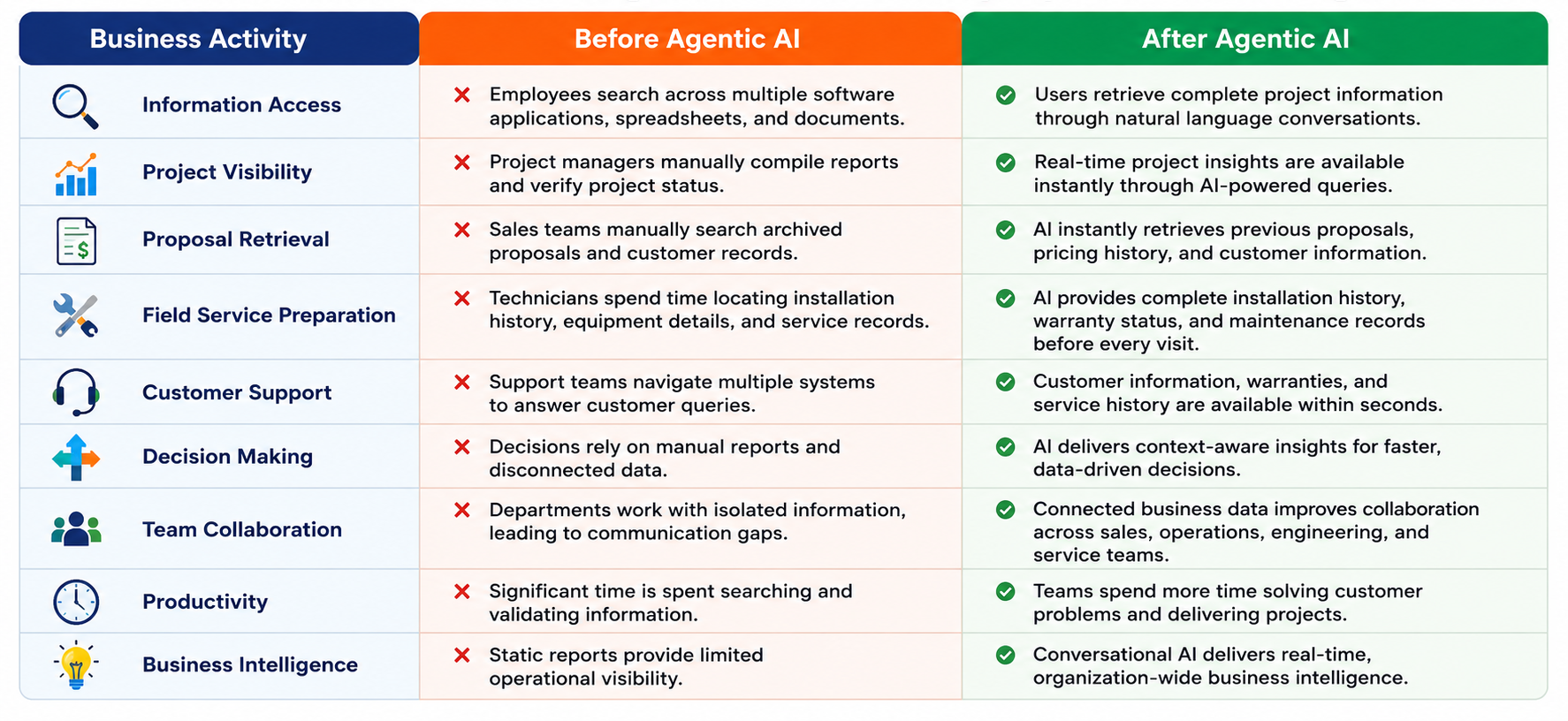
Before vs. After Agentic AI infographic showing how AI transforms AV business operations with faster information retrieval, real-time project insights, field service automation, improved collaboration, and AI-powered business intelligence.
The shift isn’t just about finding information faster—it’s about making smarter business decisions. By reducing manual effort and connecting every stage of the project lifecycle, Agentic AI empowers AV businesses to improve productivity, strengthen collaboration, and deliver a more proactive customer experience.
Why MCP Is the Foundation of Enterprise Agentic AI
An enterprise-grade Agentic AI Platform needs more than an AI model—it requires a secure and standardized way to connect AI with business systems. Model Context Protocol (MCP) serves as the communication layer between the Large Language Model (LLM) and enterprise applications.
Instead of allowing the LLM to directly access proposal tools or field service systems, MCP securely manages API calls, identifies the right business tools, retrieves relevant data, and returns structured information for AI analysis. This ensures secure, accurate, and context-aware responses.
For AV businesses, MCP offers several advantages. It enforces role-based access control, standardizes integrations across multiple applications, simplifies AI implementation, and keeps sensitive business data secure. As organizations expand their technology stack, MCP can also orchestrate communication with CRM, ERP, inventory, scheduling, accounting, document management, and workflow automation platforms.
This makes the AI platform highly scalable without requiring businesses to redesign their existing architecture. For AV System Integrators, MCP is more than a technical protocol—it is the foundation that enables secure, reliable, and future-ready Agentic AI implementations while protecting existing software investments.
AV Proposal Tools That Can Be Enhanced with Agentic AI
One of the biggest advantages of an Agentic AI Platform is that it is not limited to a single AV proposal tool. The same AI architecture can enhance multiple AVSI proposal platforms without requiring businesses to replace their existing software.
| AV Proposal Tool | Agentic AI Architecture |
| D-Tools SI | D-Tools + MCP + LLM |
| Jetbuilt | Jetbuilt + MCP + LLM |
| XTEN-AV | XTEN-AV + MCP + LLM |
| iPoint | iPoint + MCP + LLM |
| ProjX360 | ProjX360 + MCP + LLM |
| Portal.io | Portal.io + MCP + LLM |
| Simply Reliable | Simply Reliable + MCP + LLM |
In every implementation, the proposal tool remains the system of record, while the Agentic AI Platform provides a conversational layer for retrieving project information and generating AI-driven insights.
This integration-first approach helps AV businesses maximize existing software investments while enabling future integrations with CRM, ERP, field service, inventory, and workflow automation platforms through the same AI ecosystem.
Key Considerations Before Building an Agentic AI Platform
A successful Agentic AI implementation requires more than connecting an AI model to your proposal software. Consider these key factors before getting started:
- Data Readiness: Ensure proposal, project, and field service data is accurate, complete, and well-structured for reliable AI insights.
- Integration Capability: Confirm that your AV proposal software and business applications offer APIs or integration options compatible with MCP-based connectivity.
- Security & Governance: Enforce role-based access, data privacy policies, audit logs, and secure AI workflows to safeguard business data.
- Choosing the Right LLM: Select an LLM that aligns with your business needs, considering reasoning capabilities, response quality, deployment options, scalability, and cost.
- Scalable Architecture: Design the platform to support future integrations with CRM, ERP, inventory management, field service, document management, and workflow automation systems.
- Business-Centric Approach: Focus on solving operational challenges and improving decision-making rather than simply adopting AI technology.
By addressing these considerations, AV businesses can build a secure, scalable, and future-ready Agentic AI Platform that delivers long-term value while maximizing existing technology investments.
How OfficeHub Tech helps in building an Agentic AI Platform for Your AV Business
Implementing an Agentic AI platform is not about replacing the software your teams already trust—it is about making those systems significantly smarter. The process begins by understanding your AV business, identifying where operational data resides, and designing an architecture that connects proposal tools, field service applications, customer management platforms, and other business systems into a unified AI-powered experience.
Using an MCP-based integration layer, enterprise-grade LLMs securely retrieve, understand, and reason over business information in real time. Features such as workflow automation, API orchestration, user permissions, monitoring, and governance ensure the platform remains secure, scalable, and aligned with business objectives. As new systems are introduced, the Agentic AI platform can expand without disrupting existing workflows.
As the Best AV Business Workflow Solution, Consultation, Agentic AI and Tools Implementation Provider Company In USA, and an official Zoho and n8n Partner, OfficeHub Tech helps AV System Integrators modernize their operations by integrating AV proposal tools, field service platforms, MCP architecture, enterprise LLMs, workflow automation, and multi-system integrations into a unified AI-powered business ecosystem. This enables businesses to improve operational efficiency, reduce manual effort, maximize existing software investments, and build scalable, future-ready enterprise workflows.
Conclusion
Agentic AI platforms for AV businesses are transforming how AV System Integrators access and utilize operational data. By connecting proposal tools, field service records, MCP architecture, and Large Language Models (LLMs), businesses can convert existing project information into conversational business intelligence.
Instead of manually searching multiple systems, teams can instantly access contextual insights that improve decision-making, customer service, collaboration, and operational efficiency. As the AV industry advances, simply storing data in proposal software is no longer enough. Organizations that connect proposal data with installation records, technician knowledge, maintenance history, and customer interactions will gain a significant competitive advantage.
The future of AV operations is not about replacing existing tools—it is about enhancing them with intelligent capabilities that help businesses make faster, smarter, and more strategic AI-powered decisions.